Do All Cars Have Control Arms? Suspension Types Explained
If you are asking **do all cars have control arms**, the answer depends on what you mean by a control arm. Many cars in the U.S. have obvious upper or lower control arms. Others use struts, trailing arms, torsion beams, or several smaller links that do the same basic job.
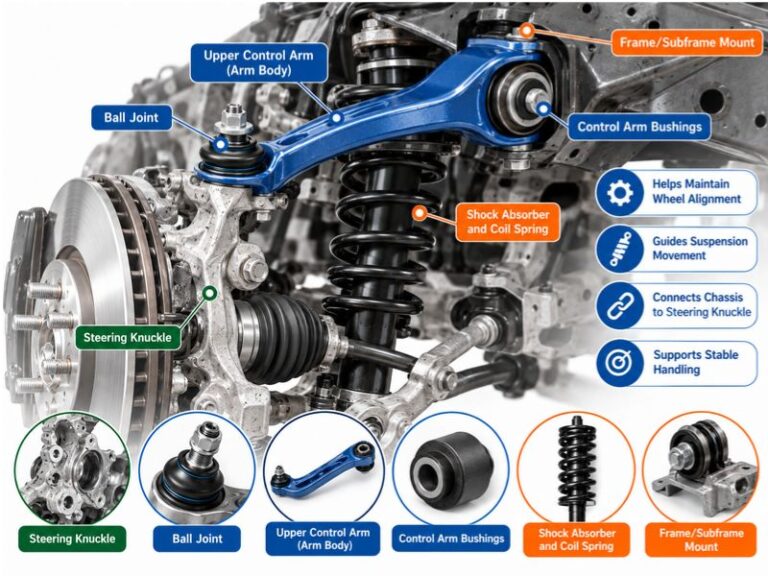
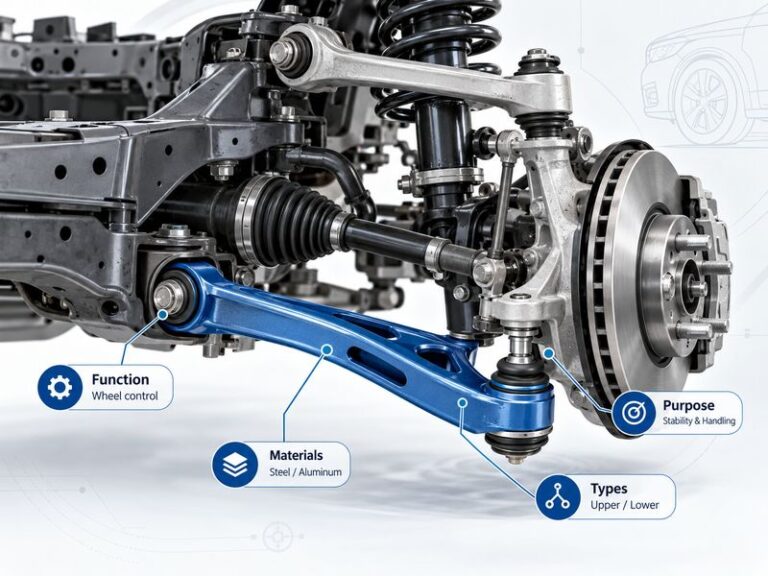
A control arm helps locate a wheel while still letting it move up and down with the suspension. It connects part of the wheel or steering knuckle to the vehicle body, frame, or subframe. Bushings at the inner mounting points let the arm pivot, while a ball joint or another joint often connects it near the wheel.
One detail often causes confusion when inspecting vehicles: two cars can perform the same suspension job with very different-looking parts. A pickup may have large upper and lower A-arms, while a compact sedan may have only one obvious lower arm at each front wheel. A multi-link luxury car may use several smaller links instead of one large arm.
This guide explains which cars have control arms, which suspension designs may not use traditional ones, how upper and lower arms differ, how many control arms a vehicle can have, and how to identify what your own car uses.
Do All Cars Have Control Arms?
No, **not all cars have control arms in the traditional sense**. Most modern vehicles have suspension links that control wheel movement, but those parts may not always be called upper or lower control arms.
The answer to **do all cars have control arms** also changes depending on which axle you are discussing. A car may use lower control arms at the front and a torsion-beam or trailing-arm setup at the rear.
For example, many front-wheel-drive cars use MacPherson struts in front. This design normally has one lower control arm on each side. The strut itself helps locate the top of the steering knuckle, so a separate upper control arm is usually not needed.
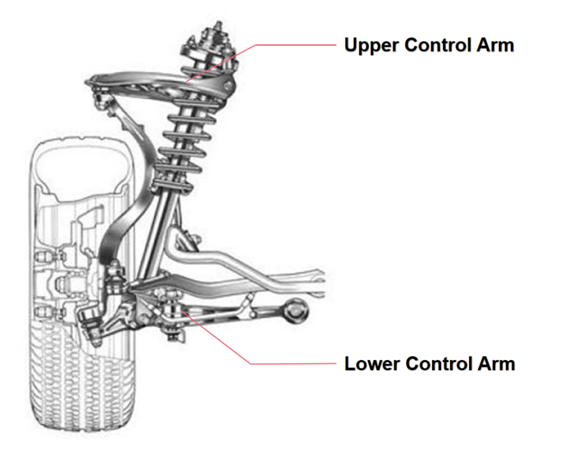
Other vehicles use double-wishbone suspension. These commonly have both an upper and a lower control arm for each wheel. Multi-link systems can look even more complex because several smaller links may replace one large conventional arm.
- ✦ MacPherson strut
Usually uses a lower control arm but no separate upper control arm.
- ✦ Double wishbone
Usually has an upper and lower control arm at each wheel that uses this design.
- ✦ Multi-link suspension
Uses several separate links that may perform jobs normally handled by control arms.
- ✦ Torsion-beam rear suspension
May use trailing-arm structures rather than separate conventional control arms.
- ✦ Solid axle suspension
May use radius arms, trailing arms, control arms, leaf springs, or other locating links depending on the design.
Why the Answer Is Not a Simple Yes or No
Automakers have many ways to hold a wheel in the correct position while allowing suspension travel. The part names differ, but the goal stays similar: control wheel movement, maintain alignment, and manage forces from braking, acceleration, and cornering.
That is why searching **do all cars have control arms** can produce different answers. One source may count every suspension locating link as a control arm, while another uses the term only for a large A-shaped or L-shaped arm.
- ✦ Terminology varies
A part may be called a control arm, wishbone, lateral link, radius arm, tension arm, or suspension link.
- ✦ Front and rear designs can differ
A single car can use one suspension layout in front and a completely different one at the rear.
What Is a Control Arm on a Car?
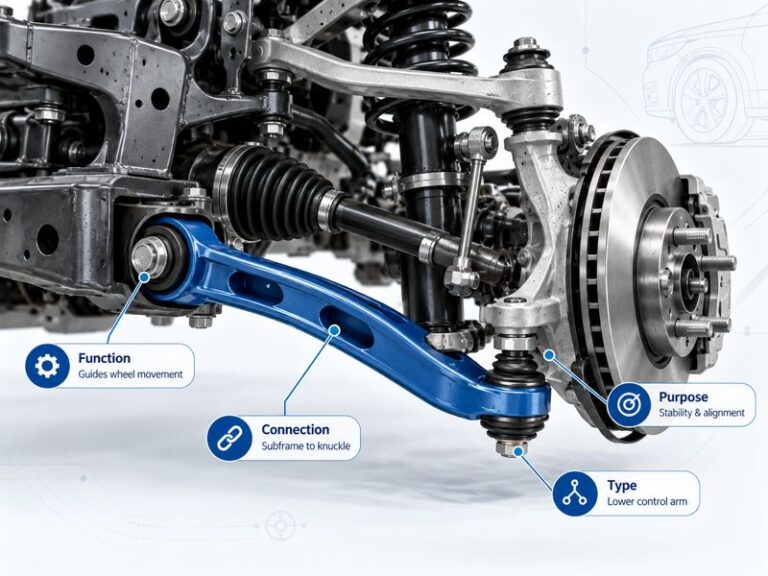
A control arm is a suspension link that connects the wheel assembly to the vehicle’s frame, body, or subframe. Its main job is to keep the wheel located correctly while allowing controlled vertical movement.
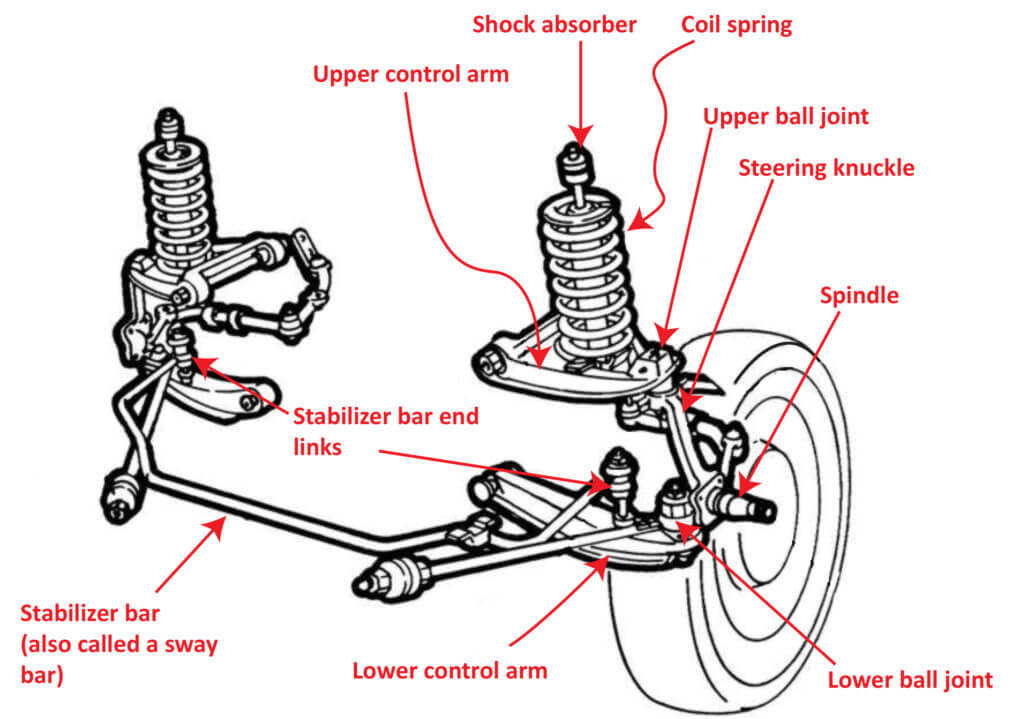
Most traditional control arms pivot on rubber or hydraulic bushings at their inner mounting points. At the outer end, the arm may connect to the steering knuckle through a ball joint. Some designs use separate joints or different mounting methods.
The arm must handle forces in several directions. It helps resist loads caused by braking, cornering, bumps, and acceleration. At the same time, it must let the suspension move through its intended range.

- ✦ Locates the wheel
The arm helps keep the wheel in the correct position relative to the vehicle.
- ✦ Allows suspension travel
Pivoting bushings let the wheel rise and fall as the car travels over bumps.
- ✦ Supports alignment geometry
The control arm helps determine wheel angles such as camber and caster.
- ✦ Transfers road forces
It carries loads between the wheel assembly and the vehicle structure.
What Does a Control Arm Connect To?
A conventional control arm normally connects the vehicle’s subframe or chassis to the steering knuckle or wheel carrier. The inner end pivots on one or more bushings. The outer end often uses a ball joint.
On some cars, the ball joint comes as part of the control arm. On others, it can be replaced separately. The exact arrangement depends on the vehicle.
- ✦ Inner connection
Usually attaches to the frame or subframe through bushings.
- ✦ Outer connection
Often connects to the steering knuckle through a ball joint.
Which Cars Usually Have Control Arms?
Most cars, crossovers, SUVs, and light trucks on U.S. roads use some form of control arm or suspension locating link. The exact part becomes easier to identify once you know the suspension type.
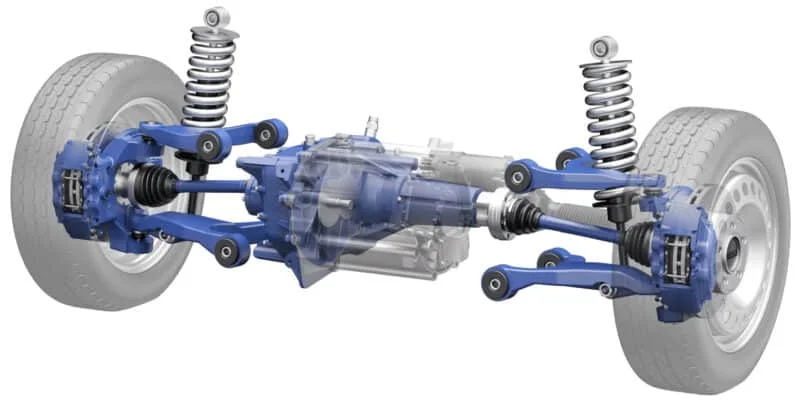
Passenger cars with MacPherson struts commonly use lower control arms in front. Trucks and SUVs with independent double-wishbone front suspension often use both upper and lower arms. Vehicles with independent multi-link suspension may have several arms or links at each corner.
So when someone asks **do all cars have control arms**, a practical answer is that traditional control arms are very common, but their number and shape vary widely.
- ✦ Compact and midsize cars
Many use MacPherson struts with one lower control arm at each front wheel.
- ✦ SUVs
Depending on the platform, they may use MacPherson struts, double wishbones, or multi-link layouts.
- ✦ Pickup trucks
Independent front suspension often uses upper and lower control arms.
- ✦ Performance cars
Double-wishbone and multi-link designs are common because they give engineers more control over wheel geometry.
- ✦ Luxury vehicles
Many use complex multi-link systems with several individual suspension arms.
Do Front-Wheel-Drive Cars Have Control Arms?
Yes, many front-wheel-drive cars have control arms. A common setup uses a MacPherson strut with one lower control arm on each front side.
The drivetrain layout does not decide whether a car has control arms. Suspension design does. Front-wheel drive, rear-wheel drive, and all-wheel drive vehicles can all use them.
Do Rear-Wheel-Drive Cars Have Control Arms?
Many rear-wheel-drive vehicles also have control arms. Independent front suspensions may use upper and lower arms, while the rear suspension can use separate control arms, multi-links, trailing arms, or a solid axle.
Older and newer rear-wheel-drive cars can differ greatly. You should identify the actual suspension layout rather than assume it from the drivetrain.
Do Cars With MacPherson Struts Have Control Arms?
Yes. A typical MacPherson strut front suspension uses a **lower control arm**. What it usually does not have is a conventional upper control arm.
In this design, the strut connects the upper part of the steering knuckle to the body of the vehicle. The lower control arm positions the bottom of the knuckle. Together, these parts guide wheel movement.
This layout is popular because it uses fewer parts and takes up less space than many double-wishbone systems. That can leave more room for the engine, transmission, and passenger compartment.

- ✦ Lower control arm
Positions the lower part of the wheel and steering knuckle.
- ✦ Strut
Provides spring and damping functions while also helping locate the upper part of the knuckle.
- ✦ No separate upper arm
The strut assembly replaces much of the locating function that an upper control arm would provide.
Why MacPherson Struts Usually Need Only a Lower Control Arm
A double-wishbone suspension needs an upper and lower arm because both arms locate the wheel carrier. A MacPherson strut uses the strut itself as one of the major locating members.
This is why seeing only one obvious control arm near a front wheel does not mean a part is missing. It can be completely normal for that suspension design.
Do Cars With Double-Wishbone Suspension Have Upper and Lower Control Arms?
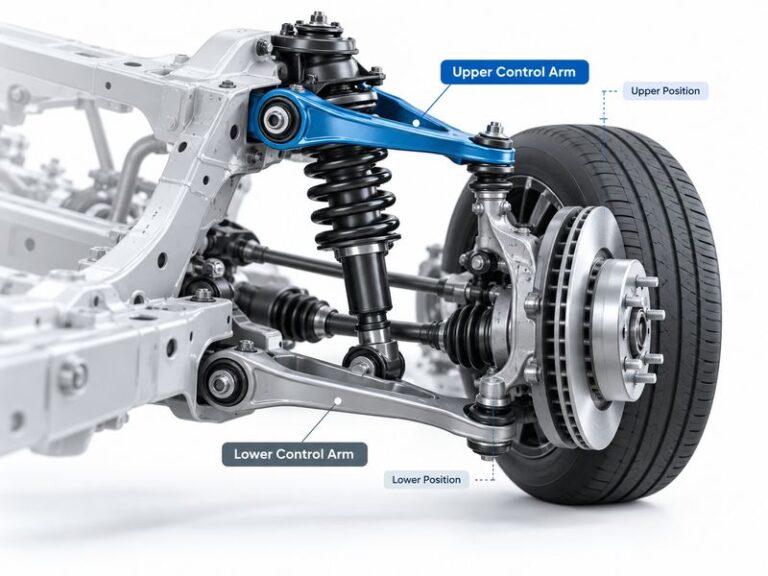
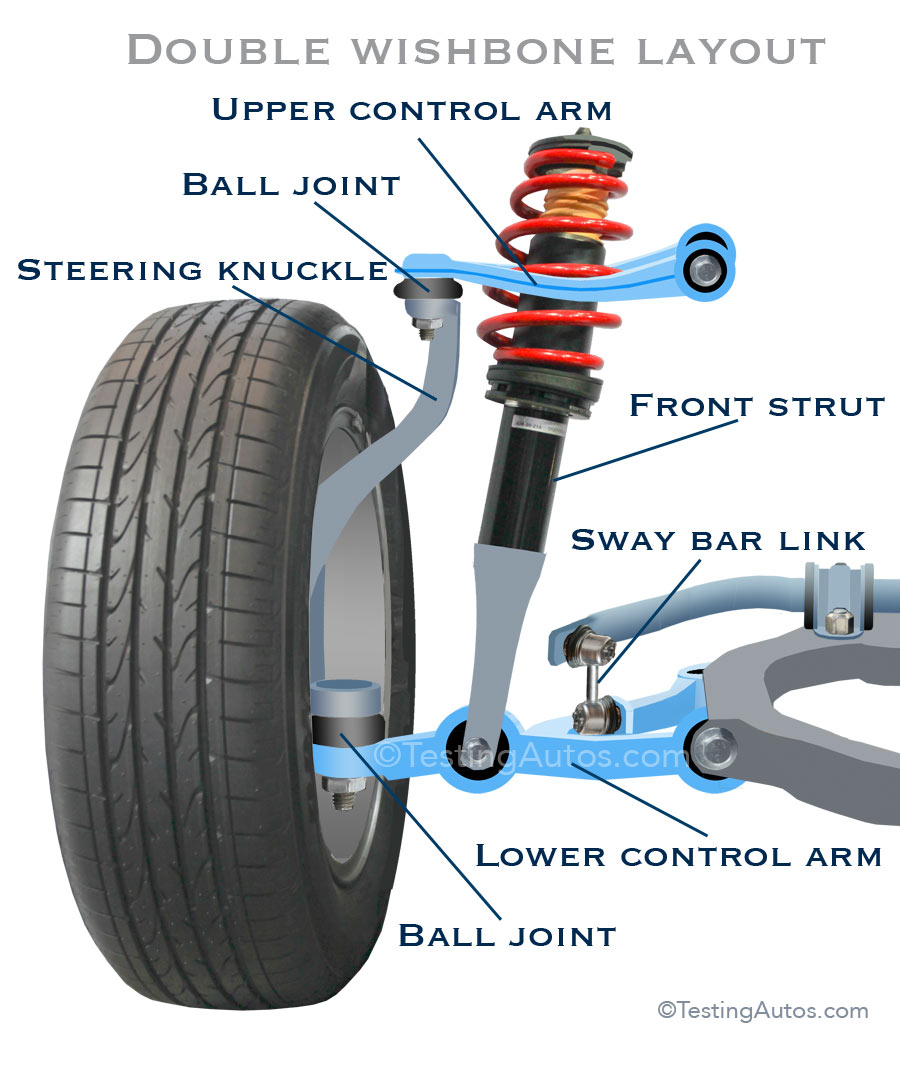
Yes. Double-wishbone suspension is one of the clearest examples of a design that uses both **upper and lower control arms**. Each arm helps control the position and angle of the wheel as the suspension moves.
The arms are often roughly A-shaped, which is why people also call them A-arms or wishbones. Their exact shape can vary. Some are true triangular arms, while others use separate links to achieve a similar result.
Engineers can tune the length, angle, and mounting points of the upper and lower arms to control wheel geometry during suspension travel. This makes the layout useful in many trucks, SUVs, sports cars, and performance applications.
- ✦ Upper control arm
Locates the upper area of the steering knuckle or wheel carrier.
- ✦ Lower control arm
Locates the lower area and often carries substantial suspension loads.
- ✦ Two-arm geometry
The upper and lower arms work together to control wheel angle through suspension travel.
Are Upper and Lower Control Arms the Same?
No. They work together, but they are different parts with different mounting points and shapes. The lower arm is usually mounted below the wheel center, while the upper arm sits above it.
On many vehicles, the lower arm is larger and carries more load. However, suspension designs vary, so the exact size and duty of each part depend on the vehicle.
What About Multi-Link Suspension?
Multi-link suspension makes the question **do all cars have control arms** more complicated. Instead of one large upper arm and one large lower arm, a multi-link system may use three, four, five, or more individual links around a wheel.
Each link can control a specific direction of movement. One may handle lateral loads, another may help control toe, and another may manage fore-and-aft movement. Together, the links perform many of the same functions as conventional control arms.
Parts catalogs and repair manuals may call these components control arms, lateral links, toe links, tension links, trailing links, or suspension arms. Names can vary even when two parts perform similar jobs.

- ✦ Lateral links
Help control side-to-side wheel location.
- ✦ Toe links
Help control the wheel’s toe angle.
- ✦ Trailing links
Help locate the wheel in the fore-and-aft direction.
- ✦ Upper or lower links
May perform roles similar to conventional upper or lower control arms.
Are Multi-Link Suspension Links Control Arms?
Sometimes. The answer depends on the manufacturer’s naming system and the shape of the part. A repair manual may call one link a control arm while calling another a toe link.
From a functional point of view, these links all help control wheel position. From a parts-ordering point of view, however, you should use the exact name and part number listed for your vehicle.
Which Cars May Not Use Traditional Control Arms?
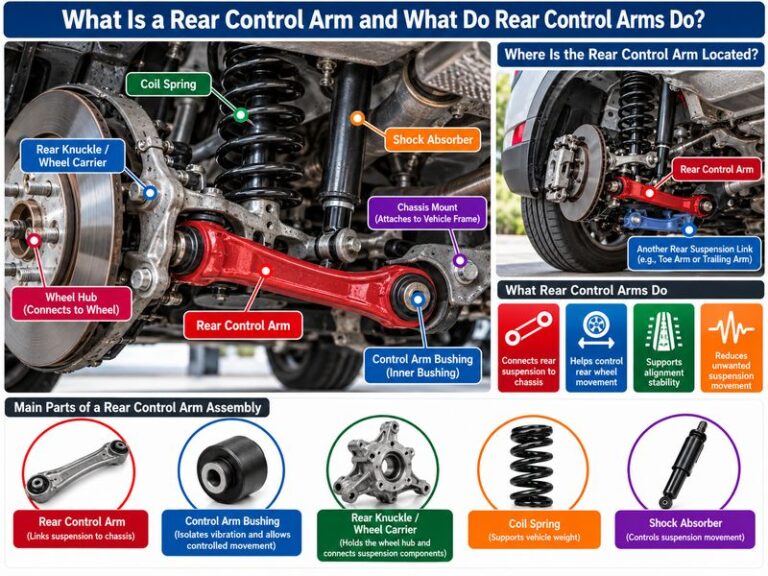
Some suspension designs do not use a part that looks or works exactly like a conventional A-shaped control arm. Instead, they locate the wheel or axle with trailing arms, radius rods, torsion beams, leaf springs, or combinations of smaller links.
This is especially common in rear suspension systems. A basic torsion-beam rear axle, for example, combines the left and right trailing structures with a cross beam. It does not look like a typical independent suspension with separate upper and lower control arms.
Some solid rear axles are also located by trailing arms or radius arms. Others use leaf springs, which can support the vehicle and help locate the axle at the same time.
Therefore, the most accurate answer to **do all cars have control arms** is no. Every car needs a way to locate its wheels or axles, but that job does not always require a conventional control arm.
- ✦ Torsion-beam suspension
Uses connected trailing structures and a cross beam rather than a normal set of upper and lower control arms.
- ✦ Leaf-spring solid axle
Leaf springs can help both support and locate the axle.
- ✦ Trailing-arm suspension
Uses arms that extend mainly forward or rearward from the wheel assembly.
- ✦ Radius-arm layouts
Use long locating arms to control axle or wheel movement.
Does Every Wheel Need a Control Arm?
No. Every wheel needs to be located and controlled by the suspension, but a traditional control arm is only one way to do that.
A wheel may instead be guided by a strut, trailing arm, several links, a beam axle, or another suspension member. What matters is that the system controls unwanted movement while allowing normal suspension travel.
How Many Control Arms Does a Car Have?
There is no single number that applies to every car. A vehicle might have only two obvious control arms, while another can have four, eight, or several suspension links that serve control-arm functions.
A common MacPherson strut front suspension may use one lower control arm on each side, giving the front axle two control arms. If the rear uses a torsion beam, the car may have no conventional rear control arms.
A double-wishbone setup can use an upper and lower arm on each side. If used at all four wheels, that can result in eight traditional control arms.
A multi-link vehicle may have even more individual suspension links. For repair work, counting only parts called control arms may give a different number from counting every wheel-locating link.

- ✦ Two control arms
Common when the front uses one lower arm per side and the rear uses another type of suspension.
- ✦ Four control arms
Possible when one axle uses upper and lower arms or when both axles use one main arm per side.
- ✦ Eight control arms
Possible on a vehicle with upper and lower control arms at all four wheels.
- ✦ More than eight links
Complex multi-link systems can use many separate locating links across four corners.
Can a Car Have Only Lower Control Arms?
Yes. This is very common on cars with MacPherson strut front suspension. The lower control arm handles the lower locating job while the strut handles much of the upper locating function.
The absence of an upper control arm is therefore not a problem by itself. It is part of the suspension’s intended design.
How Can You Tell If Your Car Has Control Arms?
The safest method is to check the suspension diagram or parts catalog for your exact year, make, model, trim, and drivetrain. Vehicles from the same model family can use different suspension parts.
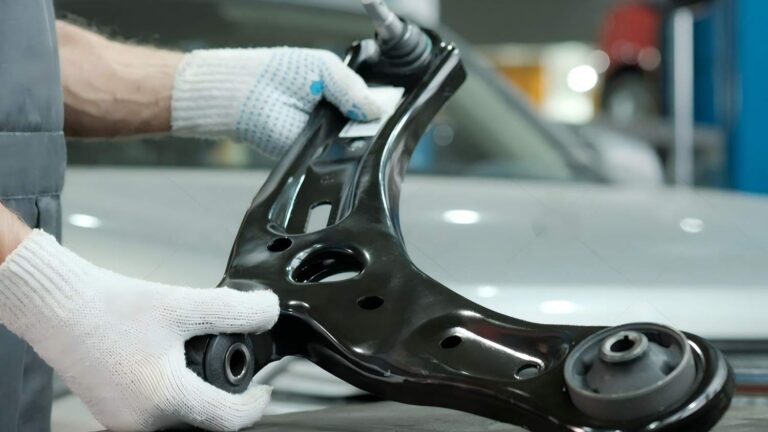
You can also look behind the wheel if the vehicle is safely parked. A lower control arm often runs from the lower steering knuckle area toward the subframe. It may appear as an A-shaped, L-shaped, curved, or stamped metal arm.
Do not rely only on appearance. Multi-link components can be small and straight, while some trailing arms are large enough to look like control arms. Part names in the service information are more reliable.
- ✦ Check the owner’s or service information
Technical suspension diagrams can show the exact layout.
- ✦ Use a vehicle-specific parts catalog
Enter the exact vehicle details to see whether upper, lower, or other suspension arms are listed.
- ✦ Inspect the suspension
Look for arms that connect the knuckle or wheel carrier to the frame or subframe.
- ✦ Ask a repair shop
A technician can identify the layout during an inspection or alignment.
Why Do Some Cars Use Different Control Arm Designs?
Suspension design involves tradeoffs. Automakers must consider ride comfort, handling, cost, weight, packaging space, durability, manufacturing needs, and the intended use of the vehicle.
A simple MacPherson strut design works well for many everyday cars because it is compact and uses relatively few parts. A double-wishbone or multi-link system gives engineers more ways to control wheel geometry, but it also adds parts and takes more space.
Pickup trucks and off-road vehicles may need strong suspension components that can handle heavy loads and long wheel travel. Sports cars may place more emphasis on precise wheel control. Economy cars often place greater weight on simplicity, cost, and packaging.
That is another reason **do all cars have control arms** cannot be answered by looking at vehicle size or price alone. The engineering goals behind each platform matter.
- ✦ Packaging
Compact suspension layouts can leave more room for engines, transmissions, batteries, and passengers.
- ✦ Cost
Fewer suspension links can reduce manufacturing and replacement costs.
- ✦ Handling
More complex geometry can give engineers finer control over wheel angles.
- ✦ Ride comfort
Suspension design affects how the vehicle responds to bumps and road changes.
- ✦ Durability
Trucks and utility vehicles may use larger parts suited to demanding loads.
What Happens When a Control Arm or Its Bushings Wear Out?
Control arms themselves are usually strong, but their bushings and ball joints can wear. Arms can also bend or crack after a hard impact, severe corrosion, or collision damage.
Worn bushings can let the wheel shift more than intended. A worn ball joint can create play between the control arm and steering knuckle. Either condition can affect steering feel, tire wear, noise, and alignment.
Symptoms should not be used as proof that a control arm is bad. Several suspension and steering parts can cause similar problems. A proper inspection is the best way to find the actual source.
- ✦ Clunking noises
Worn bushings or joints may make noise when driving over bumps or changing direction.
- ✦ Uneven tire wear
Excess movement can affect alignment and tire contact.
- ✦ Loose steering feel
Worn joints or bushings may allow unwanted wheel movement.
- ✦ Vehicle pulling
Suspension damage or alignment changes can make the car drift or pull.
- ✦ Visible damaged bushings
Cracked, torn, or separated rubber can indicate wear.
Can You Drive With a Bad Control Arm?
It depends on what is damaged and how severe the problem is. A slightly worn bushing is different from a loose ball joint, cracked arm, or badly bent suspension part.
Because control arms help locate the wheel, serious damage can become a safety issue. If the vehicle has strong clunks, unstable steering, major wheel movement, or visible structural damage, it should be inspected before normal driving continues.
Do Control Arms Need to Be Replaced in Pairs?
Control arms do not always have to be replaced in pairs. If one arm is bent from an impact and the arm on the other side is in good condition, replacing only the damaged side may be reasonable.
Pair replacement can make more sense when both sides have similar age and bushing wear. If one side has failed from normal wear, the matching side may also be approaching the end of its useful life.
The better choice depends on inspection results, part design, mileage, corrosion, and repair cost. After control-arm work, an alignment check is often wise because suspension position can affect wheel alignment.
- ✦ Replace one side
May be suitable when damage is isolated and the opposite side remains in good condition.
- ✦ Replace both sides
May make sense when both sides show similar wear or have the same service history.
- ✦ Check alignment
Suspension repairs can change wheel position, so alignment should be checked when appropriate.
Control Arms vs Other Suspension Links
It is easy to confuse control arms with other suspension parts because several components can perform overlapping jobs. Knowing the basic terms makes suspension diagrams easier to understand.
A traditional control arm usually pivots between the chassis and wheel carrier. A trailing arm mainly extends forward or rearward. A toe link mainly controls toe angle, while a radius arm controls fore-and-aft movement and sometimes axle rotation.
These labels describe the part’s geometry or main function, but manufacturers do not always use the same naming system. Always match parts to the exact vehicle rather than ordering based only on a general description.
- ✦ Control arm
A general suspension member that helps locate the wheel relative to the body or frame.
- ✦ Trailing arm
A suspension arm positioned mainly along the vehicle’s length.
- ✦ Toe link
A link used mainly to control or adjust wheel toe.
- ✦ Radius arm
A long locating arm that controls fore-and-aft movement.
- ✦ Lateral link
A link that helps manage side-to-side wheel or axle location.
What I Look for When Identifying a Vehicle’s Control Arms
A useful way to identify the suspension is to start with the steering knuckle or wheel carrier and follow each link inward. This avoids assuming that every visible arm is a conventional control arm.
I first check whether a strut attaches directly to the knuckle. If it does, the vehicle may use a MacPherson-style design with only a lower control arm. If I see separate upper and lower arms connected to the knuckle, the layout is more likely a double-wishbone design.
When several narrow links connect the wheel carrier to the body or subframe, I treat the system as a multi-link design until the vehicle-specific diagram confirms the name of each part. This simple approach is more reliable than judging the suspension by one component’s shape.
For owners, the same lesson applies: when asking **do all cars have control arms**, identify the suspension type first. The suspension layout tells you far more than the vehicle’s brand, drivetrain, or body style.
- ✦ Find the wheel carrier
Trace the suspension members that connect it to the body or subframe.
- ✦ Look for a strut
A strut attached to the knuckle often points to a MacPherson-style layout.
- ✦ Check for two wishbones
Separate upper and lower arms usually indicate double-wishbone suspension.
- ✦ Watch for multiple narrow links
Several individual arms often indicate a multi-link design.