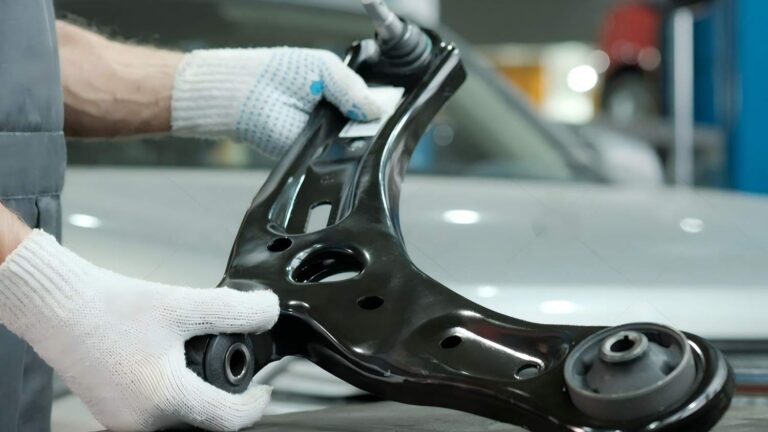
What Is a Control Arm? Function, Materials, Types, and Purpose
A control arm is a suspension component that connects the wheel-side suspension assembly to the vehicle’s frame, body, or subframe while allowing the wheel to move up and down in a controlled path. So, what does a control arm do? It helps keep the wheel properly positioned as the suspension moves, resists braking and cornering forces, and helps maintain stable steering and wheel alignment.
Control arms may look simple, but they are fundamental to suspension geometry. Depending on the vehicle, a control arm may connect to the steering knuckle through a ball joint and to the chassis through one or more control arm bushings. These flexible connections allow the wheel to move without letting it shift freely in unwanted directions.
And what are control arms made of? Most automotive control arms are manufactured from stamped steel, forged steel, cast iron or steel, or aluminum alloys. The material and shape are chosen according to vehicle weight, suspension design, strength requirements, manufacturing cost, and packaging.
Not every vehicle uses the same type or number of control arms. Some suspension systems have upper and lower control arms, while others use one lower arm with a strut. Modern multi-link suspensions may divide the traditional control arm’s job among several individual links.
This pillar guide explains control arms from A to Z, including their function, materials, construction, types, mounting points, bushings, ball joints, failure symptoms, inspection, replacement, alignment effects, safety, and common questions.
What Is a Control Arm and What Does a Control Arm Do?
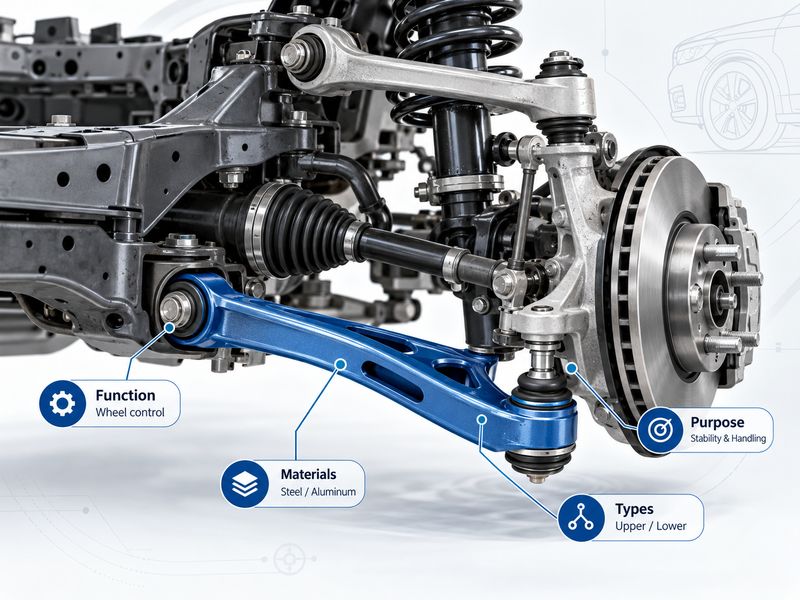
A control arm is a structural suspension link positioned between the vehicle chassis and a wheel assembly.
Its basic job is to guide the wheel through a controlled range of suspension travel.
When a tire goes over a bump, the wheel must move upward relative to the vehicle body. When the road becomes lower again, the wheel moves downward.
The control arm allows this vertical motion while preventing the wheel from moving excessively forward, backward, or sideways.
This is important because a wheel experiencing completely uncontrolled movement would not maintain proper alignment with the road.
Control arms therefore help determine:
- Where the wheel sits
- How it moves during suspension travel
- How the wheel reacts under braking
- How it behaves during cornering
- How suspension geometry changes through travel
The arm itself normally pivots around bushings at the chassis side.
Its outer end often attaches to the steering knuckle or wheel carrier through a ball joint.
These joints allow the control arm to move while keeping the wheel assembly securely connected to the vehicle.
What Does a Control Arm Do?

The easiest answer to what does a control arm do is that it controls the wheel’s position and movement relative to the vehicle.
However, several important functions are involved.
It Guides Suspension Movement
The control arm creates a defined movement path.
As the suspension compresses and extends, the arm pivots around its chassis mounting points.
Its length, shape, angle, and mounting position influence how the wheel moves.
It Helps Maintain Wheel Alignment
Control arms are part of the geometry that establishes wheel alignment.
Depending on the suspension design, they can influence:
- Camber
- Caster
- Toe behavior
- Wheelbase position
- Track width
If a control arm bends or its bushings become excessively loose, these relationships can change.
It Resists Braking Forces
During braking, large forces act on the wheel.
The control arm and its bushings help prevent the wheel from moving excessively relative to the chassis.
It Resists Cornering Forces
During turns, lateral forces push against the tire and suspension.
Control arms help keep the wheel located correctly while these loads are transferred into the chassis.
It Supports Stable Steering
Front control arms influence steering because they help maintain the steering knuckle in the correct location.
A loose or damaged arm can therefore make steering feel vague or unstable.
It Provides Mounting Points
Depending on the suspension design, a control arm may provide mounting locations for components such as:
- Ball joints
- Sway bar links
- Coil springs
- Shock absorbers
- Bump stops
Not every control arm supports all of these components.
How Does a Control Arm Work?
A control arm works as a pivoting suspension link.
The inner section attaches to the body, frame, or subframe using bushings.
The outer portion connects to the wheel-side assembly.
On many front suspension systems, the outer connection uses a ball joint attached to the steering knuckle.
When the wheel moves upward, the control arm rotates around its inner pivots.
The ball joint simultaneously changes angle as the steering knuckle moves.
During steering, the ball joint also allows the knuckle to rotate left or right.
The control arm therefore has to allow movement without allowing uncontrolled looseness.
The suspension geometry determines the arc through which the control arm travels.
This geometry is carefully designed because the wheel does not simply move straight up and down.
Its camber, position, and other angles may change slightly as the suspension moves.
Those changes are intentionally engineered into the suspension.
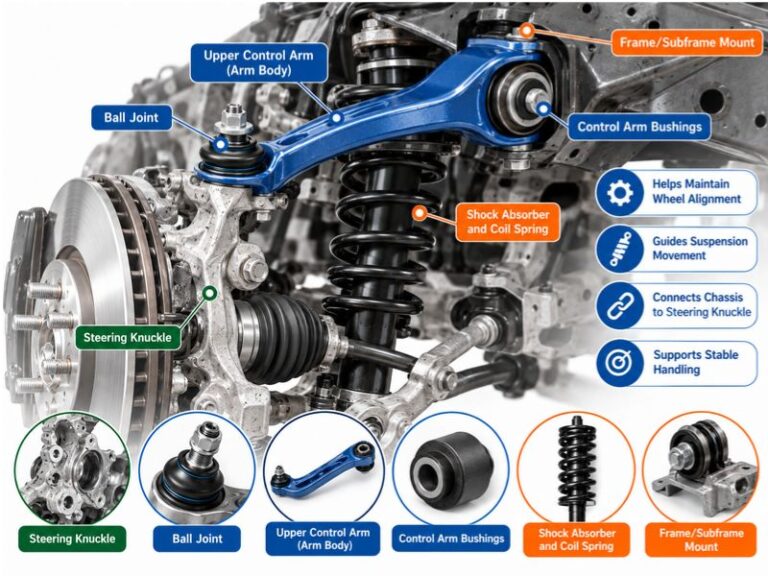
Main Parts of a Control Arm Assembly

A complete control arm assembly may include several components.
Control Arm Body
The arm itself is the structural portion.
It handles forces transferred between the wheel and chassis.
Its shape can be:
- Straight
- Curved
- L-shaped
- A-shaped
- Wishbone-shaped
Shape is determined by suspension geometry and available space around components such as the engine, transmission, brakes, driveshafts, and subframe.
Control Arm Bushings
Control arm bushings are installed at the inner mounting points.
They allow the arm to pivot while helping isolate noise and vibration.
Most standard bushings are made from rubber or another elastomer.
Some use hydraulic fluid to provide additional vibration control.
Ball Joint
Many control arms connect to the steering knuckle through a ball joint.
The ball joint allows angular movement between the control arm and knuckle.
Some ball joints are separately replaceable.
Others are permanently integrated into the control arm.
Mounting Hardware
Bolts, nuts, brackets, sleeves, and sometimes alignment hardware secure the control arm to the vehicle.
Certain vehicles use eccentric bolts or shims at the control arm to adjust alignment.
What Are Control Arms Made Of?
If you are wondering what are control arms made of, most are constructed from strong automotive metals designed to handle repeated suspension loads.
Common materials include:
- Stamped steel
- Forged steel
- Cast steel
- Cast iron
- Aluminum alloy
The best material depends on the vehicle and application.
Stamped Steel Control Arms
Stamped steel control arms are manufactured from sheet steel that is pressed into shape.
Two formed sections may be welded together to create a rigid structure.
Stamped steel is widely used because it provides a useful balance between:
- Strength
- Cost
- Manufacturing efficiency
- Durability
The hollow or formed shape can create substantial stiffness without requiring a solid piece of metal.
One disadvantage is corrosion.
If protective coatings are damaged and the vehicle operates in a salted or wet environment, rust can develop.
Forged Steel Control Arms
Forged steel control arms are formed under high pressure.
The forging process can create a strong component capable of handling significant loads.
These arms are commonly found in applications requiring substantial structural strength.
Forged arms may look thicker and more solid than stamped versions.
Cast Control Arms
Some control arms are manufactured through casting.
Molten metal is formed inside a mold to create the required shape.
Casting allows manufacturers to produce complicated shapes that would be more difficult to make from stamped sheet metal.
Cast components must be inspected carefully after impacts because cracking and deformation can appear differently than on stamped steel.
Aluminum Control Arms
Many modern and performance-oriented vehicles use aluminum control arms.
Aluminum offers an important advantage: lower weight.
Reducing suspension component weight can decrease unsprung mass, which may help suspension response.
Aluminum also resists traditional red rust, although it can still corrode or oxidize.
A major consideration is impact damage.
An aluminum arm should not normally be heated or bent back into shape after structural damage.
Replacement is generally the appropriate solution unless the manufacturer specifies otherwise.
Why Are Different Materials Used?
There is no single material that is ideal for every control arm.
Manufacturers balance several priorities.
Strength
The arm has to withstand forces generated by:
- Vehicle weight
- Braking
- Cornering
- Pothole impacts
- Acceleration
- Road irregularities
Weight
Reducing suspension weight can improve how quickly the wheel assembly reacts to road changes.
This is one reason aluminum may be used on higher-performance vehicles.
Cost
Stamped steel can often be produced economically in large volumes.
Material and manufacturing cost matter significantly in mass-produced vehicles.
Packaging
Some suspension systems require complicated arm shapes to fit around nearby components.
The manufacturing method must support that geometry.
Corrosion Resistance
Environmental conditions also matter.
Steel components normally require protective coatings.
Aluminum avoids conventional steel rust but can still experience corrosion and structural deterioration.
Types of Control Arms
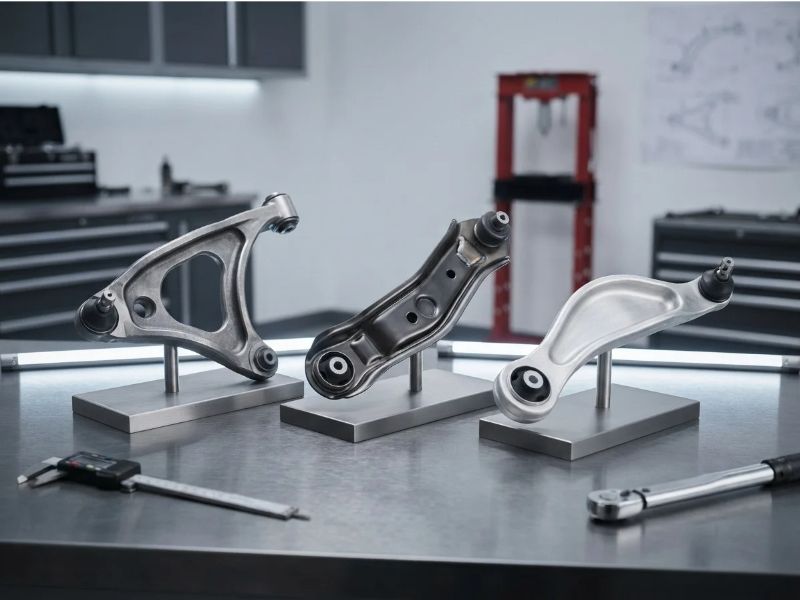
Control arms are not all identical.
Several common types exist.
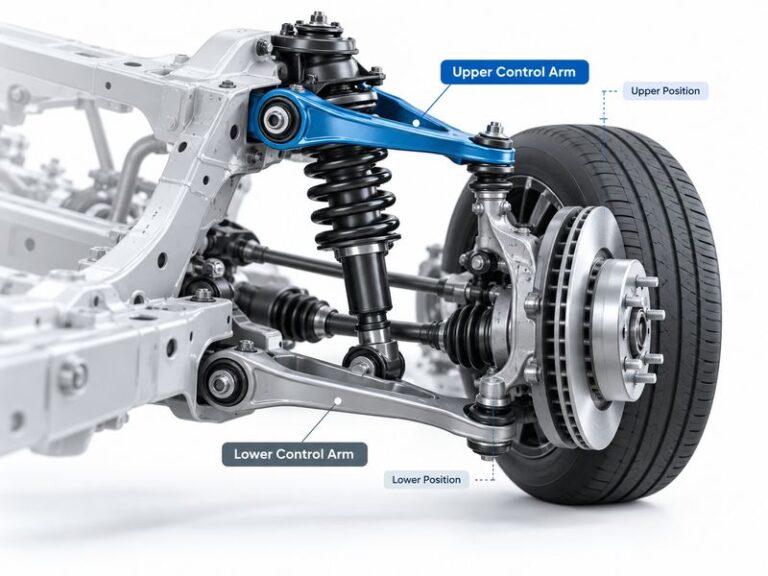
Upper Control Arms
An upper control arm connects the upper portion of the steering knuckle or wheel carrier to the chassis.
It is commonly found in:
- Double-wishbone suspension
- Short-long-arm suspension
- Some truck and SUV designs
The upper control arm helps control the upper section of the wheel assembly and influences suspension geometry.
Not every car has one.
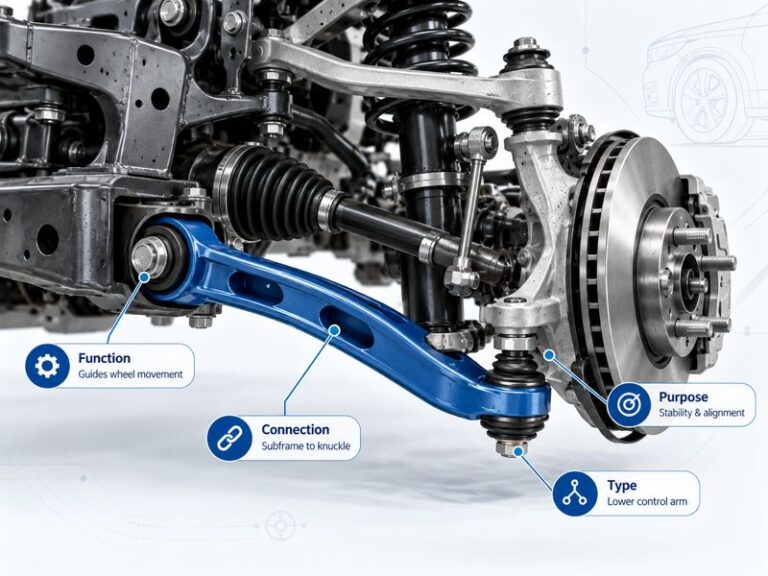
Lower Control Arms
A lower control arm connects to the lower portion of the steering knuckle or wheel carrier.
It is extremely common.
MacPherson strut suspensions, for example, typically use a lower control arm without a traditional upper arm.
Lower arms may also support:
- Coil springs
- Sway bar links
- Ball joints
- Other suspension components
depending on the design.
Front Control Arms
Front control arms are located around the front wheel assemblies.
Because the front wheels often handle steering and major braking loads, these arms play an important role in steering stability.
A worn front control arm bushing can make the vehicle feel loose or unstable under braking.
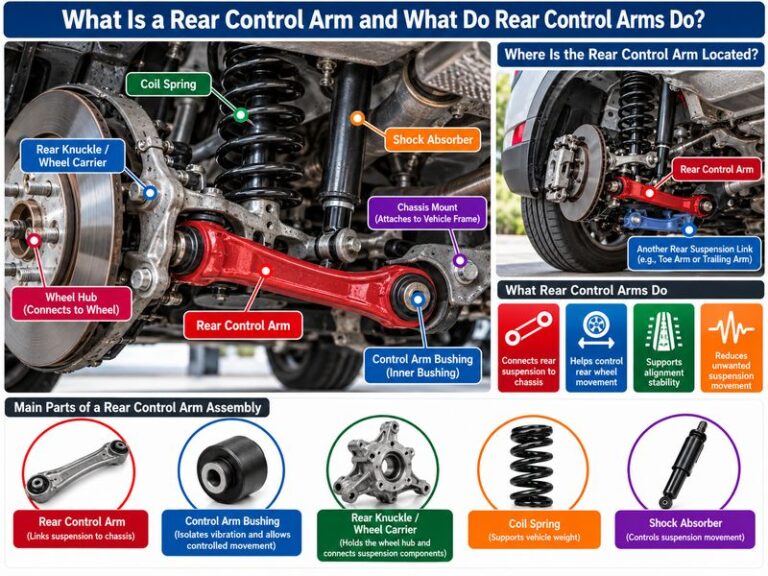
Rear Control Arms
Rear suspensions can also use control arms.
Modern independent rear suspension may have several links on each side.
These arms may control:
- Camber
- Toe
- Longitudinal movement
- Lateral movement
Some rear suspension links are called control arms, while others have more specific names such as toe links or trailing arms.
Wishbone or A-Arms
A wishbone control arm has two inner mounting points and one outer connection.
Its triangular shape resembles an A.
The two inner pivots help control wheel position in multiple directions.
Double-wishbone suspension normally uses an upper and lower wishbone.
L-Shaped Control Arms
Some control arms use an L shape.
This may allow the suspension to control forces using two differently oriented inner bushings while fitting around other components.
Multi-Link Control Arms
Multi-link suspension divides wheel control among several individual links.
One link may mainly control toe.
Another may influence camber.
Another may manage longitudinal wheel position.
These links effectively perform jobs that might otherwise be combined into a single larger control arm.
Control Arm vs Trailing Arm
A trailing arm is a specific suspension link that generally extends in the front-to-rear direction.
It helps control longitudinal wheel movement.
A control arm is a broader term describing links that locate the wheel or axle.
Some parts catalogs use the terms loosely, which can create confusion.
The exact suspension diagram for the vehicle is the best way to identify a component.
Control Arm vs Tie Rod
The control arm and tie rod serve different purposes.
A control arm is primarily part of the suspension system.
A tie rod is part of the steering system.
The tie rod transfers movement from the steering rack or steering mechanism to the steering knuckle.
The control arm helps locate the wheel assembly while allowing suspension travel.
Both can affect alignment, but they do so in different ways.
Control Arm vs Ball Joint
The control arm is the structural suspension link.
The ball joint is the movable connection between the control arm and steering knuckle.
A control arm can therefore be structurally good while its ball joint is worn.
Likewise, the ball joint may still be healthy even if the arm has a damaged bushing.
Some replacement control arms include new ball joints, while others do not.
Control Arm vs Control Arm Bushing
A control arm bushing is only one part of the control arm mounting system.
The control arm carries loads and establishes wheel position.
The bushing creates a flexible connection between the arm and chassis.
If the bushing fails, it may sometimes be replaced separately.
In other cases, replacing the complete control arm is more practical.
Do All Cars Have Control Arms?
Most modern vehicles use suspension links that perform the functions of control arms, but not every vehicle uses components with identical names or layouts.
A MacPherson strut front suspension usually has a lower control arm.
A double-wishbone system has upper and lower arms.
A multi-link system may have several individual links.
Rear suspension can vary even more.
A torsion-beam suspension, for example, does not look like a conventional independent suspension with multiple control arms.
Therefore, asking how many control arms a car has cannot be answered universally without knowing the suspension design.
How Many Control Arms Does a Car Have?
The number depends entirely on the vehicle.
A simple front suspension could use:
- One lower control arm on the left
- One lower control arm on the right
A double-wishbone layout could use:
- Two upper front arms
- Two lower front arms
Multi-link rear suspension may add several more links at each rear wheel.
A complete vehicle could therefore have only a few major control arms or numerous suspension links performing similar functions.
Always use vehicle-specific information when ordering parts.
Why Control Arm Bushings Matter
The control arm cannot simply be rigidly attached to the chassis because it needs to pivot.
Bushings solve this problem.
A healthy bushing allows controlled rotation while restricting unwanted movement.
It also helps reduce:
- Noise
- Road harshness
- Vibration
As bushings wear, they can:
- Crack
- Tear
- Separate
- Become excessively soft
- Leak if hydraulic
When that happens, the control arm may move more than intended.
This can affect steering and alignment even when the metal arm itself remains perfectly straight.
Why Ball Joints Matter
The ball joint creates a flexible connection between the control arm and steering knuckle.
A ball-shaped stud moves inside a socket.
This allows the knuckle to move through suspension travel and steering angles.
The joint is protected by a flexible boot.
If the boot tears, water and debris can enter.
This can accelerate joint wear.
Excessive ball joint wear can become a serious problem because the joint contributes directly to wheel location.
What Causes Control Arms to Go Bad?
The metal control arm itself does not normally wear in the same way rubber bushings do.
However, several things can cause problems.
Pothole Impacts
A severe pothole can bend a control arm.
Damage may be obvious, but sometimes only a small geometry change occurs.
Curb Strikes
Hitting a curb can transmit considerable force through the wheel into suspension components.
A bent arm may cause alignment to remain outside specification.
Collisions
Accidents involving the wheel area can damage control arms, knuckles, subframes, and mounting points.
Corrosion
Steel control arms can develop corrosion.
Surface rust may be cosmetic, but severe structural corrosion requires attention.
Worn Bushings
The control arm body may remain intact while its bushings become worn.
Worn Ball Joints
If the ball joint is permanently integrated, joint failure may require complete control arm replacement.
Symptoms of a Bad Control Arm
Control arm problems can produce several symptoms.
Clunking or Knocking
A worn bushing or ball joint can allow movement that produces a clunk.
The noise may appear:
- Over bumps
- While braking
- During acceleration
- When changing direction
Loose Steering
Front control arm wear can make steering feel vague.
The vehicle may wander or require frequent corrections.
Uneven Tire Wear
A bent arm or loose bushing can change wheel alignment.
This may lead to unusual tire wear.
Pulling
If one wheel moves differently under braking or acceleration, the vehicle may pull.
Alignment Problems
A damaged control arm may prevent wheel alignment from being brought within specification.
Wheel Position Changes
A bent arm can cause one wheel to sit farther forward, backward, inward, or outward than the opposite wheel.
Vibration
Control arm problems may contribute to vibration, although tires, wheels, axles, and other suspension parts should also be checked.
Can a Bad Control Arm Affect Steering?
Yes.
The control arm helps maintain the steering knuckle’s position.
If bushings or ball joints allow excessive movement, steering geometry can change as road loads are applied.
The vehicle may feel:
- Loose
- Unstable
- Unpredictable
- Sensitive to bumps
However, similar symptoms can come from tie rods, wheel bearings, tires, or alignment problems.
Diagnosis is important.
Can a Bad Control Arm Affect Wheel Alignment?
Absolutely.
Control arm mounting points are part of the geometry that determines wheel position.
A bent arm can physically change that geometry.
A worn bushing can create another issue: the wheel alignment may change while driving.
This means an alignment machine may show acceptable numbers while the vehicle is stationary, but the wheel may shift under braking or cornering loads.
Mechanical looseness should therefore be corrected before attempting the final alignment.
Can a Bad Control Arm Cause Uneven Tire Wear?
Yes, indirectly.
If control arm wear changes camber, caster, or toe behavior, the tire may no longer run correctly against the road.
However, tire wear alone is not enough to identify a bad control arm.
Other possible causes include:
- Incorrect tire pressure
- Worn tie rods
- Wheel bearing problems
- Damaged springs
- Incorrect alignment
- Bent knuckles
A complete suspension inspection is more reliable.
Can a Control Arm Bend?
Yes.
A strong impact can bend steel or aluminum control arms.
A bent arm can change:
- Camber
- Caster
- Wheel position
- Wheelbase on one side
Even a small amount of bending may create an alignment problem.
Structurally damaged control arms should generally be replaced rather than manually straightened unless the manufacturer provides an approved repair method.
How to Inspect a Control Arm
A basic control arm inspection should examine the arm, bushings, ball joint, and mounting points.
Inspect the Arm Body
Look for:
- Bending
- Cracking
- Impact damage
- Severe corrosion
- Damaged welds
Check the Bushings
Look for:
- Large tears
- Separation
- Displaced rubber
- Excessive movement
- Hydraulic fluid leakage
Small surface cracks do not always mean immediate failure.
Check the Ball Joint
Inspect the protective boot.
A torn boot can allow contamination inside.
Ball joint play should be checked using the correct procedure for the suspension design.
Compare Both Sides
A wheel sitting differently from the opposite wheel can indicate structural or suspension damage.
Review Alignment Results
Abnormal camber, caster, or toe readings can help support the diagnosis.
When Should a Control Arm Be Replaced?
A control arm may need replacement when:
- The arm is bent
- It is cracked
- Severe corrosion has weakened it
- A non-serviceable ball joint is worn
- A non-serviceable bushing has failed
- Collision damage has altered its geometry
A control arm should not automatically be replaced because the vehicle has reached a specific mileage.
Condition matters more than age alone.
Can Control Arm Bushings Be Replaced Without the Arm?
On many vehicles, yes.
The old bushing may be pressed out and a new one installed.
However, this can require:
- Hydraulic press equipment
- Special adapters
- Correct orientation
- Proper support of the arm
If the ball joint is also worn or the arm is corroded, replacing the complete control arm may make more sense.
Should Control Arms Be Replaced in Pairs?
Not always.
If one arm was bent by an isolated impact and the opposite side remains in good condition, only the damaged arm may need replacement.
Pair replacement may be practical when both sides have similar age and bushing or joint wear.
Both sides should be inspected before deciding.
There is no universal rule requiring all control arms to be replaced in pairs.
Do Control Arms Come With Bushings and Ball Joints?
Some do.
A complete replacement control arm may include:
- Preinstalled bushings
- Preinstalled ball joint
- Both
Other arms may contain only bushings.
Some may be sold nearly bare.
Always check the parts description before purchasing.
The same vehicle may have several aftermarket options with different included components.
Do You Need an Alignment After Replacing a Control Arm?
An alignment check is generally recommended after control arm replacement.
The control arm directly influences wheel position.
Replacing it can change:
- Camber
- Caster
- Toe
Some suspension designs use control arm mounting bolts as alignment adjusters.
If those fasteners are disturbed, alignment can change immediately.
If the old arm was bent, an alignment is especially important.
How Is a Control Arm Replaced?
Replacement procedures differ between vehicles, but a basic process may include:
- Safely raising and supporting the vehicle.
- Removing the wheel.
- Supporting the suspension if required.
- Disconnecting the ball joint or outer connection.
- Removing inner control arm bolts.
- Removing the old arm.
- Installing the replacement.
- Reconnecting the ball joint.
- Tightening fasteners correctly.
- Positioning the suspension at normal ride height when required.
- Performing an alignment.
Actual repairs can be more complicated.
Springs, sway bars, axles, subframes, or other components may interfere with access.
Why Ride-Height Torque Matters
Many traditional rubber control arm bushings work by twisting their bonded rubber.
The inner sleeve is clamped firmly when the mounting bolt is tightened.
If the bolt is tightened while the suspension is hanging fully downward, the rubber may be twisted when the vehicle is lowered to normal ride height.
This can leave the bushing under constant stress.
Possible consequences include:
- Reduced bushing life
- Limited suspension movement
- Premature tearing
Some vehicles therefore require final tightening of specific suspension bolts at or near normal ride height.
Always follow manufacturer procedures because bushing designs vary.
How Long Do Control Arms Last?
There is no universal control arm lifespan.
The metal arm may last for a very long time if it is not damaged.
Bushings and ball joints usually experience more wear.
Service life depends on:
- Road conditions
- Vehicle weight
- Climate
- Corrosion
- Potholes
- Driving habits
- Suspension design
- Replacement-part quality
Condition-based inspection is more useful than a universal mileage rule.
Can You Drive With a Bad Control Arm?
That depends on what has failed.
Minor bushing deterioration is different from:
- A severely loose ball joint
- A cracked arm
- A completely separated bushing
- Major structural damage
A serious control arm failure can compromise wheel control.
If the vehicle has obvious wheel movement, severe steering changes, structural damage, or major suspension looseness, continued driving may be unsafe.
The vehicle should be inspected promptly.
Common Control Arm Replacement Mistakes
Several mistakes can create problems after replacement.
Replacing Parts Without Diagnosis
A clunk does not automatically mean the control arm is bad.
Sway bar links, strut mounts, tie rods, and other components can make similar noises.
Ignoring Ball Joint Condition
If only bushings are replaced, the ball joint should also be inspected.
Incorrect Bushing Bolt Tightening
Tightening certain rubber-bushed arms at full suspension droop can preload the bushings.
Using Incorrect Torque
Suspension fasteners should be tightened to vehicle specifications.
Skipping Alignment
Even a correctly installed arm can leave the wheel out of alignment.
Ignoring Collision Damage
A new control arm cannot correct a bent subframe or steering knuckle.
Control Arm Safety
Control arm repair can involve significant vehicle loads and stored spring energy.
Never work underneath a vehicle supported only by a hydraulic jack.
Use appropriate jack stands and manufacturer-approved lifting points.
Be especially careful when a coil spring rests directly on a lower control arm.
Removing that control arm without properly controlling the spring can release dangerous stored energy.
Do not remove suspension bolts until you understand:
- Where the spring is located
- What components carry its load
- How the suspension should be supported
Vehicle-specific service information should be used for any repair involving spring-loaded components.
FAQs About Control Arms
Is a control arm part of the suspension?
Yes, a control arm is a major suspension component that helps locate and guide the wheel assembly. It connects the wheel-side suspension to the frame, body, or subframe.
Its geometry influences wheel movement and alignment.
What does a control arm connect to?
A control arm generally connects the vehicle’s frame or subframe to the steering knuckle, wheel carrier, or axle assembly. Bushings usually form the inner pivots, while a ball joint may form the outer connection.
The exact layout varies by suspension design.
What are control arms made of?
Control arms are commonly made from stamped steel, forged steel, cast metal, or aluminum alloy. Manufacturers select materials according to strength, weight, cost, and suspension requirements.
Different arms on the same vehicle can even use different materials.
Is aluminum better than steel for control arms?
Neither material is universally better. Aluminum can reduce weight, while steel can offer excellent strength, cost efficiency, and durability.
The entire control arm design matters more than material alone.
Can a control arm cause clunking?
Yes, worn bushings, a loose ball joint, or damaged mounts can cause clunking around a control arm. The noise may appear over bumps or when braking and accelerating.
Other suspension components can create similar sounds.
Can a bad control arm cause steering problems?
Yes, especially when front control arm bushings or ball joints have excessive movement. The vehicle may wander or feel loose because wheel position changes under load.
A complete steering and suspension inspection should confirm the cause.
Does a control arm affect alignment?
Yes, control arms are fundamental to suspension geometry and wheel alignment. Bent arms or worn bushings can affect camber, caster, toe behavior, or wheel position.
Mechanical looseness should be repaired before final alignment.
Does every car have upper and lower control arms?
No. Double-wishbone suspension commonly uses both, while MacPherson strut suspension usually uses a lower control arm without a conventional upper arm. Multi-link systems can use several smaller suspension links instead.
Vehicle design determines the layout.
Should control arms be replaced in pairs?
Not necessarily. A single damaged arm can often be replaced if the opposite side remains serviceable. Pair replacement may make sense when both sides show similar age-related wear.
Inspect both sides before deciding.
Do I need an alignment after replacing a control arm?
An alignment check is generally recommended after control arm replacement. The arm influences wheel position, and its mounting hardware may also be part of the alignment adjustment system.
This helps ensure proper handling and tire wear.
Conclusion
Understanding what is a control arm begins with recognizing that it is one of the primary suspension links keeping a wheel connected to the vehicle while still allowing controlled movement.
So, what does a control arm do? It guides suspension travel, helps maintain wheel alignment, resists braking and cornering forces, supports stable steering, and keeps the wheel assembly positioned correctly relative to the chassis.
And what are control arms made of? Most are manufactured from stamped steel, forged steel, cast metal, or aluminum alloy. Each material offers a different balance of strength, weight, manufacturing cost, corrosion resistance, and packaging flexibility.
Control arms themselves are only part of the complete assembly. Bushings and ball joints provide the flexible connections that allow movement while restricting unwanted looseness. In many cases, these components wear before the metal arm does.
Control arm design also varies significantly. Some vehicles use upper and lower wishbones, others use a lower arm with a MacPherson strut, and modern multi-link suspension can use several separate arms to control the wheel.
Symptoms such as clunking, loose steering, uneven tire wear, wheel-position changes, or persistent alignment problems can point toward a control arm issue, but proper diagnosis is essential because many suspension components create similar symptoms.
When replacement is required, safe lifting, correct installation, proper bushing torque procedures, and an alignment check help ensure the suspension returns to its intended geometry. A properly functioning control arm may not be something a driver notices directly, but it plays a major role every time the vehicle brakes, turns, accelerates, or travels over an uneven road.