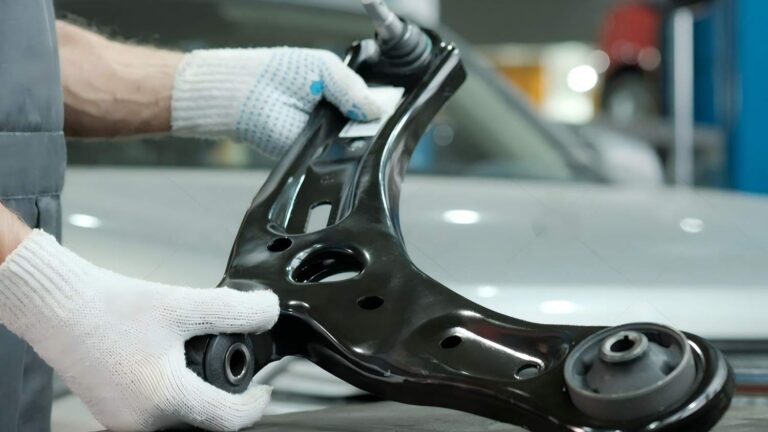
What Is a Rear Control Arm and What Do Rear Control Arms Do?
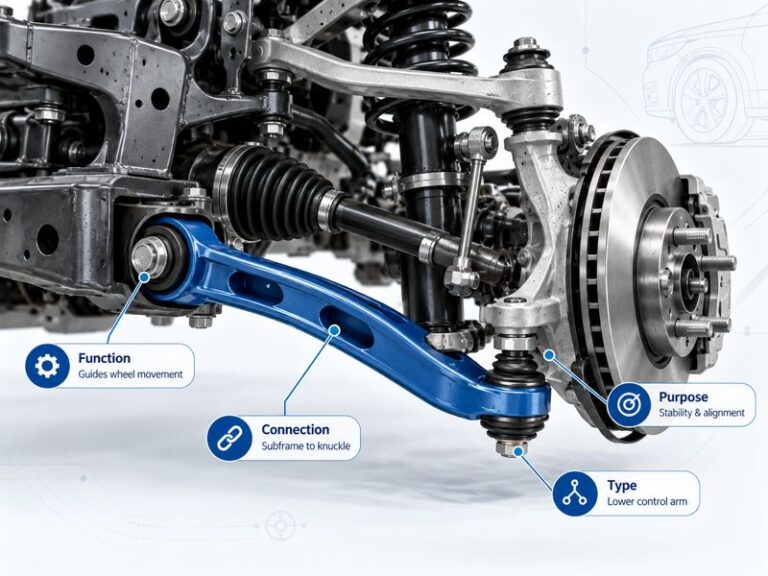
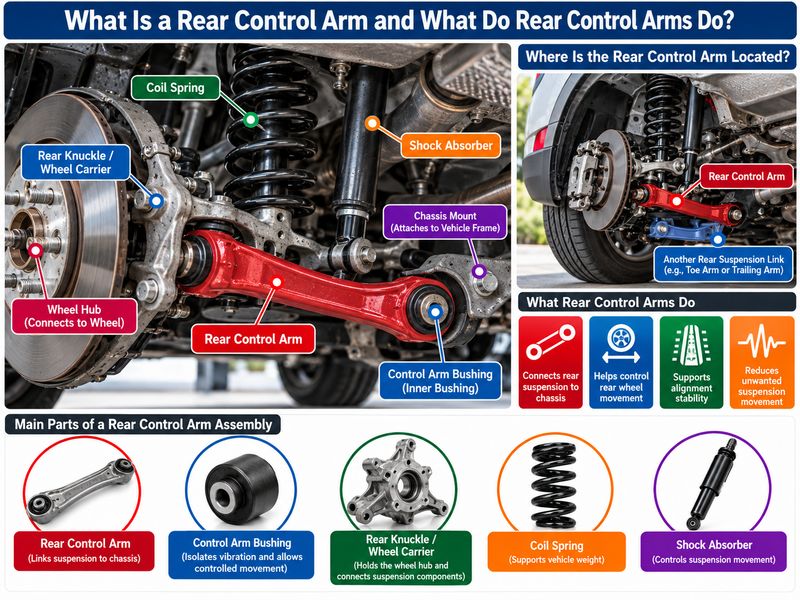
A rear control arm is a suspension link that connects part of the rear wheel assembly, knuckle, axle, or hub carrier to the vehicle’s body, chassis, or subframe.
Its job is to hold the rear wheel in the correct position while still allowing the suspension to move as the vehicle travels over bumps and uneven roads.
So, what do rear control arms do in everyday driving? They control rear-wheel movement, help maintain alignment, resist braking and cornering forces, and keep the tires positioned correctly relative to the road.
Rear control arms can look very different from one vehicle to another. Some are large wishbone-shaped components, while others are narrow links in a multi-link rear suspension. A vehicle may have one major rear control arm on each side or several upper, lower, lateral, trailing, toe, and camber links working together.
The metal arm itself is usually strong, but the control arm bushings, ball joints, mounting points, and related suspension joints can deteriorate with age or damage. When that happens, symptoms may include clunking, rear-end instability, uneven tire wear, poor alignment, or a feeling that the rear of the vehicle is shifting during turns.
Understanding how rear control arms work makes these problems much easier to diagnose. This guide covers their purpose, construction, different designs, common failure symptoms, inspection, replacement, alignment, safety, and other practical details.
What Is a Rear Control Arm and What Do Rear Control Arms Do?
A rear control arm is a structural suspension component that connects the rear wheel or axle assembly to the vehicle while controlling the direction in which that assembly is allowed to move.
The easiest way to understand it is to imagine the rear wheel trying to move in several directions at once.
When the vehicle hits a bump, the wheel needs to move upward.
During braking, forces try to move the wheel forward or backward relative to the body.
During cornering, sideways forces act on the tire.
During acceleration, additional forces can pass through the suspension, especially on driven rear wheels.
The rear control arm helps keep all of these movements controlled.
So, what do rear control arms do? They allow the suspension to move where it is supposed to move while limiting movement in directions that would negatively affect alignment, stability, or handling.
Depending on the suspension design, a rear control arm may help control:
- Camber
- Toe
- Wheelbase position
- Side-to-side wheel movement
- Forward and backward wheel movement
- Suspension travel
- Rear-wheel stability under braking
- Rear-wheel position during cornering
One control arm does not necessarily perform every one of these functions.
Modern multi-link suspensions often divide the work among several separate links.
This is why identifying the exact suspension design is important before diagnosing or ordering a rear control arm.
Where Is the Rear Control Arm Located?
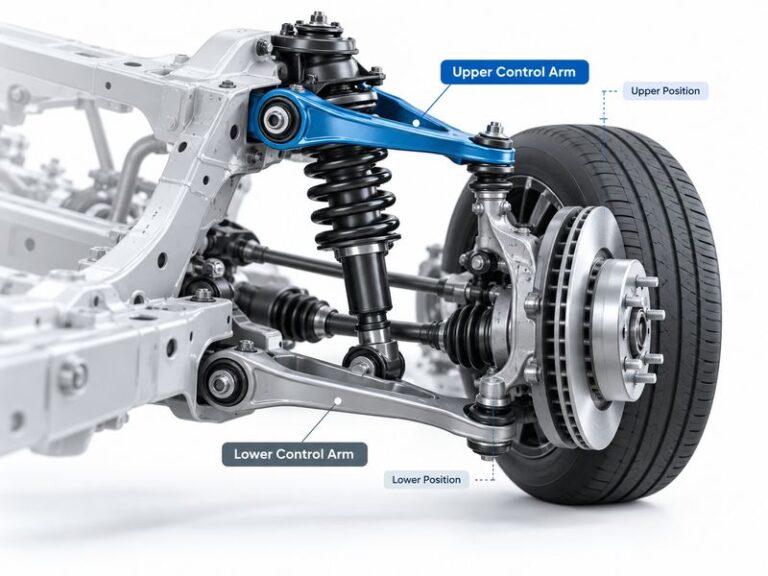
Rear control arms are located around the rear suspension between the vehicle body or rear subframe and the rear wheel assembly.
If the vehicle has an independent rear suspension, you may see several arms extending from the subframe toward the rear knuckle or wheel carrier.
Some sit above the hub.
Others run underneath it.
Some extend mostly sideways across the vehicle, while others run forward from the wheel toward the chassis.
The position often gives a clue about the arm’s function.
A link running primarily from front to rear may help control longitudinal wheel movement.
A lateral arm can help control side-to-side position.
A toe link influences rear-wheel toe.
A camber link helps establish the wheel’s inward or outward tilt.
On vehicles with a solid rear axle, the layout is different.
Control arms may connect the axle housing itself to the chassis instead of connecting directly to individual wheel knuckles.
This arrangement allows the axle to move vertically while controlling its forward, backward, and rotational movement.
Because these designs vary so much, there is no single universal rear control arm position that applies to every car, truck, or SUV.
How Does a Rear Control Arm Work?
A rear control arm works by creating a controlled pivot between the vehicle and the wheel or axle.
At one end, the arm is attached to the body, frame, or rear subframe.
At the other end, it may connect to:
- A rear steering knuckle
- Wheel carrier
- Hub carrier
- Rear axle
- Another suspension component
The connection usually includes rubber bushings, spherical joints, or ball-joint-type connections that allow movement without letting the suspension become uncontrolled.
When the wheel travels upward over a bump, the control arm pivots.
When the wheel moves downward again, the arm returns through its designed arc.
The important point is that the arm does not merely hold the wheel.
It determines part of the wheel’s movement path.
The length, angle, position, and pivot points of each control arm are carefully chosen to control suspension geometry throughout the wheel’s travel.
This is particularly important on independent rear suspensions because each rear wheel can move independently.
A small amount of unwanted movement caused by a damaged bushing can therefore change rear alignment while the vehicle is moving.
Main Parts of a Rear Control Arm
A rear control arm assembly may contain several components.
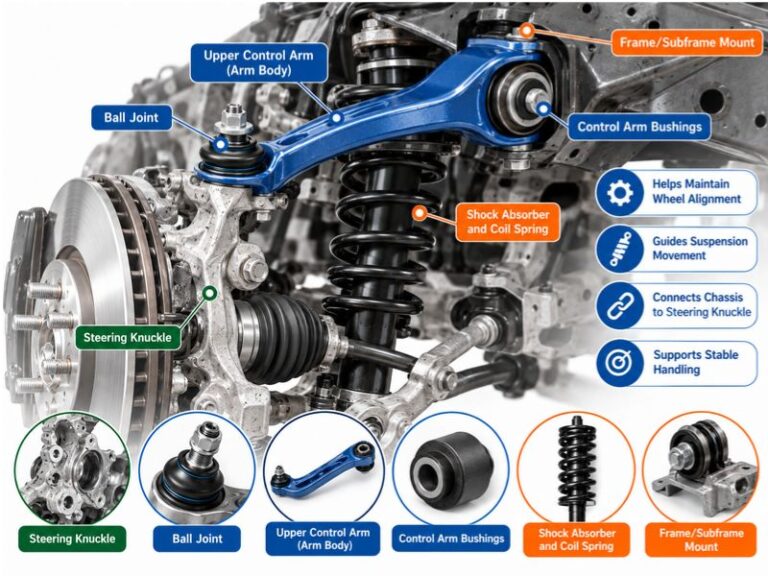
Control Arm Body
The arm itself is the structural portion.
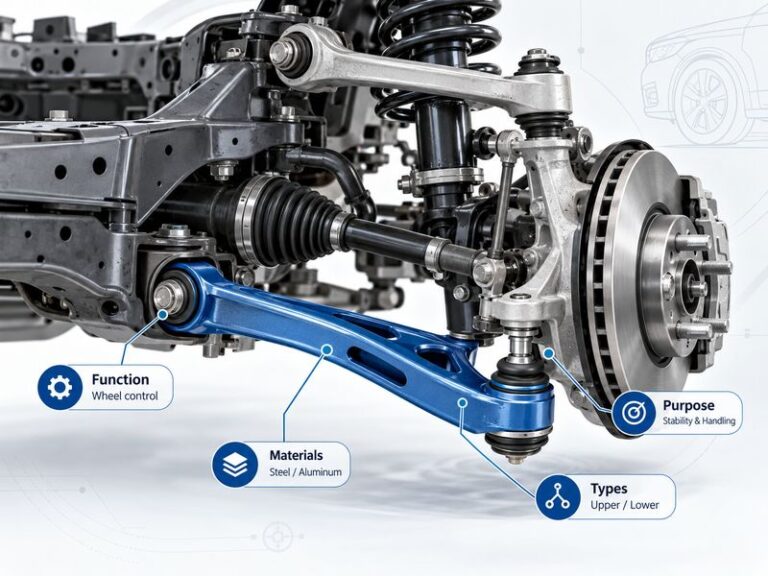
Depending on the vehicle, it may be made from:
- Stamped steel
- Forged steel
- Cast material
- Aluminum
- Another engineered metal structure
The shape depends on available space, suspension geometry, and the forces it must handle.
Some arms resemble a wishbone.
Others are almost straight.
Control Arm Bushings
Bushings are commonly fitted at one or both mounting points.
They isolate vibration while allowing limited suspension movement.
Most standard bushings use rubber or a similar flexible material.
Some vehicles use hydraulic bushings containing fluid for additional vibration control.
Bushings are among the most common rear control arm wear points.
Ball Joints and Spherical Joints
Some rear control arms connect through a ball joint or spherical joint.
These connections allow movement through multiple angles while preventing excessive play.
Not every rear control arm uses a traditional ball joint.
Mounting Bolts
Large bolts secure the arm to the subframe, body, knuckle, or axle.
Some mounting bolts also incorporate alignment adjusters.
On those vehicles, moving an eccentric bolt can change camber or toe.
Because of this, disturbing a rear control arm can directly affect wheel alignment.
Different Types of Rear Control Arms
The term “rear control arm” can refer to several different suspension links.
Understanding the differences helps avoid confusion.
Rear Upper Control Arm
A rear upper control arm attaches higher on the suspension assembly.
It may help control camber, axle rotation, wheel position, or other geometry depending on the design.
Independent suspensions may use one or more upper links.
Solid-axle suspensions may also use upper arms to control axle rotation.
Rear Lower Control Arm
A rear lower control arm attaches lower on the suspension.
Some designs use a large lower arm that supports significant loads and may provide mounting points for a spring, shock, or sway bar link.
Others use narrow lower links.
Trailing Arm
A trailing arm generally extends forward from the rear wheel area toward the body.
Its main function is often controlling forward and backward wheel movement.
Some parts catalogs and mechanics may loosely describe trailing arms as rear control arms because both locate the rear suspension.
Lateral Control Arm
A lateral arm runs primarily across the vehicle and helps maintain side-to-side wheel position.
It may also influence camber or toe depending on its mounting points.
Toe Link
The toe link helps establish the direction the rear wheel points relative to the vehicle’s centerline.
A worn toe-link bushing or joint can create unstable handling and rapid tire wear.
Camber Arm
A camber arm primarily helps control or adjust rear-wheel camber.
Some aftermarket replacement arms are adjustable, although factory designs may be fixed or use eccentric alignment hardware.
Multi-Link Arms
A multi-link suspension uses several smaller arms instead of relying on one large wishbone.
Each link is positioned to control a particular combination of forces and wheel movement.
These links may all be described generally as rear control arms even though manufacturers give them more specific names.
Rear Control Arm vs Trailing Arm
Rear control arms and trailing arms are related suspension components, but the terms are not always interchangeable.
A control arm broadly describes a suspension member that helps locate the wheel or axle.
A trailing arm is more specific.
It usually runs longitudinally, meaning roughly from front to rear, and controls the wheel’s forward and backward position while allowing vertical suspension travel.
Some suspension systems use a large trailing arm combined with lateral links.
Others use multiple control arms without a conventional trailing arm.
Parts catalogs can make the terminology confusing because one manufacturer may call a component a trailing arm while another supplier lists a similar component as a control arm.
The safest approach is to identify the component by its actual mounting points and vehicle-specific diagram.
Rear Control Arms in Independent Rear Suspension
Independent rear suspension allows the left and right rear wheels to move more independently of one another.
Because the wheel carrier must be controlled in multiple directions, these systems often use several suspension links.
A typical multi-link rear suspension may include separate links controlling:
- Camber
- Toe
- Longitudinal movement
- Lateral movement
The advantage is that engineers can fine-tune how the wheel behaves as the suspension moves.
For example, the geometry can be designed to control camber changes during cornering or maintain stable toe characteristics under braking.
The disadvantage from a maintenance standpoint is that there are more bushings and joints that can eventually wear.
One worn link can affect the entire suspension geometry.
That is why rear suspension diagnosis should consider all connected arms rather than looking at one component in isolation.
Rear Control Arms on Solid-Axle Vehicles
A solid rear axle connects both rear wheels through a single axle housing.
Control arms in these vehicles attach the axle housing to the vehicle’s frame or body.
A common arrangement uses multiple arms to control axle movement.
Lower arms may resist acceleration and braking forces.
Upper arms may help control axle rotation.
Another component, such as a Panhard rod or Watts linkage, may control side-to-side axle position.
When bushings in these arms deteriorate, the entire rear axle can shift more than intended.
The driver may notice clunks, rear steering sensations, instability, or changes in handling as throttle or braking forces load and unload the suspension.
Although the basic purpose is similar to independent-suspension control arms, the way the forces travel through the suspension is different.
Why Rear Control Arm Bushings Matter
The rear control arm’s metal body cannot simply be bolted rigidly to both ends because the suspension needs to move.
Bushings create controlled flexibility.
They allow the arm to pivot while reducing noise and vibration transferred into the vehicle.
At the same time, a good bushing resists unwanted movement.
As the rubber ages, it can:
- Crack
- Tear
- Separate from its sleeve
- Become too soft
- Harden
- Shift within the housing
Hydraulic bushings may also leak.
Once excessive movement develops, the control arm no longer holds the wheel as precisely as intended.
The wheel may move slightly under braking, acceleration, or cornering.
Even a small change can influence alignment and handling.
This is why worn rear control arm bushings can create noticeable driving symptoms without the metal arm itself being damaged.
What Causes Rear Control Arms to Go Bad?
The control arm body and its attached components can deteriorate for several reasons.
Normal Bushing Wear
Rubber bushings repeatedly flex as the suspension moves.
Over time, heat, age, road contamination, and environmental exposure can break down the material.
Ball Joint or Joint Wear
Where a rear arm uses a ball joint or spherical joint, repeated suspension movement can eventually create looseness.
A damaged protective boot can accelerate wear by allowing moisture and debris inside.
Pothole and Curb Impacts
A strong impact can bend a control arm or damage its mounting points.
Rear-wheel impacts are sometimes overlooked because drivers tend to focus on the front suspension after hitting a pothole.
Collision Damage
A side or rear collision involving the wheel area can change control arm geometry.
Even a slightly bent arm can cause persistent alignment problems.
Corrosion
Vehicles exposed to road salt, moisture, or harsh environments can develop severe corrosion.
Surface rust is not necessarily structural damage, but heavy corrosion around the arm or its mounting areas deserves careful inspection.
Incorrect Installation
Improper fastener torque, incorrect bushing orientation, or tightening rubber-bushed arms at the wrong suspension position can shorten component life.
Symptoms of a Bad Rear Control Arm
A rear control arm problem can produce symptoms ranging from minor noises to noticeable handling changes.
Common signs include:
- Clunking or knocking from the rear suspension
- Rear-end wandering
- Unstable cornering
- Uneven rear tire wear
- Vehicle pulling or feeling unsettled
- Alignment that repeatedly goes out of specification
- Rear-wheel position appearing incorrect
- Vibration
- Squeaking or creaking
- Excessive movement in a control arm bushing
- Torn or separated rubber
- Bent suspension components
Some symptoms become more noticeable when braking or accelerating because those forces load the control arm bushings in different directions.
However, none of these symptoms confirms a bad rear control arm by itself.
Wheel bearings, shocks, springs, tires, sway bar links, subframe bushings, and other suspension parts can produce similar complaints.
Can Bad Rear Control Arms Cause Clunking?
Yes. Worn bushings, loose joints, or damaged mounting points can allow the control arm to move farther than intended and produce clunking.
The noise may occur:
- Over bumps
- Entering driveways
- During hard braking
- When accelerating
- When transitioning between forward and reverse
- During sharp turns
A torn bushing can allow the inner sleeve or arm to shift as suspension load changes.
A loose joint can create similar movement.
However, rear sway bar links, shock mounts, exhaust components, loose brake hardware, and other suspension parts can also clunk.
A physical inspection is necessary before replacing the arm.
Can Bad Rear Control Arms Affect Alignment?
Yes. Rear control arms can have a significant effect on rear-wheel alignment.
Their mounting points help establish the position of the wheel relative to the vehicle.
Depending on the suspension design, the arms may influence:
- Rear camber
- Rear toe
- Wheelbase
- Thrust angle
A bent arm can permanently change geometry.
A worn bushing can create a more difficult problem because alignment may shift while the vehicle is moving.
The wheel might sit correctly during a static alignment but move when braking or cornering forces load the worn bushing.
This can produce unstable handling even if initial alignment numbers appear close to specification.
Mechanical looseness should therefore be corrected before attempting a final alignment.
Can a Bad Rear Control Arm Cause Uneven Tire Wear?
Yes.
If a damaged arm or worn bushing changes rear camber or toe, the tire may no longer contact the road correctly.
Excessive negative or positive camber can contribute to edge wear.
Incorrect toe can create rapid scrubbing across the tread.
A worn control arm may also allow alignment angles to change dynamically while driving.
However, tire wear alone does not prove the rear control arm is bad.
Other possible causes include:
- Incorrect tire pressure
- Worn wheel bearings
- Broken or sagging springs
- Incorrect alignment adjustment
- Bent knuckles
- Damaged subframes
- Worn toe links
- Tire defects
Suspension inspection and alignment measurements should be used together.
Can Rear Control Arms Affect Handling?
Absolutely.
Rear-wheel position has a major influence on vehicle stability.
If a control arm bushing allows excessive movement, the rear wheels may change direction slightly as forces act on them.
The driver can experience a sensation sometimes described as the rear of the vehicle steering itself.
The vehicle may feel stable while cruising but move unexpectedly during:
- Lane changes
- Hard braking
- Acceleration
- Cornering
- Driving over bumps
Because these symptoms can affect vehicle control, significant rear instability should be investigated promptly.
Can a Rear Control Arm Affect Braking?
A worn rear control arm can influence how the vehicle behaves during braking.
As braking force acts on the wheel, suspension links resist forward and backward movement.
If a bushing is badly worn, the rear wheel may shift slightly under braking.
This movement can affect wheel alignment and make the rear of the vehicle feel unsettled.
It may also contribute to clunking when the direction of force changes.
However, braking instability can have many other causes, including:
- Brake problems
- Tire differences
- Wheel alignment
- Loose wheel bearings
- Suspension damage
Control arms should therefore be inspected as part of the overall diagnosis rather than automatically blamed.
Can a Rear Control Arm Bend?
Yes.
Although control arms are engineered to handle substantial normal loads, a severe impact can bend one.
Common causes include:
- Hitting a curb
- Large potholes
- Collisions
- Off-road impacts
- Road debris
- Accident damage around the wheel
A bent rear control arm may not always look obviously damaged.
A small geometry change can be enough to make camber or toe impossible to adjust correctly.
One wheel may also sit differently in the wheel opening compared with the opposite side.
Structurally bent suspension arms are generally replaced rather than heated or bent back into shape unless an approved manufacturer procedure specifically allows another repair.
How to Inspect Rear Control Arms
A rear control arm inspection should combine visual checks with movement checks.
1. Inspect the Tires
Look for unusual rear tire wear.
Differences between the left and right tires can provide clues about alignment or suspension problems.
2. Compare Wheel Position
Stand to the side or behind the vehicle and compare how each rear wheel sits.
A visibly different angle may indicate alignment or suspension damage.
3. Inspect the Arm
Look for:
- Bending
- Cracks
- Impact marks
- Heavy corrosion
- Damaged mounting points
4. Check the Bushings
Look for severe cracking, tearing, separation, leaking hydraulic bushings, or rubber pulling away from the inner sleeve.
5. Check Joints
If the arm uses a ball joint or spherical joint, inspect its protective boot and check for excessive play using the manufacturer-approved procedure.
6. Check for Movement
A technician may use a suitable pry tool to apply controlled force while watching the bushing.
Some movement is normal because rubber bushings are designed to flex.
The goal is to identify excessive or separated movement, not eliminate all movement.
7. Check Alignment
Rear camber, toe, and thrust-angle measurements can provide valuable clues.
Alignment readings should be interpreted together with the physical inspection.
When Should Rear Control Arms Be Replaced?
A rear control arm should generally be replaced when the arm itself or a non-serviceable component attached to it can no longer perform its intended function.
Reasons may include:
- A bent arm
- Structural cracking
- Severe corrosion
- Major impact damage
- Failed integrated ball joint
- Failed non-replaceable bushing
- Excessive suspension movement
Some vehicles allow individual bushings or joints to be serviced separately.
In those cases, replacing the entire arm may not always be necessary.
However, a complete control arm can sometimes be the more practical repair because it may already include new bushings and joints.
The decision should be based on the suspension design, parts availability, labor requirements, and condition of the complete assembly.
Should Rear Control Arms Be Replaced in Pairs?
Rear control arms do not always have to be replaced in pairs.
If one arm was damaged by an isolated impact and the opposite side remains in excellent condition, replacing only the damaged component may be appropriate.
Pair replacement can make sense when both sides have:
- Similar age
- Similar mileage
- Similar bushing deterioration
- Comparable joint wear
Replacing both may also reduce the likelihood of performing nearly identical repair work again soon.
However, suspension parts should be replaced because they are worn or damaged, not solely because the corresponding component on the other side failed.
Inspect both sides and follow applicable manufacturer recommendations.
Do Rear Control Arms Come With Bushings?
Many complete rear control arm assemblies include new bushings, but not all do.
Parts may be sold as:
- Bare control arms
- Arms with one or more bushings installed
- Complete arms with bushings and joints
The exact configuration varies by manufacturer and suspension type.
This is particularly important with multi-link suspensions because some replacement links may include permanently installed joints while others require separate components.
Always confirm what is included before ordering.
Can Rear Control Arm Bushings Be Replaced Separately?
Sometimes.
Replaceable bushings can often be pressed out of the original arm and new ones installed.
However, this can require:
- A hydraulic press
- Special adapters
- Correct bushing orientation
- Proper support of the arm
- Vehicle-specific installation procedures
Some bushings are difficult to service without damaging the arm.
In other cases, the price and labor involved make replacing the complete arm more practical.
If the arm is undamaged and a high-quality replacement bushing is available, bushing-only replacement can still be a reasonable option.
Do You Need an Alignment After Replacing a Rear Control Arm?
An alignment check is strongly advisable after replacing a rear control arm that affects wheel position.
Many rear control arms directly influence camber or toe.
Others may not provide an adjustment themselves but still determine the wheel’s physical position.
Even small differences between the old and new components can affect alignment.
An alignment is especially important if:
- The old arm was bent
- Alignment hardware was removed
- Eccentric bolts were disturbed
- Bushings had excessive movement
- Tire wear was already present
- The vehicle was involved in an impact
If alignment remains outside specification after installing the new control arm, another suspension component, knuckle, subframe, or mounting point may also be damaged.
How Is a Rear Control Arm Replaced?
The exact procedure depends heavily on the suspension design.
A basic replacement may involve:
- Safely raising and supporting the vehicle.
- Removing the rear wheel.
- Supporting the suspension where required.
- Marking alignment adjuster positions if applicable.
- Removing the inner and outer control arm fasteners.
- Removing the old arm.
- Installing the replacement arm.
- Positioning the suspension correctly before final tightening when required.
- Tightening fasteners to manufacturer specifications.
- Checking wheel alignment.
The simple outline can hide significant complexity.
Some rear arms sit next to coil springs, fuel tanks, exhaust systems, driveshafts, brake hoses, parking-brake cables, or other components.
Certain bolts may only come out after nearby parts are moved.
On conventional rubber-bushed arms, final tightening may need to occur with the suspension positioned near normal ride height.
Tightening some bushings while the wheel hangs fully downward can preload the rubber when the vehicle is lowered.
Always use vehicle-specific service information.
Rear Control Arm Replacement Safety
Rear suspension work can involve heavy components and stored spring energy.
Never work underneath a vehicle supported only by a jack.
Use correctly rated jack stands and manufacturer-approved support points.
If a rear control arm supports or helps locate a coil spring, removing the arm without controlling the spring can be dangerous.
Some independent rear suspensions place the spring directly between the body and lower control arm.
The arm may therefore be carrying spring force even when its purpose appears simple.
Do not remove suspension bolts until you understand how the spring is retained.
Also avoid damaging:
- Brake hoses
- ABS wiring
- Parking brake cables
- Driveshafts
- CV joints
Suspension fasteners should be tightened with the correct torque values and replacement hardware used when specified by the manufacturer.
How Long Do Rear Control Arms Last?
There is no universal replacement interval.
A rear control arm may remain serviceable for a very long time if:
- The vehicle travels mainly on smooth roads
- Bushings remain healthy
- Corrosion is limited
- The suspension has not suffered major impacts
Other vehicles may develop bushing or joint problems sooner because of:
- Rough roads
- Potholes
- Road salt
- Heavy loads
- Performance driving
- Off-road use
- Suspension modifications
The metal arm itself often survives longer than the rubber bushings or movable joints.
For that reason, rear control arms should usually be replaced based on actual condition rather than mileage alone.
Can You Drive With a Bad Rear Control Arm?
It depends on the severity of the problem, but significant rear control arm damage should not be ignored.
Minor aging of a bushing is different from:
- A completely separated bushing
- A loose joint
- A cracked arm
- A badly bent arm
- A wheel with visible unwanted movement
Serious failure can change rear-wheel alignment while driving and reduce vehicle stability.
If the rear of the vehicle suddenly feels unstable, a wheel appears out of position, or there is severe suspension looseness, continued driving may be unsafe.
A professional inspection—and towing when necessary—is safer than continuing to operate a vehicle with a potentially critical suspension problem.
Common Rear Control Arm Replacement Mistakes
One mistake is replacing a control arm based only on noise.
Rear suspensions contain many components that can clunk, including shocks, sway bar links, subframe bushings, and brake hardware.
Another mistake is replacing one arm without inspecting the other links in a multi-link suspension.
Several worn bushings may contribute to the same handling problem.
Incorrectly tightening rubber-bushed suspension arms is another issue.
If manufacturer procedures require final tightening near normal ride height, ignoring that step can place unnecessary twist in the bushing.
Other mistakes include:
- Reusing one-time-use fasteners
- Losing alignment-adjuster positions
- Installing an arm backward
- Using incorrect torque
- Skipping the alignment afterward
- Ignoring a bent knuckle or subframe
A successful repair requires diagnosing the complete suspension, not simply installing a new part.
FAQs About Rear Control Arms
Are rear control arms important?
Yes, rear control arms are important because they help maintain the rear wheel or axle in its correct position. They control suspension movement and contribute to alignment, handling, and vehicle stability.
A seriously worn or damaged arm can affect how the vehicle behaves on the road.
Does every car have rear control arms?
Not every vehicle uses the same type of component called a rear control arm. Some use trailing arms, multi-link suspension links, torsion beams, or solid-axle locating arms.
The exact design depends on the vehicle’s rear suspension system.
Can bad rear control arms cause clunking?
Yes, worn bushings, loose joints, or damaged mounts can cause clunking from the rear suspension. The sound may appear over bumps or when braking and accelerating.
Other rear suspension parts can create similar noises, so diagnosis is important.
Can rear control arms cause uneven tire wear?
Yes, if the control arm changes rear-wheel camber or toe, abnormal tire wear can result. Worn bushings can also allow alignment to shift while driving.
Tire wear should be evaluated together with suspension and alignment checks.
Do rear control arms affect alignment?
Yes, many rear control arms directly or indirectly control rear camber, toe, wheelbase position, or thrust angle. A bent arm or loose bushing can therefore create alignment problems.
Some rear arms also contain the actual alignment adjustment hardware.
Should rear control arms be replaced in pairs?
Not automatically. One arm can be replaced if only that component is damaged or worn. Pair replacement may be practical when both sides have similar deterioration.
Both sides should be inspected before deciding.
Can I replace only the rear control arm bushings?
Sometimes, if the suspension design allows the bushings to be serviced separately. Special tools or a press may be required.
If the arm or other joints are also worn, replacing the complete assembly may be more practical.
Do I need an alignment after replacing a rear control arm?
An alignment check is generally recommended because rear control arms influence wheel position. This is especially important when camber or toe adjustment hardware has been disturbed.
Correct alignment also helps protect the new tires and suspension parts.
Can a bad rear control arm make the car feel unstable?
Yes, excessive movement in a rear control arm can allow the rear wheel to shift under cornering, braking, or acceleration. This can make the rear of the vehicle feel loose or unpredictable.
Significant instability should be inspected promptly.
Is a rear control arm the same as a trailing arm?
Not always. A trailing arm is a specific type of suspension link, while rear control arm is a broader term. Some catalogs may use the terms interchangeably for certain vehicles.
Vehicle-specific suspension diagrams are the best way to identify the exact component.
Conclusion
Understanding what is a rear control arm starts with recognizing that it is one of the components responsible for locating the rear wheel or axle while still allowing the suspension to move.
So, what do rear control arms do? They guide rear suspension movement, resist forces created by braking and cornering, help maintain wheel alignment, and keep the tires positioned correctly relative to the vehicle and road.
The exact design varies widely.
A vehicle may use a large upper or lower control arm, a trailing arm, several multi-link suspension arms, or control arms that locate a solid rear axle. Each component has a specific job within the complete suspension geometry.
Many rear control arm problems actually begin with worn bushings or joints rather than damage to the metal arm. Clunking, uneven tire wear, alignment changes, rear-end wandering, or unstable handling can all indicate a problem, but these symptoms should be diagnosed carefully because other rear suspension components can produce similar behavior.
When damage or excessive wear is confirmed, proper replacement matters. The suspension must be safely supported, bushings and alignment hardware installed correctly, fasteners tightened according to vehicle specifications, and the rear alignment checked afterward when appropriate.
A healthy rear control arm may not be something a driver notices during normal driving—and that is exactly the point. When the rear suspension links are doing their job correctly, the wheels remain controlled, alignment stays predictable, and the vehicle feels stable through bumps, braking, acceleration, and corners.