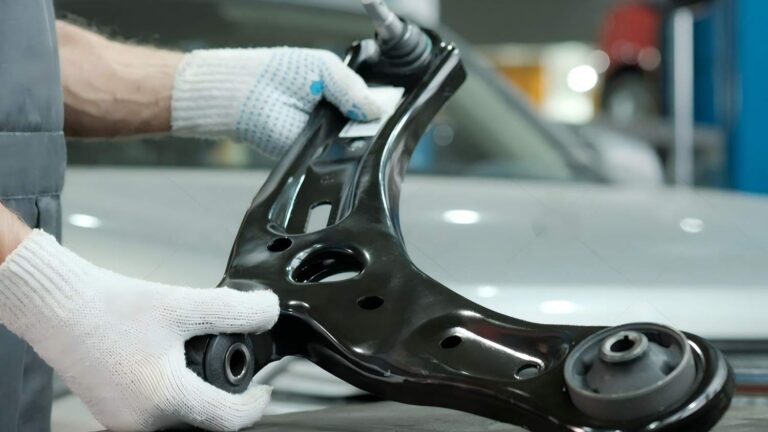
What Is a Lower Control Arm and What Does a Lower Control Arm Do?
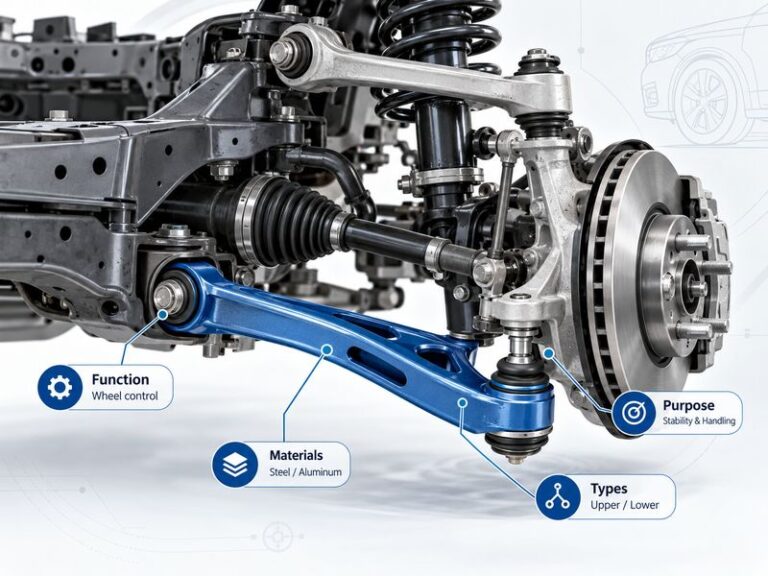
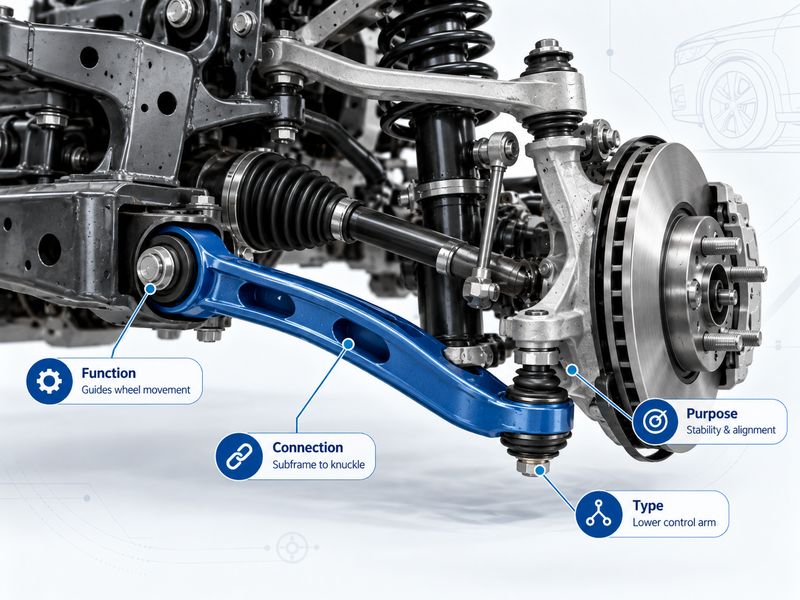
If you are wondering what is a lower control arm, it is a suspension component that connects the wheel-side suspension assembly to the vehicle’s frame or subframe while allowing the wheel to move up and down. And what does a lower control arm do? It helps control wheel movement, maintain proper suspension geometry, support stable steering, and keep the tire positioned correctly as the vehicle travels over bumps, corners, accelerates, and brakes.
The lower control arm may look like a simple metal arm, but it works with several important suspension parts, including control arm bushings, ball joints, steering knuckles, struts or shocks, springs, and the subframe. A problem with the arm itself—or with the bushings or ball joint attached to it—can lead to clunking noises, steering instability, unusual tire wear, alignment problems, or excessive wheel movement.
Lower control arm design varies considerably between vehicles. Some cars use one lower arm and a MacPherson strut, others use upper and lower control arms, and some modern multi-link suspension systems use several individual links instead of a traditional single wishbone-style arm.
Understanding how the lower control arm works makes it easier to recognize suspension problems, diagnose worn components, and decide when inspection or replacement is necessary. This guide covers the lower control arm from basic construction and operation to common symptoms, testing, replacement, alignment, and related suspension questions.
What Is a Lower Control Arm?
A lower control arm is a structural suspension link positioned between the vehicle body or subframe and the wheel assembly. Its primary job is to hold the wheel in a controlled position while allowing the suspension to move vertically.
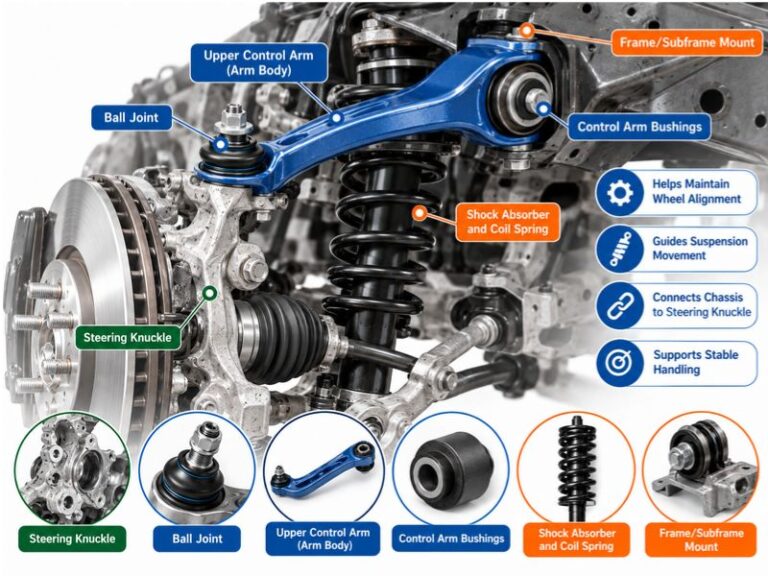
Depending on the suspension design, the control arm may be shaped like an A, a wishbone, an L, or a relatively straight arm. The inner portion usually attaches to the frame or subframe through rubber, hydraulic, or other types of control arm bushings. The outer portion commonly connects to the steering knuckle through a ball joint.
This combination allows the suspension to move without letting the wheel move freely in unwanted directions.
When the tire encounters a bump, the wheel moves upward relative to the body. The lower control arm pivots at its inner mounting points, while the ball joint allows the steering knuckle to change position and, on steering wheels, turn left and right.
The lower control arm is therefore both a structural component and a movement-control component.
It should not be confused with a tie rod. A tie rod is primarily part of the steering system and transfers steering movement to the steering knuckle. A control arm is primarily part of the suspension geometry.
What Does a Lower Control Arm Do?
The simplest answer to what does a lower control arm do is that it controls the position and movement of the wheel relative to the vehicle body.
Without properly located suspension links, the wheel would not remain at the intended angle or position as suspension loads changed.
The lower control arm performs several functions at the same time.
It allows controlled suspension travel as the wheel moves over bumps and dips. It also helps resist forces generated during braking, acceleration, and cornering. At the same time, it helps maintain suspension geometry so the tire stays properly positioned against the road.
On many vehicles, the lower control arm also provides the mounting location for the lower ball joint.
The arm itself generally does not absorb road impacts in the same way a shock absorber or strut does. Instead, it guides suspension movement. The spring supports vehicle weight, while the shock or strut controls oscillation. The control arm establishes the path in which the wheel assembly is allowed to move.
This is why a bent arm or worn control arm bushing can affect steering and alignment even when the shock absorber is still working properly.
How a Lower Control Arm Works

A lower control arm essentially works as a pivoting link.
The inner end is attached to the vehicle through one or more bushings. These mounting points allow a limited amount of rotation while isolating road vibration from the passenger compartment.
At the wheel end, a ball joint often connects the arm to the steering knuckle.
As the wheel moves upward, the control arm rotates around its inner mounting points. As the wheel moves downward, the arm moves in the opposite direction.
The exact path is determined by suspension geometry.
A control arm bushing must be flexible enough to allow suspension movement yet firm enough to prevent excessive forward, backward, or sideways movement.
A ball joint performs a different function. Its spherical design permits angular movement between the control arm and steering knuckle. On the front suspension, this movement may occur while the wheel is also steering.
Together, these components provide controlled movement without rigidly fixing the wheel to the body.
Main Parts Associated With a Lower Control Arm
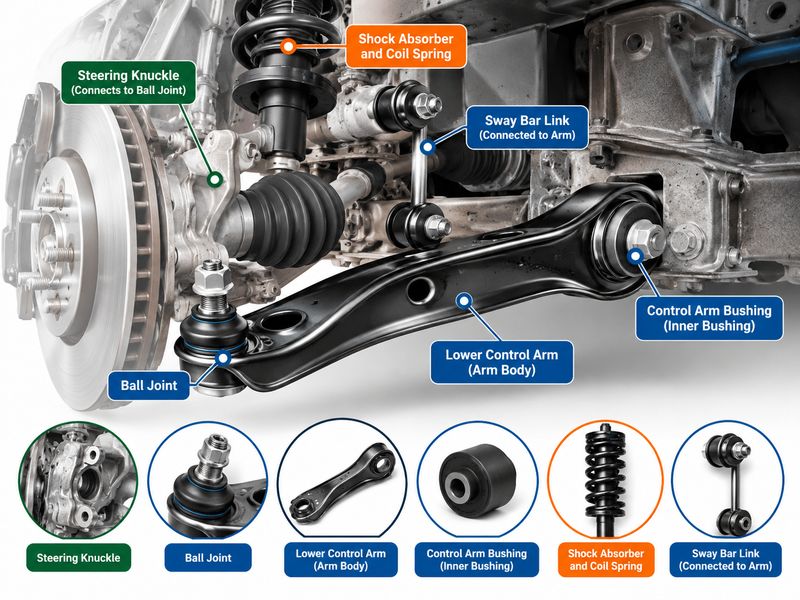
Although people often refer to the complete assembly simply as a control arm, several components may be involved.
Control Arm Body
The main control arm is normally manufactured from stamped steel, forged steel, cast material, or aluminum depending on vehicle design.
Its shape and strength are engineered around the loads produced by that particular suspension.
A control arm should not normally be modified, drilled, heated, bent back into shape, or welded unless a manufacturer-approved repair procedure specifically allows it.
Control Arm Bushings
Bushings sit between the control arm and its mounting points on the body or subframe.
They isolate vibration while allowing limited movement.
As bushings deteriorate, they may crack, separate, soften, or develop excessive movement. Hydraulic bushings can also leak fluid when damaged.
A worn bushing can allow the wheel to shift slightly under braking or acceleration even if the metal arm itself is undamaged.
Ball Joint
The ball joint creates a movable connection between the control arm and steering knuckle.
Some ball joints are permanently integrated into the control arm. Others are bolted, pressed, or otherwise serviceable separately.
A severely worn ball joint is particularly important because excessive joint movement can compromise wheel control.
Mounting Bolts and Brackets
The inner control arm is secured to the frame or subframe using bolts and mounting brackets.
The exact fastener arrangement varies widely.
Correct tightening procedures matter, particularly when conventional rubber bushings are used. On some designs, final bushing fastener tightening must be performed with the suspension positioned near normal ride height to avoid twisting the rubber bushing at rest.
Always follow the vehicle-specific service procedure.
What Does the Lower Control Arm Connect To?

What does the lower control arm connect to? In a common suspension design, its inner end connects to the vehicle’s frame or subframe, while its outer end connects to the steering knuckle or wheel carrier, usually through a ball joint.
The exact layout depends on the suspension system. Some lower arms have two widely spaced inner mounting points, creating a triangular wishbone shape. Other vehicles use a narrower arm combined with additional suspension links to control wheel position.
The lower control arm may also provide attachment points for components such as the sway bar link or other hardware, depending on the vehicle.
Because suspension layouts differ substantially, the control arm on one vehicle may not connect or operate exactly like the arm on another. A service manual or manufacturer suspension diagram is the best reference when identifying individual mounting points on a specific model.
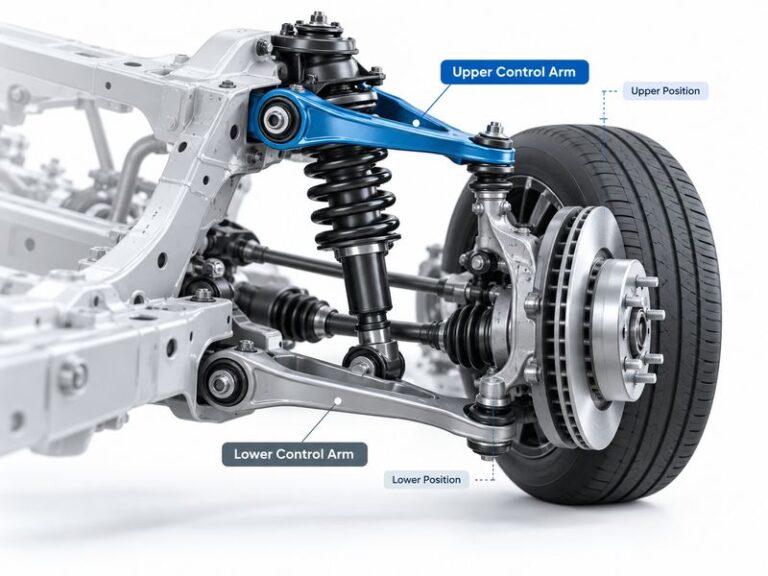
What Are Upper and Lower Control Arms?
What are upper and lower control arms? They are suspension links positioned above and below the wheel hub area in suspension systems designed to use both arms.
A typical double-wishbone arrangement uses an upper control arm and a lower control arm, with each connecting the chassis to the steering knuckle or wheel carrier. Together, they guide wheel movement and help control alignment geometry as the suspension travels.
The lower arm is usually mounted below the wheel center and may carry significant suspension loads, depending on where the spring or shock is mounted. The upper arm helps locate the upper part of the knuckle.
Not every vehicle uses this arrangement. MacPherson strut suspensions often use a lower control arm while the strut assembly performs part of the locating function that an upper control arm would perform in a double-wishbone suspension.
What Is the Difference Between Upper and Lower Control Arms?
What is the difference between upper and lower control arms? Their main difference is their position and the role each plays within the suspension geometry.
The lower control arm attaches near the bottom of the steering knuckle or wheel carrier, while the upper control arm, when equipped, connects higher on the assembly.
In many suspension designs, the lower arm is larger because it may deal with substantial suspension and braking loads. However, this is not a universal rule.
Upper and lower arms also influence wheel geometry differently. Their lengths, angles, pivot points, and movement are engineered to control changes in camber and wheel position throughout suspension travel.
Neither should automatically be considered more important. In a suspension that uses both, the two arms work together as part of the same geometry.
Do All Cars Have Upper and Lower Control Arms?
Do all cars have upper and lower control arms? No. Suspension design determines which arms and links are used.
A double-wishbone suspension commonly has a separate upper and lower control arm. A MacPherson strut front suspension typically uses a lower control arm but no conventional upper control arm because the strut helps locate the upper portion of the steering knuckle.
Multi-link suspension systems can be even more different. Instead of one recognizable upper or lower A-arm, they may use several individual links, each controlling movement in a particular direction.
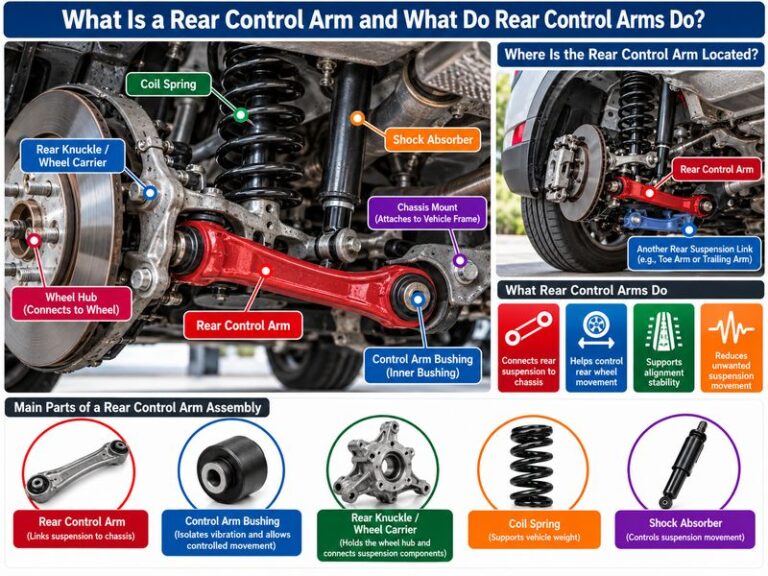
Rear suspension layouts also vary widely. A vehicle might have control arms at the front but trailing arms, lateral links, multi-links, or another arrangement at the rear.
For this reason, you should identify the suspension design of the specific year, make, model, and drivetrain before ordering control arm parts.
Do Lower Control Arms Come With Ball Joints?
Do lower control arms come with ball joints? Some do, while others do not. It depends on how the manufacturer designed the suspension and how the replacement part is supplied.
On some vehicles, the ball joint is built into the control arm assembly and the entire arm is replaced when the joint becomes worn. This is particularly common when the ball joint is considered a non-serviceable part of the arm.
Other vehicles use a ball joint that can be replaced separately. It might bolt to the arm, press into it, or use another manufacturer-specific mounting arrangement.
Aftermarket control arms may also be sold either complete or incomplete. One replacement arm may include bushings and a ball joint, while another may include only the arm and bushings.
Always check exactly what is included before purchasing replacement parts.
Common Types of Lower Control Arms
Lower control arms do not all look alike.
Traditional A-arms or wishbones have two inner attachment points that spread apart and one outer connection near the wheel. This triangular layout provides good control over wheel movement.
Some vehicles use an L-shaped or curved arm designed around the engine, transmission, exhaust, or subframe.
A MacPherson strut suspension may use a relatively simple lower control arm combined with the strut and sometimes another locating link.
Modern multi-link systems may divide the traditional functions of a control arm across multiple separate suspension links.
These differences are important when diagnosing suspension problems. What appears to be a lower control arm problem on one design could involve a tension strut, lateral link, thrust arm, or another suspension member on a different vehicle.
Why Lower Control Arm Bushings Matter
The bushings may be small compared with the arm itself, but they have a major influence on how the suspension feels.
Rubber bushings are designed to deform slightly during suspension movement. This flexibility helps isolate harsh vibration and noise.
However, the same rubber eventually ages.
When a bushing develops excessive movement, the control arm may shift more than intended during braking, acceleration, or cornering.
The result can feel like loose steering, delayed response, wandering, or a clunk as suspension load changes direction.
Some vehicles use hydraulic bushings filled with fluid to provide additional vibration isolation. Fluid around one of these bushings may indicate failure, although nearby fluid leaks should be ruled out before replacing the arm.
Minor surface cracking does not always mean immediate failure. What matters is whether the bushing has torn, separated, leaked, or developed excessive movement beyond the manufacturer’s acceptable condition.
Why the Lower Ball Joint Matters
A ball joint must move in several directions while still holding the wheel assembly securely.
Inside the joint, a ball-shaped stud rotates within a socket. A protective boot keeps lubricant in and contamination out.
If the boot tears, water and road debris can enter the joint, accelerating wear.
As wear progresses, clearance can develop between the ball and socket.
Some ball joints create noticeable clunks or steering looseness when worn. Others may show little obvious noise before significant deterioration occurs.
The correct inspection method varies because some suspension designs place the ball joint under load while others unload it when the vehicle is lifted.
For that reason, simply grabbing the wheel and checking for play is not a universal test for every vehicle.
Follow the manufacturer-specific ball joint inspection procedure whenever possible.
Symptoms of a Bad Lower Control Arm
A damaged lower control arm or worn components attached to it can create several symptoms, but none should automatically be treated as proof that the arm is faulty.
A vehicle with lower control arm problems may develop clunking or knocking noises, especially over bumps or when braking and accelerating.
Steering may feel less precise. The vehicle may wander or require frequent steering corrections.
A badly worn bushing can allow the wheel to change position slightly when braking. In more serious cases, this can contribute to pulling or unstable behavior.
Abnormal tire wear can also occur if control arm damage changes wheel alignment.
Other possible signs include vibration, an off-center steering wheel, suspension movement that feels loose, visible bushing damage, or a wheel that no longer appears correctly positioned in the wheel opening.
However, similar symptoms can come from tie rods, wheel bearings, struts, shocks, sway bar links, tires, alignment problems, or other suspension components.
Diagnosis matters more than symptoms alone.
Can a Bad Lower Control Arm Cause Clunking?
Yes. Clunking is one of the more common complaints associated with worn control arm bushings or ball joints.
The noise usually occurs because a component is moving farther than intended before contacting another surface or reaching the limit of its clearance.
You might hear the sound while driving over bumps, entering a driveway, braking, accelerating, or changing direction.
But a clunk does not automatically identify the lower control arm.
Sway bar links, strut mounts, loose brake components, engine mounts, tie rods, ball joints, and other suspension parts can make similar sounds.
The best approach is to reproduce the noise, inspect the suspension, and check each relevant joint rather than replacing the first component that appears suspicious.
Can a Bad Lower Control Arm Affect Steering?
Yes. The lower control arm helps maintain the wheel’s position, so excessive movement can influence steering feel.
A worn rear control arm bushing, for example, may allow the wheel to shift slightly as braking or acceleration loads change.
A damaged ball joint can also create looseness between the control arm and steering knuckle.
The driver may notice wandering, vague steering, inconsistent response, or a vehicle that does not feel as settled as it normally does.
Severe steering changes should be inspected promptly because several potentially serious suspension and steering faults can produce similar symptoms.
Can a Lower Control Arm Cause Uneven Tire Wear?
A worn or bent lower control arm can contribute to uneven tire wear if it changes wheel alignment or allows the alignment to move while driving.
The control arm geometry influences the position of the wheel. If the arm is bent, the mounting point shifts, or the bushings allow excessive movement, camber, caster, or toe behavior may be affected depending on the suspension design.
However, tire wear alone does not prove a control arm is faulty.
Incorrect tire pressure, worn tie rods, damaged springs, alignment settings, bent suspension parts, wheel bearing problems, and other conditions can produce similar wear.
The suspension should be inspected before performing an alignment if mechanical looseness is suspected.
Can a Lower Control Arm Bend?
Yes. A control arm can bend or otherwise suffer structural damage after a substantial impact.
Hitting a deep pothole, curb, road debris, or another object can transmit significant force through the wheel and suspension.
Collision damage can also bend a control arm or shift its mounting points.
A bent arm may cause the wheel to sit farther forward, backward, inward, or outward than intended. Alignment measurements may remain outside specification even after adjustment.
Aluminum components may show cracking or deformation differently from stamped-steel arms.
A structurally damaged arm should generally be replaced rather than manually straightened unless an approved manufacturer repair procedure states otherwise.
What Causes Lower Control Arms to Go Bad?
The metal arm itself can last a long time under normal conditions, but the components attached to it often wear first.
Age and repeated suspension movement gradually deteriorate rubber bushings. Heat, oil contamination, road salt, water, and environmental exposure can accelerate this process.
Ball joints wear through normal movement and loading. A torn protective boot can allow contamination inside and shorten joint life.
Impacts are another major cause of control arm damage.
A hard pothole or curb strike can bend the arm even when the damage is not immediately obvious.
Corrosion can also become important in regions where road salt is heavily used. Severe corrosion around mounting points or structural sections can reduce component strength.
Poor-quality replacement parts, incorrect installation, improperly tightened fasteners, or damaged mounting hardware can contribute to premature problems as well.
How to Inspect a Lower Control Arm
A basic lower control arm inspection can reveal obvious problems, but some checks require proper lifting equipment and knowledge of the vehicle’s suspension design.
- Park safely. Use a level surface, apply the parking brake, and follow safe lifting procedures if the vehicle must be raised. Never work underneath a vehicle supported only by a jack.
- Inspect the arm visually. Look for obvious bending, cracking, impact marks, heavy corrosion, or damage around mounting points.
- Check the bushings. Look for major tears, separation, displaced rubber, or leakage from hydraulic bushings.
- Inspect the ball joint boot. A torn, missing, or leaking boot can allow contamination into the joint.
- Check for excessive movement. Use the manufacturer-specified procedure because suspension loading can change how ball joint or bushing play should be measured.
- Compare wheel position. A wheel sitting noticeably farther forward or backward than the opposite side may indicate structural or suspension damage.
- Check alignment-related evidence. Uneven tire wear or unusual alignment readings can support the diagnosis, but they should not be used alone to condemn a control arm.
A professional suspension inspection is appropriate when the source of looseness cannot be clearly identified.
Lower Control Arm vs Ball Joint
The control arm and ball joint are related but separate components.
The control arm is the structural suspension member.
The ball joint is the movable joint connecting the arm to the steering knuckle or wheel carrier.
A vehicle can therefore have a perfectly straight control arm with a worn ball joint.
Likewise, the ball joint may still be good while a control arm bushing has failed or the arm itself has been bent.
On some vehicles, the ball joint can be replaced independently. On others, the complete control arm assembly must be replaced.
This is why a parts catalog may list both a lower control arm assembly and an individual ball joint for some vehicles but only a complete assembly for others.
Lower Control Arm vs Control Arm Bushing
A control arm bushing is one part of the control arm mounting system, not the entire control arm.
If only the bushing has failed, some vehicles allow it to be pressed out and replaced independently.
However, replacing only the bushing is not always the most practical option.
The complete arm may already include new bushings and a new ball joint, reducing the number of separate operations required.
On other vehicles, a high-quality replacement bushing may make more sense if the original arm and ball joint are still in good condition.
The correct choice depends on parts availability, labor requirements, the condition of the other components, and the suspension design.
Lower Control Arm vs Tie Rod
The lower control arm and tie rod can both influence how the wheel behaves, but they perform different jobs.
The lower control arm is part of the suspension locating system. It controls where the wheel assembly sits and how it travels with suspension movement.
The tie rod is part of the steering linkage. It transfers movement from the steering rack or steering mechanism to the steering knuckle.
A worn tie rod commonly causes steering play and toe-related problems.
A worn control arm bushing can also make steering feel loose, which is why symptoms sometimes overlap.
The parts should be inspected independently instead of assuming steering looseness automatically means one or the other is bad.
How Long Do Lower Control Arms Last?
There is no universal replacement interval for lower control arms.
Their lifespan depends on suspension design, road conditions, vehicle weight, driving habits, climate, component quality, and the condition of the bushings and ball joint.
A vehicle driven primarily on smooth roads may place less impact stress on suspension components than one regularly driven over potholes, broken pavement, gravel roads, or curbs.
The metal arm may remain serviceable while a bushing or ball joint wears out.
Because of these variations, lower control arms are generally inspected based on condition rather than replaced at one predetermined mileage.
Regular suspension inspections and attention to new noises or handling changes are more useful than relying on a universal lifespan figure.
Can You Drive With a Bad Lower Control Arm?
That depends on what has failed and how severe the damage is, but a suspected lower control arm problem should not be ignored.
A slightly deteriorated bushing and a severely loose ball joint do not present the same level of concern.
A badly damaged ball joint, cracked arm, or severely displaced bushing can compromise wheel control.
If the wheel has obvious movement, steering suddenly changes, the vehicle feels unstable, or a structural component appears damaged, driving the vehicle may be unsafe.
Having the vehicle towed for inspection is safer than attempting to continue driving with a potentially critical suspension failure.
Even less severe wear can affect tire wear and handling, so diagnosis should not be delayed unnecessarily.
When Should a Lower Control Arm Be Replaced?
Replacement is usually appropriate when the arm or a non-serviceable component attached to it has deteriorated beyond acceptable condition.
A control arm may require replacement if it is bent, cracked, severely corroded, or structurally damaged.
Replacement may also be recommended when an integrated ball joint or bushing is worn and cannot reasonably be serviced separately.
However, visible cosmetic rust or minor rubber surface cracking does not automatically mean the complete arm needs replacement.
The decision should be based on actual structural condition and measured or confirmed component wear.
If the vehicle was involved in an impact and alignment cannot be brought within specification, suspension geometry should be checked for bent components before parts are replaced at random.
Should You Replace Lower Control Arms in Pairs?
Should you replace lower control arms in pairs? Not always. A lower control arm can usually be replaced individually when only one side is damaged and the opposite arm, bushings, and ball joint remain in good condition.
Pair replacement may make sense when both sides have similar mileage, age, and wear, especially if the bushings or ball joints are deteriorating at a similar rate. It may also reduce the chance of returning soon afterward to replace the opposite side.
However, replacing a perfectly serviceable arm simply because one side was damaged by a curb or collision is not automatically necessary.
Inspect both sides and consider component condition, parts design, labor, and manufacturer recommendations. After replacement, suspension alignment should be checked when required by the vehicle’s repair procedure.
Should You Replace Upper and Lower Control Arms Together?
Should you replace upper and lower control arms together? Usually not unless both are worn, damaged, or replacement is justified by the suspension’s overall condition.
Upper and lower arms are separate components even though they work together to control wheel geometry.
If a lower arm bushing fails while the upper arm and its joints remain within specification, replacing the upper arm solely because the lower arm is being replaced may provide little benefit.
However, on an older suspension with widespread joint and bushing deterioration, inspecting all control arms at the same time is sensible.
The decision should be based on measured wear rather than a blanket rule. Replacing multiple components at once can be practical in some cases, but unnecessary replacement adds parts and labor cost without correcting an actual fault.
How a Lower Control Arm Is Replaced
The basic idea behind lower control arm replacement is straightforward, but the actual procedure can vary significantly.
The vehicle must first be safely supported, and components that prevent access to the arm may need to be removed.
The control arm is disconnected from the steering knuckle or ball joint connection and then unbolted from its inner mounting points.
On some vehicles, the sway bar link, engine cradle hardware, axle components, or other parts may affect access.
The new arm is installed using the correct fasteners and torque procedures.
One especially important issue is bushing position.
Many conventional rubber suspension bushings are designed to sit relatively neutral at normal ride height. Tightening certain pivot bolts while the suspension hangs fully downward can preload the rubber when the vehicle is lowered.
That can affect ride quality and potentially shorten bushing life.
Follow the manufacturer procedure regarding ride-height positioning and final torque.
Some vehicles also specify replacement of particular fasteners rather than reusing them.
Do You Need an Alignment After Replacing a Lower Control Arm?
An alignment check is generally advisable after lower control arm replacement because the component directly affects wheel location and suspension geometry.
Even when the replacement arm matches the original dimensions, slight differences in bushing position, mounting tolerances, or the previous component’s condition can influence alignment.
Some suspension designs also include alignment adjustment at the control arm mounting point.
If the old arm was bent, the alignment may have been significantly altered before replacement.
A proper alignment also helps confirm that another suspension component or mounting point was not damaged.
If alignment readings remain outside specification after a control arm replacement, further diagnosis may be necessary rather than forcing an adjustment beyond its intended range.
Can Lower Control Arm Bushings Be Replaced Separately?
On some vehicles, yes.
The old bushing can sometimes be pressed or removed from the control arm and a new one installed.
Whether that is worthwhile depends on the design.
Bushing replacement may require a hydraulic press, special adapters, correct orientation, and careful support of the control arm to prevent damage.
Some bushings also have installation marks that must face a specific direction.
If the control arm is damaged or the ball joint is also near the end of its service life, installing a complete control arm assembly may be more practical.
The availability and quality of individual replacement bushings should also be considered.
Is a Lower Control Arm a Wear Item?
The arm itself is not usually considered a routine maintenance item with a fixed replacement interval.
However, the bushings and ball joints associated with it experience repeated movement and can wear over time.
In vehicles where these parts are integrated into the arm, the complete control arm effectively becomes the service replacement component when one of them fails.
This is why someone may be told that a “control arm is worn out” even though the metal arm itself is not damaged.
The actual failure may be the bushing or built-in ball joint.
How Lower Control Arms Affect Wheel Alignment
Control arms are fundamental to suspension geometry.
The position of their pivot points helps establish how the wheel sits relative to the road and how that position changes during suspension travel.
Depending on the suspension design, the lower control arm can influence camber, caster, wheelbase position, and indirectly toe behavior.
A bent arm physically changes these relationships.
A worn bushing can create a different problem: the alignment may appear acceptable while the vehicle is stationary but change when braking, accelerating, or cornering loads move the arm.
This type of movement can create handling problems that a simple static alignment does not completely explain.
Mechanical looseness should therefore be repaired before attempting to correct alignment settings.
How Lower Control Arms Affect Braking
The suspension experiences substantial forces when a vehicle slows down.
The lower control arm and its bushings help resist movement caused by these braking forces.
If a bushing is badly worn, the wheel assembly can move slightly forward or backward as braking load increases.
The driver may feel a clunk, steering movement, instability, or pulling.
These symptoms can also come from brake problems, tires, alignment, or other suspension components, so the control arm should not be diagnosed from braking behavior alone.
A complete inspection is particularly important if the vehicle changes direction noticeably during braking.
How Lower Control Arms Affect Ride Quality
Control arms help guide suspension motion, while their bushings isolate some vibration.
When the bushings are in good condition, they allow the suspension to move while reducing the amount of harshness transmitted to the body.
As bushings deteriorate, impacts may feel sharper or produce noise.
Excessively soft or separated bushings can create delayed suspension response because the arm shifts before the wheel follows the intended path.
However, poor ride quality is frequently caused by tires, shocks, struts, springs, mounts, or other suspension components rather than control arms alone.
Lower Control Arm Problems After Hitting a Pothole or Curb
A severe impact can damage several suspension components at once.
After a hard curb or pothole impact, pay attention to changes in steering wheel position, new vibration, pulling, unusual tire position, clunking, or immediate tire damage.
A lower control arm can bend without being dramatically folded or broken.
The steering knuckle, wheel, tie rod, strut, wheel bearing, subframe, and other components may also be affected.
For that reason, replacing the first visibly damaged part is not always enough after a significant impact.
Suspension geometry and alignment should be inspected to determine whether additional components have shifted or bent.
Lower Control Arm Maintenance
Most modern lower control arms do not require routine maintenance of the metal arm itself.
Inspection is more important.
Control arm bushings should be checked when suspension work is performed or when steering and handling symptoms appear.
Ball joint boots should remain intact.
Some older or serviceable ball joints have grease fittings and require lubrication according to the applicable maintenance schedule. Many modern joints are sealed and cannot be greased.
Oil or other petroleum contamination should not be ignored when it contacts rubber suspension bushings because some materials can deteriorate when repeatedly exposed.
Correct tire inflation, proper wheel alignment, and avoiding severe impacts can also reduce unnecessary stress on suspension components.
Common Lower Control Arm Replacement Mistakes
One common mistake is replacing a complete control arm based only on a noise without confirming where that noise originates.
Another is ignoring other worn suspension components. Installing a new control arm will not correct looseness from a worn tie rod, wheel bearing, strut mount, or another joint.
Incorrect bushing bolt tightening is another potential problem. On applications that require ride-height torque, tightening pivot bolts with the suspension fully extended can leave the bushing twisted when the vehicle returns to normal ride height.
Using incorrect torque values can create problems as well.
Suspension fasteners should be tightened according to the manufacturer specification rather than by feel.
Finally, skipping an alignment inspection after replacing a component that influences wheel position can leave an otherwise successful repair with poor handling or tire wear.
Safety When Working Around Lower Control Arms
Suspension components can support substantial vehicle loads, and springs may store significant energy.
Never work underneath a vehicle supported only by a hydraulic jack.
Use properly rated jack stands at appropriate support points and follow the manufacturer’s lifting procedure.
Do not remove components that retain or control a coil spring unless you understand the specific suspension design and have the correct equipment.
Some lower control arms directly support the spring, meaning removing the arm without controlling spring force can be dangerous.
Avoid assuming that a repair procedure for one vehicle applies to another.
Suspension layout, spring placement, fastener design, and ball joint separation procedures vary substantially between models.
When in doubt, use manufacturer service information or have the repair performed by a qualified technician.
FAQs About Lower Control Arms
Can a bad lower control arm cause vibration?
Yes, a worn lower control arm bushing or damaged arm can contribute to vibration, but vibration has many other possible causes. Tires, wheels, wheel bearings, axles, and other suspension components should also be inspected.
The speed and conditions under which the vibration appears can help narrow down the source.
Can a bad lower control arm cause a clunking noise?
Yes, excessive movement in a control arm bushing or ball joint can cause clunking or knocking. The sound may be more noticeable over bumps or when braking and accelerating.
Other suspension parts can create nearly identical noises, so inspection is needed before replacing the arm.
Can a lower control arm affect wheel alignment?
Yes, the lower control arm directly influences wheel position and suspension geometry. A bent arm or excessively worn bushing can cause alignment problems or allow alignment to change under load.
Mechanical suspension problems should normally be corrected before performing a final alignment.
Can I replace only the lower control arm bushings?
Sometimes, depending on the suspension design and parts availability. Some bushings can be replaced separately, while other control arms are designed to be replaced as complete assemblies.
The condition of the arm and ball joint should be considered before choosing which repair makes sense.
Does a lower control arm affect steering?
Yes, excessive control arm movement can make steering feel loose, inconsistent, or unstable. The arm helps keep the wheel positioned correctly as steering and suspension forces change.
Similar symptoms can also result from worn tie rods, ball joints, bearings, or alignment problems.
Can you repair a bent lower control arm?
Replacement is generally the appropriate solution for a structurally bent control arm unless the manufacturer specifically approves another repair. Heating or manually bending suspension components can alter their strength and geometry.
A hard impact may also damage nearby suspension parts, so the complete area should be inspected.
Do lower control arms need regular replacement?
No, there is no universal interval for replacing lower control arms. They are normally replaced based on wear, damage, or failure of integrated bushings or ball joints.
Inspection is more useful than replacing them at a predetermined mileage.
Do I need a wheel alignment after replacing a lower control arm?
An alignment check is generally recommended because the lower control arm affects wheel position and suspension geometry. This is especially important if the old arm was bent or the mounting arrangement influences alignment adjustments.
Manufacturer procedures should determine the final requirement.
Is a bad lower control arm dangerous?
It can be, particularly if the problem involves severe ball joint wear, structural damage, or major bushing separation. These failures can reduce the ability of the suspension to control the wheel properly.
Obvious looseness, instability, structural cracking, or sudden steering changes should be inspected promptly.
Is the lower control arm part of the steering or suspension?
The lower control arm is primarily a suspension component, although its condition can significantly affect steering behavior. It positions the wheel assembly while still allowing controlled suspension movement.
The steering system works through components such as the steering rack and tie rods, while the control arm establishes part of the wheel’s suspension geometry.
Conclusion
Understanding what is a lower control arm starts with recognizing that it is one of the key links holding the wheel assembly in the correct relationship to the vehicle’s frame or subframe.
As for what does a lower control arm do, its main purpose is to guide wheel movement, help maintain suspension geometry, transfer suspension forces, and provide a controlled connection between the chassis and wheel assembly.
The arm normally works together with bushings and a ball joint, and problems with any of these parts can lead to clunks, steering changes, uneven tire wear, alignment issues, or excessive suspension movement.
Not every vehicle uses the same arrangement. Some have upper and lower control arms, some use only a conventional lower arm with a MacPherson strut, and others rely on several multi-link components.
That makes vehicle-specific diagnosis important.
A lower control arm should not be replaced solely because of a noise or because the vehicle has accumulated a certain amount of mileage. Inspect the arm, bushings, ball joint, mounting points, and surrounding suspension components first. When structural damage or excessive wear is confirmed, proper replacement, correct fastener tightening, and an alignment check can restore the controlled wheel movement the suspension was designed to provide.