What Is the Difference Between Upper and Lower Control Arms?
The main difference between upper and lower control arms is their position, design, and role in controlling suspension movement. Lower control arms usually carry more of the vehicle’s suspension load and connect the lower part of the steering knuckle to the frame or subframe, while upper control arms—when used—connect the upper portion of the steering knuckle to the vehicle structure.
If you are wondering what is the difference between upper and lower control arms, the answer also depends on the suspension design. Some vehicles use both upper and lower control arms, while many modern cars use a MacPherson strut arrangement that may have only a lower control arm at each front wheel.
Both components help keep the wheel positioned correctly as the suspension moves. Their bushings and ball joints also allow controlled movement while maintaining wheel alignment.
Understanding the differences can make it easier to diagnose suspension noises, uneven tire wear, steering problems, or alignment issues. Below, you’ll learn where upper and lower control arms are located, what each one does, how they work together, how they differ in construction, and what happens when either one begins to fail.

What Is the Difference Between Upper and Lower Control Arms?
The upper control arm connects the upper area of the steering knuckle or wheel assembly to the chassis, while the lower control arm connects the lower area of the knuckle to the frame or subframe.
The exact arrangement varies between suspension systems, but the basic differences are:
| Feature | Upper Control Arm | Lower Control Arm |
| Position | Above the wheel centerline | Below the wheel centerline |
| Connection | Upper knuckle to chassis | Lower knuckle to frame/subframe |
| Typical load | Helps guide wheel geometry | Often carries more suspension load |
| Ball joint | Often uses an upper ball joint | Often uses a lower ball joint |
| Common on | Double-wishbone and SLA suspension | Nearly all independent front suspension designs |
| Size | Often smaller | Often larger and heavier |
| Spring attachment | Less commonly supports spring | May support coil spring on some vehicles |
| Presence | Not found on every vehicle | Very common |
On a double-wishbone suspension, both arms work together to control the wheel’s movement. On a MacPherson strut suspension, the strut performs part of the job that an upper control arm would otherwise perform.
That is why a vehicle can operate normally without a separate upper control arm but generally still needs a lower suspension link or control arm.
What Is a Control Arm?
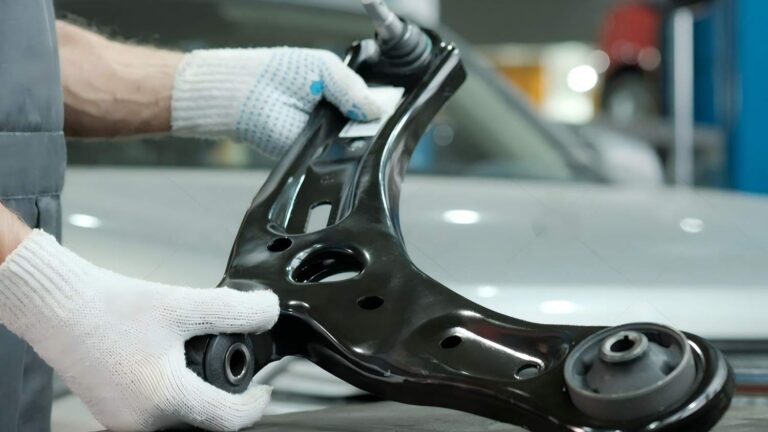
A control arm is a hinged suspension component that connects a wheel assembly to the vehicle’s chassis or subframe.
Most control arms have:
- A rigid steel, cast iron, forged aluminum, or stamped metal body
- One or more rubber or hydraulic bushings
- A ball joint or mounting point near the steering knuckle
The bushings allow the control arm to pivot vertically as the wheel moves over bumps. The ball joint allows the steering knuckle to move while maintaining a secure connection to the suspension.
Control arms help maintain:
- Wheel position
- Camber
- Caster
- Suspension travel
- Steering stability
- Tire contact with the road
Without properly functioning control arms, the wheel could move excessively forward, backward, inward, or outward relative to the vehicle.
What Is an Upper Control Arm?
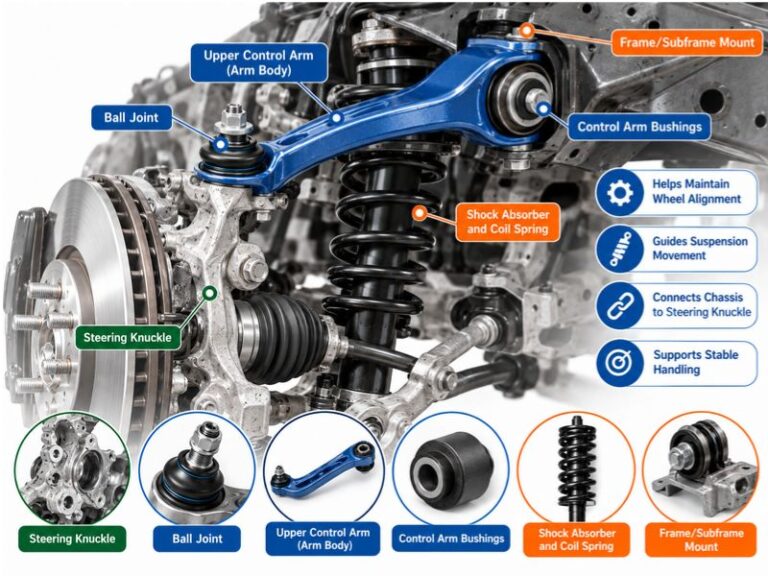
An upper control arm is the suspension link positioned above the lower control arm in vehicles that use double-wishbone, short-long-arm, or similar suspension designs.
It typically connects:
Vehicle frame or chassis → upper control arm bushings → upper control arm → upper ball joint → steering knuckle
The upper arm usually pivots from two chassis-mounted bushings and attaches to the top of the steering knuckle through an upper ball joint.
Upper control arms are especially common on:
- Pickup trucks
- SUVs
- Body-on-frame vehicles
- Double-wishbone front suspensions
- Some independent rear suspension systems
They can also appear in multi-link suspension designs, although the components may not always look like a traditional A-shaped control arm.
What Does an Upper Control Arm Do?
The upper control arm helps guide the top of the wheel assembly as the suspension moves up and down.
Its important functions include:
- Controlling the upper steering knuckle position
- Helping maintain camber angle
- Helping maintain caster geometry
- Preventing excessive wheel movement
- Allowing controlled suspension travel
- Supporting stable steering behavior
On a double-wishbone suspension, the upper and lower arms form two pivoting links around the steering knuckle.
The upper arm is often shorter than the lower arm. Suspension engineers can use this difference in arm length and mounting position to control how the wheel’s camber changes during suspension compression.
What Is a Lower Control Arm?
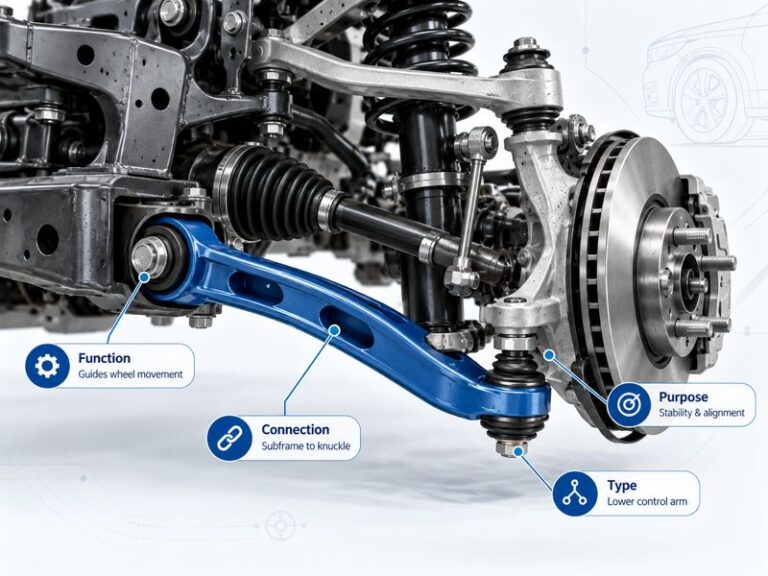
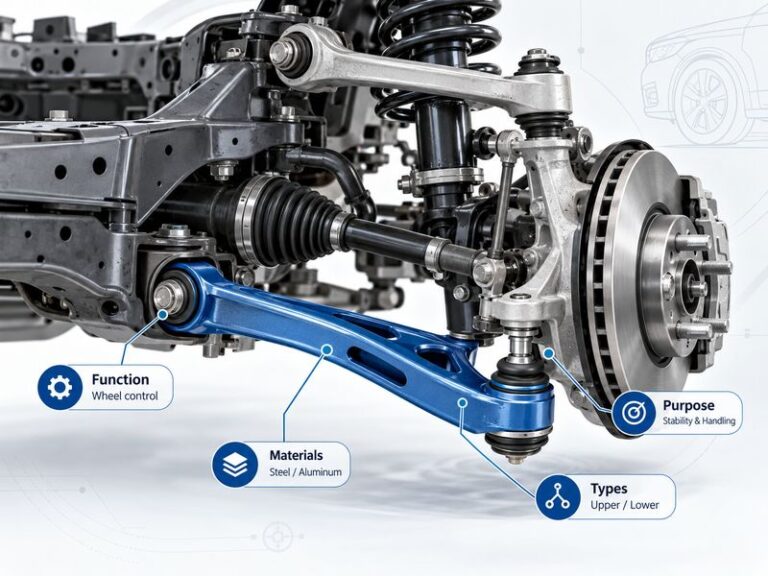
A lower control arm is the suspension member located beneath the wheel hub or steering knuckle.
It typically connects:
Subframe or chassis → lower control arm bushings → lower control arm → lower ball joint → steering knuckle
Lower control arms are found on a very large number of vehicles because they are used in both double-wishbone and MacPherson strut suspension systems.
Depending on the design, a lower control arm may be:
- A-shaped
- L-shaped
- Triangular
- Straight
- Curved
- Split into multiple links
The shape depends on available space, suspension geometry, drivetrain layout, steering components, and vehicle design.
What Does a Lower Control Arm Do?
The lower control arm keeps the bottom of the wheel assembly located correctly while allowing vertical suspension movement.
Its main functions include:
- Connecting the lower steering knuckle to the chassis
- Controlling front-to-back wheel movement
- Controlling side-to-side wheel movement
- Helping maintain wheel alignment
- Supporting suspension loads
- Providing a mounting location for the lower ball joint
On some suspension systems, the coil spring sits directly on the lower control arm. If so, the arm supports significant spring load.
Other vehicles use a coil-over shock or MacPherson strut arrangement in which the spring load is transferred differently.
Upper vs Lower Control Arm Location
The easiest way to understand the difference is to look at where each component sits.
Upper Control Arm Location
The upper control arm is located above the wheel hub or steering knuckle.
If you look behind the front wheel of a pickup truck with double-wishbone suspension, you may see a triangular arm extending from the frame toward the upper portion of the steering knuckle.
Its outer end typically connects to an upper ball joint.
Lower Control Arm Location
The lower control arm sits below the wheel hub and typically extends from the frame or subframe toward the bottom of the steering knuckle.
The outer connection normally uses a lower ball joint.
On many passenger cars, the lower control arm is much easier to see because there is no separate upper control arm.
Why Some Vehicles Have Both Upper and Lower Control Arms
Vehicles with double-wishbone suspension use both an upper and a lower control arm.
Viewed from the side or front, these two arms form a pair of links connecting the steering knuckle to the vehicle body.
The arrangement gives suspension engineers substantial control over wheel geometry.
Potential advantages include:
- Precise camber control
- Good suspension articulation
- Strong load handling
- Flexible geometry tuning
- Good steering characteristics
This is one reason double-wishbone arrangements are common on many trucks, SUVs, performance vehicles, and certain luxury vehicles.
However, they also require more components and installation space than simpler suspension layouts.
Why Some Vehicles Have Only Lower Control Arms
Not every vehicle needs a separate upper control arm.
Many cars use MacPherson strut suspension, in which the strut assembly attaches near the top of the steering knuckle and serves as an important structural suspension member.
A simplified MacPherson strut layout looks like this:
Vehicle body → strut mount → strut → steering knuckle → lower ball joint → lower control arm → subframe
The strut takes over part of the locating function that an upper control arm would perform in a double-wishbone system.
Therefore, seeing only a lower control arm does not mean anything is missing.
It may simply be how the suspension was designed.
Do All Cars Have Upper and Lower Control Arms?
No. Not all cars have both upper and lower control arms.
A vehicle’s suspension architecture determines which arms are required.
A double-wishbone system commonly uses both.
A MacPherson strut system normally uses a lower control arm without a conventional upper control arm.
Multi-link suspension may use several smaller individual links rather than one clearly recognizable upper or lower A-arm.
Because suspension terminology varies between manufacturers, always check the service information for your particular make, model, year, and suspension configuration.
Upper vs Lower Control Arm Size and Strength
Lower control arms are often physically larger and more heavily constructed than upper control arms.
That is partly because the lower arm may experience substantial:
- Vertical suspension loads
- Braking forces
- Cornering forces
- Road impacts
- Spring forces
On vehicles where the spring sits on the lower control arm, the arm must also withstand forces transmitted through the coil spring.
Upper control arms still handle important structural forces, but their primary role is often related more to wheel guidance and geometry than direct spring support.
This is not a universal rule. Suspension designs vary considerably.
Upper vs Lower Control Arm Ball Joints
A traditional double-wishbone suspension often has both:
- Upper ball joint
- Lower ball joint
These joints allow the steering knuckle to pivot for steering while also moving vertically with the suspension.
The ball joint may be:
- Pressed into the arm
- Bolted onto the arm
- Riveted in place
- Permanently integrated into the control arm
Whether the joint is serviceable separately depends on the vehicle.
Do Lower Control Arms Come With Ball Joints?
Some do and some do not.
Many replacement lower control arms are sold as complete assemblies that include:
- Control arm
- Bushings
- Ball joint
Others are sold without the ball joint.
Similarly, some OEM designs require replacement of the complete arm if the ball joint is worn, while others allow the ball joint to be replaced separately.
Always verify the exact part configuration before ordering replacement components.
Upper vs Lower Control Arm Bushings
Both upper and lower control arms commonly use control arm bushings where they attach to the vehicle structure.
These bushings perform two jobs:
- Allow the control arm to pivot.
- Isolate vibration and road harshness.
Traditional bushings are usually made from rubber bonded to metal sleeves.
Some vehicles use:
- Hydraulic bushings
- Elastomer bushings
- Performance polyurethane bushings
Lower control arm bushings are frequently large because they must manage substantial braking and acceleration forces.
Some lower arms have separate front and rear bushings with different shapes and stiffness levels.
How Upper and Lower Control Arms Work Together
On a double-wishbone suspension, the upper and lower arms move through different arcs.
As the wheel travels upward over a bump, both arms pivot at their chassis-mounted bushings.
The steering knuckle moves with them.
Because the upper and lower arms can have different lengths and mounting angles, the suspension can alter wheel angle slightly throughout its travel.
This controlled change helps maintain better tire contact during:
- Cornering
- Braking
- Suspension compression
- Suspension rebound
The geometry is carefully engineered. Even small changes caused by bent parts, worn bushings, incorrect ride height, or improperly installed components can affect alignment.
Which Control Arm Carries More Weight?
The lower control arm often handles greater suspension loads, but the exact answer depends on suspension design.
If a coil spring sits directly on the lower arm, that arm carries substantial spring force.
In a coil-over or other suspension arrangement, the load paths can be different.
It is more accurate to think of both arms as structural suspension components rather than assuming one is always “load-bearing” and the other is not.
Both must remain structurally sound.
What Happens When an Upper Control Arm Goes Bad?
Upper control arm problems usually involve:
- Worn bushings
- Worn upper ball joints
- Bent arms
- Loose mounting hardware
- Corrosion or structural damage
Possible symptoms include:
- Clunking over bumps
- Steering instability
- Uneven tire wear
- Excessive wheel movement
- Alignment that will not remain within specification
- Noise while turning
- Vehicle pulling to one side
A damaged upper control arm can allow the top of the steering knuckle to move beyond its intended position.
This can change camber or caster and affect steering behavior.
What Happens When a Lower Control Arm Goes Bad?
Lower control arm problems can create similar symptoms, but because the lower arm often handles substantial suspension forces, deterioration can become especially noticeable.
Common signs include:
- Clunking from the suspension
- Steering wandering
- Vibration
- Uneven tire wear
- Pulling during braking
- Wheel shifting under acceleration or braking
- Poor alignment
- Loose or unstable steering feel
A cracked or severely bent lower control arm requires immediate attention.
A failed ball joint or structural control arm connection can result in severe loss of wheel control.
Upper vs Lower Control Arm Failure Symptoms
Because both arms help locate the wheel, their symptoms can overlap.
| Symptom | Possible Upper Arm Problem | Possible Lower Arm Problem |
| Clunk over bumps | Yes | Yes |
| Uneven tire wear | Yes | Yes |
| Steering wandering | Yes | Yes |
| Alignment changes | Yes | Yes |
| Braking instability | Possible | Common with lower bushing wear |
| Ball joint play | Upper joint | Lower joint |
| Wheel movement | Possible | Possible |
| Squeaking | Possible | Possible |
Symptoms alone are not always enough to determine which component is defective.
A proper suspension inspection is usually required.
How to Check Upper and Lower Control Arms
Control arm inspection normally involves checking the arm itself, its bushings, mounting points, and ball joints.
Inspect the Control Arm Body
Look for:
- Cracks
- Severe corrosion
- Bends
- Impact damage
- Deformation
- Damaged mounting points
A visibly bent control arm should generally not be straightened and reused unless a manufacturer-approved repair procedure specifically allows it.
Inspect the Bushings
Look for:
- Torn rubber
- Separation between rubber and sleeve
- Cracks
- Excessive movement
- Fluid leakage from hydraulic bushings
Minor surface cracking does not automatically mean a bushing has failed. What matters is whether it has excessive movement, separation, or deterioration beyond the manufacturer’s acceptable condition.
Check the Ball Joint
Testing procedures vary by suspension design.
Some ball joints are loaded by the vehicle’s weight, while others are unloaded during certain inspection conditions.
Because of this, the correct lifting and testing method depends on the suspension.
Follow the vehicle manufacturer’s procedure rather than assuming every ball joint should be tested the same way.
Can Bad Control Arms Affect Alignment?
Yes. Worn or damaged control arms can change wheel alignment.
Control arms help position the steering knuckle. If a bushing collapses, an arm bends, or a ball joint develops excessive play, the wheel can move away from its intended geometry.
Possible changes include:
- Camber
- Caster
- Toe indirectly
An alignment may temporarily bring some angles back within specification, but an alignment cannot repair a worn mechanical component.
If there is excessive suspension play, the worn part should be addressed before alignment.
Can Bad Control Arms Cause Uneven Tire Wear?
Yes.
When control arm bushings, ball joints, or mounting points allow excessive wheel movement, tire contact with the road can become uneven.
Possible tire wear patterns include:
- Inner-edge wear
- Outer-edge wear
- Feathering
- Irregular tread wear
However, uneven tire wear has many possible causes, including incorrect tire pressure, worn tie rods, damaged struts, incorrect alignment, bent suspension components, or wheel bearing issues.
The control arms should be diagnosed rather than replaced based only on tire wear.
Should You Replace Lower Control Arms in Pairs?
You do not always have to replace lower control arms in pairs.
If one control arm is damaged from an impact and the other is in good condition, replacing only the damaged side may be reasonable.
However, replacing both sides can make sense when:
- Both arms have similar mileage and wear
- Bushings on both sides are deteriorated
- Both ball joints have measurable wear
- Corrosion affects both components
- A complete suspension refresh is being performed
The correct decision depends on inspection results, vehicle condition, and manufacturer recommendations.
Should You Replace Upper and Lower Control Arms Together?
Upper and lower control arms do not automatically need to be replaced together.
Each component should be inspected independently.
For example, you may have:
- A worn upper ball joint with a healthy lower control arm
- A damaged lower bushing with a healthy upper arm
- One bent arm after hitting a pothole or curb
Replacing additional parts merely because one control arm failed is not always necessary.
However, if several suspension components are similarly worn, replacing them during the same repair may reduce repeated labor and alignment costs.
Does Replacing a Control Arm Require an Alignment?
An alignment is generally advisable after control arm replacement.
Replacing an arm, ball joint, or bushing can change the wheel’s position relative to the chassis.
This is particularly important if the repair affects:
- Camber
- Caster
- Toe
- Ride height
- Subframe position
Some vehicles use eccentric bolts, slotted mounts, or adjustable suspension links for alignment.
Others have little or no factory adjustment.
A professional alignment check verifies whether the suspension geometry remains within manufacturer specification.
Is Replacing an Upper Control Arm Different From a Lower Control Arm?
Yes.
Although both involve suspension components, the repair process can be very different.
An upper control arm replacement may involve:
- Removing upper mounting bolts
- Separating the upper ball joint
- Working around the wheel well
- Dealing with limited bolt clearance
A lower control arm replacement can involve additional complications such as:
- Coil spring load
- Sway bar links
- Shock mounts
- Subframe connections
- Lower ball joint separation
- Axle or steering clearance
The exact procedure depends heavily on the vehicle.
Never remove a suspension component that supports a loaded coil spring without understanding how spring tension is controlled. Stored spring energy can cause serious injury.
Control Arm Replacement Safety
Suspension repairs deserve careful attention because the components support and control the wheel.
Important precautions include:
- Park on a stable, level surface.
- Use properly rated jack stands.
- Never work underneath a vehicle supported only by a floor jack.
- Follow the correct manufacturer lifting points.
- Support suspension components when required.
- Be cautious around loaded coil springs.
- Use the correct ball joint separation method.
- Torque suspension fasteners to manufacturer specification.
- Tighten bonded rubber bushing bolts at the specified suspension position when required.
The last point is especially important.
Some rubber control arm bushings are designed to rest in a neutral position at normal ride height. Tightening them while the suspension hangs fully extended can preload the rubber and shorten bushing life.
Follow the manufacturer’s installation procedure.
Can You Drive With a Bad Upper or Lower Control Arm?
It depends on the severity of the problem, but significant control arm, bushing, or ball joint damage should not be ignored.
A slightly worn bushing may initially cause only noise or alignment changes.
A severely worn ball joint, cracked control arm, or loose mounting point can become a serious safety problem because it affects wheel location.
If you notice:
- Severe clunking
- Visible wheel movement
- Sudden steering changes
- A leaning or displaced wheel
- Major ball joint play
- Cracked suspension components
avoid unnecessary driving and have the suspension inspected.
Upper vs Lower Control Arm Replacement Cost
Control arm replacement cost varies widely.
Important factors include:
- Vehicle make and model
- Upper or lower arm
- Aluminum versus steel construction
- Whether bushings are included
- Whether the ball joint is included
- Labor accessibility
- Suspension design
- Alignment requirements
- OEM versus aftermarket parts
A simple bolt-on upper arm may require considerably less labor than a lower arm that interacts with the spring, subframe, or other suspension components.
Because pricing varies by vehicle and region, it is better to obtain a vehicle-specific estimate rather than rely on one universal figure.
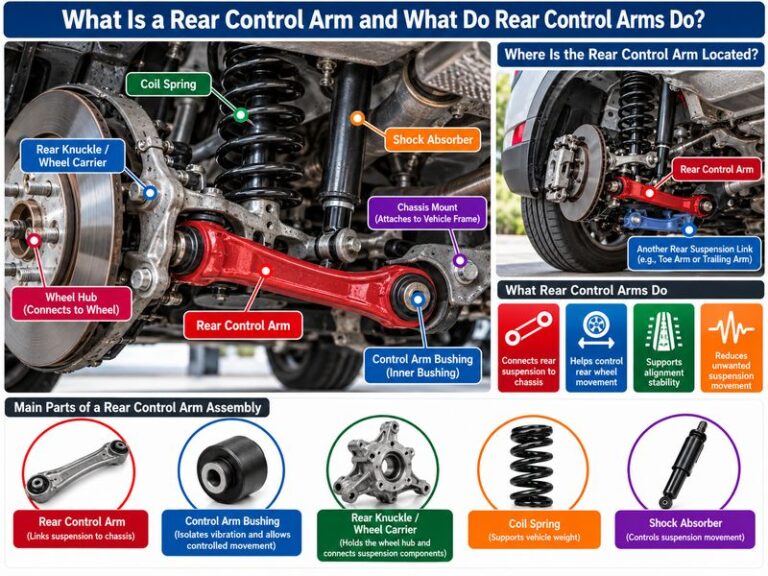
Control Arm vs Trailing Arm vs Suspension Link
Not every suspension arm is technically an upper or lower control arm.
Modern vehicles can use several types of suspension links.
Control Arm
Primarily locates the wheel while allowing controlled vertical suspension travel.
Trailing Arm
Runs generally forward-to-rearward and controls longitudinal wheel movement.
Toe Link
Helps control or adjust wheel toe.
Camber Link
Helps locate the wheel laterally and influence camber.
Multi-Link Suspension Arm
One of several individual links used to control wheel movement independently.
This terminology matters when ordering parts because a manufacturer may call a component a “lateral link” or “tension arm” even if it performs part of the job traditionally associated with a control arm.
Common Mistakes When Comparing Upper and Lower Control Arms
Assuming Every Vehicle Has Both
Many vehicles have only a lower control arm because the strut replaces the traditional upper arm function.
Assuming the Lower Arm Is Always the Same Shape
Lower control arms can be A-shaped, L-shaped, straight, curved, or divided into several links.
Replacing Parts Based on Noise Alone
Clunking can also come from:
- Sway bar links
- Tie rods
- Ball joints
- Struts
- Shocks
- Strut mounts
- Wheel bearings
Inspection is more reliable than guessing.
Skipping Alignment After Suspension Repair
Control arm work can alter wheel geometry. Checking alignment afterward helps prevent poor handling and abnormal tire wear.
Tightening Suspension Bushings Incorrectly
Certain bonded rubber bushings can be damaged if their fasteners are tightened with the suspension hanging when the manufacturer requires tightening at normal ride position.
Which Is More Important: Upper or Lower Control Arm?
Both are important when the vehicle uses both.
The lower arm may carry greater loads in many suspension designs, but the upper arm is still necessary for maintaining correct wheel geometry in double-wishbone systems.
A suspension system is engineered as a complete assembly.
A worn upper control arm can compromise steering and alignment just as a worn lower control arm can.
Instead of deciding which one is “more important,” focus on whether each component is structurally sound and operating within specification.
Frequently Asked Questions
What is the main difference between an upper and lower control arm?
The upper control arm attaches to the upper part of the steering knuckle, while the lower control arm attaches to the lower part. The lower arm often carries more suspension load, depending on the suspension design.
Do all vehicles have upper control arms?
No, many vehicles do not have a separate upper control arm. MacPherson strut suspensions commonly use the strut to perform part of the wheel-locating function that an upper arm performs in a double-wishbone setup.
Do all vehicles have lower control arms?
Most independent front suspension systems use a lower control arm or an equivalent lower suspension link. The exact design and terminology vary between manufacturers.
Can you replace only one control arm?
Yes, a single control arm can often be replaced if only that component is defective. However, the opposite side should also be inspected for similar wear.
Do control arms come with ball joints?
Some complete control arm assemblies include ball joints, while others do not. The ball joint may be integrated, bolted on, pressed in, or sold separately depending on the vehicle.
Can a bad upper control arm cause uneven tire wear?
Yes, worn upper control arm bushings or ball joints can alter wheel alignment and contribute to uneven tire wear. Camber or caster changes can affect how the tire contacts the road.
Can a bad lower control arm cause steering problems?
Yes, excessive movement in lower control arm bushings or the lower ball joint can make the steering feel unstable or imprecise. The vehicle may also pull, wander, or shift during braking.
Should upper and lower control arms be replaced at the same time?
Not necessarily. Upper and lower control arms should be replaced according to their individual condition. Replacing both may be appropriate when multiple components show significant wear.
Do I need an alignment after replacing a control arm?
An alignment check is generally recommended after control arm replacement. Replacing suspension components can alter camber, caster, or toe.
Is a lower control arm stronger than an upper control arm?
Lower control arms are often larger and designed to handle substantial loads, but this varies by suspension system. Both components are engineered for the forces they experience and should not be compared solely by physical size.
Conclusion
Understanding what is the difference between upper and lower control arms comes down mainly to their location and suspension function. The upper control arm guides the upper portion of the steering knuckle, while the lower control arm guides the lower portion and often handles greater suspension loads.
Vehicles with double-wishbone suspension commonly use both, while MacPherson strut systems often use only a conventional lower control arm because the strut performs the upper locating function.
Regardless of the design, control arms, bushings, and ball joints are critical to wheel alignment, suspension movement, steering stability, and tire contact with the road. If you notice clunking, uneven tire wear, wandering steering, or excessive wheel movement, inspect the complete suspension rather than assuming either the upper or lower arm is automatically responsible.
When replacement is necessary, use the correct vehicle-specific procedure, follow manufacturer torque specifications, handle spring-loaded suspension components carefully, and check the wheel alignment afterward.