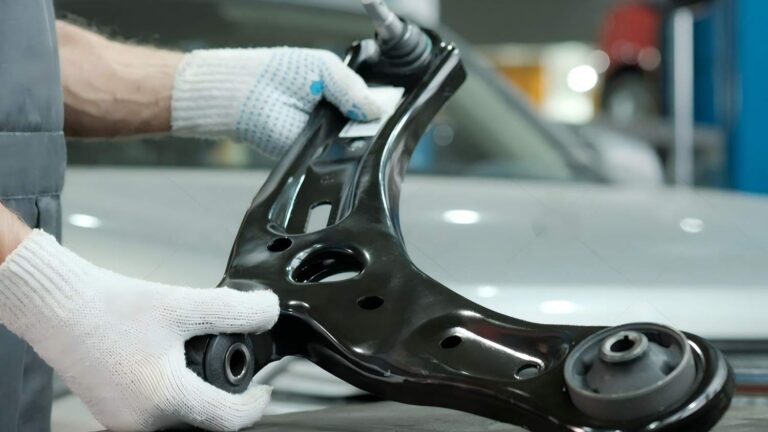
What Is an Upper Control Arm and What Does an Upper Control Arm Do?
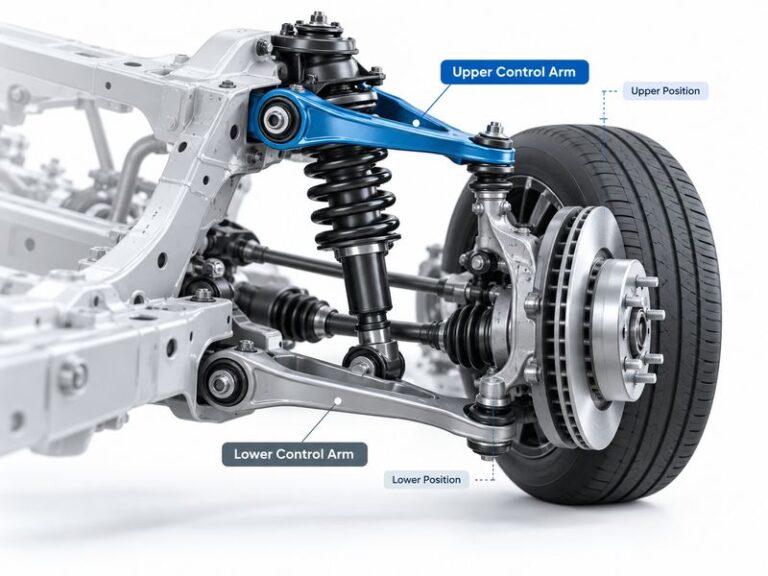
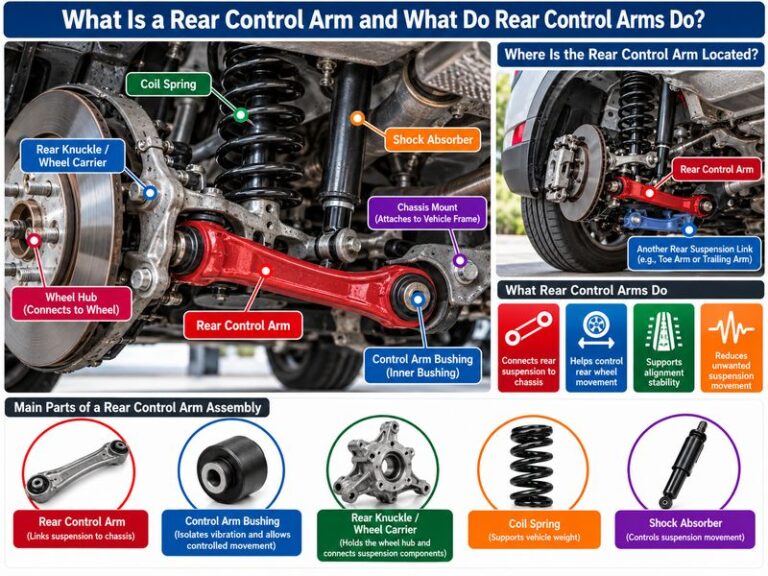
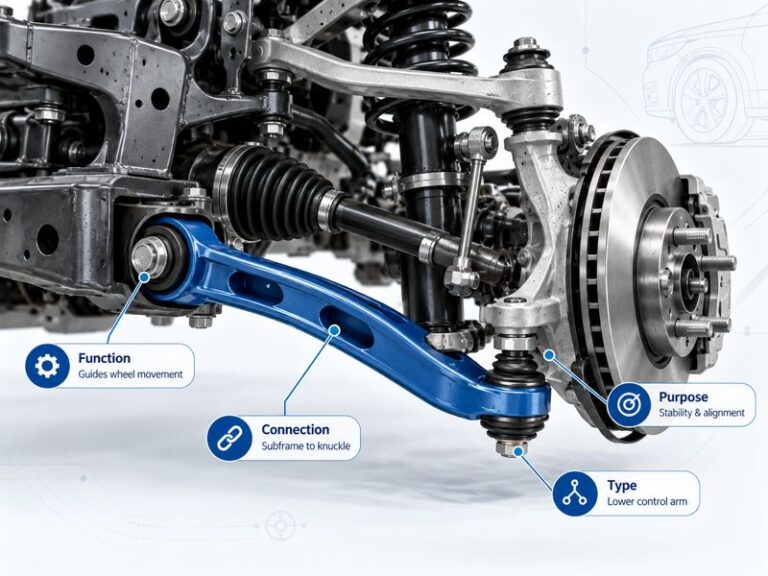
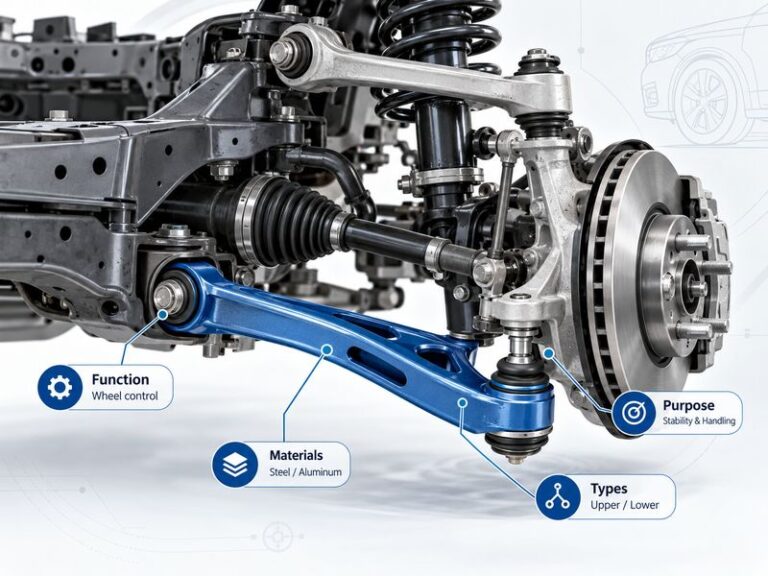
An upper control arm is a suspension component that connects the upper part of the steering knuckle or wheel carrier to the vehicle’s frame or chassis on suspension systems designed to use one. So, what does an upper control arm do? It guides the upper portion of the wheel assembly as the suspension moves, helps maintain proper wheel alignment and suspension geometry, and allows controlled movement through its bushings and ball joint.
Upper control arms are especially common in double-wishbone and short-long-arm suspension systems, although not every vehicle has them. Many cars with MacPherson strut front suspension use a lower control arm without a conventional upper control arm because the strut performs part of the upper locating function.
Although the arm itself is usually a strong metal component, its bushings and ball joint are wear points. When these parts deteriorate, the vehicle may develop clunking noises, steering looseness, uneven tire wear, alignment problems, or changes in handling.
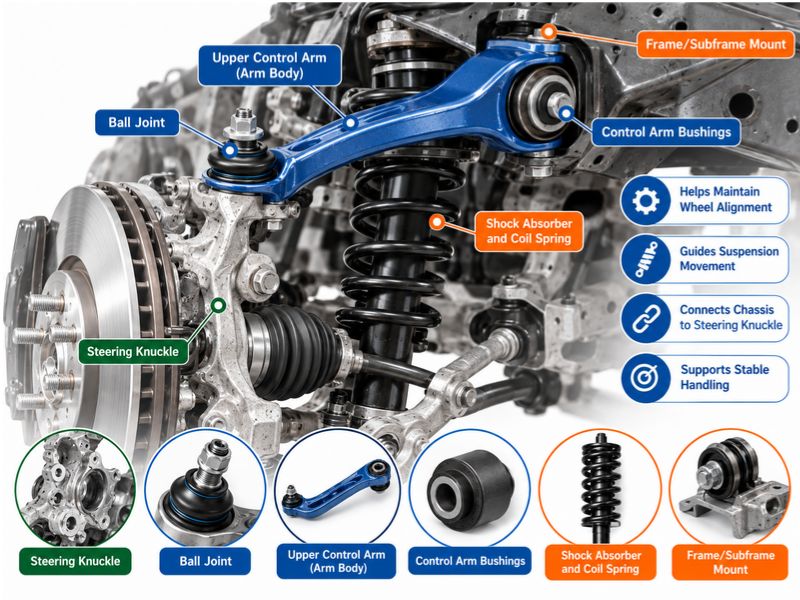
Understanding what is an upper control arm and how it interacts with the rest of the suspension makes diagnosing these symptoms much easier. Below, you’ll learn how upper control arms work, where they are located, what components they connect, how they differ from lower control arms, common failure symptoms, inspection methods, replacement considerations, and other practical information.
What Is an Upper Control Arm?
An upper control arm is a suspension link positioned above the wheel hub area that connects the vehicle’s chassis or frame to the upper part of the steering knuckle or wheel carrier.
Its purpose is to keep the wheel assembly moving along a controlled path rather than allowing it to move freely as road and steering forces act on it.
A typical upper control arm has:
- A metal control arm body
- One or more inner control arm bushings
- An outer ball joint
- Mounting bolts or shafts connecting it to the chassis
The inner part of the control arm pivots through its bushings as the suspension moves up and down.
At the outer end, the upper ball joint allows the steering knuckle to move through suspension travel and, on steering wheels, rotate as the driver turns the steering wheel.
The exact shape varies by vehicle. Some upper control arms resemble an A or wishbone, while others have different shapes to fit around springs, shocks, frame rails, and other suspension components.
What Does an Upper Control Arm Do?
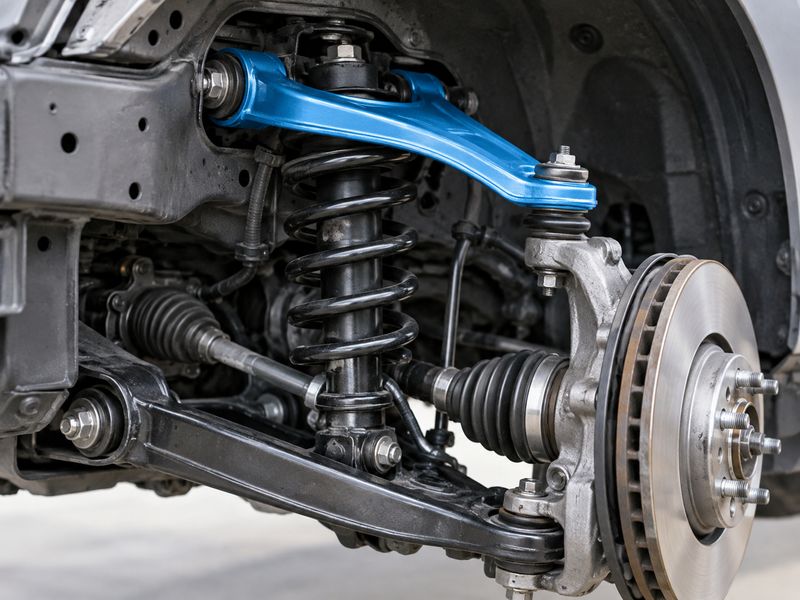
The simple answer to what does an upper control arm do is that it controls the position and movement of the upper part of the wheel assembly.
In a suspension that uses upper and lower control arms, both arms work together to locate the steering knuckle.
The upper control arm helps:
- Guide vertical wheel movement
- Maintain suspension geometry
- Control changes in wheel angle
- Keep the steering knuckle properly positioned
- Resist cornering and braking forces
- Provide an attachment point for the upper ball joint
- Allow suspension movement without rigidly attaching the wheel to the chassis
The arm is particularly important for maintaining the relationship between the wheel and the road as the suspension compresses and extends.
It does not perform the same job as a shock absorber.
The spring supports vehicle weight, while the shock absorber controls suspension oscillation. The upper control arm primarily determines how the wheel assembly is positioned and the path it follows during suspension movement.
Where Is the Upper Control Arm Located?
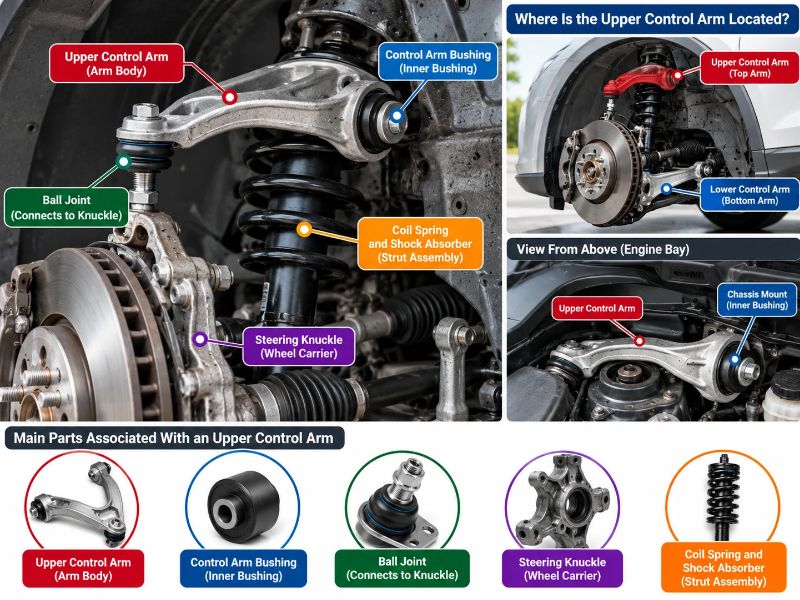
The upper control arm is normally located above the wheel hub and steering knuckle.
Looking behind the front wheel of a vehicle with double-wishbone suspension, you may see the arm extending outward from the frame toward the top of the steering knuckle.
Its inner pivots attach to the body, frame, or suspension mounting structure.
Its outer end typically connects to an upper ball joint, which connects the arm to the steering knuckle.
The exact location varies significantly among vehicles.
Pickup trucks and body-on-frame SUVs often make the upper control arm relatively easy to identify because it sits prominently above the wheel hub.
On other vehicles, components such as the spring, shock absorber, inner fender, brake hardware, and frame can make the arm less visible.
If you cannot identify it, checking a suspension diagram for the specific year, make, and model is preferable to assuming that every vehicle has the same layout.
How Does an Upper Control Arm Work?
An upper control arm works by pivoting at its chassis-side mounting points while remaining connected to the steering knuckle through a ball joint.
Imagine the control arm as a hinged link between the body and wheel assembly.
When the wheel encounters a bump, the wheel moves upward.
The upper control arm rotates around its inner bushings while the ball joint changes angle to accommodate the movement of the steering knuckle.
When the suspension extends, the arm moves in the opposite direction.
The upper and lower control arms are positioned at carefully engineered lengths and angles. Their relationship determines how the wheel moves as suspension travel changes.
This geometry can influence camber, caster, tire contact, steering response, and handling characteristics.
The control arm therefore does much more than simply hold the wheel in place. Its location and dimensions are part of the suspension’s overall design.
Main Parts of an Upper Control Arm
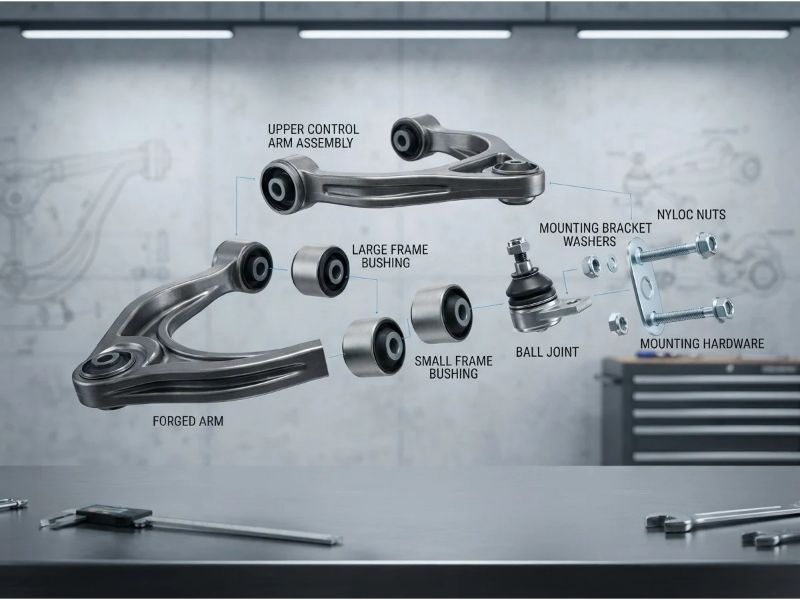
An upper control arm assembly may contain several components.
Control Arm Body
The body is the main structural portion.
It may be made from stamped steel, forged steel, cast material, aluminum, or another material chosen by the manufacturer.
The shape depends on the available space and the geometry required for that suspension.
The metal arm normally lasts much longer than its bushings or ball joint unless it becomes bent, cracked, heavily corroded, or damaged in an impact.
Upper Control Arm Bushings
The inner mounting points normally use rubber or similar bushings.
These bushings allow controlled rotation while isolating vibration between the suspension and vehicle body.
They must remain flexible enough to permit movement but firm enough to prevent the control arm from shifting excessively.
As bushings deteriorate, the control arm may move farther than intended under braking, acceleration, or cornering loads.
Upper Ball Joint
The upper ball joint usually connects the outer end of the upper control arm to the steering knuckle.
The joint allows angular movement while maintaining a secure mechanical connection.
On front steering suspensions, the ball joint also accommodates movement as the steering knuckle turns.
Some upper control arms have permanently integrated ball joints, while others use replaceable ball joints.
Mounting Hardware
Bolts, nuts, shafts, washers, brackets, and sometimes alignment hardware secure the control arm to the chassis.
Certain vehicles use eccentric bolts, shims, or other adjustment methods around the upper control arm to help set wheel alignment.
Never assume mounting hardware is interchangeable between vehicles.
What Does an Upper Control Arm Connect To?
An upper control arm generally connects the vehicle’s frame, chassis, or suspension mounting structure to the upper portion of the steering knuckle or wheel carrier.
At the inner side, bushings create pivot points where the arm attaches to the vehicle.
At the outer side, a ball joint usually connects the arm to the steering knuckle.
This creates a movable triangular relationship among the chassis, upper control arm, and wheel assembly.
In some suspension designs, the shock absorber or other components may be positioned near or inside the control arm area, but that does not mean they necessarily attach directly to the upper arm.
Always check the specific suspension layout because attachment points vary between manufacturers.
Upper Control Arm and Suspension Geometry
One of the upper control arm’s most important functions is controlling suspension geometry.
Wheel alignment is not just about where the tire points while the vehicle is sitting still.
As the wheel moves upward and downward, its angle relative to the road can change.
Engineers use control arm length, mounting height, angle, and pivot locations to manage those changes.
Camber
Camber describes the inward or outward tilt of the wheel when viewed from the front of the vehicle.
Upper control arm movement can significantly influence how camber changes during suspension travel.
A bent arm, worn bushing, or incorrect mounting position can therefore contribute to unwanted camber.
Caster
Caster relates to the forward or rearward tilt of the steering axis when viewed from the side.
On some suspension designs, upper control arm position or adjustment helps establish caster.
Changes caused by worn bushings or incorrect installation can therefore affect steering feel and straight-line stability.
Toe
Toe is primarily controlled through steering linkage on many front suspensions, but changes in control arm position can indirectly influence the overall alignment relationship.
This is one reason suspension wear should normally be repaired before performing the final wheel alignment.
Upper Control Arm vs Lower Control Arm
Upper and lower control arms work together on suspension systems that use both, but they are separate components with different mounting positions.
The upper control arm connects to the upper portion of the steering knuckle.
The lower control arm connects near the bottom of the knuckle.
Together, they establish the path the wheel follows as the suspension travels.
The lower control arm is often larger and may carry substantial suspension loads, especially when the spring mounts directly to it. However, this varies by suspension design.
The upper control arm plays an important role in controlling the top of the steering knuckle and managing wheel geometry.
Neither component should be considered unnecessary simply because the other arm is larger.
In a double-wishbone suspension, both are integral parts of the system.
Do All Cars Have Upper Control Arms?
No, not all cars have conventional upper control arms.
Whether a vehicle uses an upper control arm depends on its suspension design.
A double-wishbone suspension normally uses both upper and lower control arms.
Many pickup trucks, SUVs, performance vehicles, and some passenger cars use variations of this design.
A MacPherson strut suspension, however, commonly has a lower control arm but no traditional upper control arm. The strut itself provides part of the upper structural location for the steering knuckle.
Multi-link suspension can be more complicated. Several individual links may perform functions that would otherwise be handled by a single upper control arm.
Rear suspension design also varies considerably.
The correct way to determine whether a vehicle has an upper control arm is to identify its specific suspension type rather than assuming all four-wheel independent suspensions use the same arrangement.
Why Do Some Cars Not Have Upper Control Arms?
Different suspension systems accomplish wheel control in different ways.
A double-wishbone system uses two arms to locate the knuckle.
A MacPherson strut system uses the strut assembly as an important structural suspension member, reducing the need for a conventional upper control arm.
This arrangement can use fewer components and occupy less horizontal space.
Multi-link systems divide wheel-control functions among several smaller links.
Therefore, a vehicle without a recognizable upper control arm is not missing a suspension component. Its suspension was simply engineered using a different layout.
Do Upper Control Arms Come With Ball Joints?
Some replacement upper control arms include a ball joint, while others do not.
It depends on the original suspension design and how the replacement component is manufactured.
On some vehicles, the ball joint is permanently incorporated into the control arm. When the joint wears out, the complete arm is replaced.
Other vehicles use a removable ball joint that can be serviced independently.
Replacement control arms may also be sold in different configurations. One part may include:
- The control arm
- New bushings
- A new ball joint
Another may contain only the arm and bushings.
Before ordering a replacement, verify exactly which components are included and whether the existing ball joint is reusable.
What Causes an Upper Control Arm to Fail?
The metal upper control arm itself does not normally wear in the same way that rubber bushings or ball joints do.
Most problems originate from components attached to the arm.
Worn Bushings
Repeated suspension movement gradually wears rubber bushings.
Heat, age, road contamination, oil exposure, environmental conditions, and heavy use can accelerate deterioration.
Worn Ball Joint
The upper ball joint experiences continuous movement whenever the suspension or steering moves.
Wear inside the joint can eventually create excessive clearance.
A damaged protective boot may allow dirt and water into the joint, which can accelerate deterioration.
Potholes and Curbs
A strong impact can bend an upper control arm or damage its mounting points.
The arm does not necessarily need to appear dramatically bent for its geometry to be incorrect.
Collision Damage
A crash involving the wheel or suspension can damage the arm, steering knuckle, frame mounting points, or nearby suspension components.
Corrosion
Severe corrosion can weaken metal control arms or their mounting areas, especially where road salt is commonly used.
Incorrect Installation
Incorrect fastener tightening, improperly installed bushings, unsuitable replacement parts, or incorrect alignment hardware positioning can cause premature problems.
Symptoms of a Bad Upper Control Arm
A bad upper control arm can produce several symptoms, although the symptoms usually come from worn bushings, a failing ball joint, structural damage, or incorrect geometry rather than from the arm simply becoming old.
Common signs may include:
- Clunking or knocking noises
- Loose or vague steering
- Vehicle wandering
- Uneven tire wear
- Alignment that will not remain correct
- Steering wheel changes after hitting bumps
- Excessive wheel movement
- Visible bushing damage
- Torn ball joint boot
- A bent or cracked arm
- Abnormal wheel position
The same symptoms can also result from tie rods, lower control arms, wheel bearings, shocks, struts, sway bar links, tires, or other suspension parts.
A proper inspection is therefore necessary before replacing the upper control arm.
Can a Bad Upper Control Arm Cause Clunking?
Yes. Worn bushings or excessive play in an upper ball joint can produce a clunking or knocking sound.
The noise may occur when:
- Driving over bumps
- Entering driveways
- Braking
- Accelerating
- Turning
- Changing suspension load
A worn bushing can allow the arm to shift before reaching the limit of its movement.
A worn ball joint can create movement between the arm and steering knuckle.
However, many suspension components can make similar noises.
Clunking should therefore be diagnosed rather than automatically blamed on the upper control arm.
Can a Bad Upper Control Arm Affect Steering?
Yes. An upper control arm problem can affect steering because the component helps maintain the steering knuckle’s position.
If its bushings allow excessive movement, wheel geometry may change as loads move through the suspension.
A worn upper ball joint can also introduce looseness.
The driver may notice:
- Wandering
- Vague steering
- Reduced straight-line stability
- Steering corrections becoming more frequent
- Changes in steering behavior during braking
- Unusual response over bumps
These symptoms are not specific to an upper control arm, so steering linkage and other suspension parts should also be inspected.
Can a Bad Upper Control Arm Cause Uneven Tire Wear?
Yes, particularly when the problem alters wheel alignment.
A bent upper control arm can change the position of the steering knuckle.
Likewise, worn bushings may allow the arm to move under road loads.
Depending on the suspension, this can affect camber or caster and may contribute to tire wear.
Possible patterns can include excessive wear toward one edge of the tire, although tire wear patterns alone should not be used to diagnose a control arm.
Incorrect tire pressure, toe problems, worn steering components, damaged springs, alignment errors, and wheel bearing issues can also produce uneven wear.
Can an Upper Control Arm Bend?
Yes.
Upper control arms can bend after a substantial impact involving the wheel or suspension.
Common causes include:
- Striking a curb
- Hitting a severe pothole
- Collision damage
- Off-road impacts
- Suspension overloading or physical damage
A bent control arm changes suspension geometry even if the difference is difficult to see.
One clue may be an alignment angle that remains outside specification even when available adjustments have been used correctly.
The position of one wheel may also differ visibly from the opposite side.
A structurally bent control arm is generally replaced rather than manually straightened unless the vehicle manufacturer provides an approved repair procedure.
How to Inspect an Upper Control Arm
A basic inspection begins with visual checks, but determining whether a ball joint or bushing has excessive play may require vehicle-specific procedures.
1. Park the Vehicle Safely
Use a flat surface and follow the manufacturer’s lifting instructions if the vehicle needs to be raised.
Never work underneath a vehicle supported only by a jack.
Use appropriately rated jack stands and correct support points.
2. Inspect the Metal Arm
Look for:
- Bending
- Cracks
- Impact marks
- Severe corrosion
- Damaged mounting areas
Compare the left and right sides if their designs are similar.
3. Check the Bushings
Inspect the rubber around each inner pivot.
Look for major separation, large tears, displacement, or excessive deterioration.
Some surface cracking can occur with age without necessarily meaning the bushing has failed.
Actual movement and manufacturer inspection criteria matter.
4. Inspect the Ball Joint Boot
Check whether the protective boot is:
- Torn
- Missing
- Split
- Leaking grease
- Contaminated
A damaged boot can allow debris into the joint.
5. Check for Excessive Play
Ball joint inspection procedures differ depending on suspension design.
Some joints are loaded differently depending on where the vehicle is supported.
Follow manufacturer service information rather than assuming one pry-bar or wheel-rocking test is correct for every vehicle.
6. Inspect Tire and Alignment Evidence
Uneven tire wear, altered wheel position, or unusual alignment readings can help identify suspension problems.
They should support the diagnosis rather than replace a physical suspension inspection.
Upper Control Arm Bushings: Why They Matter
Upper control arm bushings create flexible pivot points between the arm and chassis.
Without them, road vibration and impact would transfer more directly through the suspension structure.
The bushings also allow the control arm to rotate through its intended range.
At the same time, they must restrict unwanted movement.
A healthy bushing therefore balances flexibility and control.
As the rubber deteriorates, the control arm can begin moving forward, backward, or sideways more than intended.
This may alter steering response and wheel alignment under load.
In some cases, a bushing can look relatively normal when the vehicle is sitting still but move excessively during braking or acceleration.
Upper Control Arm Ball Joint: Why It Matters
The upper ball joint provides a movable connection between the control arm and steering knuckle.
Its spherical design allows movement through multiple angles.
This is necessary because the knuckle moves as the suspension compresses and extends, and on the front wheels it also rotates during steering.
The joint must allow this movement without excessive looseness.
As wear develops, clearance inside the ball-and-socket assembly may increase.
A severely deteriorated ball joint is important to address because it is part of the physical connection that helps locate the wheel assembly.
If significant ball joint wear is suspected, the vehicle should be inspected promptly.
Upper Control Arm vs Upper Ball Joint
The upper control arm and upper ball joint are not the same component.
The upper control arm is the structural suspension link.
The upper ball joint is the movable connection between that arm and the steering knuckle.
On some vehicles, the ball joint can be replaced separately.
On others, it is permanently integrated into the arm, making the complete upper control arm assembly the service part.
This distinction matters when ordering parts.
A mechanic saying that an upper control arm needs replacement may sometimes be referring to a worn built-in ball joint rather than damage to the metal arm itself.
Upper Control Arm vs Control Arm Bushing
A bushing is only one component of the upper control arm assembly.
It sits at the inner pivot where the control arm attaches to the vehicle.
If the bushing is worn but the metal arm and ball joint remain good, some suspension designs allow the bushing to be replaced separately.
Whether doing so is practical depends on:
- Parts availability
- Labor requirements
- Required pressing tools
- Condition of the ball joint
- Condition of the arm
- Cost of a complete assembly
A complete replacement arm frequently comes with new bushings and sometimes a new ball joint, which can make it a practical repair option.
How Long Do Upper Control Arms Last?
There is no universal mileage or time interval for upper control arm replacement.
The service life depends on factors such as:
- Vehicle design
- Road quality
- Driving conditions
- Vehicle weight
- Suspension travel
- Climate
- Corrosion
- Ball joint design
- Bushing material
- Previous impacts
- Replacement-part quality
The metal arm may last for much of the vehicle’s service life if it is not damaged.
Bushings and ball joints are more likely to become worn first.
For this reason, upper control arms should generally be replaced based on their actual condition rather than at an arbitrary mileage.
Can You Drive With a Bad Upper Control Arm?
Whether a vehicle can safely be driven depends on exactly what has failed and how serious the problem is.
A small amount of aging in a rubber bushing is very different from:
- A severely loose ball joint
- A cracked control arm
- A heavily separated bushing
- A bent suspension component
- Excessive wheel movement
A serious upper control arm or ball joint problem may compromise wheel control.
If the vehicle suddenly feels unstable, the wheel has visible movement, steering changes significantly, or a structural suspension component is damaged, continuing to drive may not be safe.
In that situation, having the vehicle inspected—and towing it when necessary—is safer than continuing to drive and hoping the problem does not worsen.
When Should an Upper Control Arm Be Replaced?
Replacement may be necessary when the upper control arm is:
- Bent
- Cracked
- Severely corroded
- Structurally damaged
- Equipped with a failed non-serviceable ball joint
- Equipped with failed non-serviceable bushings
A complete arm may also be replaced when servicing individual bushings or ball joints is impractical compared with installing a complete assembly.
However, replacing the arm solely because the vehicle has high mileage is not usually necessary.
The actual condition of the component should determine the repair.
Should Upper Control Arms Be Replaced in Pairs?
Upper control arms do not automatically have to be replaced in pairs.
If one control arm was bent by an isolated impact while the other side remains in good condition, replacing only the damaged side may be appropriate.
Pair replacement may make more sense when both sides have similar age and wear, particularly when both sets of bushings or ball joints are deteriorating.
The best approach is to inspect both sides.
Replacement decisions should be based on actual component condition, the reason for failure, parts availability, labor considerations, and manufacturer recommendations rather than a universal rule that both arms must always be replaced together.
Should Upper and Lower Control Arms Be Replaced Together?
Not necessarily.
Upper and lower control arms work together, but they are individually serviceable components on many vehicles.
A failed upper ball joint does not automatically mean the lower control arm must also be replaced.
Likewise, lower control arm bushing failure does not automatically make the upper arm bad.
However, if a vehicle has extensive suspension wear, inspecting all control arms, ball joints, bushings, tie rods, and related components at the same time is sensible.
Replace components that are actually worn or damaged rather than replacing every suspension arm simply because one has failed.
How Is an Upper Control Arm Replaced?
The exact replacement procedure varies considerably by vehicle.
Generally, the repair involves safely supporting the vehicle, removing the wheel, disconnecting the upper ball joint from the steering knuckle, removing the inner mounting hardware, and installing the replacement arm.
However, actual access may be much more complicated.
Depending on the vehicle, technicians may need to work around:
- Springs
- Shock absorbers
- Struts
- Brake hoses
- Wiring
- Frame components
- Engine-bay components
- Alignment shims or eccentric hardware
Positioning of alignment hardware should be noted before removal when applicable.
The replacement arm must be installed in the correct orientation and all fasteners tightened according to manufacturer specifications.
With conventional rubber bushings, certain pivot fasteners may require final tightening with the suspension positioned at or near normal ride height.
This prevents the rubber bushing from being continuously twisted while the vehicle sits at rest.
Always follow vehicle-specific service procedures.
Do You Need an Alignment After Replacing an Upper Control Arm?
An alignment check is generally advisable after upper control arm replacement.
The upper control arm directly affects the position of the steering knuckle and suspension geometry.
On some vehicles, camber or caster adjustments are performed through upper control arm mounting points.
Even on designs without direct adjustment there, replacement can alter wheel position slightly due to component tolerances or the condition of the previous arm.
An alignment becomes particularly important when:
- The old arm was bent
- Alignment hardware was disturbed
- The vehicle previously had uneven tire wear
- Bushings were badly worn
- A collision or curb impact caused the damage
If alignment cannot be brought within manufacturer specification after replacing the arm, additional suspension or structural damage should be investigated.
Can Upper Control Arm Bushings Be Replaced Separately?
Sometimes.
Some upper control arms use bushings that can be pressed out and replaced separately.
Others are sold and serviced primarily as complete assemblies.
Bushing replacement can require:
- A hydraulic press
- Special adapters
- Correct orientation
- Careful support of the control arm
- Manufacturer installation specifications
If the ball joint is also worn, replacing the entire arm may be more practical.
If the original arm and ball joint are in excellent condition, replacing only the bushings may be reasonable when quality replacement bushings are available.
The repair choice should be based on the specific suspension rather than assuming one method is always better.
Upper Control Arms on Trucks and SUVs
Upper control arms are especially familiar to owners of many pickups and SUVs because double-wishbone or similar independent front suspension designs are common in these vehicles.
The basic function remains the same: control the upper portion of the steering knuckle and maintain proper suspension geometry.
However, trucks can place substantial demands on suspension components due to:
- Vehicle weight
- Towing and payload
- Rough roads
- Off-road operation
- Larger tires
- Suspension modifications
Modified ride height can also change control arm and ball joint operating angles.
This is why suspension modifications should be considered as a complete geometry change rather than simply adding or replacing one component.
Any aftermarket control arm should be appropriate for the exact vehicle and suspension configuration.
Upper Control Arms and Lifted Vehicles
Suspension lifts can change the relationship between the upper control arm, ball joint, steering knuckle, and frame.
When ride height is altered significantly, the original control arm may operate at a different angle than intended.
Depending on the vehicle and lift design, this can affect:
- Ball joint angle
- Suspension travel
- Camber
- Caster
- Tire clearance
- Droop travel
Some modified vehicles use specially designed upper control arms intended to work with altered ride height.
However, aftermarket geometry varies widely, so there is no universal rule that every lifted vehicle requires a replacement upper control arm.
Lift manufacturer instructions, suspension geometry, alignment capability, and vehicle-specific requirements should determine what components are necessary.
Common Upper Control Arm Replacement Mistakes
Several mistakes can lead to poor results even when the correct replacement part is installed.
Replacing the Arm Without Diagnosing the Noise
A clunk may come from the upper control arm, but it can also come from the lower control arm, sway bar link, strut mount, tie rod, wheel bearing, brake hardware, or another component.
Confirm the source first.
Ignoring Other Suspension Wear
Installing one new arm does not fix worn components elsewhere in the suspension.
Inspect related joints and bushings while the vehicle is already raised.
Incorrectly Tightening Bushing Bolts
Some rubber bushings should be tightened at normal suspension ride position.
Ignoring the required procedure can preload the rubber.
Losing Alignment Hardware Position
Shims or eccentric adjusters may affect camber or caster.
Their original position should be documented when applicable.
Skipping the Alignment Check
A suspension repair can be mechanically correct while the vehicle’s wheel alignment remains incorrect.
Using Incorrect Torque
Suspension fasteners experience substantial loads.
Always follow the vehicle manufacturer’s torque specifications rather than guessing or tightening everything as much as possible.
Upper Control Arm Safety
Suspension repair requires careful attention to vehicle support and stored spring energy.
Never rely on a hydraulic jack alone while working around suspension components.
Use proper jack stands and approved vehicle support points.
Be particularly careful when the suspension design places springs near control arms.
A compressed coil spring can contain significant stored energy.
Do not disconnect components that retain or control spring force unless you understand the exact suspension design and have the appropriate equipment.
Ball joint separation can also require specific tools and procedures.
Avoid damaging the steering knuckle, ball joint stud, brake hose, wheel-speed sensor wiring, or nearby components.
If the repair procedure is unclear, manufacturer service information or professional assistance is the safer approach.
FAQs About Upper Control Arms
Is an upper control arm part of the suspension?
Yes, an upper control arm is a suspension component that helps locate and guide the wheel assembly. It connects the chassis to the upper portion of the steering knuckle on suspension systems designed to use one.
It works together with other suspension components to maintain controlled wheel movement.
Does every vehicle have an upper control arm?
No, many vehicles do not use a conventional upper control arm. MacPherson strut suspensions commonly use the strut instead of a traditional upper arm.
Double-wishbone systems typically use both upper and lower control arms.
Can a bad upper control arm cause clunking?
Yes, worn upper control arm bushings or a loose upper ball joint can produce clunking or knocking. The noise may become noticeable over bumps, during braking, or when suspension load changes.
Other suspension components can cause similar noises, so inspection is important.
Can an upper control arm affect alignment?
Yes, the upper control arm helps establish wheel position and suspension geometry. Damage or excessive bushing wear can contribute to incorrect camber, caster, or other alignment changes depending on the suspension design.
Repair suspension looseness before relying on a final alignment adjustment.
Can a bad upper control arm cause uneven tire wear?
Yes, if upper control arm wear or damage changes wheel alignment, uneven tire wear can result. However, many other steering, suspension, tire, and alignment problems can cause similar wear.
The suspension should be inspected before replacing parts based solely on tire wear.
Can you replace an upper ball joint without replacing the control arm?
Sometimes, because some vehicles use separately serviceable upper ball joints. Other designs integrate the ball joint into the control arm and require complete arm replacement.
Check the specific suspension design before ordering parts.
How do I know if my upper control arm bushings are bad?
Large tears, separation, excessive control arm movement, or abnormal suspension behavior can indicate worn bushings. Visual appearance alone is not always enough to determine their condition.
The bushings should be inspected under the correct loading conditions.
Do I need an alignment after replacing an upper control arm?
An alignment check is generally recommended after replacing an upper control arm. The arm affects steering knuckle position and may directly influence camber or caster adjustment on some vehicles.
This is particularly important when alignment hardware was disturbed during replacement.
Is it dangerous to drive with a bad upper control arm?
A severely damaged upper control arm, failed ball joint, or badly separated bushing can create a safety concern. These components help maintain control of the wheel assembly.
Sudden steering changes, severe looseness, structural damage, or unusual wheel movement should be inspected promptly.
Are upper control arms the same as lower control arms?
No, although both are suspension links that help control wheel movement. The upper arm connects to the upper portion of the steering knuckle, while the lower arm connects lower on the assembly.
On double-wishbone suspensions, the two work together to control suspension geometry.
Conclusion
Understanding what is an upper control arm is easier once you see it as the upper suspension link that connects the chassis to the steering knuckle and guides the wheel through a controlled range of movement.
So, what does an upper control arm do in practical terms? It helps maintain suspension geometry, keeps the upper portion of the wheel assembly properly located, allows controlled suspension travel, and works with the lower control arm, bushings, ball joint, springs, and dampers to provide predictable steering and handling.
Not every vehicle has an upper control arm because suspension designs vary. Double-wishbone systems commonly use one, while MacPherson strut systems typically do not use a traditional upper arm.
When problems occur, the metal arm itself may be bent or damaged, but worn upper control arm bushings and upper ball joints are also common reasons the assembly requires attention.
Clunking, loose steering, alignment changes, unusual tire wear, and visible suspension movement are reasons to inspect the system—not automatic proof that the control arm needs replacement.
Accurate diagnosis, safe repair procedures, correct fastener tightening, and an alignment check when appropriate are the best ways to keep the upper control arm and the rest of the suspension working as designed.