Do All Cars Have Upper and Lower Control Arms? Explained
If you look under two cars parked next to each other, their suspension parts may look very different. One vehicle may have clear upper and lower control arms. The other may have only a lower arm, a strut, and several smaller links. That is why the answer to **do all cars have upper and lower control arms** is no.
In practical suspension work, the part name alone can cause confusion. A driver may search for an upper control arm because another vehicle has one, only to find that the car uses a MacPherson strut instead. The suspension design, vehicle type, axle, and model year all matter.
This guide explains which cars use upper and lower control arms, why some cars do not, and what parts take their place. It also covers MacPherson strut, double wishbone, multi-link, solid axle, and rear suspension layouts so you can better understand what is under your vehicle.

Do All Cars Have Upper and Lower Control Arms?
No. **Not every car uses both an upper and a lower control arm.** The parts a car needs depend on its suspension design. Some systems use two control arms at each wheel. Others use one main control arm and a strut.
So, when someone asks **do all cars have upper and lower control arms**, there is no single layout that applies to every car. A pickup truck, compact sedan, sports car, and luxury SUV may all use different systems.
Many vehicles with double wishbone suspension use both upper and lower arms. Many vehicles with MacPherson strut suspension use a lower control arm but no separate upper control arm. Multi-link systems can be even more complex because they may use several links instead of one large upper arm.
The same car can also use different suspension types at the front and rear. For example, the front may use MacPherson struts while the rear uses a multi-link setup.

- ✦ Double wishbone
Usually has a distinct upper control arm and lower control arm.
- ✦ MacPherson strut
Usually has a lower control arm but no traditional upper control arm.
- ✦ Multi-link
Uses several links or arms that divide the jobs handled by larger control arms.
- ✦ Solid axle
May use trailing arms, radius arms, links, or leaf springs instead of a normal upper-and-lower control arm pair.
Why Suspension Designs Differ
Automakers balance cost, space, ride comfort, handling, strength, and weight. A simple compact car does not need the same suspension layout as an off-road truck or performance coupe.
Packaging also matters. The engine, transmission, steering gear, brakes, and drive axles all compete for space near the wheels. Engineers choose suspension parts that fit those limits while keeping the wheel controlled.
- ✦ Cost
Simpler suspension layouts can use fewer parts and may cost less to build.
- ✦ Space
Some designs leave more room for the engine bay, cargo area, or passenger cabin.
- ✦ Handling
More complex designs can give engineers greater control over wheel movement and alignment.
What Are Upper and Lower Control Arms?
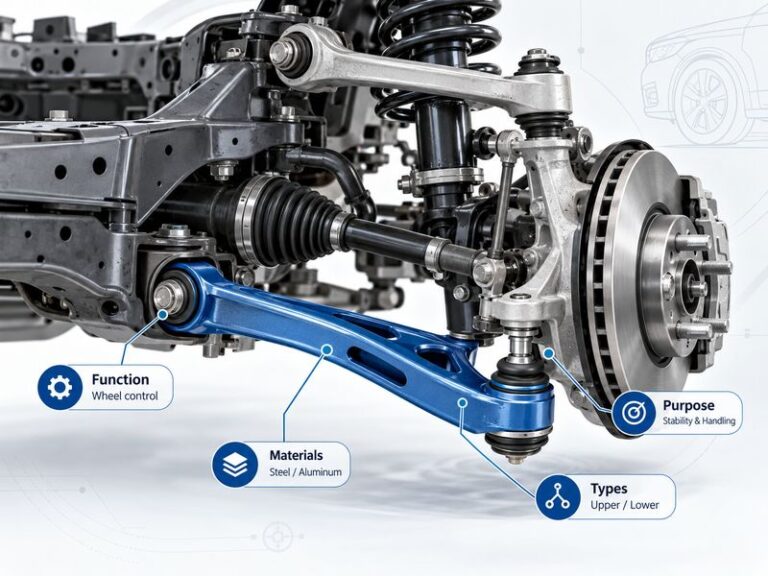
Control arms are suspension links that connect parts of the wheel assembly to the vehicle structure. They let the wheel move up and down while helping keep it in the correct position.
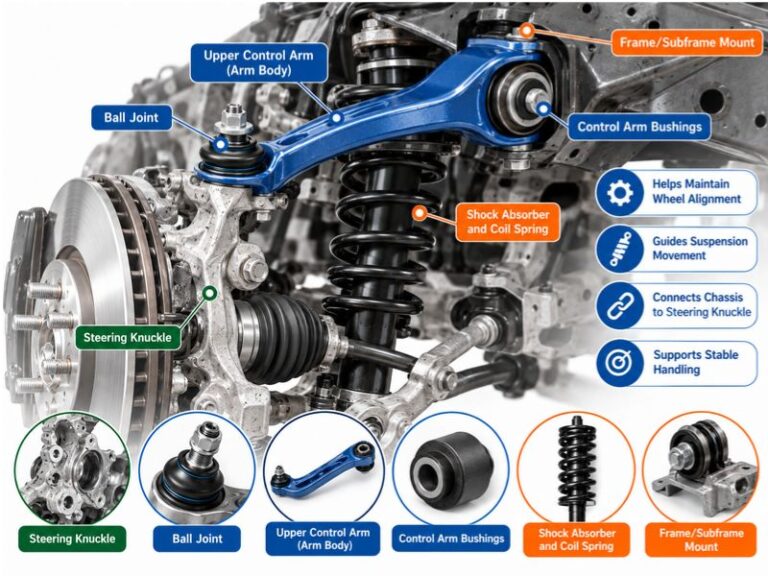
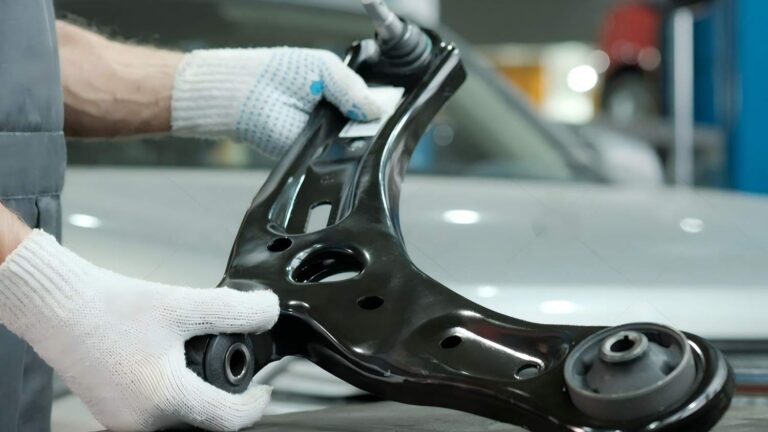
A typical control arm connects to the frame or subframe through rubber or hydraulic bushings. Its outer end often connects to the steering knuckle through a ball joint. This setup lets the suspension move while also allowing steering movement.
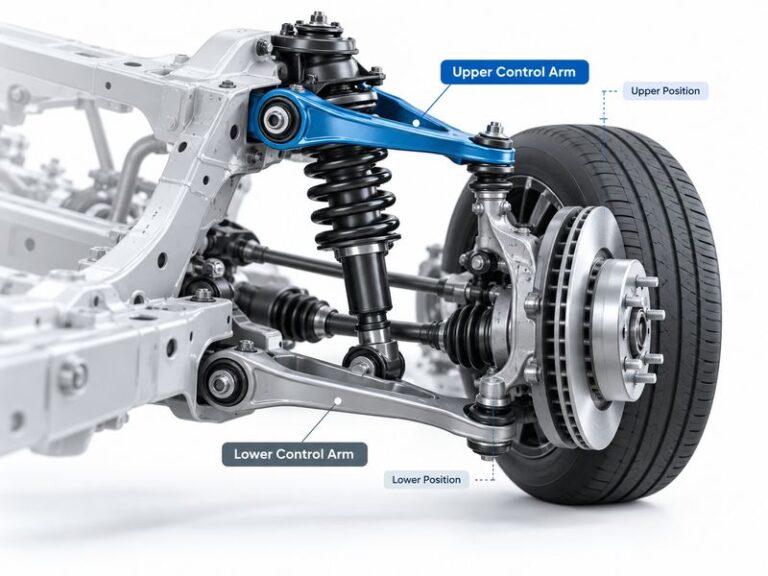
On a suspension with two control arms, the upper arm sits above the wheel hub area and the lower arm sits below it. Together, they help control the wheel’s path as the suspension moves.

- ✦ Control arm bushings
These flexible mounts reduce noise and allow controlled arm movement.
- ✦ Ball joint
This pivot lets the knuckle move with the suspension and, at a steering axle, turn with the wheels.
- ✦ Steering knuckle
This part supports the wheel hub and connects several suspension and steering parts.
What Does the Upper Control Arm Do?
The upper control arm helps locate the top of the steering knuckle or wheel carrier. It guides wheel movement and can help control camber as the suspension travels.
Not every vehicle needs a separate upper control arm. In some designs, the strut or several smaller links perform the same basic locating job.
- ✦ Upper wheel control
It helps keep the top of the wheel assembly in the intended path.
What Does the Lower Control Arm Do?
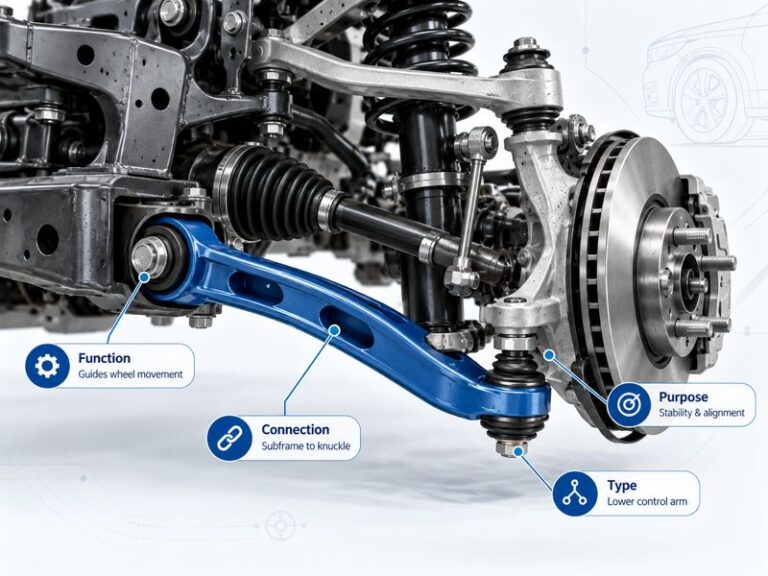
The lower control arm supports and locates the lower part of the wheel assembly. It usually attaches to the subframe or chassis and then to the steering knuckle.
On many common passenger cars, the lower control arm is one of the main links between the wheel and the vehicle body. This is why a car can have lower control arms even when it has no upper control arms.
- ✦ Lower wheel location
It controls the lower section of the wheel assembly as the suspension moves.
Why Some Cars Have Only Lower Control Arms
One major reason the answer to **do all cars have upper and lower control arms** is no is the MacPherson strut. This suspension is common on passenger cars and crossovers.
A MacPherson strut combines several jobs in one tall unit. The strut connects near the top of the wheel assembly and mounts to the vehicle body. The lower control arm locates the bottom of the steering knuckle.
Because the strut helps locate the upper part of the wheel assembly, a normal upper control arm is often not needed. This can save space and reduce the number of suspension parts.
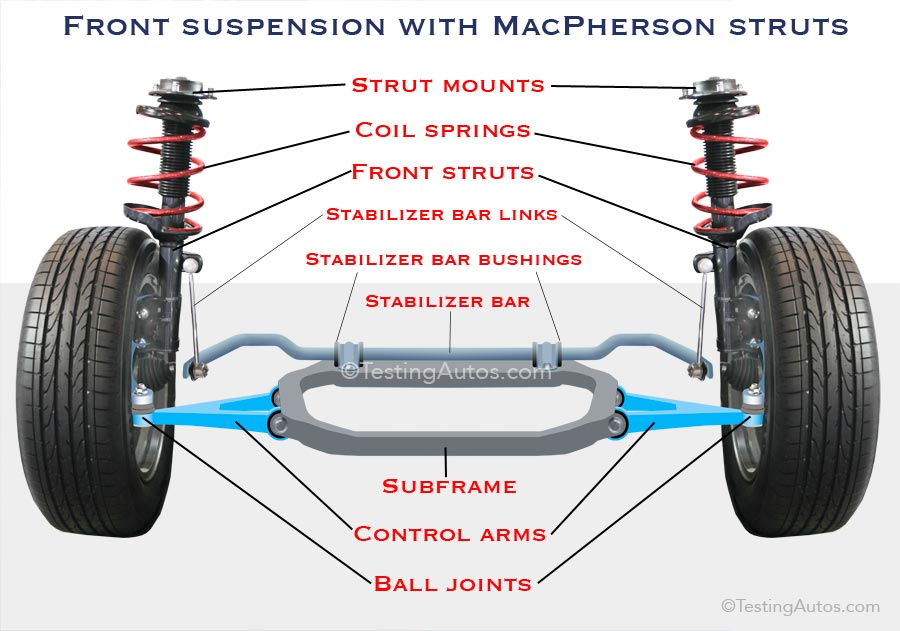
- ✦ Lower control arm
Locates the lower part of the steering knuckle.
- ✦ Strut
Acts as a structural suspension member while also containing the damper.
- ✦ Strut mount
Connects the upper end of the strut to the vehicle body.
- ✦ Steering knuckle
Connects the wheel hub, strut, lower arm, and steering parts.
How a MacPherson Strut Replaces the Upper Arm
With a double wishbone setup, an upper arm controls the upper part of the knuckle. With a MacPherson design, the strut itself helps guide that area.
This does not mean the suspension lacks upper support. It means the support comes from a different part. The strut and its upper mount take on work that a separate upper control arm would handle in another design.
- ✦ Key difference
The strut becomes part of the wheel-locating structure rather than serving only as a shock absorber.
Why Automakers Use MacPherson Struts
MacPherson struts are compact and use relatively few major parts. They also leave useful space in many front-engine cars.
That makes the design well suited to many sedans, hatchbacks, and crossovers sold in the United States. It is one of the main reasons you should never assume every car has an upper control arm.
- ✦ Simple layout
The design can achieve effective wheel control with fewer major links.
- ✦ Useful packaging
It can work well in vehicles where engine-bay space matters.
Cars That Use Both Upper and Lower Control Arms
Vehicles with double wishbone suspension commonly use both an upper and a lower control arm. The two arms form a shape that looks somewhat like two wishbones holding the steering knuckle between them.
This design gives engineers a lot of control over wheel motion. They can tune the arm lengths, angles, and mounting points to manage how the wheel tilts and moves through suspension travel.
Double wishbone layouts can appear on sports cars, luxury vehicles, SUVs, and trucks. Still, the presence of both arms depends on the exact model and axle.
So, if you are researching **do all cars have upper and lower control arms** because you need a replacement part, do not order parts based only on vehicle type. Check the exact year, make, model, trim, and suspension.
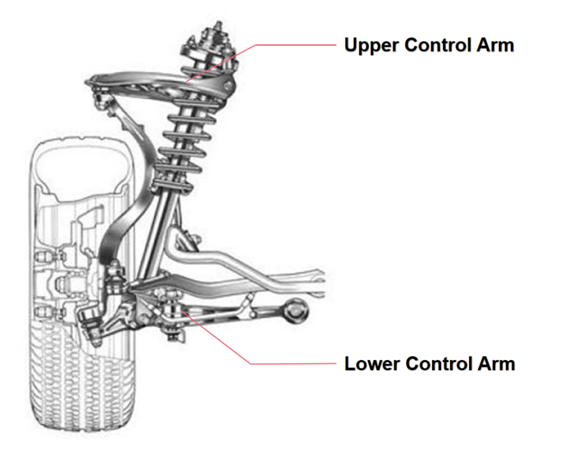
- ✦ Upper control arm
Guides the upper part of the steering knuckle.
- ✦ Lower control arm
Guides and supports the lower part of the steering knuckle.
- ✦ Two ball joints
Many double wishbone systems use upper and lower ball joints, though designs can vary.
Advantages of Using Upper and Lower Arms
The layout gives suspension engineers more freedom to control wheel alignment as the suspension moves. This can help maintain tire contact during cornering and over uneven roads.
It can also work well where strength and suspension travel matter. That is one reason versions of the design are used in some trucks and performance vehicles.
- ✦ Wheel control
The two-arm layout allows precise control of wheel movement.
- ✦ Alignment tuning
Arm geometry can be designed to manage camber changes through suspension travel.
- ✦ Design flexibility
Engineers can adapt the layout for comfort, handling, load capacity, or off-road use.
What About Multi-Link Suspension?
Multi-link suspension makes the question **do all cars have upper and lower control arms** more complex. Instead of using one large upper arm and one large lower arm, a multi-link setup can use several individual links.
Each link can control a different part of wheel movement. One may help manage lateral motion. Another may control fore-and-aft movement. Other links can help control wheel angle.
Some manufacturers still call one or more of these parts control arms. Others use names such as lateral link, toe link, trailing link, tension arm, or camber arm.
The key point is that a multi-link car may not have parts that look like a classic upper and lower control arm pair. It still has links that locate the wheel.

- ✦ Lateral link
Helps control side-to-side wheel position.
- ✦ Toe link
Helps control the direction the wheel points relative to the vehicle.
- ✦ Trailing link
Helps control forward and backward wheel movement.
- ✦ Camber link
Can help control wheel tilt as the suspension moves.
Why Multi-Link Parts Can Be Confusing
Part names are not always consistent between manufacturers. A link that one brand calls a control arm may have another name in a different parts catalog.
For repair work, the safest approach is to use a suspension diagram or an exact vehicle parts catalog. Do not identify a link only by its shape.
- ✦ Check the diagram
A suspension diagram shows where each link mounts and what the manufacturer calls it.
- ✦ Match the vehicle
Use the year, make, model, drivetrain, and suspension option when buying parts.
Do Front and Rear Suspensions Use the Same Control Arms?
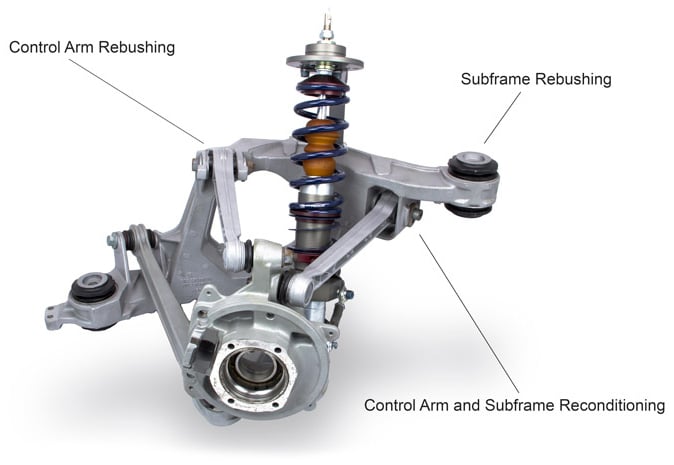
No. Front and rear suspension systems can use very different layouts on the same vehicle. A car may have lower control arms at the front and several links at the rear.
The front wheels often need suspension parts that work with steering. On front-wheel-drive and all-wheel-drive vehicles, the system must also leave room for drive axles.
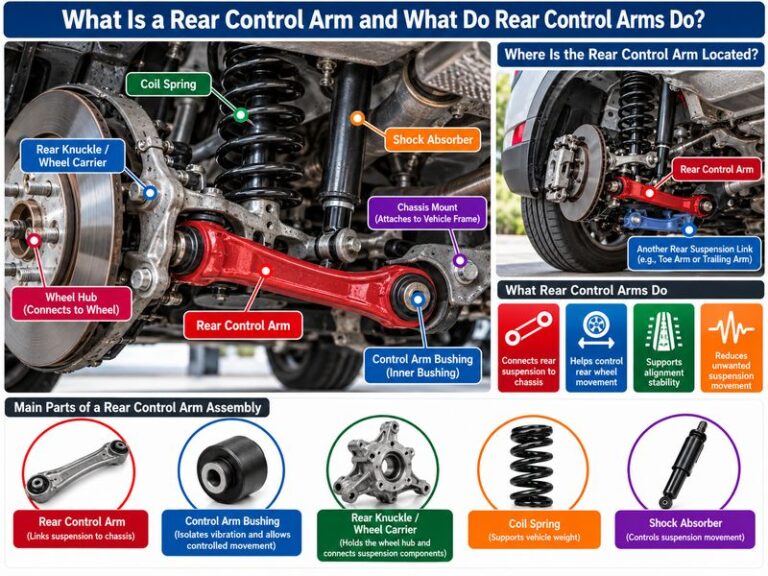
Rear wheels may use trailing arms, lateral links, control arms, a torsion beam, or a solid axle. This means asking **do all cars have upper and lower control arms** is not enough by itself. You also need to ask which axle you mean.
- ✦ Front axle
Often combines suspension with steering and may also need space for drive axles.
- ✦ Rear axle
May use independent links, trailing arms, a beam axle, or other layouts.
- ✦ Same vehicle, different systems
The front and rear suspension do not need to use matching designs.
Rear Independent Suspension
An independent rear suspension lets each rear wheel move with less direct effect on the wheel on the other side. It may use several control arms or links.
Some rear systems have parts that can reasonably be described as upper and lower arms. Others use several links with more specific names.
- ✦ Independent movement
Each wheel has its own set of links and can move through its suspension travel separately.
Torsion Beam and Solid Axle Designs
A torsion beam rear suspension does not normally use a traditional upper-and-lower control arm pair at each rear wheel. The beam and attached trailing sections locate the wheels.
Solid axle systems also use different methods. They may rely on leaf springs, trailing arms, radius arms, or multiple links to locate the axle.
- ✦ Different structure
These systems control an axle or beam rather than locating each wheel with two wishbone-style arms.
How to Tell Whether Your Car Has Upper and Lower Control Arms
The easiest method is to check an accurate suspension diagram for your exact vehicle. Owner manuals may not show every suspension component, so a repair manual or model-specific parts catalog is often more useful.
You can also look behind the wheel if you can see the suspension safely. A double wishbone design often has one arm connected near the upper part of the steering knuckle and another connected near the bottom.
A MacPherson strut setup usually has a large strut attached to the upper area of the steering knuckle and a control arm below it. Multi-link systems may show several smaller arms running in different directions.
If you came here asking **do all cars have upper and lower control arms** because a shop recommended a repair, ask which exact arm or link needs service. A clear part name and location can prevent confusion.
- ✦ Use your VIN
A VIN-based parts lookup can help identify the correct suspension configuration.
- ✦ Check a repair manual
A model-specific manual can show suspension diagrams and component names.
- ✦ Look at the steering knuckle
Check which arms, links, or struts connect the knuckle to the vehicle.
- ✦ Ask for the exact location
Terms such as front left lower arm or rear upper link are more useful than the words control arm alone.
Do Not Assume the Left and Right Sides Use Identical Parts
The basic suspension layout is usually similar from side to side, but the actual parts may be side-specific. A left control arm may not fit the right side.
Some models also change suspension designs between trim levels, drivetrains, or production years. Always verify the part number before buying a replacement.
- ✦ Verify fitment
Match the replacement part to the exact side, axle, model year, and suspension package.
Upper vs. Lower Control Arms: Key Differences
On a vehicle that has both, the upper and lower control arms share the job of locating the wheel assembly. Their positions and loads are not identical, though.
The lower control arm is mounted below the wheel hub area and often carries significant suspension loads. Depending on the design, the spring or strut may attach to the lower arm.
The upper control arm sits above the hub area. Its geometry helps locate the upper portion of the knuckle and control wheel angle through suspension movement.
Neither part should be viewed as more important in every vehicle. The suspension works as a system, and failure of a ball joint, bushing, arm, or mounting point can affect handling and tire wear.
- ✦ Position
The upper arm sits above the hub area, while the lower arm sits below it.
- ✦ Load
The lower arm may carry major suspension loads depending on spring and shock placement.
- ✦ Geometry
Both arms help guide the wheel, but their length and angle can serve different geometry goals.
- ✦ Availability
Lower arms are used in many systems that have no separate upper arm.
Do Control Arms Always Come With Ball Joints?
No. Some replacement control arms come with a ball joint already installed. Others are sold as a bare arm, or the ball joint may be a separate service part.
The design varies by vehicle and parts brand. Check the product description before buying so you know whether the ball joint and bushings are included.
- ✦ Complete assembly
May include the arm, bushings, and ball joint.
- ✦ Bare control arm
May require separate bushings or a separate ball joint.
Why Knowing Your Suspension Type Matters
Knowing what suspension your car uses can save time when you diagnose noise, shop for parts, or discuss a repair. It can also stop you from searching for a part that your vehicle does not have.
For example, a driver may hear that worn upper control arm bushings can cause suspension noise. If that driver’s car has MacPherson struts and no upper control arms, the actual source must be somewhere else.
The same rule applies when shopping online. A generic search for upper control arms is not enough. Correct fit depends on the exact suspension design.
That practical point is one of the most useful lessons behind the question **do all cars have upper and lower control arms**. Learn the layout first, then diagnose or order parts.
- ✦ Better diagnosis
You know which joints, arms, mounts, and links actually exist on the vehicle.
- ✦ Correct parts
You are less likely to order a component meant for another suspension design.
- ✦ Clearer repair discussions
You can ask a shop which exact arm, link, bushing, or joint needs attention.
Common Signs of Worn Control Arm Parts
Worn control arm bushings or ball joints can cause clunks, loose steering feel, uneven tire wear, or alignment problems. The exact symptoms depend on which part has wear and how severe it is.
These symptoms can also come from tie rods, strut mounts, wheel bearings, sway bar links, or other parts. A proper inspection is important before replacing anything.
- ✦ Clunking noise
A worn joint or bushing may move when the suspension changes direction.
- ✦ Uneven tire wear
Excess movement can change wheel alignment while driving.
- ✦ Loose handling
Worn suspension joints can reduce precise wheel control.
- ✦ Alignment trouble
Damaged or worn suspension parts can make correct alignment hard to maintain.
Common Misconceptions About Upper and Lower Control Arms
One common mistake is thinking every independent suspension needs both upper and lower control arms. Independent suspension only means the wheels can move with a degree of independence from each other. It does not require a double wishbone design.
Another mistake is assuming that a car without an upper control arm is missing a suspension part. In a MacPherson setup, the strut is part of the intended structure.
People also sometimes assume every suspension link is a control arm. The term can be used broadly, but modern multi-link systems often give individual links specific names based on their job.
- ✦ Myth: Every car has two control arms per wheel
False. The number and type of suspension links vary widely.
- ✦ Myth: No upper arm means an incomplete suspension
False. A strut or other links can locate the upper part of the wheel assembly.
- ✦ Myth: All control arms look alike
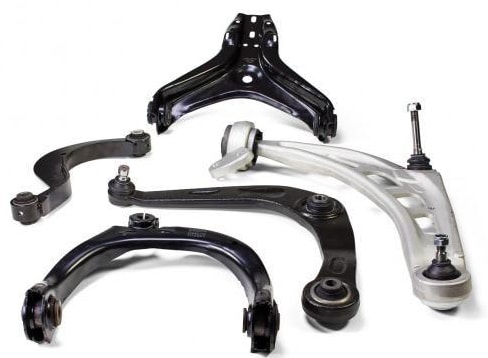
False. They can be A-shaped, L-shaped, straight, curved, stamped, cast, or forged.
- ✦ Myth: Front and rear suspension must match
False. Many cars use one suspension type at the front and another at the rear.
Control Arm Names Can Vary
Automakers and parts makers do not always use the same terms. A part may be called a control arm, wishbone, tension arm, radius arm, or suspension link depending on the design.
Focus on where the part mounts and what job it performs. That is more reliable than assuming a name means the same thing on every vehicle.
- ✦ Best practice
Use the factory diagram or a trusted vehicle-specific parts catalog to confirm component names.