Can You Replace Ball Joint Without Replacing Control Arm?
If you are asking, “can you replace ball joint without replacing control arm,” the answer depends on how your vehicle was built. On many cars, trucks, and SUVs, the ball joint is a separate part that can be pressed, bolted, or otherwise removed from the control arm. In that case, there is no need to replace a good control arm just because its ball joint has worn out.
Other vehicles are different. Some manufacturers sell the ball joint only as part of a complete control arm assembly. The joint may be permanently attached, or removing it may not be an approved repair. This is common on many newer suspension designs where the manufacturer treats the arm, bushings, and ball joint as one unit.
The best repair also depends on the condition of the rest of the suspension. A separate ball joint may save money when the arm and bushings are healthy. If the control arm bushings are cracked, loose, or badly worn, installing a complete arm can solve several problems at once.
A useful repair rule is simple: do not replace more parts than needed, but do not install a new ball joint into a control arm that is already near the end of its life. Check the complete assembly before deciding.

Can You Replace Ball Joint Without Replacing Control Arm?
Yes, you can replace ball joint without replacing control arm on vehicles that use a serviceable ball joint. The ball joint may be pressed into the arm, bolted to it, or held with other removable hardware. When the control arm itself is straight and its bushings are still in good shape, replacing only the worn joint can be a sound repair.
The key word is serviceable. Some ball joints were designed to come out of the control arm. Others were not. You should confirm the design before buying parts or taking the suspension apart.
A replacement parts catalog can give you an early clue. If your exact vehicle has a separately listed ball joint, there is a good chance it can be serviced alone. Still, the correct repair procedure should be checked because aftermarket parts may offer options that differ from the original factory setup.
If only complete control arm assemblies are listed for your vehicle, the joint may be integrated into the arm. In that case, replacing the full assembly is usually the correct solution.

- ✦ Separate ball joint
The joint can usually be removed and replaced while the original control arm stays in service.
- ✦ Integrated ball joint
The ball joint is treated as part of the control arm, so the full arm normally gets replaced.
- ✦ Condition matters
Even a removable joint may not be worth replacing alone if the control arm bushings or arm are already worn.
How to Tell If Your Ball Joint Is Replaceable
Look at the way the ball joint attaches to the control arm. A visible retaining ring, mounting bolts, or a press-fit housing often indicates that the joint can be serviced. A joint built permanently into a formed or cast arm may require complete control arm replacement.
Do not rely only on appearance. Vehicle-specific service information is the safest guide because suspension designs that look similar can use different repair methods.
- ✦ Check parts listings
Search by year, make, model, engine, and drivetrain to see whether a separate ball joint is sold.
- ✦ Check service information
Confirm whether the manufacturer provides a procedure for removing and installing the joint separately.
How the Ball Joint and Control Arm Work Together
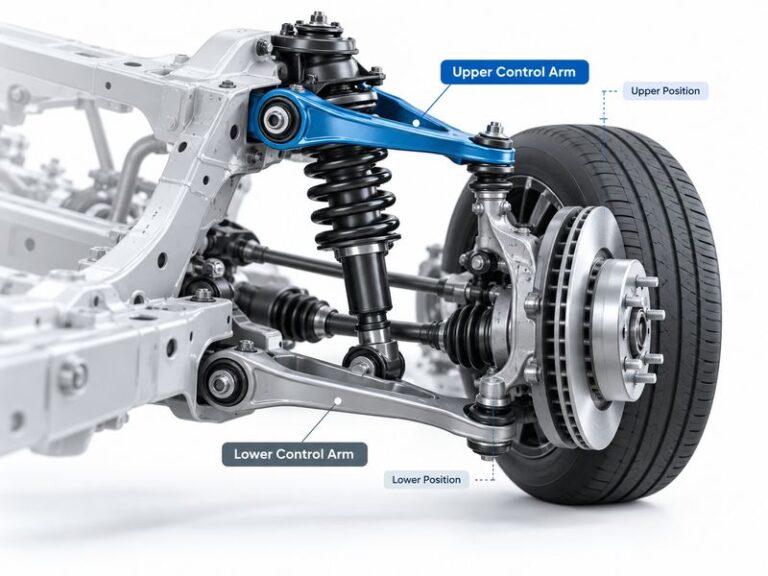
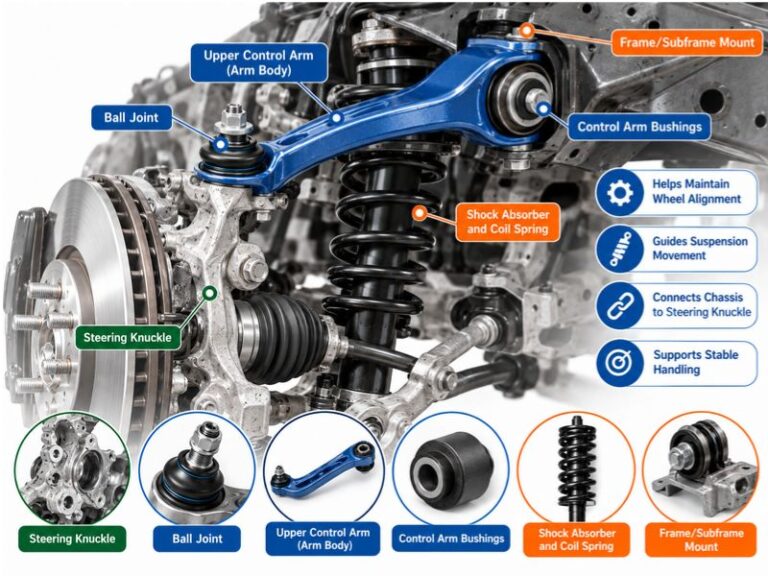
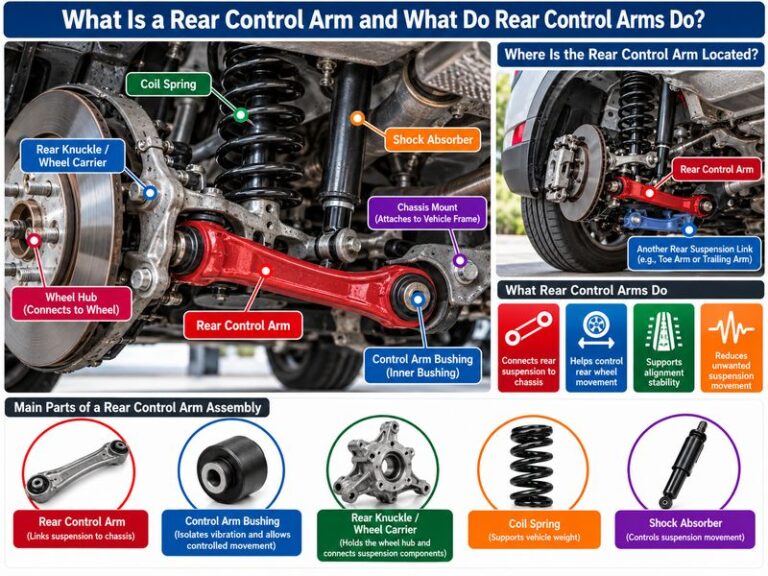
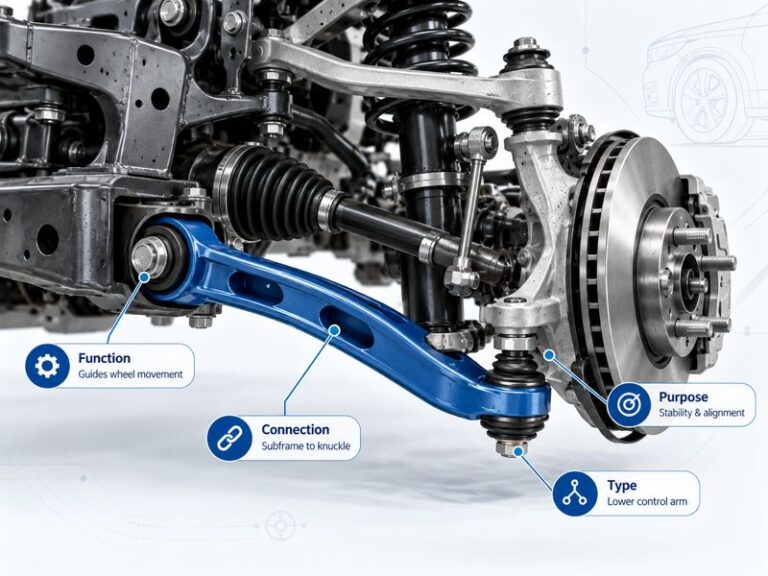
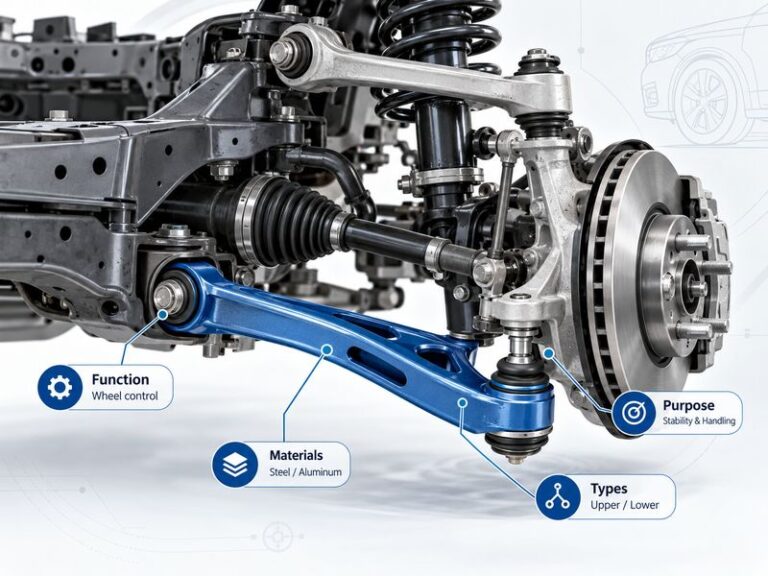
A control arm connects the wheel assembly to the vehicle’s frame or subframe. Its inner end normally pivots on rubber or hydraulic bushings. The outer end often connects to the steering knuckle through a ball joint.
The ball joint works like a strong metal pivot. It lets the suspension move up and down while also allowing the steering knuckle to change angle as the wheels turn. This movement must happen while the joint carries significant vehicle load.
Inside a typical ball joint is a hardened ball stud inside a socket. Grease reduces friction, while a rubber boot keeps dirt and water away from the moving surfaces. Once the boot fails or the internal surfaces wear, looseness can develop.
The ball joint and control arm work together, but they do not always wear at the same rate. This is why the answer to can you replace ball joint without replacing control arm is often yes. One part can fail while the other remains completely usable.

- ✦ Control arm
Positions the wheel and allows controlled suspension movement.
- ✦ Control arm bushings
Let the arm pivot while helping absorb road vibration and impact.
- ✦ Ball joint
Creates a flexible connection between the control arm and steering knuckle.
Upper vs. Lower Ball Joints
Some suspension systems have both upper and lower control arms, with a ball joint at each arm. Other systems, such as many MacPherson strut designs, often use only a lower control arm and lower ball joint.
The replacement method can differ between upper and lower joints. One may be removable while another comes only with its control arm. Check each location separately.
Types of Ball Joint Mounting Designs
Knowing the mounting design makes it much easier to understand whether you can replace the ball joint alone. Several common designs are used on vehicles sold in the United States.
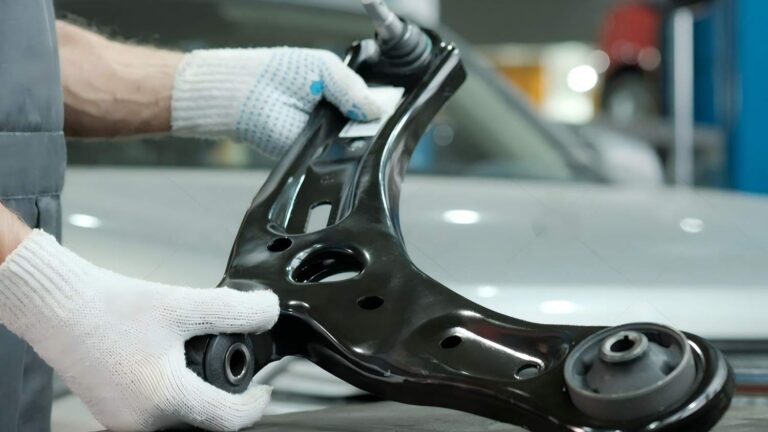
A press-fit ball joint sits tightly inside a machined opening in the control arm. A special ball joint press is commonly used to push the old joint out and install the new one without damaging the arm.
Bolt-in joints attach with nuts and bolts. These are often easier to replace because no heavy press work is needed. Some older original joints were riveted to the arm, while replacement joints use bolts after the rivets are removed.
An integrated joint is different. The joint and control arm are supplied as one assembly. If that joint fails, replacement of the complete control arm is normally required.

- ✦ Press-fit
The joint is pressed tightly into the control arm and normally requires a suitable press tool.
- ✦ Bolt-in
Bolts secure the joint to the arm, making separate replacement relatively straightforward.
- ✦ Riveted
Factory rivets may need to be removed before a bolt-in replacement joint can be fitted.
- ✦ Integrated
The joint is part of the control arm assembly and normally cannot be serviced separately.
Why Press-Fit Joints Need Extra Care
A press-fit joint must enter the control arm straight. The installer should support the arm correctly and apply force to the correct part of the joint housing. Poor tool placement can damage the new joint, distort the arm, or damage the mounting bore.
If the hole in the control arm has become enlarged, damaged, or badly rusted, a new press-fit ball joint may not fit securely. In that situation, replacing the control arm is safer than forcing another joint into a damaged mounting point.
When Replacing Only the Ball Joint Makes Sense
Replacing only the ball joint makes the most sense when the joint is clearly the failed part and everything around it remains healthy. This approach avoids throwing away a good control arm and can reduce the total parts cost.
For example, imagine a truck with a worn lower ball joint but firm control arm bushings. The arm is straight, rust is minor, and the ball joint is sold as a separate service part. In that case, replacing the joint alone is usually reasonable.
This can be especially useful when the original control arm is a high-quality factory part. A good original arm with new serviceable components may be preferable to replacing it simply because one wear item has failed.
However, labor must also be considered. A low-cost ball joint is not automatically the cheapest repair if removing and pressing it takes far more time than installing a complete preassembled control arm.
- ✦ The control arm is straight
There should be no bends, cracks, impact damage, or severe corrosion.
- ✦ The bushings are healthy
Bushings should not have major cracks, separation, excessive movement, or fluid leakage on hydraulic designs.
- ✦ The joint is serviceable
A correct replacement joint and approved installation method should exist for the vehicle.
- ✦ The mounting bore is sound
A press-fit joint needs a solid, correctly sized mounting surface.
Replacing a Good Control Arm Is Not Always Necessary
A worn ball joint does not automatically mean the control arm has failed. Ball joints and bushings are separate wear points, even when they share the same assembly.
This distinction matters when deciding can you replace ball joint without replacing control arm. If inspection shows the arm and bushings are still sound, a separate joint can restore the failed connection without replacing extra parts.
When You Should Replace the Whole Control Arm
There are also many cases where replacing the complete control arm is the better repair. The most obvious is an integrated ball joint that is not intended to come out of the arm.
A complete arm also makes sense when the bushings are worn. Installing a new ball joint while leaving badly cracked or loose bushings can result in continued clunks, poor handling, unstable braking, or alignment problems.
Replace the arm if it is bent, cracked, heavily corroded, or damaged near the ball joint bore. A new ball joint cannot correct structural damage to the arm.
Complete control arms are often sold with new bushings and a new ball joint already installed. This can reduce labor because the technician does not need to remove old bushings or press a ball joint in and out.

- ✦ Ball joint is integrated
The joint is not designed as a separate service part.
- ✦ Bushings are worn
Replacing the complete assembly renews the joint and bushings at the same time.
- ✦ Control arm is damaged
Bent, cracked, or badly corroded suspension arms should be replaced.
- ✦ Ball joint bore is damaged
A loose or distorted press-fit opening may not safely retain a new joint.
- ✦ Labor favors a complete arm
A preassembled control arm can sometimes reduce shop time enough to offset its higher parts price.
Check the Bushings Before Making the Decision
Control arm bushings deserve close attention. Look for major rubber cracks, tearing, separation from the sleeve, excessive movement, or obvious fluid leakage on fluid-filled designs.
A few small surface cracks do not always mean a bushing has failed. What matters is whether the bushing still controls movement as designed.
Rust Can Change the Repair Plan
Surface rust is common in many parts of the United States and does not always require arm replacement. Heavy scaling, deep corrosion, or weakened metal is different.
Rust can also make a press-fit ball joint difficult to remove. If corrosion has damaged the bore or weakened the arm, replacing the full assembly can provide a more dependable repair.
How to Check Whether the Control Arm Is Still Good
Before replacing only the ball joint, inspect the complete control arm. This step is important because a failed ball joint can hide other suspension wear.
Start with the arm itself. Look for bends, cracks, severe rust, damaged mounting points, or signs that the vehicle hit a curb or pothole hard enough to distort the suspension.
Next, inspect the bushings. They should hold the arm firmly while still allowing normal suspension movement. Excessive movement, torn rubber, or separation from the inner or outer sleeve can indicate failure.
Finally, inspect the ball joint mounting area. A press-fit replacement depends on a tight connection between the new joint and the arm. If the bore has become enlarged or distorted, the control arm should usually be replaced.
- ✦ Look for bends
Compare the arm shape with the opposite side when possible.
- ✦ Inspect bushings
Watch for torn rubber, separation, fluid leakage, or excess movement.
- ✦ Check corrosion
Pay special attention to mounting points and the area around the ball joint.
- ✦ Inspect the joint bore
A press-fit joint must fit tightly and securely.
Why a Visual Check Alone May Not Be Enough
Some worn bushings look acceptable until the suspension is loaded or moved with the proper tool. A technician may use a pry bar or other approved method to check unwanted movement.
Ball joint inspection also varies by suspension design. Some joints must be checked with the suspension loaded, while others require the wheel to hang. Follow the correct procedure for the vehicle.
Signs the Ball Joint May Need Replacement
Ball joints wear slowly in many cases, but symptoms tend to become more noticeable as internal clearance increases. The driver may first notice a light clunk from one front corner when crossing bumps.
Steering can also feel less precise. The vehicle may wander, feel loose, or need more correction than before. Tire wear can become uneven if joint movement changes wheel alignment while driving.
A damaged grease boot is another warning sign. Once the boot tears, grease can escape and dirt or water can enter the joint. The joint may still feel tight at first, but contamination can speed up wear.
Do not diagnose a ball joint from noise alone. Tie rods, sway bar links, struts, wheel bearings, control arm bushings, and other suspension parts can cause similar symptoms.
- ✦ Clunking noise
A loose joint may knock when the suspension changes direction over bumps.
- ✦ Loose steering feel
Excess joint movement can reduce steering precision.
- ✦ Uneven tire wear
A badly worn joint can allow wheel alignment angles to change.
- ✦ Torn dust boot
Boot damage exposes the internal joint to contamination and loss of grease.
- ✦ Measured play
Movement beyond the vehicle maker’s limit is strong evidence that replacement is needed.
Can You Drive With a Bad Ball Joint?
Driving with a confirmed badly worn ball joint is risky. The joint is part of the connection that keeps the wheel and steering knuckle positioned under the vehicle.
Severe failure can allow the joint to separate. That can cause major loss of wheel control and additional suspension damage. A vehicle with significant ball joint looseness should be repaired promptly.
Ball Joint Replacement Without Replacing the Control Arm: Basic Process
The exact procedure differs by vehicle, but the general idea is similar. The vehicle is safely raised, the wheel is removed, and the suspension is accessed. The ball joint stud is then separated from the steering knuckle.
After that, the joint must be removed from the control arm. A bolt-in joint may require only normal hand tools. A press-fit joint often requires a C-frame ball joint press and adapters that match the joint and arm.
The new joint must be installed in the correct direction and fully seated. Any required retaining ring, nut, cotter pin, or locking hardware must then be installed correctly.
Suspension hardware often has specific torque requirements. Some control arm bushing bolts also need final tightening at normal ride height. Following the correct service method helps prevent bushing damage and loose hardware.

- ✦ Raise and support the vehicle
Use safe lifting points and suitable jack stands before working under the vehicle.
- ✦ Disconnect the ball joint
Separate the ball joint stud from the steering knuckle using the proper method.
- ✦ Remove the old joint
Unbolt, drill out, or press out the joint according to its mounting design.
- ✦ Install the new joint
Seat it fully without damaging the boot, stud, housing, or control arm.
- ✦ Torque all fasteners
Use vehicle-specific torque specifications and install required locking hardware.
- ✦ Check alignment
Verify wheel alignment after suspension work when the repair can affect suspension geometry.
Do You Need a Ball Joint Press?
You need a ball joint press when the vehicle uses a press-fit joint and the service procedure calls for one. The tool applies controlled force through adapters that support the control arm and joint housing.
Hammering a press-fit joint in or out can damage the control arm or new joint. It can also make it hard to keep the joint straight during installation.
Can You Replace a Ball Joint Without Removing the Control Arm?
Sometimes you can. Many press-style tools are designed to remove and install the joint while the control arm remains attached to the vehicle.
Access varies greatly, though. Exhaust parts, axles, steering components, or the shape of the suspension may make removal of the control arm easier or necessary.
Ball Joint Only vs. Complete Control Arm Replacement
The choice between a ball joint and complete control arm should be based on total repair value, not just the price shown for one part. A separate joint is usually cheaper to buy. However, the installation can require more labor and special tools.
A complete control arm costs more as a part, but many assemblies include new bushings and a new ball joint. The old arm comes off and the new assembly bolts into place. This can be faster than pressing individual components.
For a DIY repair, tool access can change the decision. Buying or renting a press may make a separate joint practical. If pressing the joint is difficult or the bushings also need work, a complete arm can simplify the job.
In a professional shop, labor rates also matter. In some cases, the extra price of an assembled arm is offset by reduced labor time. That is why two valid repair estimates for the same vehicle may use different approaches.
- ✦ Ball joint only
Usually lower parts cost and ideal when the rest of the control arm is healthy.
- ✦ Complete control arm
Usually higher parts cost but may include new bushings and reduce installation labor.
- ✦ Best choice
Depends on vehicle design, arm condition, bushing condition, labor, tools, and replacement part quality.
Do Not Judge the Repair by Parts Price Alone
A ball joint may cost far less than an assembled control arm, but total cost includes labor and related work. Pressing out a badly rusted joint can take much longer than replacing an assembled arm.
On the other hand, replacing an expensive control arm makes little sense if a removable ball joint is the only worn part and installation is straightforward.
Does a Ball Joint Replacement Require an Alignment?
An alignment check is a smart idea after ball joint or control arm work. The ball joint helps locate the steering knuckle, so changes in its position can affect suspension geometry.
Whether adjustment is required depends on the vehicle design and the parts disturbed during repair. Some ball joint replacements have little direct effect on adjustable settings, while removing the control arm or other suspension hardware can change alignment.
There is another reason to check alignment. A badly worn ball joint may have allowed the wheel to move outside its proper position before repair. Once the loose part is replaced, measuring the alignment confirms that the rest of the suspension is positioned correctly.
If the steering wheel is off-center, the vehicle pulls, or tire wear is uneven, an alignment should receive special attention after the repair.
- ✦ Alignment check
Useful after suspension repairs to confirm wheel angles remain within specification.
- ✦ Control arm replacement
More likely to justify alignment measurement because major locating points have been disturbed.
- ✦ Existing tire wear
Uneven wear may show that alignment or other suspension issues were already present.
Common Mistakes to Avoid During Ball Joint Replacement
Ball joint replacement can look simple, but small errors can create serious problems. One common mistake is buying parts before confirming whether the joint is actually removable from the control arm.
Another mistake is pressing against the wrong surface. Force should be applied through the correct adapters so the ball joint housing and control arm are supported properly. Pressing against the stud or dust boot can ruin a new joint.
Ignoring the rest of the suspension is also a poor approach. If the ball joint has substantial wear, inspect the control arm bushings, tie rods, sway bar links, wheel bearing, and related components while access is available.
Finally, do not guess at fastener torque. Ball joint studs and suspension bolts are safety-critical hardware. Use the correct specification for the exact vehicle and replacement part.

- ✦ Assuming every ball joint is replaceable
Some joints are integrated and require complete control arm replacement.
- ✦ Using the wrong press adapters
Incorrect support can damage the joint or control arm.
- ✦ Damaging the dust boot
A torn new boot can allow contamination into the joint.
- ✦ Ignoring worn bushings
A new ball joint will not fix movement caused by failed control arm bushings.
- ✦ Skipping torque specifications
Improperly tightened suspension hardware can loosen or damage components.
Can You Replace Just One Ball Joint?
Yes, replacing one failed ball joint can be acceptable. Ball joints do not have to be replaced in pairs simply because they are located on opposite sides of the vehicle.
However, both sides often have similar age and mileage. If one has worn out, the joint on the other side deserves a careful inspection. Replace it if it also has excessive play, a damaged boot, or other clear signs of failure.
Do not replace a good joint only because the opposite side failed unless the vehicle maker, service condition, or repair strategy gives you a sound reason. Condition-based replacement can help control repair costs without ignoring safety.
The same idea applies when deciding can you replace ball joint without replacing control arm. Inspect each component and replace what the condition and vehicle design require.
- ✦ One failed joint
It can normally be replaced by itself when the opposite joint remains within specification.
- ✦ High-mileage suspension
Inspect the opposite side because similar wear may be developing.
- ✦ Replace based on condition
Use actual wear, damage, service guidance, and repair value to make the decision.
How to Decide Between a New Ball Joint and a New Control Arm
If you are still deciding can you replace ball joint without replacing control arm, work through the problem in a simple order. First, confirm whether your vehicle supports separate ball joint replacement.
Next, inspect the control arm and bushings. If the arm is straight and solid and the bushings are healthy, a separate ball joint often makes sense. If several parts of the assembly are worn, a complete arm becomes more attractive.
Then compare total repair cost. Include parts, labor, tool rental, alignment, and any additional hardware. The lowest parts price does not always produce the lowest final cost.
Lastly, consider how long you plan to keep the vehicle. Renewing the full assembly may provide better value on an older vehicle if the bushings are already close to needing replacement. On a vehicle with a healthy control arm, there may be little benefit in replacing good components early.
- ✦ Step 1
Confirm that the ball joint is available and approved as a separate service part.
- ✦ Step 2
Inspect the control arm, bushings, mounting points, and ball joint bore.
- ✦ Step 3
Compare the full cost of both repair methods.
- ✦ Step 4
Choose the repair that restores the suspension without leaving known worn parts behind.
A Practical Shop-Style Rule
A useful practical rule is to treat the suspension as a system rather than focusing on one part. If only the ball joint is bad, replace the joint when the design allows it. If the arm, bushings, and joint are all worn, replacing the assembly avoids doing similar labor again soon.
This approach also prevents unnecessary parts replacement. The goal is not to install the most parts. The goal is to restore safe, controlled suspension movement with a repair that makes sense for the vehicle.