Are Camber Arms and Control Arms the Same? Key Differences
If you have been shopping for suspension parts, you may wonder, **are camber arms and control arms the same**? The confusion is easy to understand. Both parts can connect the wheel assembly to the vehicle, and some aftermarket sellers use the terms almost interchangeably.
The key difference is purpose. A standard control arm helps locate the wheel and lets the suspension move through its normal travel. A camber arm usually refers to an arm that lets you change the wheel’s camber angle. In some vehicles, the same physical arm can perform both jobs.
This matters when you lower a car, install coilovers, change ride height, or try to fix uneven tire wear. Buying the wrong type of arm can leave you with no useful alignment adjustment. It can also waste time and money at the alignment shop.
From a practical repair point of view, I treat the part name as only the starting point. The mounting points, suspension layout, adjustment method, and vehicle application matter more than the label on the box. This guide explains how both parts work and how to tell which one your vehicle actually needs.

Are Camber Arms and Control Arms the Same?
So, **are camber arms and control arms the same**? Not in every case. A control arm is a broad type of suspension link. A camber arm is usually a more specific suspension link that affects or adjusts camber.
The two terms overlap because an adjustable control arm can sometimes change camber. In that case, the part may be sold as a control arm, camber arm, adjustable control arm, or camber kit. All four labels may describe very similar hardware.
However, many control arms have no camber adjustment at all. They may use fixed mounting points and simply keep the wheel hub in the correct position as the suspension moves.
A good way to think about it is this: **control arm describes what the link does in the suspension, while camber arm often describes what the adjustable version lets you change.**

- ✦ Standard control arm
Guides and locates the wheel assembly as the suspension moves.
- ✦ Camber arm
Usually provides a way to change the wheel’s inward or outward tilt.
- ✦ Adjustable control arm
May function as a camber arm if changing its length changes camber.
- ✦ Vehicle-specific naming
Manufacturers and aftermarket brands may use different names for similar suspension links.
Why the Names Get Confusing
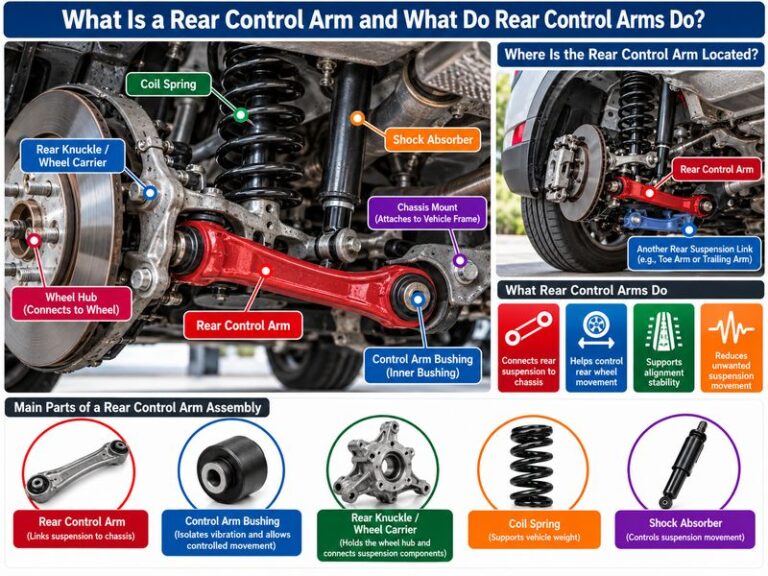
Modern suspension systems use several links around one wheel. Depending on the design, one may be called an upper control arm, lower control arm, lateral link, toe arm, trailing arm, radius arm, or camber arm.
Aftermarket companies often name adjustable links by the alignment angle they control. That means a factory upper link might be called an upper control arm in a service manual but sold as a rear camber arm when an adjustable version replaces it.
- ✦ Factory terminology
Usually focuses on the arm’s position and structural role.
- ✦ Aftermarket terminology
Often focuses on the adjustment the part provides.
What Is a Control Arm?
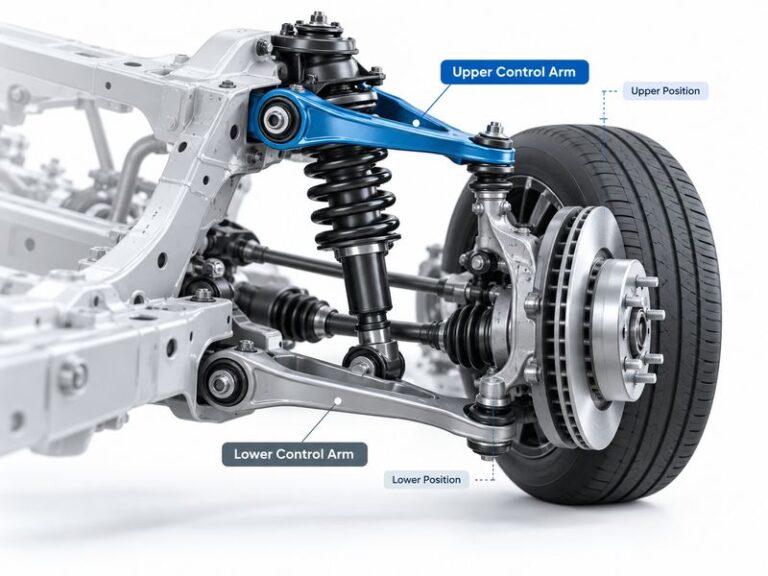
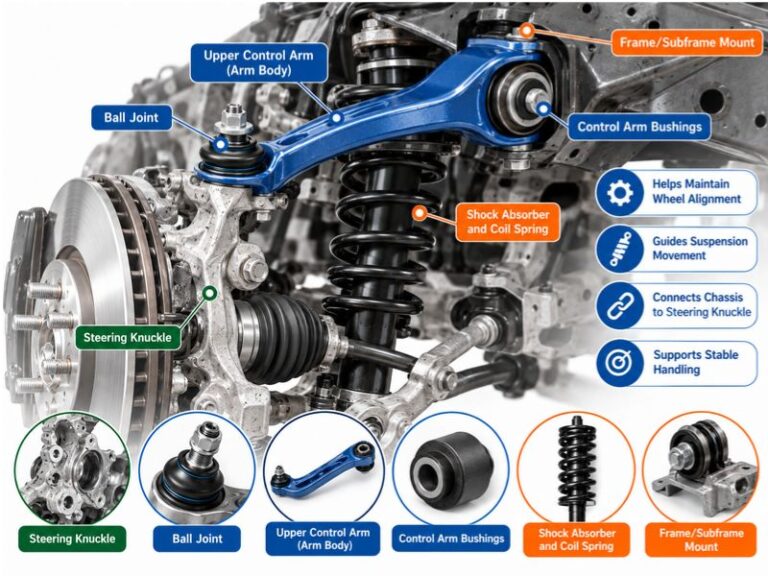
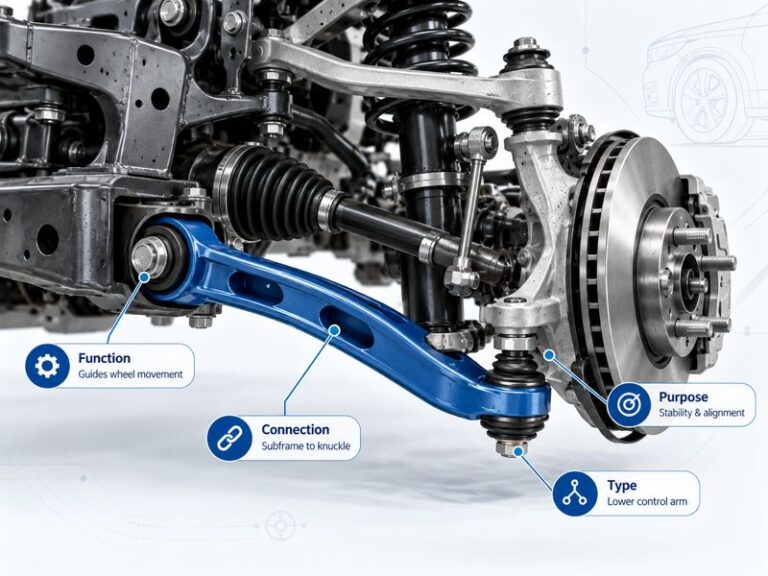
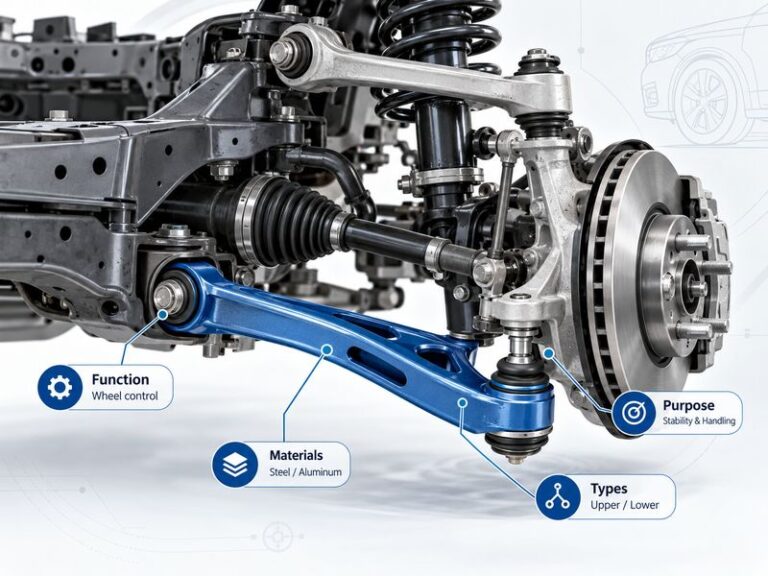
A control arm is a suspension link that connects part of the wheel assembly to the vehicle’s frame, subframe, or chassis. Its job is to hold the wheel in a controlled path while still allowing suspension movement.
Most control arms use bushings at the chassis side. Many also connect to the steering knuckle through a ball joint. This setup lets the wheel move up and down while keeping its position under control.
Some cars use one upper and one lower control arm. Others use a MacPherson strut design with a lower control arm only. Multi-link suspension may use several smaller links instead of the classic A-shaped control arm.
Control arms also help maintain suspension geometry. Their length, angle, and mounting points influence camber, caster, track width, and wheel movement.
- ✦ Connects suspension parts
A control arm links the wheel or knuckle to the chassis or subframe.
- ✦ Controls wheel motion
It guides how the wheel moves as the suspension compresses and rebounds.
- ✦ Supports alignment geometry
Its position helps define wheel angles throughout suspension travel.
- ✦ Uses joints and bushings
These parts allow controlled movement while reducing harsh vibration.
Upper vs. Lower Control Arms
Upper and lower control arms sit at different points around the wheel. In a double-wishbone design, both work together to guide the steering knuckle.
Changing the effective length of an upper or lower arm can change camber. This is why adjustable versions of either part may also be marketed as camber arms.
- ✦ Upper control arm
Often helps control the top of the steering knuckle and can have a strong effect on camber.
- ✦ Lower control arm
Supports the lower part of the knuckle and may also affect track width, caster, or camber.
What Is a Camber Arm?
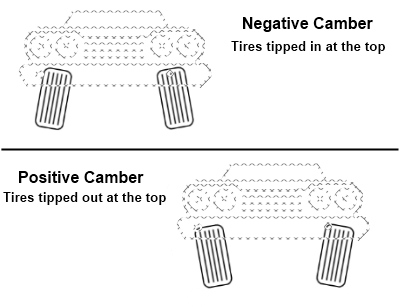
A camber arm is usually an adjustable suspension link used to change the wheel’s camber angle. Camber describes how much the wheel tilts inward or outward when viewed from the front or rear of the vehicle.
If the top of the tire leans inward, the wheel has negative camber. If the top leans outward, it has positive camber. A nearly upright wheel is close to zero camber.
Factory vehicles are designed with a specific camber range. Ride-height changes, worn suspension parts, crash damage, or performance modifications can move the wheel outside that range.
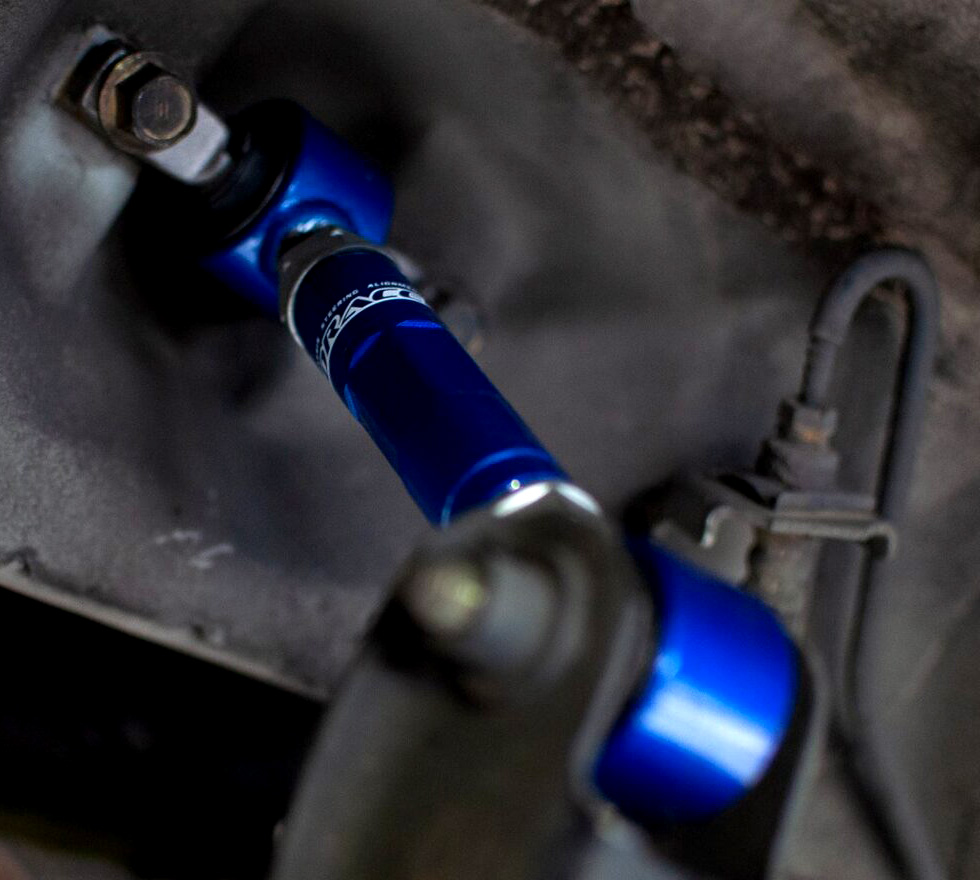
An adjustable camber arm changes the effective distance between two suspension mounting points. That moves part of the wheel carrier inward or outward and gives the alignment technician more control over camber.

- ✦ Main purpose
Provides more camber adjustment than the factory suspension may allow.
- ✦ Common location
Often found in the rear multi-link suspension, though designs vary widely.
- ✦ Typical design
Uses threaded sections, eccentric hardware, or another adjustable mechanism.
- ✦ Common use
Helps restore alignment after lowering or other suspension changes.
What Camber Actually Changes
Camber changes how the tire meets the road. Too much negative or positive camber can place more load on one edge of the tread.
Performance cars may use some negative camber to improve tire contact during cornering. Street cars still need a practical setting that balances grip, stability, steering feel, and tire life.
- ✦ Negative camber
The top of the wheel tilts toward the center of the vehicle.
- ✦ Positive camber
The top of the wheel tilts away from the center of the vehicle.
Camber Arm vs. Control Arm: The Main Differences
When drivers ask **are camber arms and control arms the same**, the easiest answer comes from comparing their normal roles. Both may be suspension links, but they are not defined in exactly the same way.
A standard control arm is part of the basic suspension structure. It keeps the wheel in its designed path. A camber arm usually adds adjustment so the wheel angle can be corrected or tuned.
The distinction is not based only on appearance. Two arms can look almost identical while having different adjustment ranges, mounting points, or effects on alignment.

- ✦ Primary role
A control arm locates the wheel. A camber arm usually adds camber adjustment.
- ✦ Adjustability
Many original control arms are fixed, while aftermarket camber arms are often adjustable.
- ✦ Alignment effect
Changing a camber arm is intended to alter camber, while changing a control arm may affect several alignment angles.
- ✦ Replacement reason
Control arms are often replaced for wear or damage. Camber arms are often installed for alignment correction or suspension tuning.
- ✦ Vehicle application
One vehicle may use a dedicated camber link, while another changes camber through an adjustable control arm.
Can a Control Arm Also Be a Camber Arm?
Yes. This is the most important exception. If an adjustable control arm changes the wheel’s camber angle when its length or mounting position changes, it is serving as a camber arm.
That does not mean every control arm is a camber arm. Fixed control arms may influence camber through their geometry but provide no direct adjustment.
- ✦ Fixed control arm
Maintains a designed geometry with little or no user adjustment.
- ✦ Adjustable control arm
May let the technician alter camber, caster, or another suspension setting.
How Control Arms Affect Camber
Even a control arm that is not called a camber arm can affect camber. Suspension geometry is based on the position of several links working together.
Imagine the upper part of a wheel carrier being pulled slightly toward the center of the car. The top of the tire also moves inward, which creates more negative camber. Moving it outward reduces negative camber or may create positive camber.
An upper control arm can often create this change directly. In some rear multi-link systems, another lateral link performs the same job.
The result is why the question **are camber arms and control arms the same** cannot be answered by part shape alone. You need to know which mounting points the arm controls.

- ✦ Arm length
Changing link length can pull or push part of the wheel carrier.
- ✦ Mounting angle
The angle of the arm affects how the wheel moves through suspension travel.
- ✦ Ride height
Lowering or raising the vehicle changes the resting position of the suspension links.
- ✦ Bushing condition
Worn bushings may let the wheel shift and change alignment under load.
Static Camber vs. Camber Gain
Static camber is the angle measured while the car sits at normal ride height. Camber gain describes how that angle changes as the suspension moves.
Control-arm length and mounting position affect both. An adjustable camber arm mainly helps set the resting alignment, but changing link geometry can also influence suspension behavior through its travel.
- ✦ Static camber
The wheel angle measured at the vehicle’s normal alignment height.
- ✦ Camber gain
The change in camber as the wheel moves up or down.
Why Cars Need Camber Arms After Lowering
Lowering a vehicle changes the normal resting position of the suspension. The control arms and other links may sit at different angles than they did at factory ride height.
On many independent suspension designs, this creates more negative camber. A small change may still fall within the manufacturer’s alignment range. A larger drop may exceed the available factory adjustment.
An adjustable camber arm can help move the wheel back toward the desired setting. It does this by changing the effective length of the suspension link.
This is one of the most common reasons owners encounter the phrase camber arm while shopping for suspension parts. The part may actually replace a factory control link but adds the adjustment needed after lowering.
- ✦ Lower ride height
Can move suspension links into a different part of their normal travel.
- ✦ Extra negative camber
May appear because the wheel follows the suspension’s designed movement path.
- ✦ Limited factory adjustment
Some vehicles cannot return to the desired specification with stock hardware.
- ✦ Adjustable arm solution
Provides a wider correction range when the original setup is no longer enough.
Do All Lowered Cars Need Camber Arms?
No. A mild drop may still allow a proper alignment with factory adjustment. Other cars may need aftermarket parts even after a modest ride-height change.
The smart approach is to measure the alignment after the suspension settles. Do not buy parts only because another owner with a different wheel setup or suspension package needed them.
- ✦ Measure first
Get alignment readings before deciding which adjustment parts are required.
- ✦ Check specifications
Compare the readings with the vehicle maker’s range or your chosen performance target.
How to Tell Whether You Need a Camber Arm or Control Arm
The first step is to identify the problem you are trying to solve. If a control arm is bent, cracked, or has worn bushings or a worn ball joint, you normally need a replacement control arm or its serviceable components.
If the suspension is healthy but camber cannot be adjusted to the needed setting, an adjustable camber arm may be the better solution. This often happens after lowering or other geometry changes.
Do not assume an adjustable arm can fix every bad alignment reading. Toe, caster, ride height, damaged components, shifted subframes, bent knuckles, and worn wheel bearings may also affect the alignment.
When people ask **are camber arms and control arms the same**, this diagnostic difference is useful. One term often points to a structural suspension repair, while the other often points to added alignment adjustment.
- ✦ Replace a damaged control arm
Use the correct replacement if the original arm is bent, cracked, or has failed joints.
- ✦ Add a camber arm for adjustment
Consider an adjustable arm when camber is outside the desired range and stock adjustment is not enough.
- ✦ Inspect related parts
Check bushings, ball joints, tie rods, wheel bearings, springs, struts, and mounting points.
- ✦ Verify with an alignment
Use actual alignment measurements rather than tire appearance alone.
Signs a Standard Control Arm May Be Bad
A worn control arm may cause clunks, unstable steering, uneven tire wear, or movement during braking. Torn bushings and loose ball joints are also common signs.
These symptoms point to a mechanical wear problem. An adjustable camber arm should not be used as a way to hide worn or damaged suspension parts.
- ✦ Clunking noise
Loose joints or bushings may knock when the wheel moves over bumps.
- ✦ Steering movement
A worn arm can let the wheel shift under braking or cornering.
- ✦ Visible damage
Bent metal, cracked bushings, or loose joints require inspection and repair.
Signs You May Need More Camber Adjustment
A vehicle may need more camber adjustment when the alignment shop cannot bring camber into the desired range. This is common after major ride-height changes.
Excess inner or outer tire wear can also appear with poor camber, but toe errors often cause severe tire wear too. A full alignment reading helps separate the causes.
- ✦ Camber remains out of range
Factory adjusters reach their limit before the target setting is achieved.
- ✦ Modified ride height
Lowered or raised suspension may require more adjustment than stock hardware provides.
Can a Camber Arm Replace a Control Arm?
Sometimes, but only if the adjustable camber arm is designed to replace that exact factory suspension link. The mounting style, dimensions, joint type, strength, and adjustment range must match the vehicle.
For example, a rear adjustable camber arm may replace a fixed rear upper suspension link. In that case, it takes over the original link’s structural job while adding camber adjustment.
You should never install an unrelated adjustable arm simply because the mounting holes appear close. Suspension links handle large loads and control wheel position. The correct vehicle application matters.
This is another reason the answer to **are camber arms and control arms the same** depends on design. A purpose-built adjustable replacement may be both, but a generic control arm is not automatically a camber arm.
- ✦ Direct replacement
The adjustable arm must be intended for the same suspension location.
- ✦ Correct joint design
Bushings, spherical joints, or ball joints must suit the vehicle and intended use.
- ✦ Adequate strength
The arm must safely handle braking, cornering, and road loads.
- ✦ Proper adjustment range
The arm must provide enough correction without creating unsafe geometry.
Camber Arms, Toe Arms, and Trailing Arms Are Not the Same
Multi-link suspension can make part names even more confusing. Several short links may connect one wheel carrier to the chassis, and each one can affect alignment in a different way.
A camber arm mainly changes camber. A toe arm mainly changes the direction the tire points when viewed from above. A trailing arm usually controls front-to-rear wheel movement and handles braking or acceleration forces.
Adjusting one link can still influence another alignment setting. That is why an alignment should be checked after changing any major suspension link.
Understanding this relationship helps answer **are camber arms and control arms the same** without oversimplifying the suspension. Camber arms belong to the wider family of locating links, but each link can have a different job.
- ✦ Camber arm
Primarily changes wheel tilt when viewed from the front or rear.
- ✦ Toe arm
Primarily changes whether the tire points inward or outward when viewed from above.
- ✦ Trailing arm
Primarily controls fore-and-aft movement of the wheel.
- ✦ Control arm
A broad suspension link that helps locate and guide the wheel.
How Adjustable Camber Arms Work
Most aftermarket camber arms work by changing their effective length. A threaded center section, turnbuckle, adjustable end, or eccentric mounting point moves the wheel carrier slightly.
The technician adjusts the arm, measures camber on alignment equipment, and repeats the process until the target is reached. The locking hardware must then be tightened to the correct specification.
Small changes at the arm can cause noticeable changes at the wheel. For that reason, guessing by eye is not a good alignment method.
After any camber adjustment, toe should also be checked. Changing one suspension link can shift other wheel angles.

- ✦ Threaded adjustment
Turning the adjuster lengthens or shortens the arm.
- ✦ Eccentric adjustment
An offset bolt or washer changes the mounting position.
- ✦ Locking hardware
Jam nuts or bolts hold the final adjustment in place.
- ✦ Alignment verification
Professional measuring equipment confirms the final wheel angles.
Why Alignment Is Needed After Installation
Installing an adjustable arm changes suspension geometry. Even if you match the old arm’s length before installation, the final alignment can still differ.
A four-wheel alignment is a practical choice for most modern cars because rear alignment can influence how the vehicle tracks and how the front wheels are set.
- ✦ Camber check
Confirms the wheel tilt is within the chosen target range.
- ✦ Toe check
Helps prevent rapid tire scrub after the camber change.
Do Camber Arms Improve Handling?
Camber arms do not automatically improve handling. Their value comes from giving you control over alignment.
On a modified car, the correct camber setting may improve tire contact during cornering and make steering behavior more consistent. However, excessive negative camber can reduce straight-line tire contact and contribute to uneven wear.
For a daily-driven car in the United States, a balanced alignment is usually more useful than an extreme setting. Road quality, highway driving, tire cost, wet-weather grip, and ride comfort all matter.
Performance drivers may choose a different alignment for autocross, road-course use, or other motorsports. Those settings should match the tire, suspension, driving style, and intended use.
- ✦ Street driving
Usually favors stable handling and reasonable tire wear.
- ✦ Performance driving
May use more negative camber to improve tire contact during hard cornering.
- ✦ Extreme camber
Can reduce usable tire contact in normal driving and may increase uneven wear.
Are Adjustable Camber Arms Safe?
Quality adjustable camber arms can be safe when they are designed for the vehicle, installed correctly, and kept within their intended adjustment range. The part must also be strong enough for normal suspension loads.
Installation quality matters. Loose jam nuts, improperly tightened mounting bolts, damaged threads, poor welds, or incorrect joint orientation can create serious problems.
Street-driven cars should also be checked from time to time. Bushings and joints wear, hardware can loosen, and harsh road impacts can affect alignment.
When choosing an adjustable arm, focus on correct fit, sound construction, useful adjustment range, replacement joint availability, and clear installation instructions rather than appearance alone.
- ✦ Use the correct application
Choose an arm made for your exact vehicle and suspension location.
- ✦ Follow torque specifications
Fasteners must be tightened correctly and in the proper suspension position when required.
- ✦ Inspect adjustment hardware
Make sure jam nuts, locking bolts, and threaded sections stay secure.
- ✦ Recheck alignment
Verify the settings after installation and after major suspension changes.
Common Mistakes When Comparing Camber Arms and Control Arms
One common mistake is assuming every arm near the wheel performs the same task. Modern independent suspension can use several links that look similar but control different directions of wheel movement.
Another mistake is buying an adjustable arm before getting alignment measurements. You may discover that toe is the real issue or that a bent suspension part is causing the bad reading.
Drivers also sometimes try to correct tire wear by adjusting camber alone. In many cases, poor toe can destroy tires faster than a modest camber error.
Finally, do not assume that replacing one adjustable link completes the job. Suspension settings interact, so the full alignment should be checked after installation.
- ✦ Buying by appearance
Similar-looking links can have different lengths, mounts, and functions.
- ✦ Skipping diagnosis
Alignment problems may come from damaged or worn components rather than limited adjustment.
- ✦ Ignoring toe
Toe should be measured whenever camber or suspension geometry changes.
- ✦ Using the wrong terminology
Confirm the factory suspension location rather than relying only on an aftermarket product name.
How to Buy the Right Arm for Your Vehicle
Before ordering, identify the exact suspension location and the problem you want to fix. Check whether the part replaces an upper arm, lower arm, lateral link, toe link, or another factory component.
Then confirm what alignment angle the adjustable part changes. A product called an adjustable control arm may correct camber on one vehicle but mainly change caster or wheel position on another.
This is especially important when shopping for modified Honda, Acura, BMW, Nissan, Subaru, Toyota, Ford, Chevrolet, and other common U.S. platforms. Different generations of the same model can use very different suspension layouts.
If you still wonder **are camber arms and control arms the same** while comparing products, read the application notes and adjustment description instead of relying on the product title.
- ✦ Confirm year, make, and model
Suspension designs can change between vehicle generations and trim levels.
- ✦ Confirm front or rear
Front and rear suspension links are not interchangeable.
- ✦ Confirm left and right fit
Some arms fit either side while others are side-specific.
- ✦ Check adjustment purpose
Make sure the arm actually changes camber if camber correction is your goal.
- ✦ Check adjustment range
The available range must match the amount of correction your car needs.
- ✦ Plan for an alignment
Budget for professional alignment after the installation.
OEM-Style vs. Performance Adjustable Arms
OEM-style control arms usually focus on restoring factory geometry, comfort, and service life. They often use rubber bushings and fixed dimensions.
Performance adjustable arms focus more on alignment range and precision. Some use harder bushings or spherical joints, which can increase road noise and vibration on a daily-driven car.
- ✦ OEM-style arm
Best suited to restoring stock suspension function.
- ✦ Adjustable performance arm
Useful when modified suspension requires more alignment control.