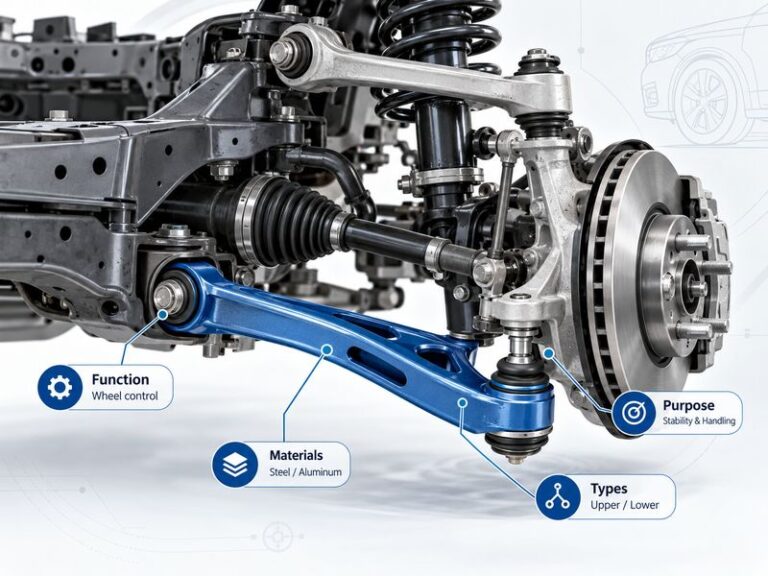
Can You Jack a Car From the Control Arm? Safe Lifting Guide
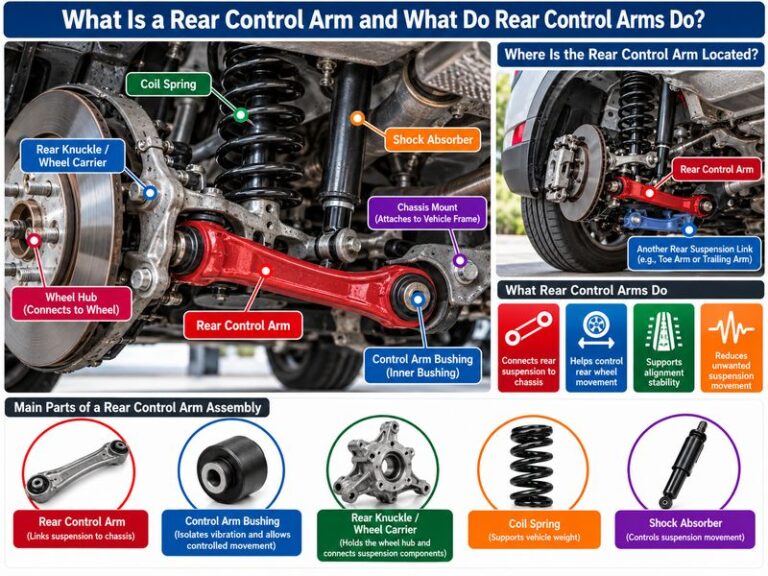
If you are asking can you jack a car from the control arm, the safest answer is that it depends on the vehicle. A thick steel lower control arm on some cars and trucks can carry lifting force without trouble. A thin stamped arm, aluminum arm, or oddly shaped suspension part may not be suitable at all.
This question often comes up when a wheel needs to be raised for brake, suspension, tire, or wheel work. The control arm looks tempting because it sits close to the wheel and already carries road loads. Yet the force from a jack is concentrated in a small area, which is different from the loads the suspension sees while driving.
In practical shop work, I treat the owner’s manual or factory service information as the first authority. If the manufacturer lists the control arm as a lifting or support point, it can be used in that way with the correct jack position. If it does not, I use a designated frame, subframe, axle, pinch weld, or other approved point instead.
This guide explains when a control arm may be used, when it should be avoided, how the risks differ between suspension designs, and how to lift a vehicle more safely.

Can You Jack a Car From the Control Arm Safely?
So, **can you jack a car from the control arm** without damaging anything? On some vehicles, yes. A strong lower control arm may be able to handle the load, especially when a service procedure specifically tells you to place a jack under it.
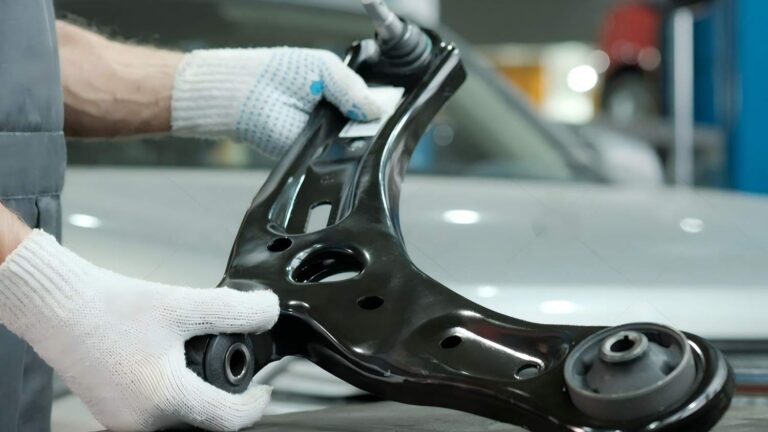
The key word is **some**. Control arms come in many shapes and materials. A large forged or boxed steel arm is very different from a thin stamped steel arm or a lightweight aluminum arm.
You also need to think about where the jack touches the arm. A broad, flat area near a strong section may handle load well. A jack placed on a curved edge, thin wall, ball-joint area, bushing mount, or unsupported section can slip or deform the part.
For routine lifting, the designated factory jack points remain the safer default. Use the control arm only when you have good reason to do so and can confirm that your vehicle allows it.

- ✦ Check the owner’s manual
Look for the manufacturer’s approved lifting and support points before choosing any suspension part.
- ✦ Identify the control arm material
Strong steel arms may tolerate lifting better than thin stamped or aluminum designs.
- ✦ Look at the contact area
The jack saddle needs a stable surface that cannot slide, crush, or bend.
- ✦ Know why you are lifting
Supporting a suspension arm during repair is different from lifting an entire corner of the vehicle.
Why Some Mechanics Jack Under a Lower Control Arm
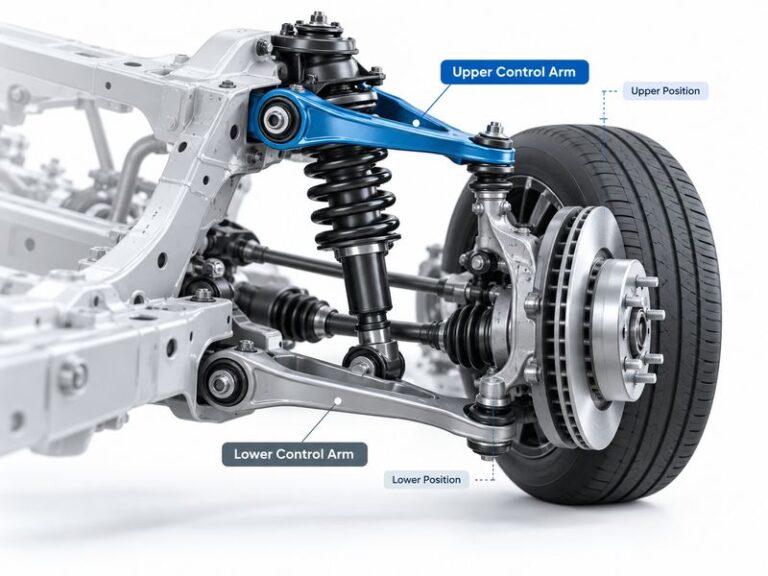
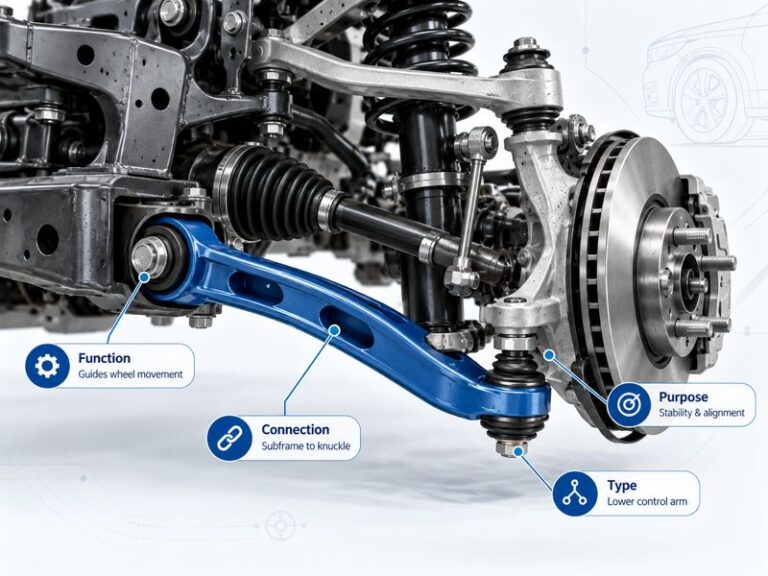
A lower control arm carries part of the vehicle’s suspension load while driving. On certain designs, technicians place a jack under the arm to raise the suspension, support the steering knuckle, or place the suspension close to normal ride height during repair.
This can also be useful when working with springs or suspension bolts that need to be tightened at normal ride height. However, that does not mean every control arm is a safe point for lifting the whole vehicle.
- ✦ Suspension support
A jack can sometimes support the control arm while another approved point supports the vehicle.
- ✦ Ride-height positioning
Some repairs call for the suspension to be compressed before final bolt tightening.
Why the Answer Changes From Vehicle to Vehicle
Suspension design varies widely across sedans, SUVs, pickups, crossovers, and performance cars sold in the United States. The same lifting method that works on an older truck may damage a modern car with lightweight suspension parts.
That is why a general rule such as “always jack from the control arm” is not safe advice. The correct answer must match the exact vehicle and suspension design.
- ✦ Vehicle weight
A heavier vehicle puts more load on the jack point.
- ✦ Suspension design
MacPherson strut, double-wishbone, and multi-link systems use different arm shapes and load paths.
Why Jacking From a Control Arm Can Be Risky
Understanding the risk is important before deciding **can you jack a car from the control arm** on your vehicle. A control arm may carry large suspension loads, but those forces normally travel through specific mounting points, bushings, and ball joints.
A floor jack adds a concentrated upward force at one small spot. If that spot was not designed for lifting, the arm can dent, bend, twist, or slip off the saddle.
The problem may not always be obvious right away. A small bend can affect wheel alignment, tire wear, steering feel, or suspension geometry. Aluminum parts can also suffer damage without showing a dramatic bend.
There is also a personal safety risk. Control arms are often angled and smooth. A jack saddle can move as the suspension changes position, especially if the vehicle or jack is not perfectly level.

- ✦ Bent control arm
Concentrated jack pressure can distort a weak or thin section of the arm.
- ✦ Jack slippage
Curved or angled surfaces can allow the jack saddle to move unexpectedly.
- ✦ Alignment changes
A damaged arm can alter camber, caster, or toe and cause poor tire wear.
- ✦ Damage to coatings
Metal-to-metal jack contact can scrape protective coatings and expose steel to corrosion.
- ✦ Damage to nearby parts
Poor jack placement can contact brake lines, ABS wiring, ball-joint boots, or other suspension parts.
Stamped Steel Control Arms
Stamped steel arms are common. Some are strong and deep, while others have thinner sections that can dent under concentrated pressure.
Never assume that a steel part is automatically safe for a floor jack. The exact shape and approved service procedure matter more than the material alone.
- ✦ Inspect the shape
Avoid thin edges, seams, open sections, and areas that already show rust or damage.
Aluminum Control Arms
Use extra caution with aluminum suspension arms. Aluminum can be strong, but the component is engineered for loads in specific directions.
A concentrated jack load in the wrong location can mark, crack, or deform the arm. Unless the manufacturer identifies the arm as a valid lifting point, choose another location.
- ✦ Avoid guessing
Do not select an aluminum control arm as a jack point based only on its size or appearance.
When Is It Acceptable to Jack From the Control Arm?
There are situations where the answer to **can you jack a car from the control arm** may be yes. The strongest case is when the factory service manual tells you to support or raise the suspension at a specific area of the lower control arm.
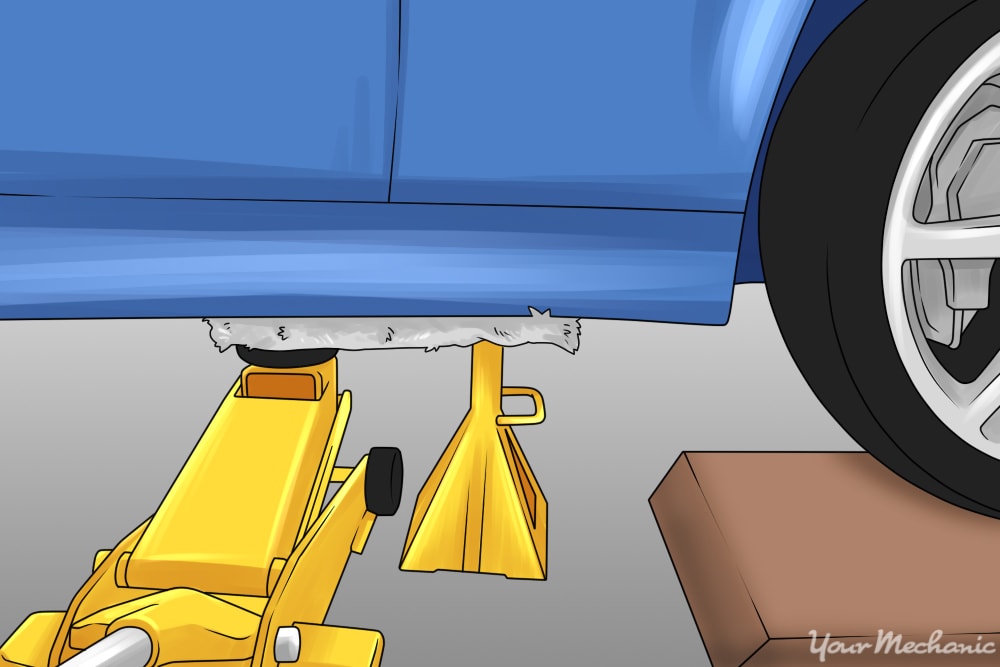
Technicians often use a floor jack beneath a control arm during suspension work. For example, the jack may support the lower arm while a shock, strut, spring, ball joint, or related part is serviced.
This is not always the same as using the arm as the main lifting point for the vehicle. The vehicle may already be resting safely on jack stands while the floor jack only moves or supports the suspension.
If your service information specifically shows a jack beneath the arm, follow its exact placement instructions. Do not move the jack several inches to a more convenient spot.
- ✦ Factory procedure allows it
This is the strongest reason to use a control arm as a jack or support point.
- ✦ The arm is structurally sound
Do not lift from an arm that is rusted, cracked, bent, heavily corroded, or previously repaired.
- ✦ The jack sits securely
The saddle should contact a stable area and remain centered as the suspension moves.
- ✦ You are supporting the suspension
Using a jack to control suspension position during service can be appropriate when the repair procedure calls for it.
Lifting the Vehicle Versus Supporting the Suspension
These two jobs are easy to confuse. Lifting the vehicle means the selected point carries enough force to raise part of the vehicle’s weight. Supporting the suspension means the vehicle may already be safely supported elsewhere while the jack controls the suspension arm.
The second use is common in suspension repair. It does not prove that the same location should carry the vehicle while you work underneath it.
- ✦ Vehicle lifting
Use designated structural lift points whenever possible.
- ✦ Suspension support
Use the arm only according to the specific repair procedure.
When You Should Not Jack a Car From the Control Arm
There are several cases where you should avoid the control arm completely. If the manufacturer’s information does not approve the location and you have a known factory jack point nearby, the factory point is the smarter choice.
Do not use a damaged control arm as a lifting point. Rust, cracks, dents, previous impact damage, or a bent arm can reduce its strength.
You should also avoid placing the jack against a ball joint, ball-joint boot, bushing, brake hose, ABS sensor wire, spring seat edge, or other delicate component. A few inches of incorrect placement can turn a simple lifting job into a suspension repair.
If you cannot clearly see the area where the jack saddle will contact the vehicle, stop and reposition. Safe lifting requires a stable and visible contact point.

- ✦ Thin or damaged arm
Do not use a control arm that looks bent, cracked, rusted, weak, or heavily corroded.
- ✦ Unknown lifting procedure
If you cannot confirm the point, choose an approved frame or body lifting location.
- ✦ Unstable jack angle
Do not lift from a curved surface where the saddle cannot remain secure.
- ✦ Contact near a ball joint
Avoid placing force on the ball joint housing, stud, boot, or mounting hardware.
- ✦ Control arm replacement
If the arm itself must be removed, the vehicle needs a separate secure support point before removal begins.
Never Rely on the Floor Jack Alone
A floor jack is designed to raise the vehicle. It should not be the only thing keeping the vehicle above you while you work.
Once the vehicle reaches the required height, place properly rated jack stands at approved support points. Lower the vehicle onto the stands in a controlled way and check stability before going underneath.
- ✦ Jack lifts
Use the hydraulic jack to raise or position the vehicle.
- ✦ Jack stands support
Use stands to hold the vehicle securely during service.
What Are the Best Jacking Points on a Car?
Before asking **can you jack a car from the control arm**, check whether your vehicle has a simpler approved point. Most passenger vehicles provide specific areas designed to handle lifting loads.
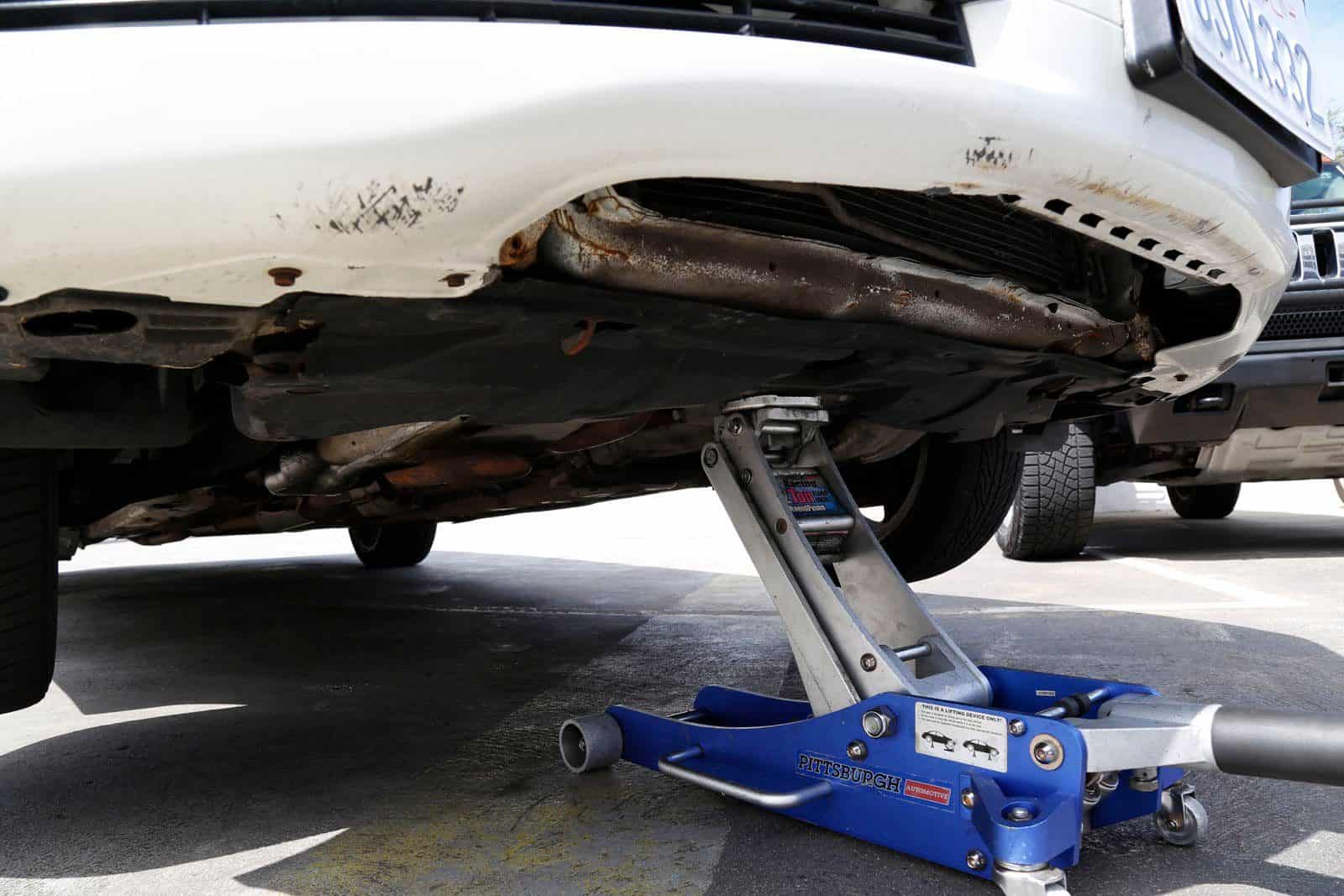
Common locations include reinforced pinch welds along the rocker panel, front or rear subframes, frame rails, designated crossmembers, and solid axle housings. The correct point depends on the vehicle.
Do not assume every crossmember or frame-looking part is safe. Some underbody braces, radiator supports, floor panels, exhaust parts, and drivetrain components may look strong but are not designed to support vehicle weight.
The owner’s manual normally identifies emergency jack points. Factory service information may provide additional points for floor jacks and shop lifts.
- ✦ Pinch welds
Many unibody cars have reinforced pinch-weld areas marked for the factory jack.
- ✦ Subframe
A strong front or rear subframe may provide approved central or side lifting points.
- ✦ Frame rails
Body-on-frame trucks and SUVs may use designated sections of the frame.
- ✦ Solid axle
Some rear-wheel-drive trucks and SUVs permit lifting beneath specified areas of a solid axle housing.
- ✦ Crossmember
Certain vehicles provide a reinforced crossmember as a central lifting point, but this must be confirmed.
How to Find the Factory Jack Points
Start with the vehicle owner’s manual. Look for sections titled tire changing, vehicle lifting, jack points, emergency jack use, or maintenance.
You may also find small notches, arrows, reinforced seams, or molded marks near the rocker panels. These marks can identify the correct position for the factory jack.
- ✦ Use the manual first
Factory instructions remove much of the guesswork.
- ✦ Inspect before lifting
Check the point for rust, damage, or deformation before placing the jack.
How to Jack Up a Car Safely
Whether you use a designated frame point or an approved control arm location, the basic lifting process matters. A good jack point cannot make up for unstable ground, an undersized jack, or poor wheel chocking.
Park on a hard, level surface. Concrete is usually much safer than soft soil, gravel, or an uneven driveway. Put an automatic transmission in Park or a manual transmission in gear, and apply the parking brake when appropriate for the lift.
Chock the wheels that will remain on the ground. Position the jack carefully, then raise the vehicle slowly while watching both the saddle and the vehicle.
If the jack starts to lean, roll poorly, slide, or lose its contact point, lower the vehicle and correct the setup. Never try to save a bad lift by pushing the car or repositioning the jack while it is heavily loaded.

- ✦ Use level ground
Lift on a hard and flat surface that can support the jack and stands.
- ✦ Chock the wheels
Prevent the vehicle from rolling as its suspension and weight shift.
- ✦ Use the correct jack capacity
Make sure your jack is rated for the load it will lift.
- ✦ Raise slowly
Watch the saddle and jack wheels as the suspension moves.
- ✦ Install jack stands
Support the vehicle at approved points before working underneath.
- ✦ Check stability
Once supported, confirm the vehicle is stable before starting work.
Using a Jack Pad
A suitable jack pad can improve contact and help protect painted or coated surfaces. Pads can also reduce metal-on-metal slipping when their shape matches the lifting point.
A pad does not make an unsafe jack point safe. You still need a structurally approved lifting location.
- ✦ Match the pad to the point
Use a pad designed for your jack saddle and the type of lifting point.
Can You Put Jack Stands Under the Control Arms?
This question is closely related to **can you jack a car from the control arm**, but the two situations are not identical. A floor jack may touch a suspension arm for a short time during a repair, while a jack stand may carry that load for much longer.
Some service procedures allow support beneath a lower control arm. Others require jack stands beneath the frame, pinch weld, subframe, or another structural point.
A jack stand also has a different saddle shape from a floor jack. If the arm is rounded or angled, the stand may not seat securely.
Unless the manufacturer specifically approves the control arm as a support point, use the designated body, frame, or subframe location for the jack stand.

- ✦ Confirm the support point
Do not assume a point that works with a floor jack is automatically safe for a jack stand.
- ✦ Check saddle contact
The stand must sit securely without resting on an edge or curved section.
- ✦ Keep stands paired when appropriate
For many repairs, supporting both sides at equal height improves stability.
Why Frame or Subframe Support Is Often Better
Supporting the body or frame can leave the suspension free to move. This is useful for many brake and suspension repairs.
It also places the vehicle’s weight on parts designed to carry structural loads. That makes approved frame or subframe locations the preferred option in many situations.
- ✦ Better access
Supporting the vehicle away from the control arm leaves more room for suspension work.
- ✦ Less risk to suspension parts
A structural support point avoids concentrated loads on components you may be repairing.
Does Jacking From the Control Arm Damage Alignment?
If the arm is designed for the load and remains undamaged, lifting from an approved location should not automatically change wheel alignment. The concern starts when the arm bends, shifts, or another suspension component becomes damaged.
A bent control arm can change the wheel’s position. Even a small change can affect toe, camber, or caster, depending on the suspension design.
After an incorrect lift, watch for a steering wheel that sits off center, pulling to one side, new tire wear, unusual steering feel, or a visible change in wheel position. These signs deserve an inspection.
If you are unsure whether the arm was damaged, compare both sides of the suspension and have the alignment checked by a qualified technician.
- ✦ Vehicle pulls
New pulling after the lift may point to alignment or suspension damage.
- ✦ Steering wheel is off center
A sudden change can indicate that wheel alignment has shifted.
- ✦ Uneven tire wear
Poor alignment can wear the inside or outside edges of a tire faster.
- ✦ Visible bending
A deformed control arm should be inspected and replaced if needed.
- ✦ New noises
Clunks or creaks may point to damaged bushings, joints, or mounting points.
What to Do If You Jacked From the Wrong Spot
If you already lifted the car from the control arm and nothing slipped or bent, do not panic. Lower the car safely and inspect the contact area for dents, cracks, chipped coatings, or obvious deformation.
If you notice damage or the vehicle drives differently afterward, avoid ignoring it. A suspension inspection and alignment check can confirm whether the arm or related parts were affected.
- ✦ Inspect first
Look carefully at the jack contact area and compare it with the opposite side.
- ✦ Test carefully
Pay attention to steering, noise, and handling during the next drive.
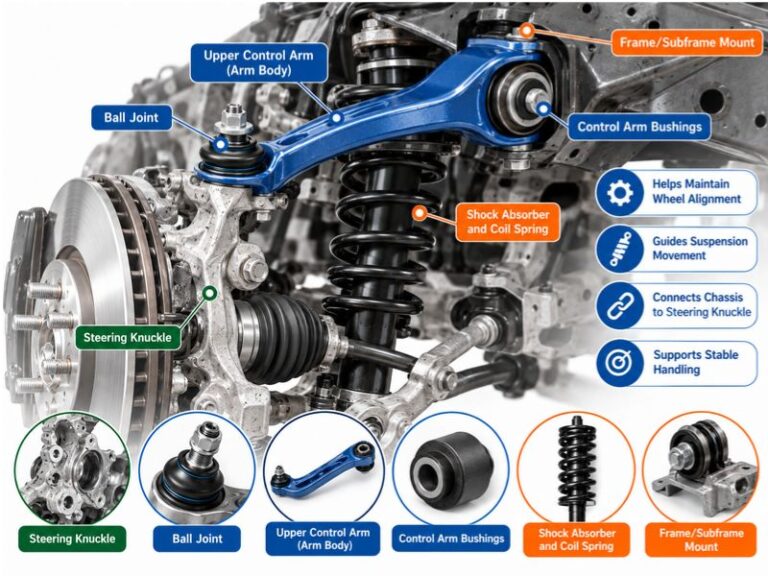
Can You Jack From an Upper Control Arm?
In most cases, an upper control arm is an even less practical lifting point than a lower arm. Upper arms are usually higher in the wheel well, harder to reach, and not positioned to accept a floor jack safely.
Many upper control arms are also relatively light components. Their job is to guide wheel movement rather than provide a convenient lifting surface.
Do not place a jack against an upper control arm unless a vehicle-specific service procedure clearly tells you to do so. A lower approved jack point, frame point, or subframe point is usually the better choice.
If you are asking **can you jack a car from the control arm** and your only accessible arm is the upper one, stop and locate the correct factory lifting point instead.
- ✦ Poor accessibility
Upper arms usually do not provide a practical path for a floor jack.
- ✦ Limited contact area
Their shape often gives a jack saddle little stable surface.
- ✦ Better alternatives exist
Use designated frame, body, subframe, or lower suspension points when approved.
Lower Control Arm Versus Upper Control Arm
A lower control arm usually carries more vertical suspension load and often has a larger structure. This is one reason some repair manuals use it as a temporary support point.
An upper arm generally has less room beneath it and is not commonly used for routine lifting. Always follow the procedure for the exact suspension system.
- ✦ Lower arm
May be suitable for controlled suspension support on specific vehicles.
- ✦ Upper arm
Usually not a practical or recommended floor-jack location.
Can You Jack a Car From the Control Arm During Suspension Repairs?
During suspension repairs, a floor jack under the lower control arm can serve a useful purpose. It may hold the arm while bolts are removed, control suspension movement, or bring the suspension toward normal ride height.
This is especially important when a suspension component is under load. However, coil springs can store a large amount of energy, so spring-related repairs require the correct procedure and tools.
Never remove suspension hardware simply because a jack appears to be supporting the arm. Confirm which parts are loaded and follow vehicle-specific service instructions.
If you are replacing the control arm itself, support the vehicle independently. The jack beneath the arm may help control the part during removal, but it cannot remain the vehicle’s primary support when that arm is disconnected.
- ✦ Support the vehicle separately
Use approved jack-stand points before loosening control-arm hardware.
- ✦ Control suspension movement
A floor jack can sometimes raise or lower the arm slowly during service.
- ✦ Respect spring load
Coil springs can release dangerous energy if the suspension is taken apart incorrectly.
- ✦ Follow torque procedures
Some suspension bushings require final tightening at normal ride height.
Why Ride Height Matters for Some Control Arm Bushings
Many rubber suspension bushings twist as the control arm moves. If their bolts are tightened while the suspension hangs fully down, the rubber may remain twisted when the vehicle returns to normal height.
Some repair procedures therefore call for the arm to be raised to normal ride position before final tightening. A floor jack under an approved part of the lower arm can help with this step.
- ✦ Reduce bushing preload
Correct ride-height tightening can prevent unnecessary twisting of bonded rubber bushings.
Common Mistakes to Avoid When Jacking Near the Control Arm
Most lifting problems come from choosing a point based only on convenience. A part may look strong while still being unsuitable for a concentrated jack load.
Another common mistake is putting the saddle under the nearest flat-looking piece without checking what is above it. Brake hoses, wiring, plastic shields, thin brackets, and suspension boots can sit close to the control arm.
People also sometimes lift the car high before checking whether the jack is rolling correctly. A floor jack must move slightly as its lifting arm travels through its arc.
Careful setup takes only a few extra minutes and can prevent expensive suspension damage or a serious accident.
- ✦ Guessing at the jack point
Confirm the location instead of choosing the strongest-looking part.
- ✦ Using wood as a structural fix
A wood block may spread force, but it cannot turn a weak or unapproved component into a safe lift point.
- ✦ Lifting on gravel
Loose ground can let the jack sink or prevent its wheels from moving normally.
- ✦ Skipping wheel chocks
The vehicle can roll as its weight shifts during lifting.
- ✦ Working under the jack
Never place yourself beneath a vehicle supported only by a hydraulic jack.
Do Not Jack on the Ball Joint
The ball joint is not a general-purpose floor-jack point. The joint, boot, stud, and housing can be damaged by poorly placed lifting force.
If the manual tells you to support the lower control arm near the ball joint, follow the exact illustrated contact point. Do not place the saddle directly on the joint unless the procedure explicitly requires it.
- ✦ Protect the boot
A torn ball-joint boot allows dirt and water into the joint.
How to Decide Whether Your Control Arm Is a Safe Jack Point
If you still wonder **can you jack a car from the control arm**, use a simple decision process. First, check the owner’s manual and service information. If the control arm appears as an approved lifting or support point, follow those instructions.
Next, inspect the actual arm. Look for its material, shape, rust, dents, cracks, weld damage, and nearby hoses or wiring. A point that was safe when new may not be safe after years of corrosion or collision damage.
Then consider your goal. If you only need to raise the whole car for a tire change, use the normal factory jack point. If you are supporting the suspension during a repair, the lower arm may be appropriate when the procedure specifies it.
When information is unclear, choose the more conservative option. A known structural lifting point is better than experimenting with a suspension part.
- ✦ Step 1
Find the approved jack and support points for your exact year, make, and model.
- ✦ Step 2
Inspect the control arm and surrounding components.
- ✦ Step 3
Determine whether you are lifting the vehicle or only supporting the suspension.
- ✦ Step 4
Make sure the jack saddle can contact the point securely.
- ✦ Step 5
Use jack stands at approved locations before working underneath.
A Practical Rule for DIY Owners
For routine tire, brake, and maintenance work, I recommend using the vehicle’s specified lifting points instead of improvising. It makes the setup easier to repeat and reduces uncertainty.
Treat the lower control arm as a vehicle-specific service point rather than a universal jack point. That one rule answers most situations safely.
- ✦ Default choice
Use factory-approved body, frame, axle, or subframe points.
- ✦ Control arm exception
Use the arm when the manufacturer or repair procedure clearly supports that method.