Can You Put Jack Stands Under Control Arms? Safety Guide
If you are asking **can you put jack stands under control arms**, the safest answer is not a simple yes or no. Some vehicles have heavy lower control arms that can carry vehicle weight. On other cars, the same-looking part may be thin, hollow, aluminum, or shaped in a way that makes a jack stand unsafe.
The key issue is not whether a control arm normally carries suspension load. It is whether the exact spot can safely hold a concentrated load from a jack stand. A suspension arm spreads forces through bushings, ball joints, springs, and the chassis while the car moves. A stand places much of the vehicle’s weight on a small saddle.
For most home repairs in the United States, the best starting point is the vehicle owner’s manual or factory service information. Look for the approved **jacking points and support points**. If the manual calls for the frame, subframe, axle housing, or reinforced pinch weld, use those points instead of guessing.
A useful shop rule is simple: if you cannot clearly confirm that a suspension part is designed to be used as a support point, choose a known structural point instead. The few extra minutes spent checking can prevent damaged suspension parts and, more importantly, a vehicle from becoming unstable while you are underneath it.

Can You Put Jack Stands Under Control Arms Safely?
So, **can you put jack stands under control arms**? You can on certain vehicles and in certain repair situations. A strong lower control arm may safely support weight when the manufacturer allows it and when the stand sits on a broad, stable section.
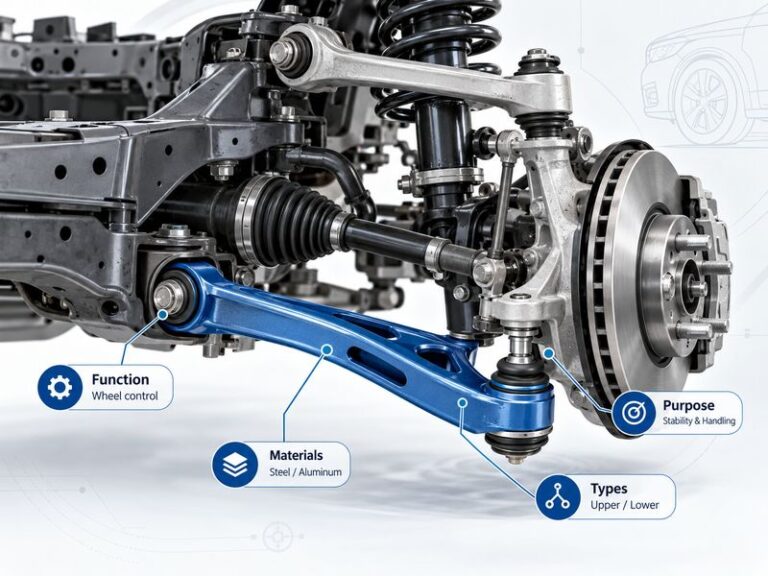
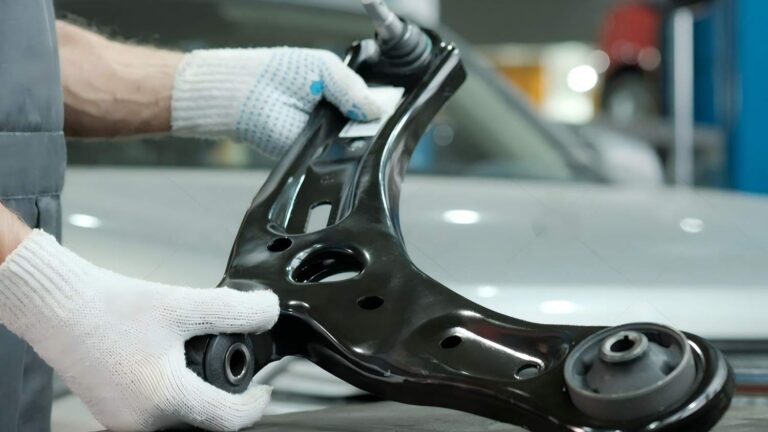
However, you should never choose a control arm only because it looks thick. Control arms come in many forms. Some are forged steel. Some are stamped sheet metal. Others are cast or forged aluminum. Their strength and safe loading points can be very different.
The safest approach is to separate two questions. First, can the part physically carry the load? Second, has the vehicle maker intended that area to be used as a lifting or support point? You want a clear yes to both before placing a stand there.
Also consider what happens if the vehicle shifts a small amount. A flat stand saddle beneath a rounded, angled, or smooth suspension arm may have very little resistance to sliding. Even a strong arm can be a poor support point if the contact shape is unstable.

- ✦ Check factory guidance
Use the owner’s manual or service information to find approved jack and stand locations.
- ✦ Inspect the arm
Do not support an arm that is bent, cracked, rusty, damaged, or heavily corroded.
- ✦ Choose a stable surface
The stand saddle should contact a broad area and should not sit on an edge, curve, brake line, or mounting bolt.
- ✦ Think about the repair
Supporting the control arm compresses the suspension and may change how parts move during the job.
Lower Control Arms Are More Common Support Candidates
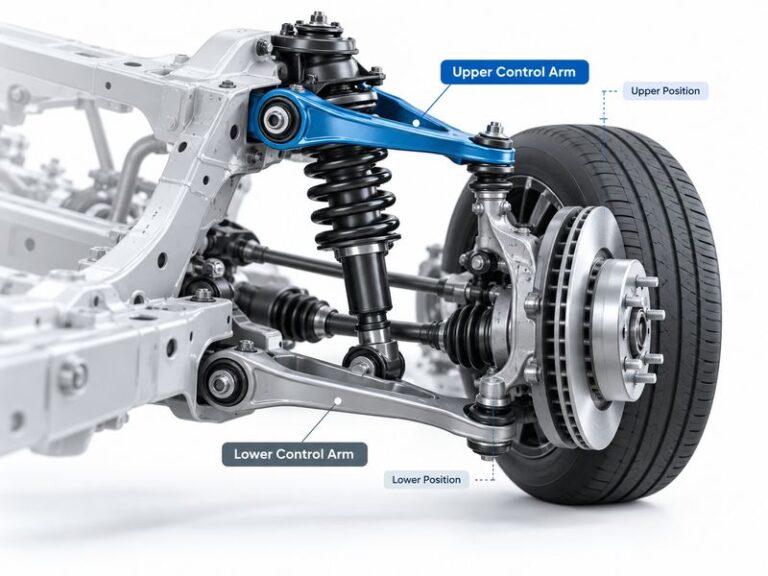
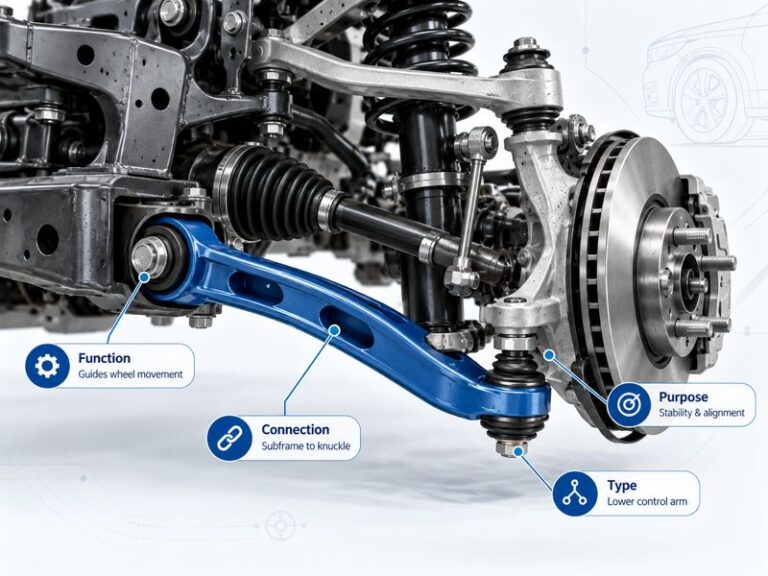
When people ask **can you put jack stands under control arms**, they usually mean the lower control arms. Lower arms are often larger because they may carry spring, strut, or wheel loads. Some designs have wide reinforced areas that can tolerate lifting loads.
That still does not make every lower control arm a safe jack stand location. The spring seat, shock mount, ball-joint area, and thin outer edges can have very different strength levels.
- ✦ Better candidates
Broad, heavy steel sections specifically identified by the vehicle maker as suitable support points.
- ✦ Poor candidates
Thin edges, curved sections, hollow aluminum areas, damaged metal, or surfaces where the stand can slide.
Upper Control Arms Usually Are Not Good Stand Points
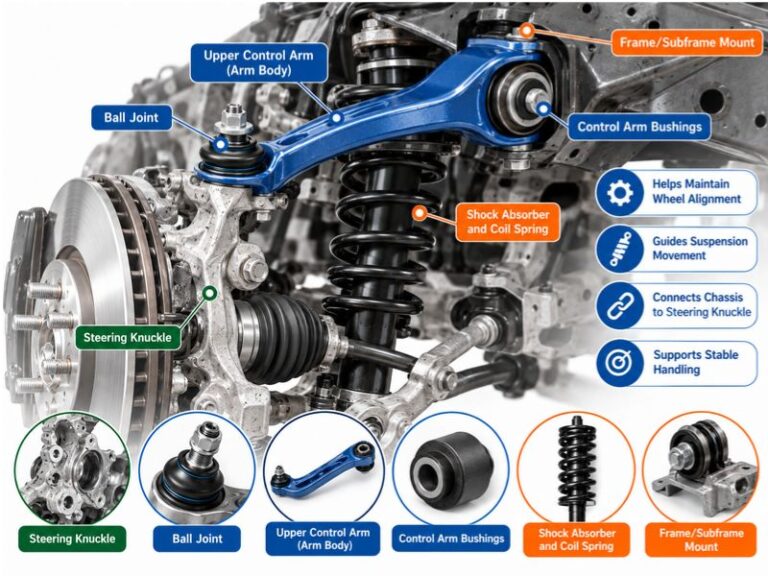
Upper control arms are usually smaller and positioned higher in the wheel well. They are commonly designed to guide wheel movement rather than serve as practical vehicle support locations.
Their shape also makes stand placement difficult. In most cases, a frame, subframe, axle, or approved body support point is easier and safer to use.
Why Control Arms Can Carry Heavy Loads but Still Be Risky
A control arm is part of the suspension link between the wheel assembly and the vehicle structure. During normal driving, it helps control wheel motion and handles forces from braking, turning, bumps, and acceleration.
That sounds like a strong reason to place a stand underneath it. The problem is that normal suspension loads and jack stand loads are not identical. Suspension forces are transferred through specific joints and mounting points, while a jack stand presses upward on a small area.
A control arm that handles thousands of miles of road use can still dent if a narrow metal saddle presses into a thin stamped section. Aluminum arms can also be strong in normal use yet poorly suited to a concentrated contact point.
This is why the answer to **can you put jack stands under control arms** depends as much on shape and load location as on the general strength of the part.
- ✦ Concentrated pressure
A stand puts vehicle weight into a relatively small contact area.
- ✦ Uneven shapes
Many control arms have slopes and curves that do not sit securely in a stand saddle.
- ✦ Material differences
Forged steel, stamped steel, cast aluminum, and forged aluminum do not react to point loads in the same way.
- ✦ Suspension movement
The arm can change angle as the car rises or settles, which may alter stand contact.
Stamped Steel Control Arms
Stamped steel arms may look large but can be made from relatively thin formed metal. A stand placed on the wrong area can dent or distort the arm.
If the manufacturer allows support beneath the arm, use the specified region rather than choosing the easiest-looking surface.
Aluminum Control Arms
Aluminum control arms can be very strong, but they deserve extra care. Sharp or narrow jack saddles can mark the material, and damage may not always look dramatic at first.
Unless factory information clearly permits supporting the vehicle there, use a designated structural support point instead.
When Putting Jack Stands Under Control Arms Can Make Sense
There are repair jobs where supporting a lower control arm is useful. The most common reason is to hold the suspension close to its normal ride position while servicing related parts.
For example, some procedures require a control arm to be raised slightly so a spring, shock, sway-bar link, or suspension fastener is not under unwanted tension. In such cases, technicians may use a floor jack or support stand under a suitable lower-arm location.
The important distinction is that a support used to control suspension position is not always carrying the entire corner of the vehicle. The main weight of the vehicle may still rest on stands placed beneath the frame or another approved structural point.
That distinction matters when answering **can you put jack stands under control arms**. Using a stand as a secondary suspension support is often different from making the control arm the sole support holding the vehicle above you.

- ✦ Holding suspension at ride height
A lower control arm may be supported to simulate normal suspension position during certain procedures.
- ✦ Controlling spring load
A floor jack beneath the arm may help control suspension movement when a procedure specifically calls for it.
- ✦ Tightening suspension bushings
Some bonded-rubber bushing fasteners should be tightened with the suspension near normal ride height.
- ✦ Supporting related components
The arm may be held while a shock, strut, sway-bar component, or other suspension part is removed.
Supporting the Suspension Is Different From Supporting the Vehicle
A repair manual may tell you to support a lower control arm with a jack. That instruction does not automatically mean the control arm should replace the vehicle’s main jack stand points.
When practical, keep the chassis safely supported on approved stands and use a second jack or stand only to position the suspension. This gives you a more stable primary support system.
When You Should Not Put Jack Stands Under Control Arms
There are several situations where the answer to **can you put jack stands under control arms** should be no. The first is simple: if the repair manual tells you to support the car somewhere else, follow that direction.
You should also avoid damaged suspension parts. A control arm with deep rust, cracks, impact damage, previous welding, severe scraping, or visible deformation should never be trusted as an improvised support point.
Do not place stands beneath a control arm when you need that arm to move freely or when you plan to remove it. Once you loosen the arm, ball joint, spring, or major mounting hardware, the load path can change quickly.
Finally, never choose convenience over stability. A jack stand that is slightly harder to place beneath a frame rail or reinforced support point is still better than a stand sitting at an angle beneath a rounded control arm.

- ✦ The control arm will be removed
Never rely on the part you are about to disconnect as the main support for the vehicle.
- ✦ The arm is damaged
Rust, cracks, bends, collision damage, or serious corrosion make the part unsuitable for support.
- ✦ The contact surface is unstable
Avoid narrow, rounded, steeply angled, oily, or slippery areas.
- ✦ The manufacturer specifies another point
Factory support instructions should take priority over general advice.
- ✦ You need full suspension droop
Supporting the control arm prevents that wheel from hanging freely.
Never Support a Vehicle by a Ball Joint or Tie Rod
Ball joints, tie rods, steering links, sway bars, and similar parts are not substitutes for proper jack stand locations. They can move, rotate, bend, or separate.
Keep the stand on a solid structural area designed to carry the vehicle’s weight.
Avoid Brake Lines and Wiring
Before placing any jack or stand near the suspension, look for brake hoses, hard brake lines, ABS wiring, ride-height sensors, and other nearby parts. A stand can crush or stretch these components if it is positioned poorly.
Better Places to Put Jack Stands
If you are unsure about **can you put jack stands under control arms**, the safest solution is often to use the vehicle’s normal support points. Most vehicles have reinforced areas intended to carry the car while it is raised.
Exact locations vary by design. A body-on-frame pickup may have strong frame rails. A unibody car may use reinforced pinch welds or subframe points. Some trucks and SUVs can be supported beneath approved axle locations.
Never assume that two similar vehicles share the same support points. Even models built by the same company can have different underbody structures, battery locations, suspension layouts, and lift instructions.
The owner’s manual can often show basic jacking points. A factory service manual or manufacturer repair database may provide more detailed instructions for workshop lifting and jack stand placement.

- ✦ Reinforced pinch welds
Common on many unibody passenger cars when identified as approved lifting or support points.
- ✦ Front or rear subframe
Heavy structural subframe sections may provide stable support when specified by the manufacturer.
- ✦ Vehicle frame
Body-on-frame trucks and SUVs often provide strong frame locations for stands.
- ✦ Approved axle points
Solid-axle vehicles may allow support at specified axle housing locations.
Pinch Welds
Pinch welds are common support areas on modern cars, but the stand should contact the reinforced section rather than any random part of the rocker seam. A suitable slotted adapter can help distribute pressure and reduce damage where appropriate.
Subframes
A subframe connects major suspension or drivetrain components to the body. Approved sections can provide a broad and stable support area.
Do not place a stand beneath a thin shield, plastic cover, oil pan, transmission pan, or other nearby component that only looks structural.
How to Place Jack Stands Safely
Safe jack stand use begins before the car leaves the ground. Park on a hard, flat, level surface. Concrete is usually a much better choice than dirt, gravel, soft asphalt, or an uneven driveway.
Set the parking brake when the procedure allows it. Put an automatic transmission in Park or a manual transmission in gear. Chock the wheels that will remain on the ground so the vehicle cannot roll.
Lift the car only at an approved jacking point. Raise it high enough to position the stands without placing your body under an unsupported vehicle. Then set both stands to equal heights when supporting the same end of the car.
Lower the vehicle slowly onto the stands. Watch the saddles as the load transfers. If either stand tilts, shifts, or contacts an unsafe area, raise the vehicle again and correct the placement before doing any work underneath.

- ✦ Use rated equipment
Make sure the floor jack and jack stands have enough rated capacity for the vehicle and intended load.
- ✦ Work on solid ground
Use a firm, flat surface that will not sink or shift under the stand feet.
- ✦ Chock the wheels
Wheel chocks reduce the chance that the vehicle will roll while being lifted or supported.
- ✦ Center the load
The support point should sit securely in the stand saddle rather than near one edge.
- ✦ Test stability
After lowering the vehicle, apply a careful push from outside the danger zone to confirm that it is stable.
- ✦ Keep the jack as backup when practical
A floor jack can remain lightly positioned at an approved point as secondary protection, but it should never replace properly placed stands.
Never Work Under a Vehicle Supported Only by a Floor Jack
A hydraulic floor jack is designed mainly for lifting, not for serving as the only support while a person works underneath the vehicle. Hydraulic leaks, seal failure, movement, or poor positioning can cause the vehicle to drop.
Use properly rated jack stands at approved support points before placing any part of your body beneath the vehicle.
Check Stand Condition Before Every Use
Inspect the stand base, saddle, locking parts, welds, pins, and adjustment mechanism. Do not use a stand that is bent, cracked, badly rusted, damaged, or missing locking parts.
Also confirm that the stand is sitting squarely on all of its feet. A rated stand can still become unstable when used on poor ground or placed at an angle.
How Control Arm Support Changes Suspension Position
One reason mechanics sometimes support a control arm is to change the suspension from full droop toward normal ride height. When the chassis is raised by its frame or body, the wheel usually drops downward as the suspension extends.
Putting a jack beneath the lower control arm raises that wheel assembly relative to the body. This compresses the suspension. Depending on the vehicle, the spring, shock, sway bar, bushings, and ball joint may all change position.
This effect is useful during certain repair procedures. It can also create stored spring force. That is why you should understand the suspension design before raising a control arm with a jack.
If your real question is **can you put jack stands under control arms to keep the suspension loaded**, the answer may be yes when the service procedure calls for it. Still, the chassis should remain securely supported at its approved points unless the manufacturer specifically directs otherwise.
- ✦ Suspension compresses
Raising the lower arm moves the wheel upward toward its normal ride position.
- ✦ Spring force can increase
The spring may store more energy as the control arm rises.
- ✦ Bushing angle changes
Rubber suspension bushings may twist as the arm moves through its travel.
- ✦ Sway-bar load may change
Supporting only one side can place added twist in the anti-roll bar.
Why Ride-Height Position Matters for Some Bushings
Many suspension bushings use rubber bonded between inner and outer sleeves. If certain fasteners are fully tightened while the suspension hangs, the rubber may be twisted once the car returns to normal ride height.
For some vehicles, service instructions call for final tightening at normal ride height or an equivalent loaded position. Always follow the torque and positioning procedure for the specific vehicle.
Can You Jack Up a Car by the Lower Control Arm?
This question is closely related to **can you put jack stands under control arms**. On some vehicles, a floor jack can be placed beneath a strong part of the lower control arm to raise or position the suspension. On others, the manufacturer may warn against it.
A floor jack has a different saddle from a jack stand, but the same concerns apply. The contact point must be strong, stable, and clear of brake lines, wiring, joints, and thin metal.
Do not place a bare metal jack saddle against an area where slipping could occur. When an approved procedure requires a pad or adapter, use one designed for automotive lifting that will not create an unstable stack.
If you are lifting the entire corner of a car through the control arm, pay close attention to how the vehicle moves. The body may rise differently because the spring is compressed as the arm moves upward.

- ✦ Use the specified location
Do not choose an arbitrary spot on the arm.
- ✦ Raise slowly
Watch the jack saddle, suspension arm, vehicle body, and nearby components as the load increases.
- ✦ Never crawl underneath during lifting
Stay outside the area beneath the vehicle until it is safely supported.
- ✦ Transfer weight to stands
A floor jack should not be the sole support when you work underneath the car.
Common Jack Stand Placement Mistakes
Many lifting problems come from choosing a point that appears strong without checking what it actually is. Plastic covers can hide structural metal, while large-looking suspension pieces may have hollow or thin sections.
Another mistake is placing a stand where the saddle touches only a tiny edge. The vehicle may initially seem stable, but a small shift can move the load off the saddle.
People also sometimes raise one end of a vehicle very high while the other wheels remain unchocked. That creates more opportunity for rolling and shifting as the suspension and tires move.
When deciding **can you put jack stands under control arms**, treat stand stability as equally important as component strength. A strong part does not help if the stand cannot stay centered beneath it.

- ✦ Using an unapproved point
A strong-looking part is not automatically a safe support location.
- ✦ Supporting on a slope
A sloped control arm can encourage the saddle to slide as weight transfers.
- ✦ Using soft ground
Stand feet can sink into soil, hot asphalt, or other weak surfaces.
- ✦ Failing to chock wheels
The vehicle can roll as its angle changes during lifting.
- ✦ Working before checking stability
Always confirm that all stands remain vertical and fully seated after lowering the car.
- ✦ Removing a supported part
Never disconnect the suspension component that is acting as the vehicle’s primary support.
Do Not Build Improvised Stand Extensions
Avoid stacking loose wood blocks, bricks, pavers, or other improvised objects on top of a jack stand to gain height. Unstable materials can split, tip, crush, or slide.
Use stands with the correct height range and capacity for the vehicle. If special adapters are needed, use products designed for the stand and support point.
Front vs. Rear Control Arm Support
Front and rear suspension layouts can be very different, so the answer to **can you put jack stands under control arms** may change from one end of the same vehicle to the other.
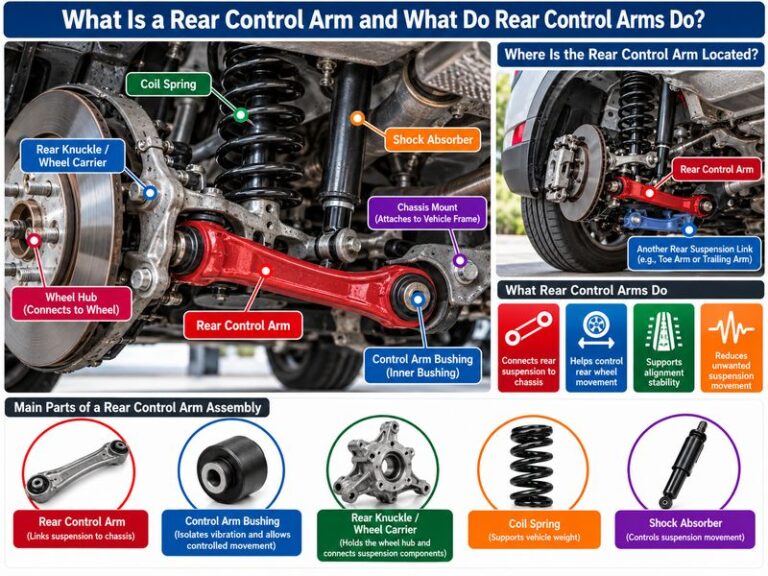
Many front suspensions use a large lower control arm connected to the steering knuckle through a ball joint. Some rear suspensions use several smaller links rather than one large arm. Those links may not be suitable for supporting vehicle weight.
A rear component called a trailing arm can also look like a control arm but perform a different job. Some are heavy structural pieces, while others are relatively thin. Names alone do not tell you whether a component is an approved jack stand location.
Independent rear suspension systems often have several arms packed close to exhaust parts, brake cables, fuel-system shields, and wiring. This can make a structural subframe point a much better choice.
- ✦ Front suspension
Large lower arms may sometimes be suitable for controlled suspension support when specified.
- ✦ Rear multi-link suspension
Small links should not be treated as jack stand points unless manufacturer information clearly says otherwise.
- ✦ Solid rear axle
Approved axle housing points may provide a better option than suspension links on some trucks and SUVs.
What to Check Before Trusting a Control Arm as a Support Point
Before placing significant weight on a control arm, inspect both the component and the surrounding area. Good lighting helps. Dirt and undercoating can hide rust or damage.
Look at the complete load path. The stand should contact only the intended structural part. It should not press against a brake hose bracket, ABS sensor wire, plastic shield, sway-bar link, grease fitting, or ball-joint boot.
Next, look at the stand itself. The saddle should fit the support point without rocking. The stand should remain nearly vertical once the vehicle’s weight is on it.
If any part of the setup makes you uncertain, move to an approved frame, subframe, axle, or body support point. When the question is **can you put jack stands under control arms**, uncertainty is a good reason to choose another location.
- ✦ Confirm the factory procedure
Check the vehicle manual or service information before selecting a suspension support point.
- ✦ Inspect for corrosion
Heavy rust can reduce the strength of both control arms and structural support areas.
- ✦ Check for cracks or bends
Collision damage or previous impacts can make a suspension part unsafe for support.
- ✦ Protect nearby components
Make sure hoses, wires, boots, and lines remain clear of the stand saddle.
- ✦ Confirm stable contact
The stand should not lean, rock, or balance on a narrow edge.
A Safer Approach for DIY Suspension Work
For most DIY work, a simple method reduces uncertainty. Support the vehicle’s chassis at manufacturer-approved points first. Then use a floor jack beneath the control arm only when you need to raise or hold the suspension.
This setup can be useful for shock replacement, sway-bar work, some bushing procedures, and other jobs where suspension position matters. The primary stands support the vehicle while the jack controls the suspension.
Remember that coil springs can store a large amount of energy. Never remove suspension parts that retain a spring unless you understand the exact procedure for that vehicle. Some designs require special tools.
This method also answers a common variation of **can you put jack stands under control arms**. Yes, a control arm can sometimes receive secondary support, but keeping the vehicle itself on known structural points often gives you a better margin of safety.
- ✦ Step 1
Park on hard, level ground and secure the wheels.
- ✦ Step 2
Lift the vehicle from the approved jacking point.
- ✦ Step 3
Place rated stands beneath approved structural support points.
- ✦ Step 4
Lower the chassis onto the stands and confirm stability.
- ✦ Step 5
If the repair requires it, use a separate jack under the approved section of the lower control arm to position the suspension.
Why This Method Is Often Easier
With the chassis supported independently, you can raise or lower the control arm without making it the only thing between you and the vehicle. This gives you more control over suspension position during many repairs.
It also lets you remove the suspension support jack when the procedure requires full droop while the vehicle remains safely supported.