Are Control Arms and Tie Rods the Same Thing? Key Differences
If you are asking **are control arms and tie rods the same thing**, the short answer is no. They may sit close to each other near the front wheels, and both can affect handling and tire wear, but they belong to different parts of the vehicle’s chassis system. A control arm mainly supports and guides suspension movement. A tie rod mainly helps turn the wheels when you move the steering wheel.
This difference matters when you are trying to diagnose a clunk, loose steering, uneven tire wear, or a failed state safety inspection. Replacing the wrong part will not fix the real cause. It may also waste money on labor and another wheel alignment.
In everyday repair work, these parts are easy to confuse because many front-end suspension kits include control arms, ball joints, tie rods, and sway bar links in one package. They may also produce similar symptoms when worn. The best way to tell them apart is to understand where each part connects, what movement it controls, and how its failure changes the way the vehicle feels.
This guide explains the difference between control arms and tie rods, how each part works, where you can find them, common failure signs, inspection basics, replacement concerns, and why both can affect alignment. It applies broadly to common U.S. passenger cars, SUVs, crossovers, and light trucks, though the exact design varies by vehicle.
Are Control Arms and Tie Rods the Same Thing?
No. **Control arms and tie rods are not the same thing.** A control arm is mainly a suspension component. A tie rod is mainly a steering component. They work together near the wheel, but each controls a different type of movement.
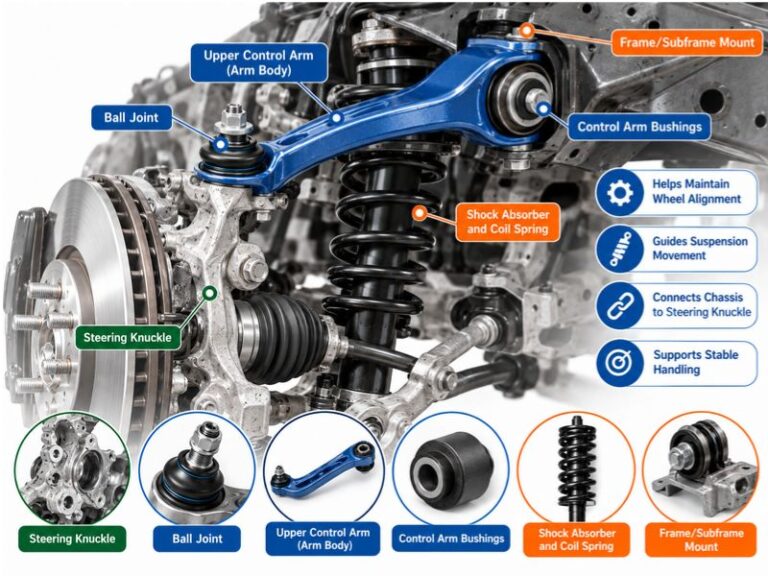
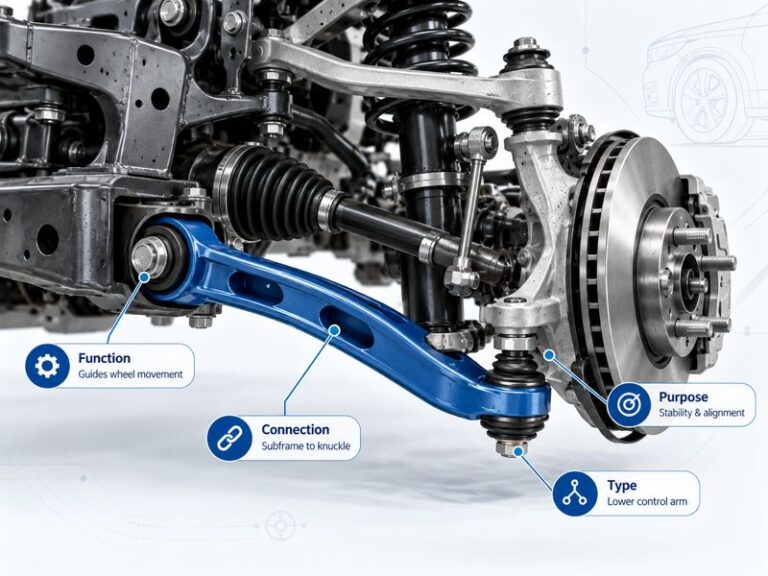
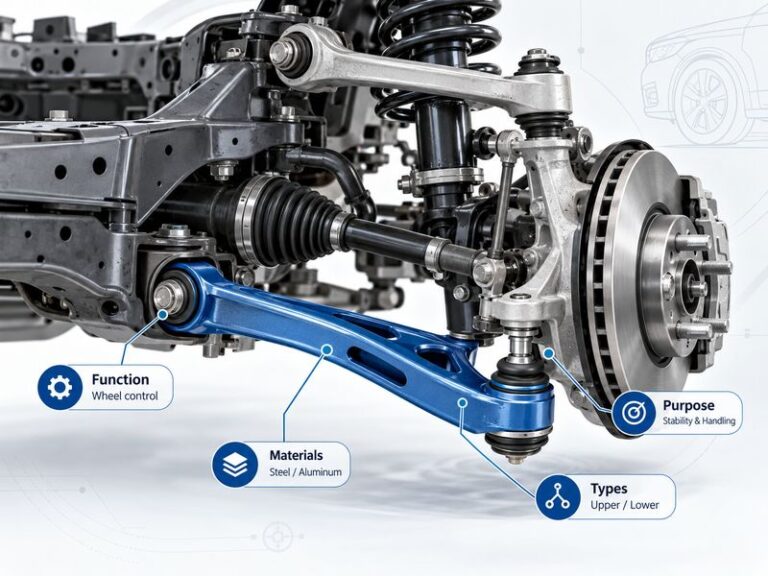
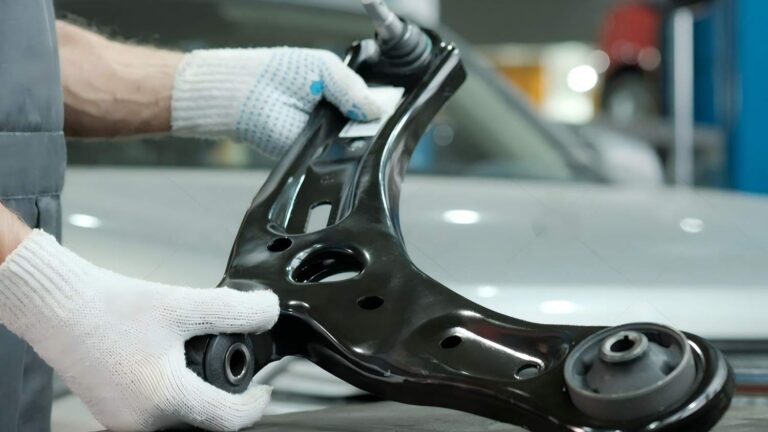
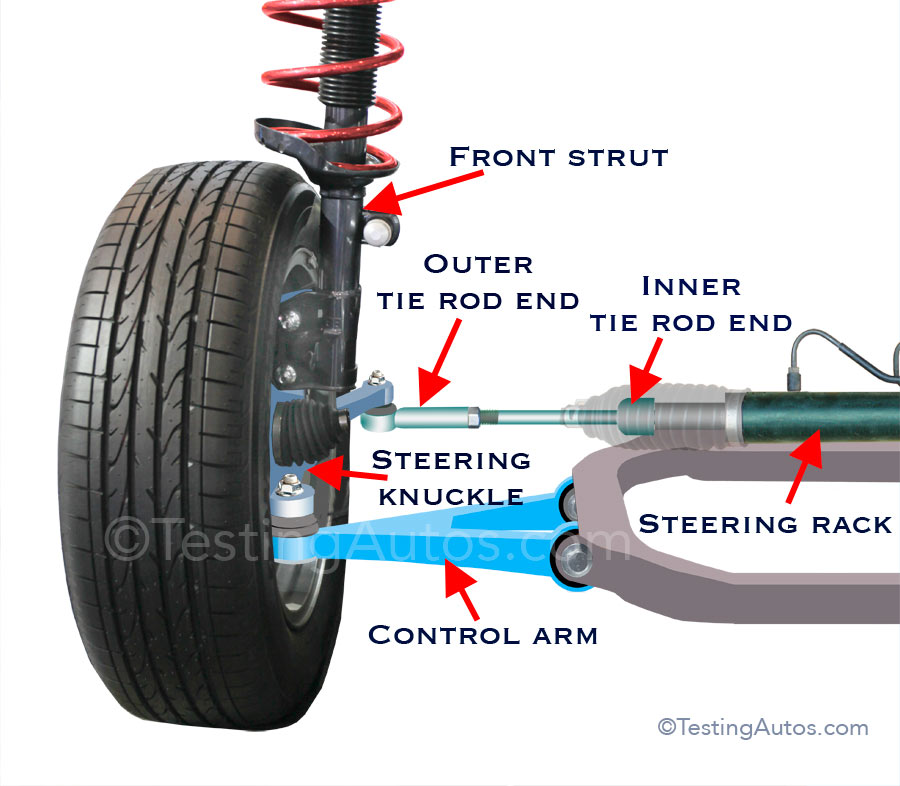
The control arm connects the wheel hub or steering knuckle area to the vehicle’s frame or subframe. It lets the wheel move up and down with the suspension while helping keep it in the correct position. Most control arms use rubber or hydraulic bushings at the frame side and a ball joint at or near the steering knuckle.
The tie rod links the steering rack or steering linkage to the steering knuckle. When you turn the steering wheel, the steering system pushes or pulls the tie rod. The tie rod then changes the direction of the front wheel.
So when someone asks **are control arms and tie rods the same thing**, the easiest way to remember the difference is this: control arms help control suspension movement, while tie rods help control steering direction.

- ✦ Control arm
Connects the wheel or steering knuckle to the frame or subframe and guides suspension movement.
- ✦ Tie rod
Connects the steering rack or linkage to the steering knuckle and helps turn the wheel.
- ✦ Shared effect
Wear in either part can affect handling, alignment, tire wear, and overall front-end stability.
Why the Two Parts Are Often Confused
Both parts sit near the front wheel on many vehicles. Both connect to or work around the steering knuckle. Both can also cause looseness, tire wear, noise, and alignment problems when worn.
The confusion grows because repair shops may use broad terms such as front-end parts, suspension parts, or steering and suspension components. Aftermarket kits also group control arms and tie rods together even though they do different jobs.
- ✦ Same general area
Both parts are usually found around the front wheel, steering knuckle, and suspension.
- ✦ Similar symptoms
Either part can contribute to wandering, uneven tires, poor alignment, or unusual noises.
What Does a Control Arm Do?
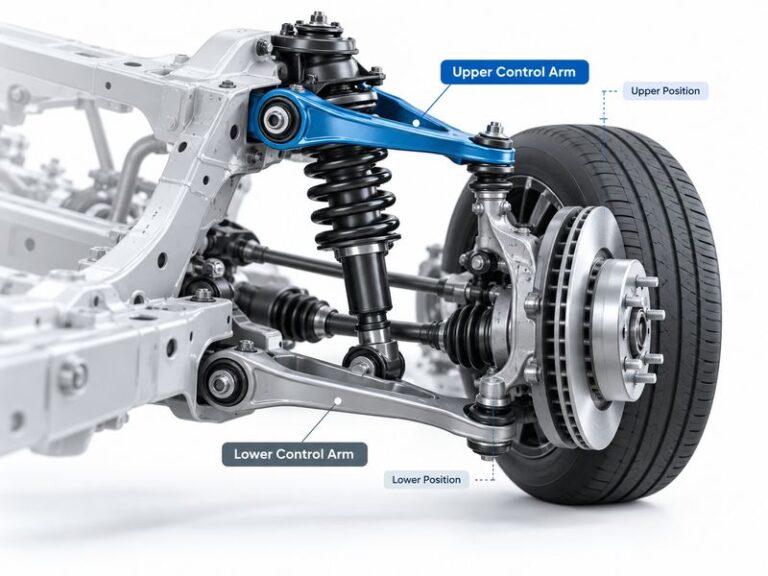
A control arm helps hold the wheel assembly in the correct position while still allowing suspension travel. One end mounts to the vehicle’s frame or subframe. The outer end usually connects to the steering knuckle through a ball joint.
As the tire moves over bumps, the control arm pivots at its bushings. This controlled motion lets the wheel travel upward and downward without moving freely in every direction. The result is more stable handling and better tire contact with the road.
Many vehicles use a lower control arm. Some suspension designs also use an upper control arm. Double-wishbone systems often use both upper and lower arms, while many MacPherson-strut vehicles rely mainly on a lower control arm.
The control arm also plays an important role in suspension geometry. Its shape, mounting points, bushings, and ball joint location help determine how the wheel moves through its suspension travel.

- ✦ Supports wheel position
The control arm helps keep the wheel located correctly in relation to the chassis.
- ✦ Allows suspension travel
Its bushings let the arm pivot as the wheel rises and falls over road surfaces.
- ✦ Works with the ball joint
The ball joint allows steering and suspension movement while connecting the arm to the knuckle.
- ✦ Influences alignment
Control arm geometry can affect camber, caster, and wheel position.
Control Arm Bushings
Control arm bushings sit between the arm and its chassis mounting points. They reduce vibration and allow controlled movement. Rubber is common, but some vehicles use hydraulic bushings or other designs.
When these bushings crack, separate, or become soft, the control arm can move more than intended. The driver may notice clunks, unstable braking, steering wander, or changes in wheel alignment.
- ✦ Common wear
Cracked rubber, separation, fluid leakage from hydraulic bushings, and excess movement.
Control Arm Ball Joint
Many control arms have a ball joint attached to or built into the outer end. The ball joint creates a flexible pivot between the control arm and steering knuckle.
A worn ball joint may create clunking, looseness, steering changes, or abnormal tire wear. On some vehicles, the ball joint can be replaced alone. On others, the complete control arm is replaced.
- ✦ Important distinction
A ball joint may be part of a control arm assembly, but the ball joint itself is not a tie rod.
What Does a Tie Rod Do?
A tie rod transfers steering force from the steering rack or steering linkage to the steering knuckle. When you rotate the steering wheel, the steering rack moves from side to side. The tie rods push or pull the knuckles, which turns the front wheels.
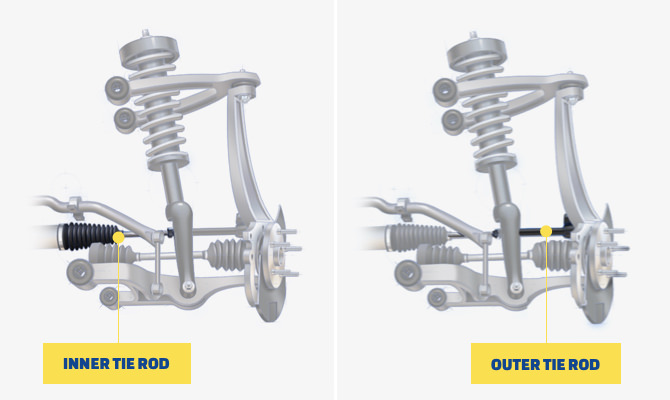
Most modern rack-and-pinion systems use an inner tie rod and an outer tie rod on each side. The inner tie rod connects to the steering rack. The outer tie rod connects to the steering knuckle.
The outer tie rod end contains a small ball-and-socket joint. This joint lets the steering linkage move as the suspension rises, falls, and turns. A rubber boot keeps grease in and helps keep water and dirt out.
Tie rods also play a direct role in toe alignment. Changing the effective length of the tie rod changes the direction the wheel points when viewed from above. That is why technicians adjust tie rods during many front wheel alignments.
- ✦ Transfers steering input
Tie rods carry movement from the steering system to the steering knuckle.
- ✦ Turns the wheels
They push and pull the knuckles when the steering rack moves.
- ✦ Controls toe
Tie rod adjustment is commonly used to set front-wheel toe during an alignment.
Inner Tie Rod
The inner tie rod sits closer to the center of the vehicle. On a rack-and-pinion system, it connects directly to the steering rack and is often covered by the rack boot.
Inner tie rod wear can create looseness at the wheel. It may also cause vague steering, wandering, or clicking and knocking during steering movement.
- ✦ Location
Between the steering rack and the outer tie rod.
Outer Tie Rod
The outer tie rod sits near the steering knuckle. Its threaded connection to the inner tie rod or adjusting sleeve allows toe adjustment on many vehicles.
Outer tie rod ends are common wear points because their joint moves each time the wheels steer and the suspension travels. A torn dust boot can speed up wear by allowing dirt and moisture into the joint.
- ✦ Location
At the outer end of the steering linkage, where it connects to the steering knuckle.
Control Arm vs Tie Rod: Main Differences
The clearest answer to **are control arms and tie rods the same thing** comes from comparing their jobs. A control arm controls the position and travel of the wheel in the suspension. A tie rod controls the direction the wheel points as part of the steering system.
Their mounting points are also different. A control arm normally connects the frame or subframe to the steering knuckle. A tie rod runs from the steering rack or steering linkage to the steering knuckle.
The joints used by the parts can look similar. A control arm may use a ball joint, while an outer tie rod end also uses a ball-and-socket joint. That visual similarity is one reason vehicle owners sometimes mistake one part for the other.
Their alignment effects also differ. Tie rods directly control toe adjustment on many vehicles. Control arms can affect camber, caster, toe, or wheel position depending on the suspension design and how much wear or damage exists.
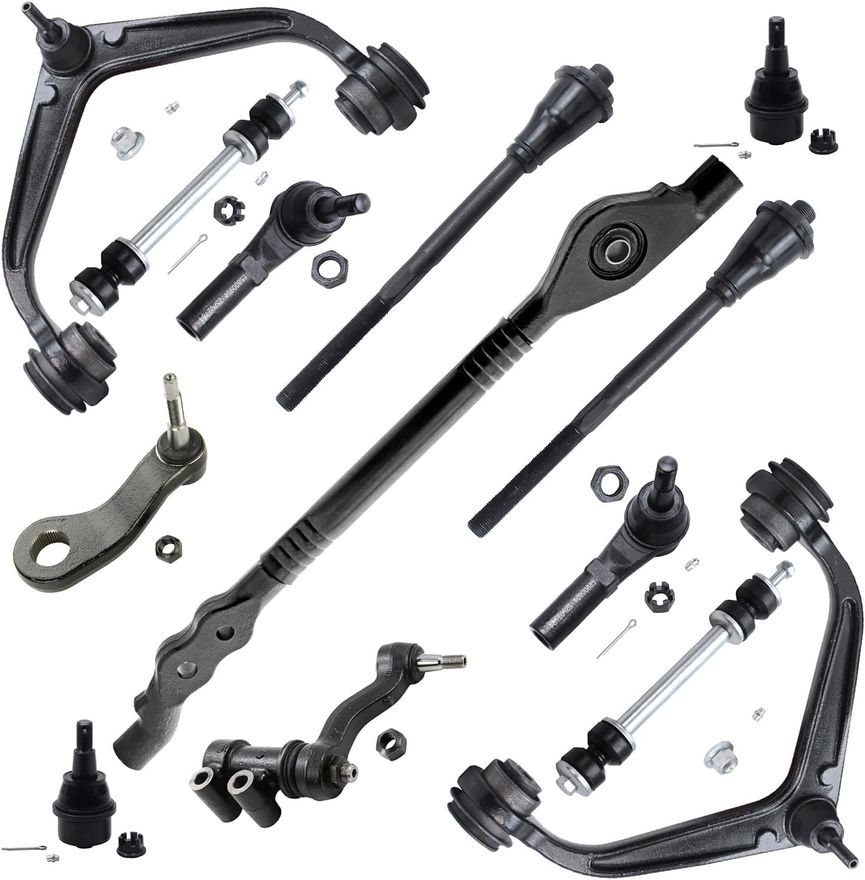
- ✦ System
Control arm: mainly suspension. Tie rod: mainly steering.
- ✦ Primary job
Control arm: guides wheel travel. Tie rod: transfers steering movement.
- ✦ Main connection
Control arm connects the chassis to the knuckle. Tie rod connects steering linkage to the knuckle.
- ✦ Common joints
Control arms often use bushings and a ball joint. Tie rods use inner joints and outer tie rod ends.
- ✦ Alignment role
Tie rods directly set toe on many cars. Control arm position can influence multiple alignment angles.
- ✦ Typical driver complaint
Control arm wear often causes clunks or unstable suspension movement. Tie rod wear often causes loose or vague steering.
Simple Way to Remember the Difference
Think of the control arm as a guide for the wheel’s suspension movement. It helps the wheel move up and down while staying located under the vehicle.
Think of the tie rod as a steering link. It moves sideways with the steering system and tells the wheel which direction to point.
- ✦ Control arm
Guides suspension movement.
- ✦ Tie rod
Guides steering direction.
Where Are Control Arms and Tie Rods Located?
Control arms and tie rods are both found around the wheel and steering knuckle, but they approach the knuckle from different points. The exact layout depends on the vehicle’s suspension and steering design.
A lower control arm usually sits below the wheel hub area. Its inner side bolts to the frame or subframe. Its outer side connects to the steering knuckle, often through a lower ball joint.
An upper control arm, when used, sits above the wheel hub and connects to the top area of the steering knuckle. Trucks, SUVs, and vehicles with double-wishbone front suspension commonly use upper and lower control arms.
Tie rods usually extend outward from the steering rack or center steering linkage toward the steering knuckles. On a rack-and-pinion car, you can often trace the steering rack boot outward to the inner tie rod and then to the outer tie rod end.

- ✦ Lower control arm
Usually below the wheel hub, running between the subframe and lower steering knuckle.
- ✦ Upper control arm
Found above the knuckle on vehicles that use an upper-and-lower-arm suspension design.
- ✦ Tie rod
Runs between the steering rack or steering linkage and the steering knuckle.
Why Location Matters During Inspection
Knowing the location helps you understand which joint a technician is checking. A mechanic may move the tire by hand, use a pry bar, or watch the steering linkage while another person turns the steering wheel.
Movement at the outer tie rod is different from movement at a control arm bushing or ball joint. Correctly identifying the loose point is more useful than replacing parts based only on noise.
- ✦ Inspection goal
Find the exact joint or bushing that moves beyond its normal range.
Symptoms of a Bad Control Arm
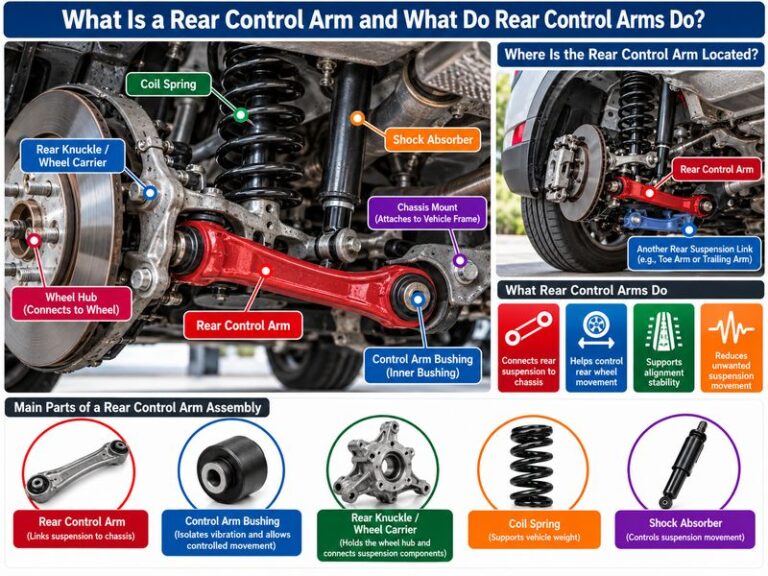
A control arm itself is a strong metal part, so the arm may last for many years unless it bends, cracks, or rusts badly. The bushings and ball joint attached to it are more common wear points.
A worn control arm bushing may let the wheel shift forward, backward, or sideways more than designed. This can create a dull clunk over bumps or during braking. The vehicle may also feel less stable when changing lanes or braking hard.
If the ball joint is worn, you may hear knocking or clunking from the wheel area. Steering can also feel less precise. Severe ball joint wear can become a major safety problem because the joint helps hold the steering knuckle to the suspension.
Uneven tire wear can occur as well. However, tire wear alone does not prove that a control arm is bad. Incorrect tire pressure, worn shocks or struts, tie rod problems, wheel alignment, and other suspension faults can cause similar patterns.

- ✦ Clunking over bumps
Worn bushings or a loose ball joint may allow unwanted movement.
- ✦ Vehicle wandering
The wheel may shift as suspension loads change.
- ✦ Unstable braking
Bad bushings can allow the wheel to move during acceleration or braking.
- ✦ Uneven tire wear
Changed suspension geometry can alter how the tire contacts the road.
- ✦ Visible bushing damage
Cracks, separation, or excessive movement can point to a worn bushing.
Can a Control Arm Bend?
Yes. A hard curb hit, deep pothole, collision, or off-road impact can bend a control arm. A bent arm may change wheel position even if its bushings and ball joint still feel tight.
After a severe impact, a wheel that suddenly sits farther forward, backward, or at an odd angle should be inspected. Alignment readings can also help reveal bent suspension parts.
- ✦ Common causes
Potholes, curb impacts, crashes, corrosion, or severe off-road use.
Symptoms of a Bad Tie Rod
Tie rod wear is often most noticeable through the steering wheel. As the inner or outer joint develops play, the wheel can move slightly before the steering system fully controls it. That can make steering feel loose or vague.
A worn tie rod can also cause the vehicle to wander or require frequent steering corrections on a straight road. Drivers may notice uneven front tire wear because looseness can let toe change as the vehicle moves.
Some bad tie rods produce clicking, clunking, or knocking during steering. A damaged outer tie rod boot may also be visible. If the boot tears, grease can escape and road dirt can enter the joint.
Severe tie rod wear is a serious safety concern. The tie rod is part of the physical connection between the steering system and wheel. If that connection fails, steering control at that wheel can be lost.

- ✦ Loose steering
The steering wheel may have more free movement than normal.
- ✦ Wandering
The car may not hold a straight path without frequent corrections.
- ✦ Uneven front tire wear
Excess tie rod play can allow toe to change while driving.
- ✦ Noise while turning
A worn tie rod joint may click or clunk as steering load changes.
- ✦ Visible boot damage
A torn or missing dust boot can expose the joint to water and grit.
Can a Bad Tie Rod Cause Steering Wheel Vibration?
It can contribute to vibration or shaking, especially when the joint has significant play. Still, vibration has many possible causes, including tire imbalance, bent wheels, worn wheel bearings, damaged tires, and other suspension problems.
A technician should inspect the complete front end rather than assuming a vibration means the tie rods need replacement.
- ✦ Do not diagnose by vibration alone
Loose steering joints should be confirmed through a physical inspection.
How to Tell a Bad Control Arm From a Bad Tie Rod
Symptoms can overlap, so the safest approach is to locate the actual play. A noise alone is not enough to identify the bad part. The front wheel, steering linkage, control arm bushings, ball joints, wheel bearing, sway bar links, and strut mounts may all need inspection.
Tie rod problems usually become clear when checking steering-side movement. With the vehicle safely supported, a technician can move the wheel and watch the inner and outer tie rod joints. Any unwanted movement at a joint can point toward wear.
Control arm problems are often found by inspecting the bushings and ball joint while the suspension is loaded or moved in a controlled way. Torn bushings, separation, excessive movement, damaged ball joint boots, or looseness can show where the problem is.
From practical experience with front-end diagnosis, the most useful rule is simple: **watch the joint while the wheel is being moved**. If the wheel moves but one connection lags, shifts, or clicks, that movement helps identify the worn part.
- ✦ More likely tie rod
Loose steering, toe-related wear, play at the steering linkage, or movement at an inner or outer tie rod joint.
- ✦ More likely control arm
Damaged bushings, wheel shifting during braking, clunks over bumps, or movement at the control arm ball joint.
- ✦ Possible other cause
Wheel bearings, sway bar links, struts, ball joints, steering rack mounts, and tires can mimic similar symptoms.
Why a Professional Inspection Can Save Money
Replacing parts based only on a sound can get expensive. A clunk may come from a sway bar link rather than a control arm. Loose steering may come from an inner tie rod, outer tie rod, steering rack, or another joint.
A proper inspection lets the technician see which part has excess movement. This reduces unnecessary parts replacement and gives you a better idea of whether related items should be repaired at the same time.
- ✦ Best practice
Confirm the worn joint before ordering parts or paying for an alignment.
Do Control Arms and Tie Rods Affect Wheel Alignment?
Yes. Both can affect wheel alignment, but they do so in different ways. Tie rods are directly involved in setting toe on most vehicles. Control arms help establish and maintain suspension geometry.
Toe describes whether the fronts of the tires point slightly toward or away from each other when viewed from above. A technician commonly changes tie rod length to adjust toe. That is why tie rod replacement is normally followed by an alignment.
A worn control arm bushing or ball joint can let the wheel move from its intended position. A bent control arm can also change alignment angles. Depending on the suspension design, this may affect camber, caster, toe, or more than one angle at once.
If you replace a control arm or tie rod, getting the alignment checked is a smart step. Even when the new component fits correctly, small changes in part dimensions and mounting position can alter alignment.
- ✦ Tie rod replacement
Usually changes toe and commonly requires a wheel alignment.
- ✦ Control arm replacement
Can change wheel position, camber, caster, or toe depending on the suspension.
- ✦ Why alignment matters
Correct alignment helps protect tires and keeps steering response predictable.
Can You Skip the Alignment After Replacement?
Skipping the alignment can lead to poor steering feel or rapid tire wear if the angles are no longer correct. This is especially important after tie rod work because tie rod length directly affects toe.
Some technicians may mark the old tie rod position during replacement, but that is only a starting point. It does not replace an accurate alignment measurement.
- ✦ Recommended step
Have the alignment measured after steering or major suspension parts are replaced.
Do Control Arms and Tie Rods Need to Be Replaced Together?
No. Control arms and tie rods do not normally need to be replaced together just because one part has failed. They are separate components, and each should be replaced based on its condition.
There are cases where several front-end parts are worn at the same time. An older vehicle with high mileage may have cracked control arm bushings, loose ball joints, worn tie rod ends, and aging sway bar links. In that case, repairing several parts during the same visit may make sense.
Replacing related worn parts together can also reduce repeated labor and alignment costs. However, replacing good parts without evidence of wear adds cost and is not always necessary.
If you are asking **are control arms and tie rods the same thing** because a shop recommended both, ask which joint or bushing has play and whether the technician can show you the movement. A clear inspection finding is more useful than replacing an entire set of parts based only on age.
- ✦ Replace only what is worn
A failed tie rod does not automatically mean the control arm is bad.
- ✦ Inspect related components
If one front-end part is worn, checking nearby joints and bushings is sensible.
- ✦ Consider alignment cost
If several worn parts need repair, doing them before one final alignment may reduce repeat work.
Should Control Arms Be Replaced in Pairs?
Not in every case. If one control arm is bent from an impact and the opposite arm is in good condition, replacing only the damaged arm may be reasonable.
On an older vehicle, the bushings on both sides may have similar wear. Replacing both sides can sometimes give more even suspension behavior, but the decision should be based on inspection and vehicle-specific repair guidance.
- ✦ Check both sides
Inspect the opposite side even when only one control arm shows an obvious problem.
Should Tie Rod Ends Be Replaced in Pairs?
Tie rod ends also do not always require pair replacement. If only one side has measurable play and the other side is tight, a single-side repair may be acceptable.
Still, both sides often have similar age and road exposure. Inspecting the opposite side before the alignment can help avoid paying for another alignment soon after.
- ✦ Practical approach
Replace confirmed worn parts and inspect matching parts on the opposite side.
Can You Drive With a Bad Control Arm or Tie Rod?
Driving with either problem can become unsafe if the wear is severe. Both components help keep the wheel controlled. The risk depends on which part has failed and how much movement exists.
A slightly cracked control arm bushing may not create the same immediate risk as a ball joint with major play. Likewise, a tie rod with a damaged dust boot but no looseness is different from a tie rod end that is already moving inside its socket.
Do not rely only on how the vehicle feels. Some worn joints can become dangerous before the driver notices a major change. If the steering suddenly becomes loose, the wheel shifts, the vehicle pulls hard, or loud clunks appear, have the front end inspected as soon as possible.
If a technician finds severe tie rod or ball joint play, driving the vehicle farther may not be wise. A tow can be safer when a steering or wheel-retaining joint is close to failure.
- ✦ Lower urgency
Minor bushing wear with no major movement may allow time to schedule repair after professional inspection.
- ✦ Higher urgency
Major tie rod or ball joint play, sudden steering changes, or visible separation requires prompt attention.
- ✦ Safety rule
Do not keep driving if the wheel or steering connection appears close to separating.
Warning Signs That Deserve Immediate Attention
Sudden changes matter more than mild, long-term noise. A steering wheel that develops a large amount of free play, a front wheel that visibly changes angle, or a loud repeated knock can signal serious movement.
When you are unsure, avoid guessing based on internet symptoms alone. A hands-on inspection can determine whether the issue is a control arm, tie rod, ball joint, bearing, or another front-end component.
- ✦ Stop and inspect
Seek immediate help for severe looseness, sudden pulling, visible joint separation, or major wheel movement.
Control Arm and Tie Rod Replacement: What to Expect
The repair process differs because these parts attach in different places. A control arm replacement may require removing bolts from the subframe and separating the ball joint from the steering knuckle. Rust can make the job harder, especially in U.S. regions that use road salt.
Tie rod replacement usually involves separating the outer tie rod end from the steering knuckle. Inner tie rod replacement may also require removing the steering rack boot and using a special inner tie rod tool.
Torque matters on both repairs. Some suspension bushings must be tightened with the suspension near its normal ride position. Tightening certain rubber bushings while the suspension hangs can preload the rubber and shorten its life.
After either repair, the front alignment should be checked. After tie rod replacement, alignment is especially important because the part directly controls toe.
- ✦ Control arm work
May involve bushings, ball joints, subframe bolts, and suspension loading procedures.
- ✦ Tie rod work
May involve inner and outer steering joints, rack boots, and toe adjustment.
- ✦ Final step
Inspect fasteners and obtain a wheel alignment after the repair.
Can a DIY Owner Replace These Parts?
Experienced DIY owners can replace many control arms and tie rods with the right tools, service information, and safe lifting equipment. However, these are safety-critical steering and suspension parts.
If you are not comfortable separating tapered joints, supporting the suspension, using a torque wrench, or checking for remaining play, professional repair is the safer choice. An alignment machine is also needed for accurate final adjustment.
- ✦ DIY requirement
Use vehicle-specific torque specifications, secure jack stands, proper joint tools, and safe lifting points.
Other Parts Commonly Confused With Control Arms and Tie Rods
Front suspensions contain several joints and links in a small area. This makes part names easy to mix up. Knowing the nearby components can make repair estimates and inspection reports easier to understand.
A ball joint connects parts of the suspension while allowing angular movement. It may be pressed into a control arm, bolted to it, or sold as part of a complete control arm assembly.
A sway bar link connects the anti-roll bar to the suspension. It does not steer the wheel or locate it in the same way as a control arm. Worn sway bar links often cause a sharp rattle or clunk over small bumps.
A steering knuckle is the central structure where several components meet. The hub, strut or upper joint, lower ball joint, and outer tie rod may all connect to or around it.
- ✦ Ball joint
A pivot joint between suspension components, often connected to a control arm and steering knuckle.
- ✦ Sway bar link
Links the stabilizer bar to the suspension and helps control body roll.
- ✦ Steering knuckle
The wheel-side structure that connects several steering and suspension parts.
- ✦ Wheel bearing
Allows the wheel and hub to rotate while supporting vehicle loads.
- ✦ Strut
A suspension unit that combines damping with a structural role on many vehicles.
Are Ball Joints and Tie Rod Ends the Same?
No. They may both use a ball-and-socket style joint, but they serve different systems. A ball joint links suspension parts and allows suspension and steering movement. A tie rod end transfers steering force.
Their similar shape can cause confusion when looking under a car. Their mounting location and connection points reveal which component you are seeing.
- ✦ Key difference
Ball joints support suspension articulation, while tie rod ends transmit steering motion.
How Long Do Control Arms and Tie Rods Last?
There is no fixed replacement interval that fits every vehicle. Control arms and tie rods may last a long time, but road conditions, driving habits, vehicle weight, part quality, and corrosion all affect service life.
Potholes and rough roads place high loads on ball joints, bushings, and tie rod ends. Vehicles driven in areas with winter road salt may also develop rust around fasteners, control arms, and steering hardware.
Large wheels, low-profile tires, heavy loads, and frequent off-road use can add stress. A vehicle that spends most of its life on smooth highways may show much less wear at the same mileage.
Instead of replacing these parts by mileage alone, inspect them when symptoms appear and during routine steering and suspension service. This approach is more useful than assuming every vehicle needs control arms or tie rods at a certain odometer reading.
- ✦ Road quality
Potholes and broken pavement can speed up wear.
- ✦ Climate
Salt, moisture, and corrosion can damage components and make service harder.
- ✦ Driving conditions
Heavy loads, curb impacts, and off-road use can increase stress.
- ✦ Component quality
Joint design, materials, sealing, and installation quality affect service life.
When Should the Front End Be Inspected?
An inspection makes sense when you notice clunks, loose steering, wandering, uneven tire wear, or a new pull. It is also useful after a hard pothole or curb impact.
Many owners also have steering and suspension parts checked when buying tires or getting an alignment. Finding loose parts first can prevent an alignment from being wasted.
- ✦ Good timing
Inspect before alignment, after a hard impact, or whenever steering and tire-wear symptoms appear.