Should You Replace Upper and Lower Control Arms Together?
If you are asking should you replace upper and lower control arms together, the key point is that control arms do not have to be changed as a matched upper-and-lower set. Each arm should be checked on its own. If the upper arm is tight and healthy but the lower arm has a torn bushing or loose ball joint, replacing only the lower arm may be the right repair.
Still, there are cases where doing both at the same time makes good sense. This is common on older vehicles, high-mileage trucks, SUVs, and cars that have spent years on rough roads. If several control arm bushings are cracked, ball joints have play, or the arms are badly rusted, replacing more than one arm can prevent another suspension repair soon after the first.
In U.S. repair shops, the decision often comes down to inspection results, labor overlap, part condition, vehicle age, and the driver’s plans for the car. A technician should check the bushings, ball joints, mounting points, arm structure, tire wear, and wheel movement before recommending parts. This guide explains when replacing both arms makes sense and when it may waste money.

Should You Replace Upper and Lower Control Arms Together?
So, should you replace upper and lower control arms together? **Usually, not automatically.** The upper and lower control arms perform related jobs, but they can wear at different rates. One arm can fail while the other remains safe and usable.
The better approach is to replace the parts that have measurable wear or damage. A mechanic should look for loose ball joints, split bushings, bent metal, heavy corrosion, cracked mounts, and unwanted movement. If the other control arm passes inspection, there may be no mechanical reason to replace it.
Replacing both becomes more reasonable when both arms show clear aging. For example, a 15-year-old suspension may have several dry and cracked rubber bushings even if only one side is making noise. Doing related parts together can reduce repeat labor and help restore consistent steering feel.
The decision should not be based only on mileage. Road conditions, vehicle weight, curb impacts, potholes, towing, off-road use, suspension design, and bushing quality can all affect how fast a control arm wears.

- ✦ Replace one arm when
Only one control arm is worn or damaged and the remaining arms and joints test well.
- ✦ Replace both when
Both arms show worn bushings, loose joints, rust, impact damage, or similar age-related deterioration.
- ✦ Inspect before buying parts
A complete suspension inspection is more useful than replacing parts only because they are the same age.
Why Control Arms Do Not Always Wear at the Same Rate
Upper and lower control arms carry different loads depending on the suspension design. The lower arm may support more vehicle weight or receive more direct road shock on some vehicles. That can cause its bushings or ball joint to wear sooner.
Driving conditions can also create uneven wear. A hard pothole hit may bend one lower arm without damaging the upper arm. A leaking fluid source can also attack one nearby rubber bushing while the other remains in good shape.
- ✦ Road impacts
Potholes, curbs, and rough roads can damage one arm more than another.
- ✦ Different loads
Upper and lower arms may handle different forces during braking, cornering, and suspension travel.
- ✦ Part design
Bushing size, ball-joint design, and arm shape affect service life.
What Upper and Lower Control Arms Actually Do
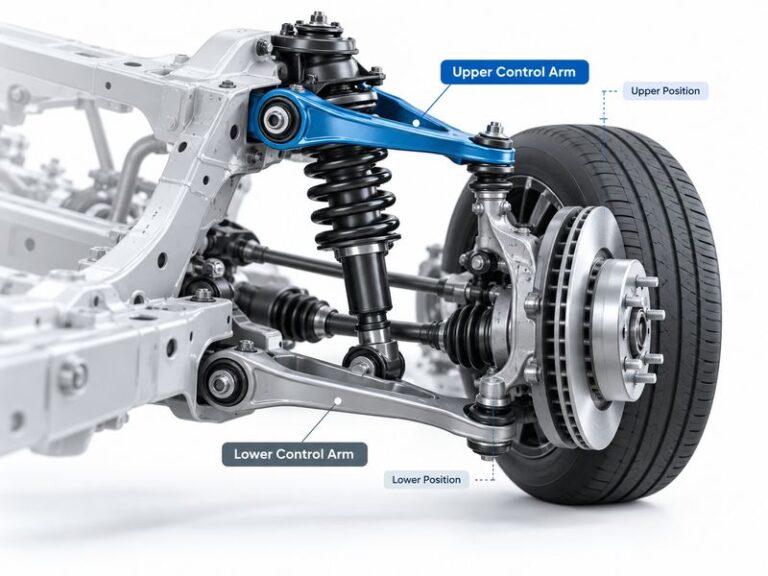
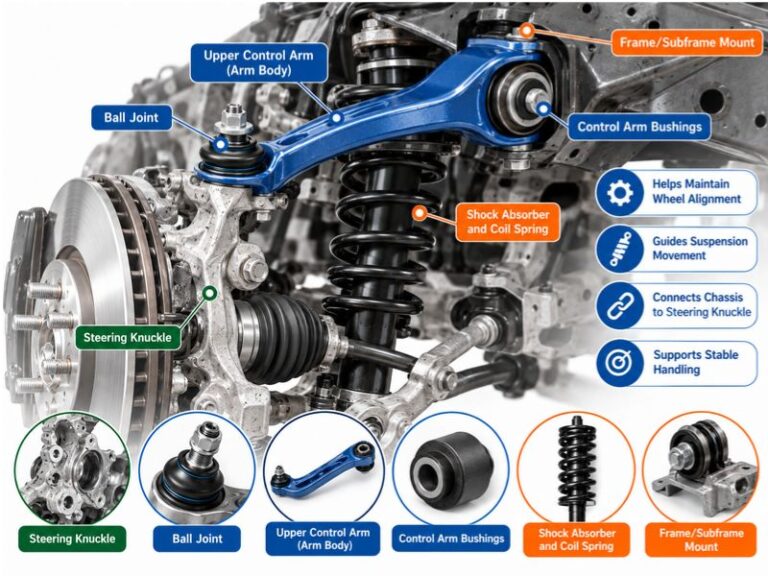
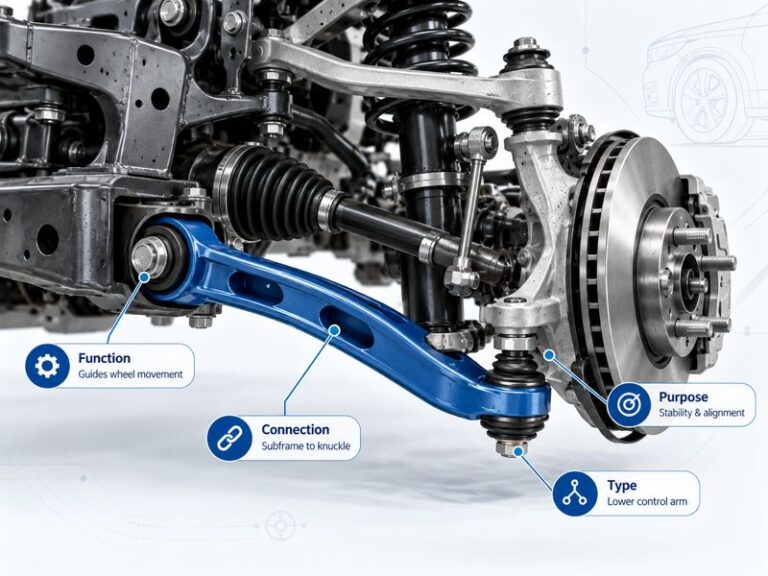
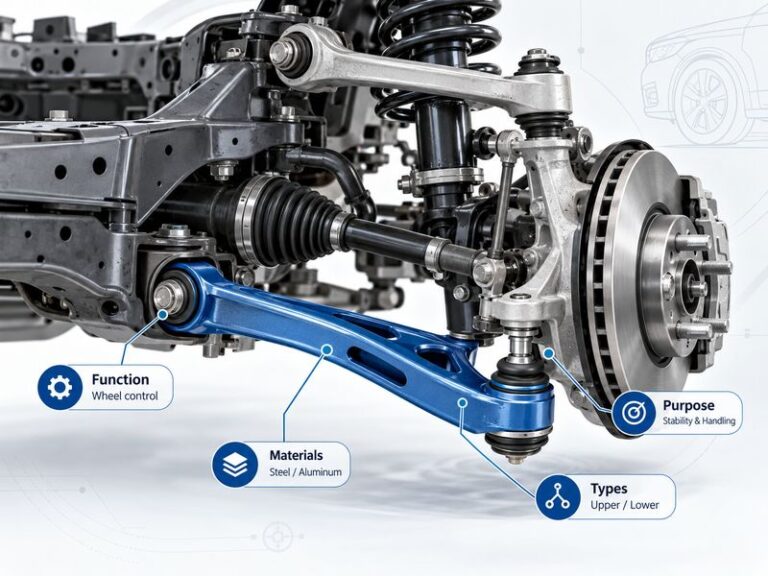
Control arms connect parts of the wheel assembly to the vehicle frame or subframe. They allow the wheel to move up and down while helping keep its position controlled. Most designs use rubber bushings at the frame end and a ball joint or similar joint near the steering knuckle.
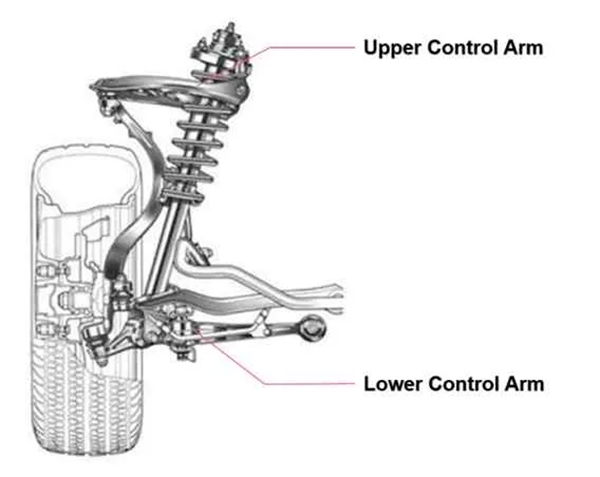
On vehicles with both upper and lower control arms, the two arms work together to guide wheel movement. This type of layout is common in double-wishbone and short-long-arm suspension systems. Trucks, SUVs, performance cars, and some passenger cars may use this design.
Because both arms affect wheel position, worn parts can change steering response and alignment angles. That does not mean both arms must always be replaced together. It means both should be inspected whenever one has a problem.
- ✦ Control wheel movement
The arms help guide the wheel as the suspension moves over bumps.
- ✦ Support alignment geometry
The arms help maintain wheel angles such as camber and caster.
- ✦ Provide mounting points
Bushings and ball joints let the suspension move while limiting unwanted looseness.
Upper Control Arm
The upper control arm usually sits above the wheel centerline and links the upper part of the steering knuckle to the chassis. On many trucks and SUVs, the upper ball joint attaches to this arm. The arm helps control wheel angle as the suspension moves.
- ✦ Common wear areas
Upper bushings and upper ball joints are common inspection points.
Lower Control Arm
The lower control arm sits below the upper arm and often handles substantial road and vehicle loads. Some designs connect the spring, shock, or sway-bar link close to this arm. Lower control arm bushings may therefore see heavy stress during braking and acceleration.
- ✦ Common wear areas
Lower bushings, lower ball joints, and arm mounting points often need close inspection.
When You Should Replace Upper and Lower Control Arms Together
If you are deciding should you replace upper and lower control arms together, start with the condition of the complete suspension. Replacing both is most useful when both have meaningful wear. It is also worth considering when the vehicle is older and several parts are close to the end of their useful life.
A good example is a truck with cracked upper bushings, torn lower bushings, and play in one ball joint. Replacing one arm may stop one symptom, but the remaining worn arm can still cause poor steering feel or alignment trouble. In that case, replacing both can provide a more complete repair.
Another case is severe corrosion. In regions that use road salt, suspension arms and their fasteners can rust heavily. If both arms are structurally weakened or their mounting areas are badly corroded, replacing both affected components may be safer than keeping one questionable part.

- ✦ Both arms have worn bushings
Deep cracks, separation, or excess movement in several bushings can justify replacing both arms.
- ✦ Both ball joints are loose
If each arm includes a worn integrated ball joint, replacing both complete arms can be practical.
- ✦ Both arms are bent
Accident damage or hard impacts can alter suspension geometry and require several arms.
- ✦ Heavy rust affects both
Structural corrosion can weaken the arms and make reuse a poor choice.
- ✦ The vehicle has widespread suspension wear
Replacing several aging components at once may reduce repeated repairs and alignment work.
When Labor Overlap Makes Replacement More Practical
Some vehicles require nearby parts to be removed or loosened before a control arm can come out. If the second arm is already worn, replacing it during the same job may reduce duplicated labor later. The amount of overlap varies greatly by vehicle.
Do not replace a healthy part only because the car is already on a lift. But if the second arm is clearly close to failure, doing both during one service visit can be convenient and may avoid paying for another alignment soon.
- ✦ Ask for inspection results
Have the shop explain which bushing, joint, or part of the arm has failed.
- ✦ Compare labor separately
Ask how much extra labor the second arm adds when both are done in the same visit.
When Replacing Only One Control Arm Makes Sense
Replacing only one arm can be completely reasonable. Suppose the lower control arm was bent by a curb hit but the upper arm has firm bushings, no ball-joint play, and no rust. There is little value in replacing a healthy upper arm simply because the lower one was damaged.
The same rule applies to normal wear. If a lower control arm bushing has separated while the upper arm is still tight and quiet, the repair can focus on the failed lower arm. This keeps the repair cost lower without sacrificing safety when the inspection is accurate.
This is why the answer to should you replace upper and lower control arms together is not a fixed yes. **Condition matters more than matching age alone.** A good technician measures looseness and examines the parts instead of replacing everything by default.

- ✦ Single impact damage
A curb or pothole may damage one arm without harming the other.
- ✦ One failed bushing
One arm may develop bushing separation long before the other.
- ✦ One loose ball joint
If the joint is part of the control arm, only that assembly may need replacement.
- ✦ Recent replacement
A newer control arm usually should not be replaced only because another arm has failed.
What Should Be Checked Before Keeping the Other Arm
The remaining arm should be checked under the correct load conditions for that suspension design. The mechanic should inspect bushing movement, ball-joint looseness, cracks, bends, rust, and the condition of mounting hardware. Tire wear and alignment readings can also provide useful clues.
- ✦ Bushing condition
Look for torn rubber, separation, major cracking, or excess movement.
- ✦ Ball-joint play
Any looseness should be compared with the vehicle manufacturer’s service limit.
- ✦ Arm shape
A bent control arm can change wheel alignment even if its bushings look good.
Signs That More Than One Control Arm May Be Worn
Control arm problems do not always create one clear symptom. Worn bushings and joints can cause clunks, steering changes, vibration, unstable braking, or uneven tire wear. The same symptoms can also come from tie rods, struts, wheel bearings, sway-bar links, or other suspension parts.
When several symptoms appear on an older vehicle, inspect the whole front suspension. If both upper and lower arms show looseness, the answer to should you replace upper and lower control arms together may be yes for that specific vehicle. The decision should still come from physical inspection, not from the noise alone.

- ✦ Clunking over bumps
Worn bushings or ball joints can let suspension parts shift and create a knock or clunk.
- ✦ Loose steering feel
Excess movement can make the vehicle feel less precise when changing direction.
- ✦ Uneven tire wear
Changed wheel geometry may wear the inside or outside edge of a tire.
- ✦ Vehicle pulls
Control arm or bushing movement may contribute to alignment changes.
- ✦ Movement during braking
A badly worn bushing may let the wheel shift slightly under braking force.
- ✦ Visible rubber damage
Separated or badly split bushings often point to a part that needs closer inspection.
Do Not Diagnose a Control Arm by Sound Alone
A clunk does not prove the control arm is bad. Sway-bar links, strut mounts, tie rods, loose hardware, and ball joints can produce similar sounds. The suspension should be inspected before parts are ordered.
This matters because replacing several control arms without confirming the source can become expensive. A proper diagnosis helps prevent replacing good parts while the true cause remains.
Should Control Arms Be Replaced in Pairs on the Same Axle?
Drivers often hear that suspension parts should always be replaced in pairs. That rule is useful for some parts, such as many shocks and struts, because balanced damping matters. Control arms are different. There is no universal rule that requires left and right control arms to be replaced together.
If the left lower control arm is damaged but the right one tests well, replacing only the left side can be acceptable. However, if both sides have the same mileage and both bushings show similar cracking, replacing the pair may prevent another repair soon.
The same logic applies when asking should you replace upper and lower control arms together. Matching parts can be convenient, but serviceability should drive the decision. Replace what is worn, damaged, unsafe, or likely to fail soon based on actual inspection.
- ✦ One bad side
Replacing one control arm can be fine when the opposite side remains healthy.
- ✦ Both sides worn
Replacing a left-right pair makes more sense when both have similar deterioration.
- ✦ Vehicle-specific design
Some suspension layouts or service procedures may make paired replacement more practical.
Upper and Lower Versus Left and Right
Upper and lower replacement refers to two different arms at one wheel. Left-and-right replacement refers to matching arms across the same axle. These are different decisions and should not be confused.
A vehicle could need one left lower control arm but no upper arm. Another could need both lower arms but neither upper arm. A third could have worn upper and lower arms on one side after collision damage.
Control Arm Bushings and Ball Joints Matter More Than the Arm Name
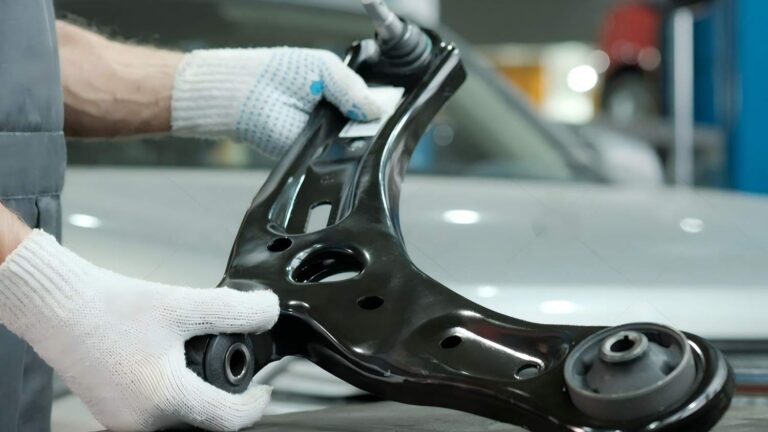
In many cases, the metal control arm itself is not the part that wears out. The problem is often the rubber bushing or ball joint attached to it. Some vehicles allow these parts to be serviced separately, while others use complete control arm assemblies.
A torn bushing may let the arm move farther than designed. A worn ball joint can create looseness between the control arm and steering knuckle. Either condition can affect steering and tire contact with the road.
When deciding should you replace upper and lower control arms together, ask which specific part has failed. A recommendation to replace a complete arm may simply mean the bushing or ball joint is built into the assembly or is more practical to replace with the arm.
- ✦ Rubber bushings
They isolate noise and allow controlled suspension movement.
- ✦ Ball joints
They let the steering knuckle pivot while supporting suspension movement.
- ✦ Complete assemblies
Many replacement arms include new bushings and a new ball joint.
Is It Better to Replace the Bushing or the Whole Control Arm?
That depends on the vehicle, labor cost, part price, arm condition, and whether the ball joint is also worn. Pressing a bushing into an old arm may save the cost of a complete assembly, but it can require more labor and special tools.
A complete arm can be attractive when it includes new bushings and a ball joint. It also avoids installing new rubber into an arm that is rusty or damaged. Still, a quality bushing replacement can be a sound repair when the arm itself is in good condition.
- ✦ Choose a complete arm when
The arm is damaged, heavily rusted, or supplied with other worn components already installed.
- ✦ Consider a bushing-only repair when
The arm is sound and the vehicle design makes bushing replacement practical.
How a Technician Checks Upper and Lower Control Arms
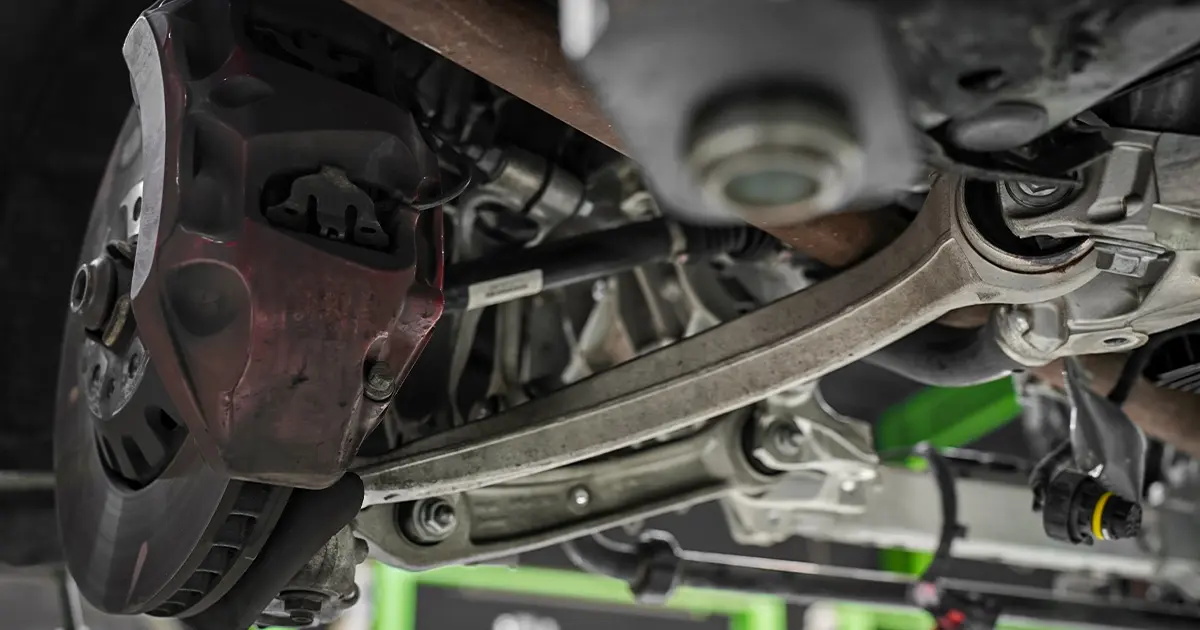
A reliable control arm diagnosis requires more than looking at the car from the ground. The technician may raise the vehicle, support the suspension correctly, move the wheel by hand, inspect the bushings, and check the ball joints for play. The exact test method depends on suspension design.
Rubber bushings should not be judged only by small surface cracks. Some aging rubber can show light cracking and still work. The bigger concerns are separation, tearing, major movement, metal-to-metal contact, or a bushing that no longer holds the arm in position.
Ball joints should be checked according to the vehicle maker’s method. Some designs normally have a small amount of movement while others should have almost none. Using the correct inspection method helps prevent false diagnoses.
- ✦ Visual inspection
Check bushings, arms, joints, welds, mounting points, and corrosion.
- ✦ Movement test
Check for unwanted movement in the joint or bushing.
- ✦ Tire inspection
Look for uneven wear that may point to alignment or suspension movement.
- ✦ Alignment check
Unusual camber or caster can help identify bent or shifted parts.
Questions to Ask the Repair Shop
If a shop recommends several control arms, ask what is wrong with each one. A useful answer should name the failed part, such as a separated rear bushing, loose upper ball joint, or bent lower arm. Clear evidence makes it easier to decide whether doing several parts at once is justified.
- ✦ Which part has failed?
Ask whether the problem is the arm, bushing, ball joint, or mounting point.
- ✦ How much play is present?
Ask whether the movement exceeds the manufacturer’s limit.
- ✦ Can you show me the damage?
Visible cracks, torn rubber, looseness, or bends can make the recommendation easier to understand.
Do You Need an Alignment After Replacing Control Arms?
An alignment is commonly recommended after control arm replacement. Removing an arm can disturb wheel geometry, and small differences in the replacement part or mounting position can change camber, caster, or toe.
The need is even stronger when the control arm directly affects an adjustable alignment point. A proper alignment also confirms that the wheel angles can return to specification. If they cannot, there may be another bent or worn suspension component.
When both upper and lower arms are replaced, plan for an alignment unless the vehicle manufacturer states otherwise. Driving with poor alignment can reduce steering quality and wear expensive tires much faster.
- ✦ Protects tire life
Correct wheel angles help prevent rapid inner-edge or outer-edge tire wear.
- ✦ Restores steering feel
Proper alignment helps the vehicle track straight and respond predictably.
- ✦ Checks the repair
Alignment readings can reveal whether another suspension part is bent or worn.
What Happens If You Replace One Arm but Leave Another Worn Arm?
Replacing one failed arm does not correct wear in another bad arm. If the remaining upper or lower control arm has loose bushings or a worn ball joint, the vehicle can still clunk, wander, pull, or wear tires unevenly.
You may also need another alignment after the second repair. This is one reason replacing several confirmed worn parts at once can make financial sense. The key word is **confirmed**. Healthy parts do not need to be replaced merely to make the repair look complete.
If a severely worn ball joint is ignored, the risk can become more serious than noise or tire wear. A joint that develops extreme looseness may compromise wheel control. Any control arm or ball joint with dangerous play should be repaired promptly.
- ✦ Repeat labor
A second repair visit may repeat some of the work done during the first visit.
- ✦ Another alignment
A second suspension repair may require another alignment service.
- ✦ Symptoms may remain
Noise or poor handling can continue if another worn arm was not repaired.
How Long Do Control Arms Last?
Control arms do not have one universal replacement interval. Many last for a large part of the vehicle’s life, while bushings or ball joints may wear much sooner. Driving environment often matters more than a fixed mileage number.
Vehicles that see rough pavement, large potholes, heavy loads, lifted suspension setups, off-road use, or salted winter roads may develop wear sooner. Rubber also ages with heat, time, oil exposure, and weather.
Instead of replacing control arms at a set mileage, inspect them when symptoms appear and during major suspension or tire service. If one arm fails on an older vehicle, that is a good time to check all related arms even if they are not automatically replaced.

- ✦ Rough-road driving
Repeated impacts place more stress on bushings, joints, and arm structures.
- ✦ Heavy vehicle use
Towing and hauling may increase suspension loads.
- ✦ Age
Rubber bushings can harden, crack, and separate over many years.
- ✦ Rust exposure
Road salt and moisture can weaken arms and seize mounting hardware.
Cost Considerations When Replacing Upper and Lower Control Arms
The total price depends on vehicle design, part quality, labor rates, corrosion, and alignment needs. A simple lower arm on a common passenger car may be easier to replace than an upper arm on a truck where access is tight. Rusted bolts can also add labor.
Replacing both upper and lower arms obviously costs more in parts. Yet if both truly need replacement, doing them in one visit can reduce repeated shop time and may avoid paying for separate alignments. Ask for an estimate that shows parts, labor, and alignment separately.
The cheapest repair is not always the one with the fewest parts. At the same time, replacing every nearby component without evidence can waste money. The best value comes from identifying all worn parts and planning the repair around their actual condition.
- ✦ Part quality
Prices vary between economy, premium aftermarket, and original-equipment parts.
- ✦ Labor time
Suspension design and rust can greatly change repair time.
- ✦ Alignment
Include post-repair alignment in the total budget when required.
- ✦ Related hardware
Seized bolts, damaged eccentric adjusters, or worn ball joints may increase the total.
Should You Replace Upper and Lower Control Arms Together on an Older Car?
On an older car, should you replace upper and lower control arms together? The answer depends on how evenly the suspension has aged. Older vehicles are more likely to have several dry bushings, rusty arms, or joints with growing play, so a broader repair can make more sense.
Suppose the lower arm is clearly failed and the upper arm has deep bushing cracks but has not started clunking. If you plan to keep the car for several years, replacing both may reduce the chance of another repair soon. If the upper arm is still firm and shows only light cosmetic aging, keeping it may be reasonable.
Vehicle value also matters. Owners of an older daily driver may prefer to repair only parts that are currently defective. Someone restoring a truck or rebuilding an entire suspension may choose to renew all control arms, bushings, and related joints at once.
- ✦ Long-term ownership
Broader replacement can be worthwhile when you plan to keep the vehicle for years.
- ✦ Budget repair
Replacing only failed parts may make sense when safe remaining components still have useful life.
- ✦ Full suspension refresh
Replacing several aging arms at once can restore a more consistent feel on an older vehicle.
Should You Replace Upper and Lower Control Arms Together After an Accident?
Collision damage changes the decision. If a wheel hit a curb, pothole, or another vehicle hard enough to bend a control arm, nearby suspension parts should receive a detailed inspection. A visibly damaged lower arm does not prove that the upper arm is safe.
Technicians may check wheel position, arm shape, steering knuckle condition, subframe mounting points, tie rods, struts, and alignment readings. A small bend can cause a large alignment change. Replacing only the obvious part may not restore correct geometry.
In this situation, should you replace upper and lower control arms together? Replace both only if both are damaged or cannot hold proper alignment. Accident-related repairs should follow measured damage rather than a blanket replacement rule.
- ✦ Check for bent metal
Control arms can bend without breaking.
- ✦ Inspect mounting points
A strong impact may shift or damage the subframe or brackets.
- ✦ Measure alignment
Abnormal readings can reveal damage that is hard to see.
A Practical Decision Guide for Control Arm Replacement
If you still wonder should you replace upper and lower control arms together, use a simple condition-based approach. First confirm which part caused the complaint. Then inspect all control arms and related joints on the same axle.
If only one part fails inspection, repair that part and align the vehicle as needed. If several arms show clear deterioration, compare the cost of one repair now with the cost of returning for another repair later. This creates a repair plan based on evidence rather than guesswork.
From a practical ownership standpoint, the best repair is the one that makes the suspension safe and stable without replacing healthy parts for no reason. Good diagnosis is more valuable than any fixed rule about replacing arms in sets.
- ✦ Step 1
Confirm the symptom and identify the failed component.
- ✦ Step 2
Inspect upper and lower arms, bushings, ball joints, and mounting points.
- ✦ Step 3
Replace every part that is worn beyond service limits or structurally damaged.
- ✦ Step 4
Keep healthy control arms unless there is a sound preventive reason to replace them.
- ✦ Step 5
Perform an alignment when the repair or manufacturer procedure calls for one.
- ✦ Step 6
Recheck steering feel, tire wear, and suspension noise after the repair.
When Replacing Both Is the Smarter Choice
Replacing both is usually easier to justify when the second arm already shows real deterioration. Examples include torn bushings, ball-joint looseness, structural rust, collision damage, or alignment problems linked to that arm.
- ✦ Best reason
Both parts have measurable wear or damage.
When Replacing One Is the Smarter Choice
Replacing only one is reasonable when the failed arm is clearly identified and the other arm remains structurally sound, tight, and within specification. This avoids unnecessary part cost while still completing a safe repair.
- ✦ Best reason
Only one part fails inspection while the other remains healthy.