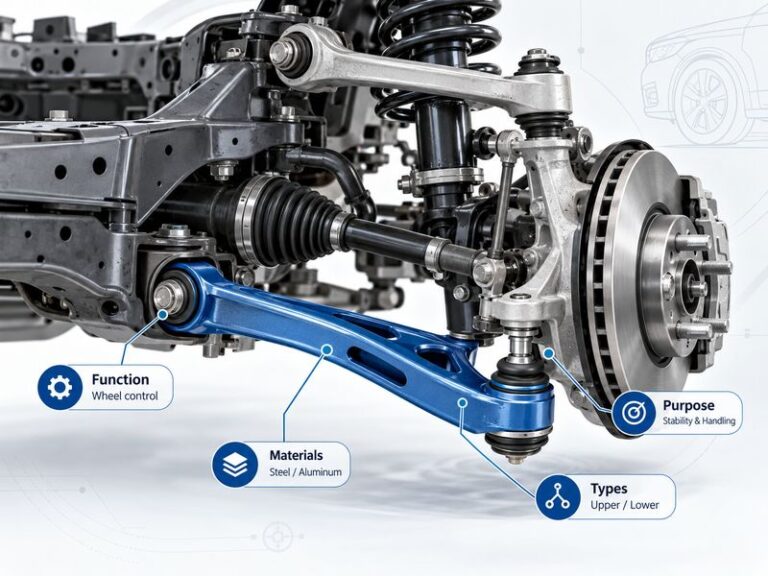
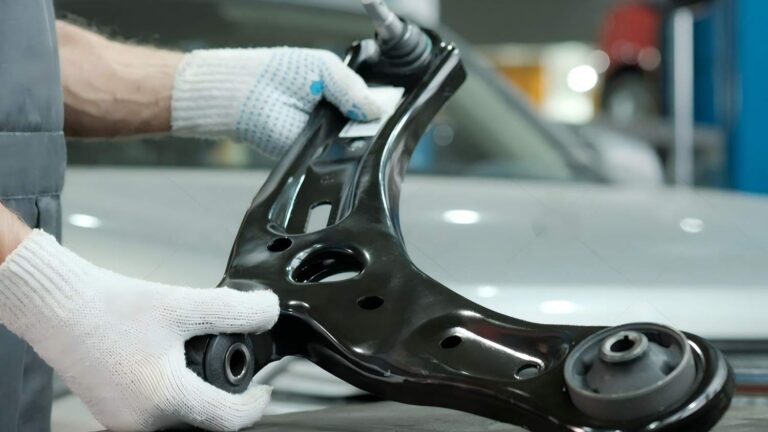
Are Control Arms Only in the Front? Front vs Rear Explained
If you are asking, **are control arms only in the front**, the answer depends on your vehicle’s suspension design. Front control arms are very common, so they get most of the attention. Yet many cars, SUVs, and some trucks also have control arms in the rear.
A control arm connects part of the wheel or suspension assembly to the vehicle’s frame or subframe. It lets the wheel move up and down while helping control its position. That job can be needed at either end of a vehicle.
The confusing part is that manufacturers do not always use the same names. A rear suspension part may be called a control arm, lateral arm, trailing arm, toe link, tension arm, or suspension link. The exact layout matters more than the name.
This guide explains where control arms are used, why some cars have them only in certain locations, how front and rear designs differ, and how you can tell what your own vehicle has.

Are Control Arms Only in the Front of a Car?
No. The idea that control arms are only in the front comes from the fact that almost every modern passenger vehicle has some type of front suspension link that performs the control-arm job. Rear suspension design varies much more.
Some vehicles have a control arm at each front wheel and several arms at each rear wheel. Others use front control arms but a torsion beam, leaf springs, or another layout at the rear.
So when someone asks **are control arms only in the front**, the best answer is that control arms can be at either end. You need to know the suspension type used on that specific vehicle.

- ✦ Front suspension
Control arms are very common because the front wheels must move with the suspension and usually steer.
- ✦ Rear independent suspension
Many independent rear systems use one or several control arms or suspension links at each wheel.
- ✦ Rear beam or solid axle
These systems may use trailing arms, radius arms, leaf springs, or other links instead of conventional control arms.
Why Front Control Arms Are So Common
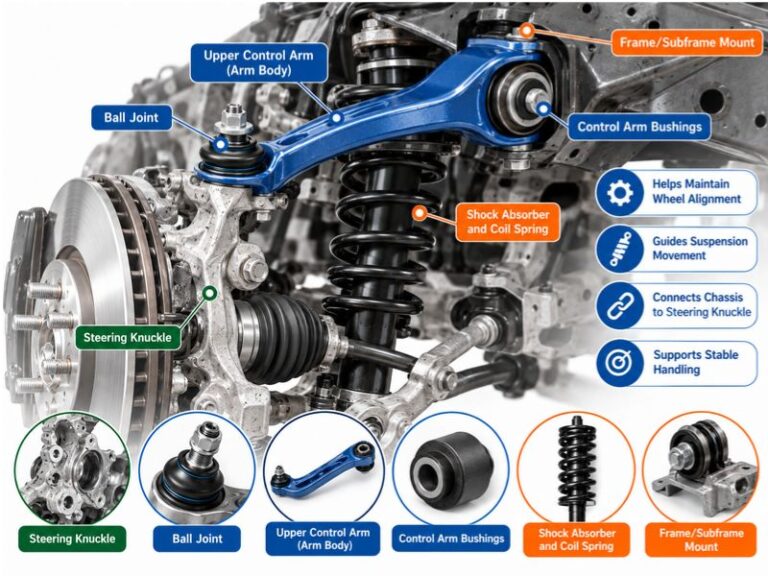
Front suspension has several jobs at once. It must carry vehicle weight, absorb bumps, keep the tire positioned correctly, and allow the wheel to steer. A control arm provides a strong pivoting connection between the wheel assembly and the body or subframe.
On many U.S. passenger cars with MacPherson strut suspension, each front wheel has one main lower control arm. The strut helps locate the upper part of the steering knuckle, so a separate upper control arm is often not needed.
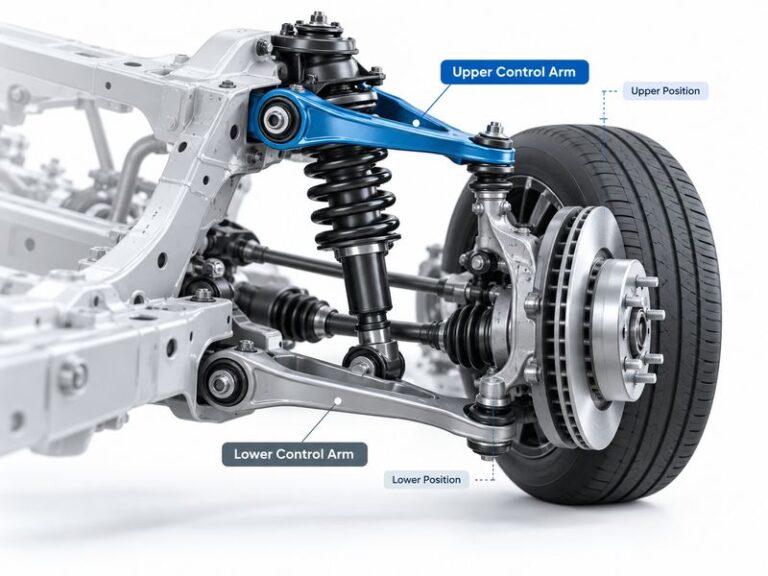
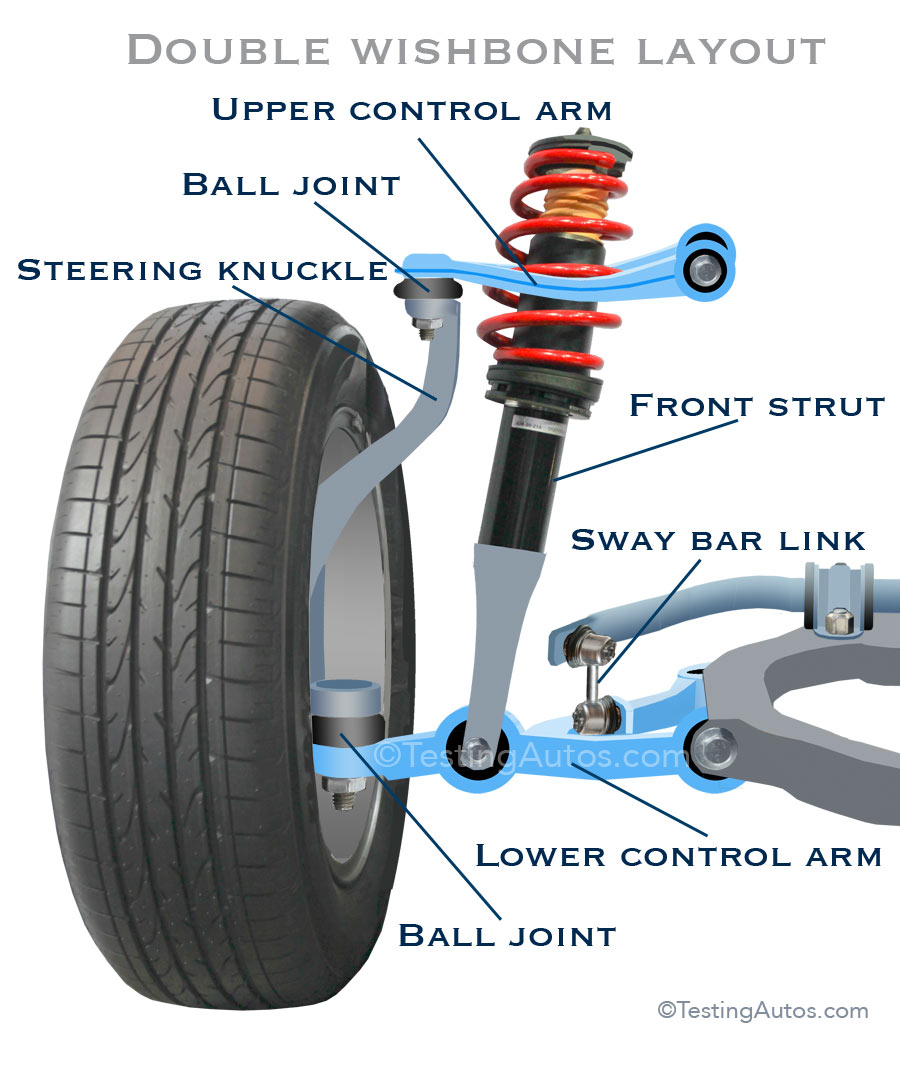
Trucks, SUVs, performance cars, and some luxury vehicles may use double-wishbone front suspension. These designs normally have an upper control arm and a lower control arm on each side.

- ✦ Wheel positioning
The arm helps keep the wheel in the correct location as the suspension moves.
- ✦ Suspension movement
Bushings let the arm pivot as the wheel travels over bumps and dips.
- ✦ Steering support
A ball joint often connects the control arm to the steering knuckle while allowing steering movement.
- ✦ Alignment control
The shape and mounting points of the arm help maintain wheel alignment.
MacPherson Strut Front Suspension
A MacPherson strut layout usually uses a lower control arm, a steering knuckle, and a strut. The strut acts as both a spring and damper unit and also helps locate the upper part of the wheel assembly.
This is one reason you may look under a car and find only a lower arm at the front. The absence of an upper control arm does not mean a part is missing.
Double-Wishbone Front Suspension
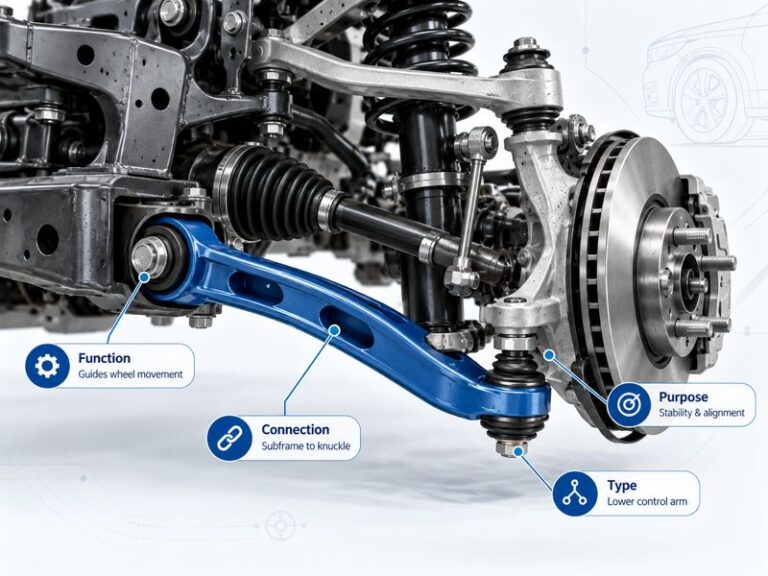
A double-wishbone system normally uses upper and lower control arms. Both arms connect the chassis or subframe to the wheel assembly.
This layout can give engineers more control over wheel geometry as the suspension moves. It is common on many trucks, SUVs, sports cars, and higher-performance applications.
Do Cars Have Rear Control Arms?
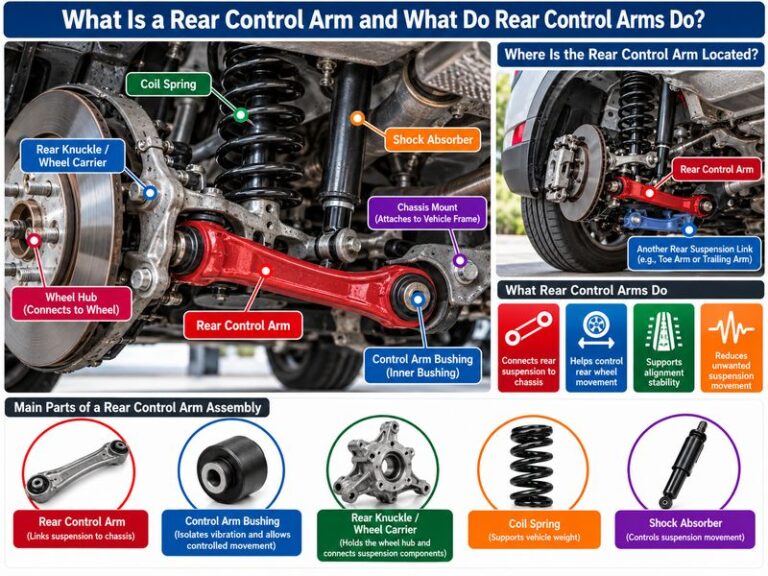
Yes, many cars have rear control arms. This is especially common with independent rear suspension, where each rear wheel can move with less direct effect on the wheel on the opposite side.
Rear suspension may need several links to control forward and backward movement, side movement, wheel angle, and suspension travel. Those links may all perform parts of the job that one large control arm performs in a simpler design.
This is why the answer to **are control arms only in the front** is clearly no on many modern cars. A vehicle with multi-link rear suspension may have more suspension links at the rear than at the front.

- ✦ Lower rear control arm
Often supports or locates the lower part of the rear wheel assembly.
- ✦ Upper control arm
May control the upper position and angle of the rear wheel.
- ✦ Toe link
Helps control rear-wheel toe, which affects straight-line stability and tire wear.
- ✦ Trailing arm
Mainly controls forward and backward wheel movement while allowing vertical suspension travel.
Independent Rear Suspension
Independent rear suspension allows the left and right rear wheels to move more independently. Engineers use different combinations of arms and links to control each wheel.
Depending on the vehicle, these parts may be described as control arms, lateral links, toe links, camber links, or trailing arms.
Why Some Vehicles Do Not Have Traditional Rear Control Arms
Not every rear suspension needs a conventional control arm. Some vehicles use a torsion beam, solid axle, leaf springs, or another design that locates the wheels in a different way.
For example, a torsion-beam rear suspension connects the two sides through a beam. The assembly includes pivoting arms, but parts catalogs and service manuals may not describe them the same way as the separate control arms used in independent suspension.
A solid rear axle also moves differently from an independent system. Depending on the design, it may be positioned by leaf springs, trailing arms, radius arms, or a multi-link arrangement.
- ✦ Torsion-beam suspension
Uses a cross beam that connects the rear wheel assemblies and twists during suspension movement.
- ✦ Leaf-spring suspension
Leaf springs can support the vehicle and help locate a solid axle.
- ✦ Solid axle with links
May use trailing arms, radius arms, or several links to hold the axle in position.
Front Control Arms vs Rear Control Arms
Front and rear control arms follow the same basic idea. They connect moving suspension parts to a fixed structure while allowing controlled movement. Their exact jobs differ because front wheels normally steer while rear wheels usually do not.
Front arms often work with steering knuckles and ball joints. Rear arms may focus more on controlling toe, camber, forward movement, and side movement.
Rear systems can also use several smaller links instead of one large arm. This can make the rear suspension look very different even though those links perform control-arm functions.

- ✦ Steering
Front control arms often work with a steering knuckle that turns left and right.
- ✦ Rear wheel geometry
Rear links may control toe and camber without needing to support steering motion.
- ✦ Number of parts
A simple front setup may have one arm per side, while a multi-link rear setup may have several links per wheel.
- ✦ Part shape
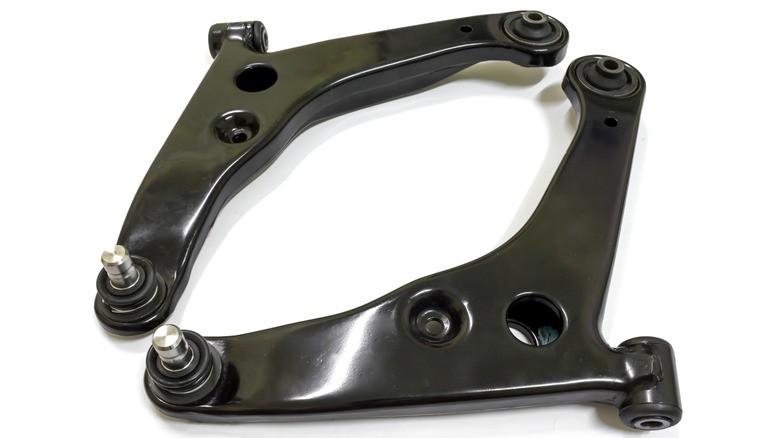
Control arms can be A-shaped, L-shaped, straight, curved, stamped steel, cast metal, or aluminum.
How Many Control Arms Does a Car Have?
There is no single number that applies to every car. The answer can range from a simple pair of front lower control arms to a much larger group of front and rear arms and links.
A basic MacPherson strut front suspension may have one lower control arm on the left and one on the right. If the rear uses a torsion beam, the car may have only those two conventional front control arms.
A double-wishbone vehicle can have four front control arms because each side has an upper and lower arm. Add multi-link rear suspension, and the total number of separate arms or links can rise much higher.
- ✦ Simple front layout
Often one lower control arm per front wheel.
- ✦ Double-wishbone front
Usually one upper and one lower control arm per front wheel.
- ✦ Multi-link rear
Can use several separate arms or links for each rear wheel.
- ✦ Vehicle-specific design
The exact number should be confirmed with the service information for the vehicle.
Do All Cars Have Upper and Lower Control Arms?
No. A vehicle does not need both an upper and a lower control arm at every wheel. The suspension design determines which links are required.
MacPherson strut front suspension is a common example. It normally uses a lower control arm but does not need a conventional upper control arm because the strut helps locate the upper part of the wheel assembly.
Double-wishbone suspension is different. It normally uses both upper and lower arms. Multi-link systems may divide these jobs among several smaller links rather than use clearly defined upper and lower arms.

- ✦ MacPherson strut
Usually has a lower control arm without a traditional upper control arm.
- ✦ Double wishbone
Usually has both upper and lower control arms.
- ✦ Multi-link
Uses several individual links that control different directions of wheel movement.
What Does a Control Arm Actually Do?
A control arm keeps the wheel connected to the vehicle while letting the suspension move. One end of the arm normally attaches to the frame or subframe through rubber or hydraulic bushings. The other end connects to the wheel assembly, often through a ball joint or another pivot.
As the tire moves over a bump, the arm swings through a controlled arc. This lets the wheel move vertically without moving freely in every direction.
The arm also helps maintain wheel position. That matters for steering feel, tire contact, braking stability, and wheel alignment.

- ✦ Connects suspension parts
It creates a controlled link between the wheel assembly and the vehicle structure.
- ✦ Allows vertical movement
The arm pivots as the suspension compresses and extends.
- ✦ Controls wheel position
It limits unwanted forward, backward, or sideways movement.
- ✦ Supports alignment
Its dimensions and mounting points help keep wheel geometry within the intended range.
Control Arm Bushings
Bushings sit where the control arm attaches to the frame or subframe. They allow a small amount of movement while reducing vibration and road noise.
Worn bushings can let the arm shift too much. That may cause clunks, vague steering, uneven tire wear, or changes in alignment.
Control Arm Ball Joints
Many control arms connect to a steering knuckle through a ball joint. The joint can move through several angles while the suspension travels.
Some replacement control arms include a new ball joint. Others do not, so the parts list should always be checked before ordering.
How to Tell If Your Car Has Rear Control Arms
The easiest method is to check a repair manual, factory service diagram, or parts catalog for your exact year, make, model, and drivetrain. Suspension layouts can change between trim levels and model years.
You can also inspect the rear suspension when the vehicle is safely supported. Look for metal arms or links running between the rear wheel carrier and the body, chassis, subframe, or axle.
Do not rely only on the word control arm. A manufacturer may call a part a trailing arm, lateral arm, toe link, camber link, or suspension link even though it helps control wheel movement.
- ✦ Check the parts catalog
Search the suspension category using the exact year, make, model, and drivetrain.
- ✦ Check a suspension diagram
A labeled diagram can show every rear arm and link and how each part connects.
- ✦ Inspect the vehicle
Look for separate links connecting the rear wheel carrier to the subframe or body.
- ✦ Expect different names
Rear suspension links are not always labeled as control arms.
Can Front and Rear Control Arms Go Bad?
Yes. Control arms themselves are strong parts, but their bushings and ball joints can wear. Corrosion, impacts, potholes, curb strikes, age, and normal suspension movement can also damage an arm or its mounting points.
The symptoms depend on which part has failed. A worn front arm may affect steering feel. A worn rear arm or link may make the rear of the vehicle feel loose or may change rear-wheel alignment.
In practical suspension diagnosis, the important step is to inspect the complete assembly rather than assume every noise means the metal control arm is damaged. Bushings, ball joints, sway-bar links, tie rods, wheel bearings, and struts can create similar symptoms.
- ✦ Clunking noise
A worn bushing or joint may knock when driving over bumps or changing direction.
- ✦ Uneven tire wear
Excess movement can change alignment and wear one part of a tire faster.
- ✦ Loose steering
Front control-arm wear can allow unwanted wheel movement.
- ✦ Rear instability
Worn rear links can make the vehicle feel less stable during turns or lane changes.
- ✦ Alignment changes
A bent arm or failed bushing may prevent the wheel from holding its intended alignment.
Does Front-Wheel Drive Mean Control Arms Are Only in Front?
No. Front-wheel drive describes which wheels receive engine power. It does not tell you whether the rear suspension has control arms.
A front-wheel-drive car can have front lower control arms and a multi-link independent rear suspension with several rear arms. Another front-wheel-drive car may use front control arms and a torsion-beam rear setup.
Rear-wheel-drive and all-wheel-drive vehicles can also use many different suspension designs. Drivetrain layout and suspension layout are related engineering choices, but one does not automatically determine the other.
Are Control Arms the Same as Trailing Arms?
Not always. Both are suspension links, but the names often describe their main direction and job. A traditional control arm usually extends inward from the wheel toward the chassis or subframe, while a trailing arm generally runs more toward the front or rear of the vehicle.
There is some overlap in naming. A trailing arm still controls the position of the wheel, so it serves a control function. Manufacturers and parts suppliers may classify similar-looking parts differently.
This naming difference helps explain why searching **are control arms only in the front** can produce mixed answers. A rear suspension may clearly have several wheel-control links even when the parts are not sold under the name control arm.
- ✦ Control arm
Usually controls wheel movement through a pivoting link between the wheel assembly and chassis.
- ✦ Trailing arm
Usually extends in a more lengthwise direction and controls forward and backward wheel location.
- ✦ Lateral link
Often controls side-to-side wheel or axle movement.
- ✦ Toe link
Primarily helps establish and control the rear wheel’s toe angle.
Should You Replace Control Arms in Pairs?
Control arms do not always have to be replaced in pairs. If one arm is bent from an impact and the opposite side is in good condition, replacing only the damaged arm may be reasonable.
The decision can be different when bushings or ball joints have worn from age and mileage. Parts on both sides have often experienced similar use, so the opposite side should at least be inspected closely.
After replacing a control arm or another part that affects wheel position, an alignment may be needed. This is especially important if the vehicle shows uneven tire wear or if an alignment adjustment was disturbed during the repair.
- ✦ Impact damage
One-sided replacement may make sense when only one arm was physically damaged.
- ✦ Age-related wear
Inspect the matching arm because bushings and joints on both sides may have similar wear.
- ✦ Alignment
Check alignment requirements after suspension work that can change wheel position.
Why the Exact Suspension Design Matters
There is no reliable rule such as front wheels have control arms and rear wheels do not. Suspension engineers can use several different ways to locate a wheel and guide its movement.
Two vehicles of similar size may have very different layouts. One compact SUV may have MacPherson struts in front and a multi-link system in the rear. Another may use a similar front setup but a torsion beam at the rear.
That is why **are control arms only in the front** should be answered by identifying the actual suspension design. The vehicle’s service information is more useful than a general assumption based on whether the car is front-wheel drive, rear-wheel drive, a sedan, truck, or SUV.
- ✦ Model year matters
A manufacturer can redesign the suspension during a vehicle’s production run.
- ✦ Trim can matter
Performance or premium versions may use a different suspension from the base model.
- ✦ Drivetrain can matter
AWD and two-wheel-drive versions sometimes use different rear suspension layouts.
- ✦ Part names vary
The same basic function may be performed by parts with different names.