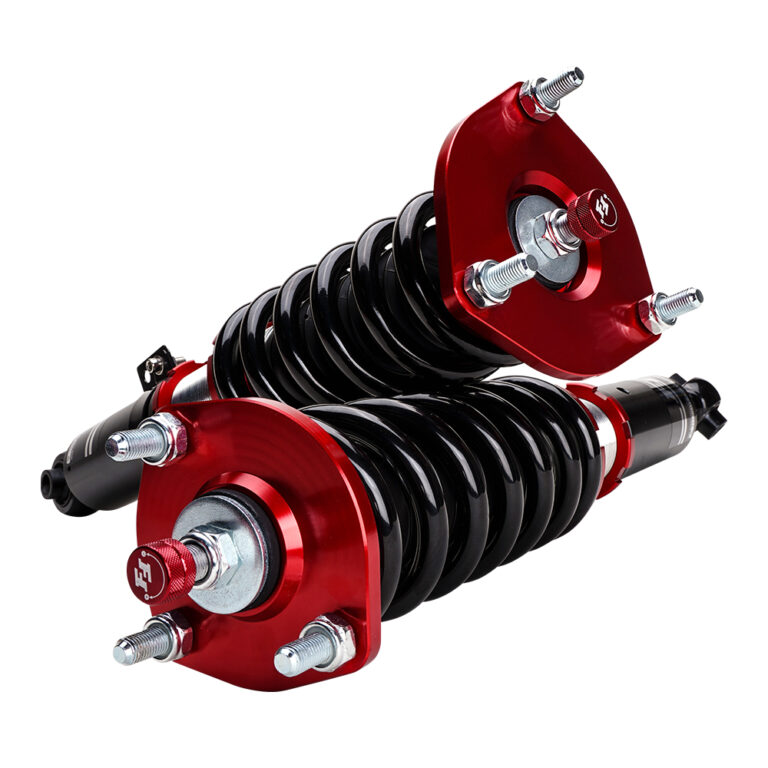
No, IS300 coilovers should not be assumed to fit a GS300. The cars use different chassis designs, and compatibility depends on the exact model year, suspension mounting points, and coilover kit.
For Lexus owners in the United States, the key question is whether an IS300 suspension kit can safely replace the original suspension on a GS300. Both cars belong to the Lexus lineup, but they are different vehicles. Sharing a brand, a rear-wheel-drive layout, or a similar engine does not establish that their suspension parts are interchangeable.
The Lexus IS300 and GS300 have different chassis families and suspension packaging. A coilover kit designed for one car may have different mounting brackets, shock lengths, spring dimensions, or adjustment ranges from a kit designed for the other. Even if a mounting bolt appears to fit, that does not prove the complete assembly is suitable.
Before ordering a kit, identify the model year, chassis code, drivetrain, and exact coilover part number. Compare the manufacturer’s vehicle application list and installation instructions. If the manufacturer does not list the GS300 as a compatible application, do not assume that drilling, swapping brackets, or changing hardware will make the kit safe.
The main reason is that the IS300 and GS300 use different vehicle platforms. The first-generation IS300 sold in the United States during the early 2000s is part of the XE10 chassis family. The second-generation GS300 sold during the late 1990s and early 2000s belongs to the S160 family. These chassis designations identify different vehicle structures, not interchangeable suspension systems.
Coilovers are engineered around the mounting points and suspension geometry of a particular vehicle. Their bodies, lower mounts, upper mounts, spring seats, and adjustment ranges must work with the intended suspension layout. A kit built for the smaller IS300 cannot be treated as a GS300 kit simply because both vehicles carry Lexus badges.
There may be aftermarket products with applications covering multiple related vehicles, but that must be confirmed in the manufacturer’s fitment data. The fact that a brand sells coilovers for both cars does not mean one part number fits both.
Source: lagunabeachphotos.blogspot.com
Different chassis families
The IS300 and GS300 have distinct chassis designs, so their suspension components must be checked by vehicle application rather than brand name.
Different suspension packaging
Mount locations, bracket shapes, shock dimensions, and spring arrangements may differ. A visual match is not enough to establish compatibility.
Different vehicle loads and geometry
A coilover must support the intended vehicle and maintain suitable suspension movement, alignment range, and clearance.
The Difference Between a Bolt-On Fit and a Safe Fit
A bolt-on fit means the part attaches to the intended mounting points without unapproved modifications. A safe fit goes further: the suspension must retain the correct range of movement, support the vehicle as designed, and avoid interference with nearby parts.
For example, a lower mount might accept a bolt while the shock body sits at the wrong angle. The spring could also foul a tire, control arm, or other component as the suspension moves. These problems may not be obvious while the car is parked.
Mounting hardware
Check bolt size, bracket width, hole spacing, fastener grade, and the specified tightening procedure.
Suspension movement
Confirm that the assembly does not bind and that it allows the intended bump and droop travel.
Clearance
Verify clearance around the tires, wheels, brake lines, sway bar, control arms, and body throughout suspension movement.
Which IS300 and GS300 Model Years Matter?
Model year matters because the names IS300 and GS300 cover more than one generation. In the United States, the original IS300 was sold mainly in the early 2000s, while the GS300 name spans several generations. A part listed for one GS300 generation is not automatically correct for another.
The original IS300 sedan and SportCross wagon also deserve separate attention. Body style, drivetrain, and factory suspension details can affect aftermarket application listings. Always use the exact vehicle details requested by the coilover manufacturer rather than relying on a general search result.
A later Lexus IS model may use a different suspension design from the original IS300. Likewise, a newer GS model may have different mounting hardware or electronic suspension features. Never treat a newer IS or GS kit as compatible with an older car without explicit documentation.
Source: f2suspension.com
Identify the chassis code
Use the vehicle identification number, factory records, or reliable vehicle documentation to identify the exact chassis generation.
Confirm the body style
Check whether the application covers the sedan or wagon where relevant, instead of assuming the parts are the same.
Confirm the drivetrain
Check whether the car is rear-wheel drive or all-wheel drive, if that configuration is available for the model being considered.
Read the complete application list
Look for the exact model year range and chassis code. A product title that only says Lexus IS or Lexus GS is not enough.
Does an Early GS300 Change the Answer?
An early GS300 still needs a coilover kit designed for its own chassis. A first-generation GS300 and a later GS300 may share the model name but have different suspension requirements. The same rule applies when comparing an IS300 kit with any GS300 generation.
If the kit listing does not state the exact GS300 generation, ask the seller or manufacturer to confirm the part number in writing. This is more reliable than judging compatibility from photographs or a forum post about a different model year.
Do not rely on the engine
An engine shared across vehicles does not mean the suspension mounts or coilover dimensions are shared.
Do not rely on appearance
Similar spring colors, damper shapes, and adjustment collars do not establish interchangeable fitment.
How to Check Whether a Coilover Kit Fits
The most reliable fitment check starts with the exact part number, not the seller’s general product description. Gather your car’s model year, model name, chassis code, body style, and drivetrain. Then compare those details with the manufacturer’s official application list and installation documentation.
If the seller lists the kit only for an IS300, treat it as an IS300-specific kit unless the manufacturer confirms that the same part number is approved for your GS300. Do not infer compatibility from the fact that another customer installed a similar-looking suspension component.
If documentation is unclear, provide the manufacturer with the vehicle identification details and ask whether the part number is a direct fit without fabrication or unapproved component swaps. Save the answer with your purchase records.
Source: texasdiamondgarage.com
Step 1: Identify the car
Record the model year, chassis generation, body style, and drivetrain. Verify these details against factory documentation.
Step 2: Find the exact kit number
Use the part number on the product listing or box. Do not rely only on a brand name or a generic Lexus compatibility label.
Step 3: Compare mounting specifications
Review upper mount type, lower bracket design, bolt spacing, damper dimensions, spring specifications, and any application-specific hardware.
Step 4: Review the installation manual
Check for required parts, approved adjustment ranges, torque specifications, and any warnings about suspension modifications.
Step 5: Get written confirmation
If the GS300 is absent from the application list, request explicit confirmation from the manufacturer before buying or installing the kit.
A Practical Fitment Checklist
Use the following checklist to compare a proposed IS300 kit with the suspension requirements of a GS300. Every important item should be confirmed by manufacturer documentation or a qualified suspension technician before installation.
Vehicle application
The exact GS300 model year and chassis are explicitly listed as compatible.
Upper and lower mounts
The mounts match the factory suspension attachment points and use the approved hardware.
Spring and damper dimensions
The spring rate, spring length, damper body, and adjustment range are appropriate for the intended application.
Brake and wheel clearance
The kit clears nearby parts through the full steering and suspension range.
Installation and alignment
The kit has usable installation instructions and permits alignment to the vehicle’s required specifications.
What Happens If You Try to Install IS300 Coilovers on a GS300?
An incompatible kit may fail to line up with the factory mounts, place the damper at an unsuitable angle, or leave too little clearance for nearby parts. The result can be an installation that cannot be completed as supplied or a modified assembly that does not operate as intended.
Forcing a suspension part into place is not a valid fitment method. Enlarging holes, cutting brackets, welding mounts, or combining parts from unrelated kits can change the strength and geometry of a safety-critical system. Such changes should not be attempted without a properly engineered solution and qualified assessment.
Even if the vehicle sits at the desired height after installation, that does not prove the suspension is suitable. Ride height is only one part of fitment. The car also needs safe steering movement, adequate bump travel, secure mounts, proper damping, and acceptable alignment.
Source: YouTube
Mounting mismatch
The upper mount or lower bracket may not align with the GS300’s factory attachment points.
Poor suspension travel
Incorrect shock length or adjustment can cause bottoming, topping out, or reduced wheel movement.
Unwanted contact
The spring or damper may contact the tire, wheel, brake hose, control arm, or body.
Alignment problems
An unsuitable assembly can prevent the technician from achieving the intended alignment settings.
Reduced reliability
Unapproved fabrication or incorrect loading can damage mounts, hardware, or suspension components.
Warning Signs After Suspension Work
Stop driving and inspect the car if you hear repeated metal-on-metal contact, feel binding during steering, notice a loose mount, or find a brake hose stretched or pinched. A sudden change in steering, an unstable ride, or tire contact with suspension parts also requires immediate attention.
A professional inspection should confirm that all fasteners are correctly installed, the springs are seated, the dampers move freely, and the wheels clear the suspension throughout the intended range. Do not use a road test to find out whether an obviously mismatched kit is safe.
Do not drive with loose mounts
Secure the vehicle and arrange a repair before use if a suspension fastener or mount is loose or damaged.
Do not ignore tire contact
Contact can damage a tire or suspension part and may lead to a loss of control.
Can You Modify IS300 Coilovers to Fit a GS300?
Physical modifications might appear to solve a mounting difference, but they do not automatically make an incompatible kit suitable. The coilover body, spring, mounts, and adjustment range work as a system. Changing one part can affect alignment, strength, suspension travel, or clearance elsewhere.
A conversion should only be considered if a qualified suspension engineer or the coilover manufacturer provides an approved solution for the exact vehicle and kit. That solution must address all affected components, not just whether a bolt can be inserted.
For most owners, buying a GS300-specific kit is the simpler and more defensible option. It avoids paying for custom fabrication and reduces uncertainty about replacement parts, installation instructions, and future service.
Source: www.clublexus.com
Bracket changes
Changing or fabricating a bracket can affect load paths, alignment, and mount strength. Do not make such changes based on visual fit alone.
Spring swaps
A spring that fits the perch may still have an unsuitable rate, length, or travel range for the vehicle.
Mixed components
Combining dampers, top mounts, and springs from different kits may create an unvalidated setup.
Electronic features
If the vehicle has electronically controlled suspension equipment, confirm whether the replacement kit supports the required functions or specifies an approved conversion.
Why a Custom Fit Is Not the Same as Direct Fitment
A custom suspension setup is designed around measured dimensions, load requirements, movement, and clearances. A direct-fit kit is intended to install on the specified vehicle using the documented mounting points and hardware.
A custom setup may be possible in a specialist shop, but it requires more than adapting a mount. Ask for a clear explanation of the engineering basis, the parts being changed, and the resulting inspection and alignment requirements before agreeing to the work.
Ask for documented approval
Request written technical guidance for the exact kit and vehicle rather than relying on informal assurances.
Consider the total cost
Include fabrication, installation, alignment, inspection, and future replacement parts when comparing a custom conversion with a dedicated kit.
Choosing Coilovers for a GS300 Instead
If your goal is to lower a GS300, improve handling, or replace worn suspension parts, start with a kit that explicitly covers your exact GS300 generation. A dedicated kit should provide the correct mounting design and application-specific instructions.
Choose the setup based on how the car will be used. A daily driver needs a sensible ride height, adequate suspension travel, and a damping range suited to public roads. A track or drift car may need a different spring and damping setup, but those choices still have to match the vehicle and intended use.
Do not select a kit only by its advertised drop or adjustment count. A large adjustment range does not guarantee a comfortable ride or correct fitment. Check the manufacturer instructions for ride-height limits, spring preload, damping adjustment, maintenance, and any restrictions on use.
Source: kenjigarage.com
Daily driving
Prioritize correct application, enough suspension travel, sensible ride height, and a damping setup suitable for local road conditions.
Confirm that the intended ride height preserves tire clearance and does not leave the car resting on its bump stops during normal use.
Track or drift use
Use a kit and spring setup approved for the exact chassis, and have alignment and handling requirements evaluated for the intended activity.
Replacement of worn suspension
Compare the full cost and service needs of coilovers with a suitable replacement spring-and-damper setup before deciding to lower the car.
What to Check Before Buying
Read the full application listing and installation manual before paying. Confirm that the kit includes the required mounts and hardware, and check whether any separate parts are required for your exact model year.
Ask about replacement dampers, service intervals, warranty limits, and support for your chassis. These details matter after installation, especially if the vehicle is driven daily or exposed to rough roads, road salt, or frequent heavy use.
Correct application
The exact GS300 chassis and model year are named in the manufacturer’s fitment data.
Adjustment limits
The instructions explain how to set ride height and damping without exceeding the kit’s approved range.
Service support
Replacement parts and maintenance instructions are available for the specific kit.
Installation, Alignment, and Safety Checks
Once you have a confirmed GS300-specific kit, follow its instructions and the vehicle service manual. Suspension work involves loaded springs and components that support the vehicle’s weight. Use suitable lifting equipment and rated jack stands, and never work beneath a car supported only by a hydraulic jack.
Coilover installation can change ride height and wheel alignment. Arrange a four-wheel alignment after installation and after any major ride-height change. The technician should use specifications appropriate to the exact GS300 and explain any settings that cannot be brought within the required range.
Before normal driving, verify that the springs are seated, fasteners are tightened to the specified torque, brake hoses and wiring are routed correctly, and the wheels turn without interference. Follow the kit maker’s guidance for rechecking fasteners and inspecting the suspension after installation.
Source: f2suspension.com
Use the right service information
Follow the vehicle service manual and coilover instructions for lifting points, hardware, torque values, and adjustment procedures.
Check full clearance
Inspect wheel and tire clearance at steering lock and through the intended suspension movement.
Get an alignment
Have a qualified shop measure and adjust alignment using the correct vehicle specifications.
Reinspect the work
Look for loose hardware, spring movement, leaks, abnormal noises, and signs of contact according to the manufacturer’s service guidance.
When to Use a Professional Installer
Use a qualified suspension shop if the kit application is uncertain, a mount does not line up, a fastener is damaged, or the installation requires fabrication. A shop can also assess clearance and alignment limits that are difficult to judge while the car is on the ground.
If the suspension binds, a spring is not seated, or a brake hose is pulled tight, do not drive the car to an alignment shop. Have the issue corrected where the vehicle is located or arrange suitable transport.
Fitment is unclear
Ask the manufacturer or a qualified shop to verify the part number before installation.
Modification is proposed
Require an approved engineering solution for any change to load-bearing suspension mounts.
Frequently Asked Questions
Q
Will first-generation IS300 coilovers fit a second-generation GS300?
Do not assume they will. The first-generation IS300 and second-generation GS300 use different chassis platforms, so a kit designed for the IS300 should be treated as incompatible unless its manufacturer explicitly lists the exact GS300 application.
Q
Do IS300 and GS300 coilovers use the same mounting bolts?
The hardware dimensions must be checked for the exact vehicles and kits. Even if a bolt diameter or one mounting point appears to match, that does not establish compatibility of the complete suspension assembly.
Q
Can GS300 coilovers fit an IS300 instead?
The reverse swap is not automatically compatible either. GS300 coilovers may differ in mounting design, dimensions, spring specifications, and intended vehicle loads. Use a kit specifically approved for the IS300 unless the manufacturer confirms a shared application.
Q
Can I use IS300 coilovers if I change the top mounts?
Changing the top mounts alone does not prove the kit will fit or operate safely. The lower mounts, damper length, spring dimensions, travel, clearance, and alignment range must also be suitable. Use only a documented conversion approved for the exact application.
Q
Will coilovers from an IS300 sedan fit an IS300 SportCross?
Do not assume sedan and SportCross suspension applications are identical. Check the manufacturer’s fitment list for the exact body style, model year, and drivetrain, and confirm the part number before ordering.
Q
What is the safest way to lower a GS300?
Choose a lowering kit or coilover system explicitly designed for your GS300 generation. Follow its ride-height and adjustment limits, confirm tire and suspension clearance, and get a professional wheel alignment after installation.
Q
Can I drive with coilovers that do not fit correctly?
No. A mismatched suspension can cause loose mounts, binding, inadequate travel, tire contact, or unstable handling. Do not drive the car if a mount is insecure, a component interferes with a tire, or the suspension does not move freely.
✦ Wrapping Up
Conclusion
IS300 coilovers are not a safe default choice for a GS300. The two Lexus models use different chassis platforms, and suspension fitment depends on the exact vehicle generation, mounting design, dimensions, and approved application. A kit that looks similar or shares one mounting measurement may still be unsuitable.
For a reliable result, identify your GS300’s chassis and model year, find a coilover kit listed for that exact application, and confirm the part number with the manufacturer if anything is unclear. A properly matched kit also makes installation, alignment, maintenance, and future replacement easier to manage.
💡 Key Takeaway
Before buying, send the coilover manufacturer your GS300 model year, chassis code, drivetrain, and the proposed IS300 kit part number. Proceed only if the manufacturer confirms the exact application in writing; otherwise, choose a GS300-specific kit.
Eric
Hi, I’m Eric Bennett, the person behind OffRoadTruckAccessories.com.
I created this blog to share my interest in trucks, off-road driving, automotive accessories, and DIY modifications. I enjoy learning how different truck accessories work, testing their usefulness, and understanding whether they are truly worth buying.
Will G37 coilovers fit G35? Learn which model years may share fitment, what changes with coupe, sedan, and AWD setups, and how to verify compatibility.