What Happens If a Control Arm Breaks While Driving?
If you are wondering what happens if a control arm breaks while driving, the main concern is control of the affected wheel. A control arm helps hold the wheel and steering knuckle in the correct position while still allowing the suspension to move. If the arm itself breaks, bends badly, or separates from one of its mounting points, the wheel may no longer stay properly aligned with the vehicle.
The result can range from severe pulling and tire rubbing to a wheel folding inward or shifting backward in the wheel well. At highway speed, this can become a serious safety problem very fast. A driver may have trouble keeping the vehicle in its lane, especially during braking, cornering, or when hitting another bump.
In practical repair work, complete control arm fractures are less common than worn bushings or ball joints. Yet corrosion, crash damage, severe pothole impacts, failed ball joints, or damaged mounting points can turn a worn suspension part into an urgent problem. That is why changes in steering feel or new suspension noises should not be ignored.
This guide explains what happens if a control arm breaks while driving, what the vehicle may feel like, what damage can follow, which warning signs may appear first, and what to do if failure occurs on a U.S. road or highway.

What Happens If a Control Arm Breaks While Driving?
What happens if a control arm breaks while driving depends on how the arm fails and which suspension design your vehicle uses. In a serious failure, the control arm can stop holding the steering knuckle and wheel in the correct position. The tire may suddenly tilt, shift backward, or move farther than the suspension was designed to allow.
You may feel the car pull hard to one side. The steering wheel can become difficult to control. You may also hear a loud bang, scraping sound, or repeated clunk as the tire and suspension parts move into places they should not be.
If the control arm separates near the ball joint or mounting point, the affected wheel can lose much of its normal support. The tire may contact the fender liner, body, brake hose, axle, or other suspension parts. In an extreme case, the wheel can fold under the vehicle.
The danger becomes greater at higher speeds. A sudden change in wheel angle can make the vehicle unstable, and hard braking may increase the pull toward the damaged side.

- ✦ Sudden steering change
The vehicle may pull, wander, or turn sharply toward the damaged side.
- ✦ Wheel movement
The wheel may tilt or shift because the suspension can no longer hold it in its normal position.
- ✦ Tire contact
The tire may rub against the fender, liner, suspension, or nearby components.
- ✦ Loss of stability
The vehicle may become hard to keep straight, especially at speed or during braking.
Can a Broken Control Arm Cause You to Lose Control?
Yes. A complete control arm failure can cause a major loss of steering and directional stability. The exact effect varies by vehicle, but you should treat any suspected break as an emergency rather than trying to continue your trip.
The problem is not simply poor alignment. The suspension geometry itself may no longer be held in place. That can make the vehicle react in ways the driver cannot easily correct.
- ✦ Higher speed means greater risk
A sudden wheel-angle change is much harder to manage at freeway speed than in a parking lot.
- ✦ Turns add stress
Cornering loads can move the damaged suspension farther out of position.
- ✦ Braking may worsen pulling
A damaged wheel can react differently when braking force is applied.
Why a Broken Control Arm Is So Dangerous
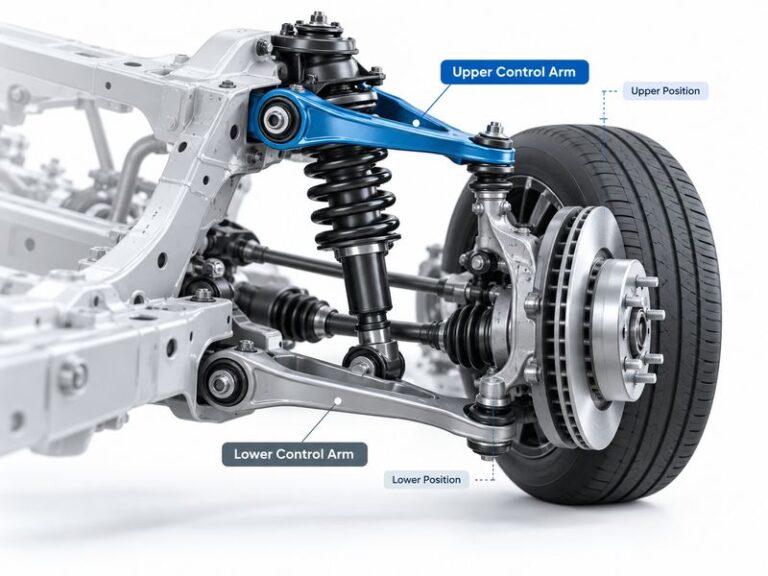
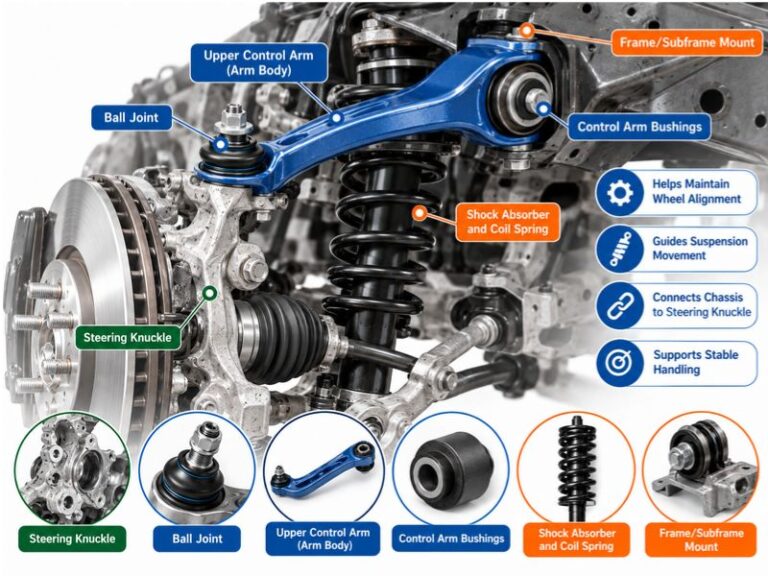
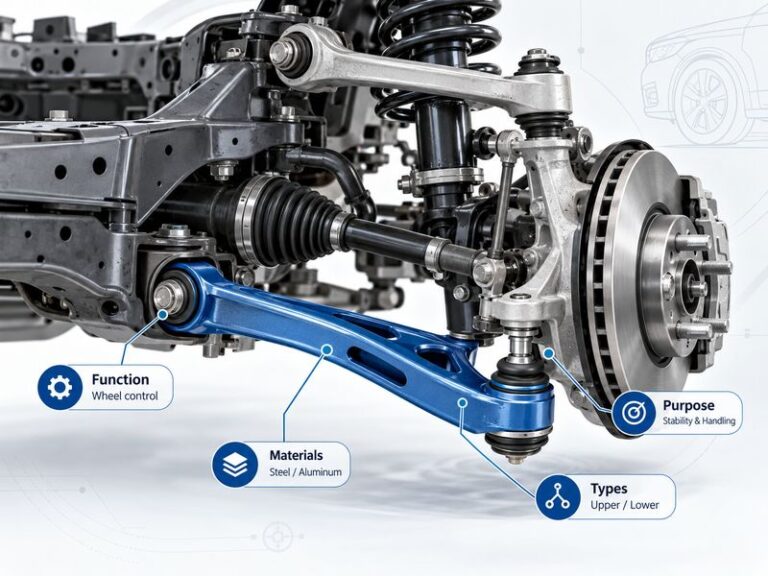
A control arm is more than a simple metal link. It helps locate the wheel in relation to the vehicle body or subframe. It also works with bushings and, in many designs, a ball joint to let the wheel move up and down while maintaining useful steering geometry.
When that structure fails, the position of the wheel can change. Camber, caster, and toe may move far outside their normal range. You do not need to know those alignment terms to feel the result. The vehicle may pull, shake, scrape, or respond poorly to steering input.
This is why what happens if a control arm breaks while driving is very different from a minor worn-bushing complaint. A worn bushing may allow some unwanted movement. A broken arm can remove a major structural connection entirely.
- ✦ Wheel alignment can change instantly
The wheel may no longer point in the same direction as the others.
- ✦ Braking can become unpredictable
The damaged wheel may shift when the brakes are applied.
- ✦ Nearby parts may be damaged
Brake hoses, CV axles, wheel-speed sensor wires, tires, and steering parts can be pulled or crushed.
- ✦ Road contact may change
A badly tilted tire has less useful contact with the pavement.
What Does a Control Arm Normally Do?
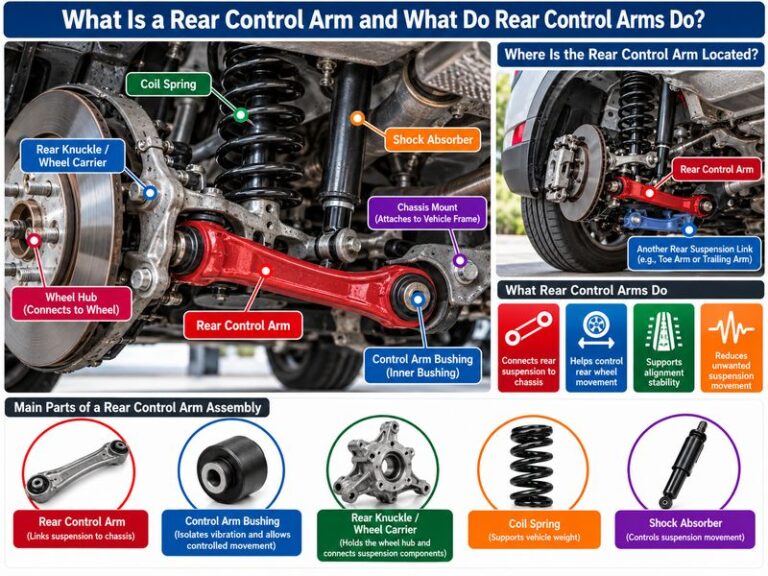
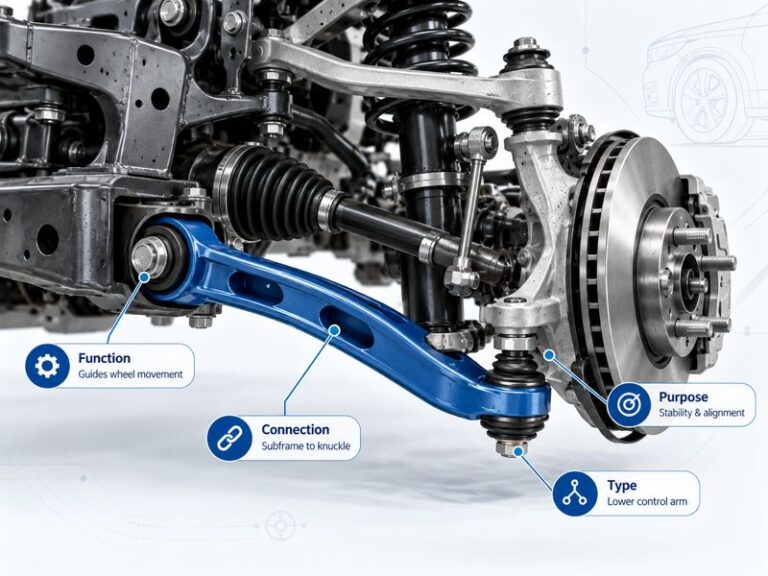
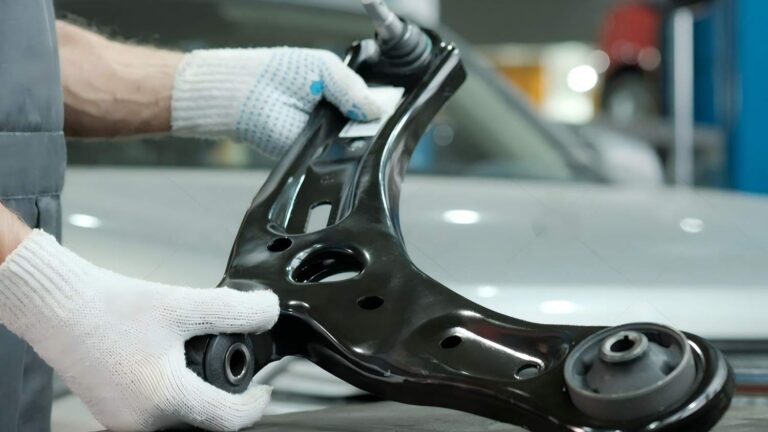
The control arm connects part of the wheel assembly to the vehicle frame, body, or subframe. Bushings usually allow controlled movement at the inner mounts, while a ball joint or similar connection lets the steering knuckle move.
The arm helps guide suspension travel while controlling unwanted forward, backward, and side movement. This job is why even a simple-looking control arm is a key safety part.
- ✦ Supports wheel position
It helps keep the wheel located correctly during driving.
- ✦ Guides suspension travel
It lets the wheel move with bumps while controlling its path.
- ✦ Maintains handling
Its fixed mounting points help preserve proper suspension geometry.
What Does a Broken Control Arm Feel Like While Driving?
A control arm does not always snap without warning. Many drivers first notice noise, steering changes, or tire wear. The symptoms can become much stronger if the part cracks, bends, or begins to separate.
If complete failure occurs, the change may be immediate. The steering wheel may jerk. The vehicle may drop slightly on one corner, pull hard, or develop a loud grinding or scraping sound.
Knowing what happens if a control arm breaks while driving can help you react without making the situation worse. Your goal should be to reduce speed and reach a safe stopping point without sudden steering or braking inputs.
- ✦ Strong pulling
The vehicle may suddenly drift or pull toward one side.
- ✦ Clunk or bang
A fracture or separation may produce a sharp noise from the suspension.
- ✦ Steering wheel movement
The wheel may jerk or feel much less stable than normal.
- ✦ Scraping or grinding
A tire, wheel, or damaged suspension part may contact nearby components.
- ✦ Visible wheel angle
After stopping, one wheel may appear tilted or pushed out of its normal location.
Could the Car Still Move After the Control Arm Breaks?
Sometimes a vehicle can still roll after the control arm has failed, but that does not mean it is safe to drive. The damaged wheel may move farther out of position with every bump, turn, or brake application.
Driving even a short distance may turn one failed part into damage to the tire, wheel, brake hose, axle, steering linkage, or body. Towing is usually the safer choice after a confirmed or strongly suspected break.
- ✦ Rolling is not the same as safe driving
A vehicle may move while still having dangerously unstable suspension geometry.
What Should You Do If a Control Arm Breaks While Driving?
If you think a control arm has broken, focus first on keeping the vehicle stable. Keep a firm grip on the steering wheel. Ease off the accelerator and allow the vehicle to slow in a controlled way.
Avoid aggressive steering. A damaged wheel may react badly to a sudden lane change. Also avoid hard braking unless you must brake quickly to prevent a collision.
Turn on your hazard lights when it is safe to do so. Move toward a shoulder, parking area, or another safe place if the vehicle still responds well enough to steer. Once stopped, do not continue driving just because the engine and transmission still work.

- ✦ Stay calm
Keep both hands on the wheel and focus on maintaining your lane.
- ✦ Reduce speed gently
Ease off the accelerator instead of making abrupt inputs.
- ✦ Avoid sharp turns
Sudden steering can place more load on the failed suspension.
- ✦ Brake smoothly
Use gradual braking when conditions allow.
- ✦ Stop somewhere safe
Move away from traffic if the vehicle can be controlled safely.
- ✦ Arrange a tow
Have the vehicle transported for inspection instead of trying to drive it farther.
What If the Failure Happens on a Highway?
A highway failure requires extra care because nearby traffic may be moving much faster. Do not make a sudden move across several lanes. Reduce speed in a smooth way and work toward the nearest safe shoulder if the vehicle remains controllable.
After stopping, keep yourself away from moving traffic when possible. If the vehicle is in a dangerous traffic position, contact emergency services or highway assistance based on the immediate risk.
- ✦ Use hazard lights
Warn nearby drivers that your vehicle has a problem.
- ✦ Do not inspect beside fast traffic
Your personal safety matters more than checking the damaged suspension at the roadside.
What Can Cause a Control Arm to Break?
Control arms are built to handle large forces, so they do not normally break during ordinary driving when they are in good condition. Failure often involves severe impact damage, corrosion, a weakened mounting area, an earlier collision, or another suspension problem that places unusual stress on the arm.
In states that use road salt, rust deserves special attention. Heavy corrosion can reduce the thickness and strength of a steel arm. Surface rust alone does not always mean a control arm is unsafe, but deep scaling, holes, cracks, or weakened mounting areas need professional inspection.
Large potholes, curbs, debris, and crash impacts can also bend or crack a control arm. The damage may not always be obvious from the driver’s seat. A wheel alignment problem or new steering symptom after a hard impact is a good reason to have the suspension checked.

- ✦ Severe corrosion
Rust can weaken a steel control arm over time, especially in areas that use road salt.
- ✦ Pothole impact
A deep pothole hit can bend or damage suspension parts.
- ✦ Curb strike
Hitting a curb can place a sudden load on the arm, ball joint, wheel, and steering parts.
- ✦ Collision damage
A previous crash can bend an arm or weaken its mounting points.
- ✦ Failed ball joint
On some designs, ball-joint separation can cause effects similar to a broken control arm because wheel location is lost.
- ✦ Damaged mounting area
Loose, cracked, or heavily corroded mounts can allow the arm to separate from the vehicle.
Can a Pothole Break a Control Arm?
A severe pothole impact can damage a control arm, but the outcome depends on impact speed, pothole depth, tire size, suspension design, and the condition of the parts before impact. A healthy arm may survive an impact that finishes off a part already weakened by corrosion or earlier damage.
After a major pothole strike, watch for a crooked steering wheel, pulling, clunks, vibration, or a wheel that appears out of position. These signs justify a suspension inspection.
- ✦ Check after a hard hit
New steering or suspension symptoms should not be dismissed after a severe impact.
Warning Signs Before a Control Arm Completely Fails
Understanding what happens if a control arm breaks while driving is useful, but catching trouble before failure is much better. Many control arm problems begin with worn bushings, ball-joint wear, impact damage, or corrosion rather than a sudden clean break.
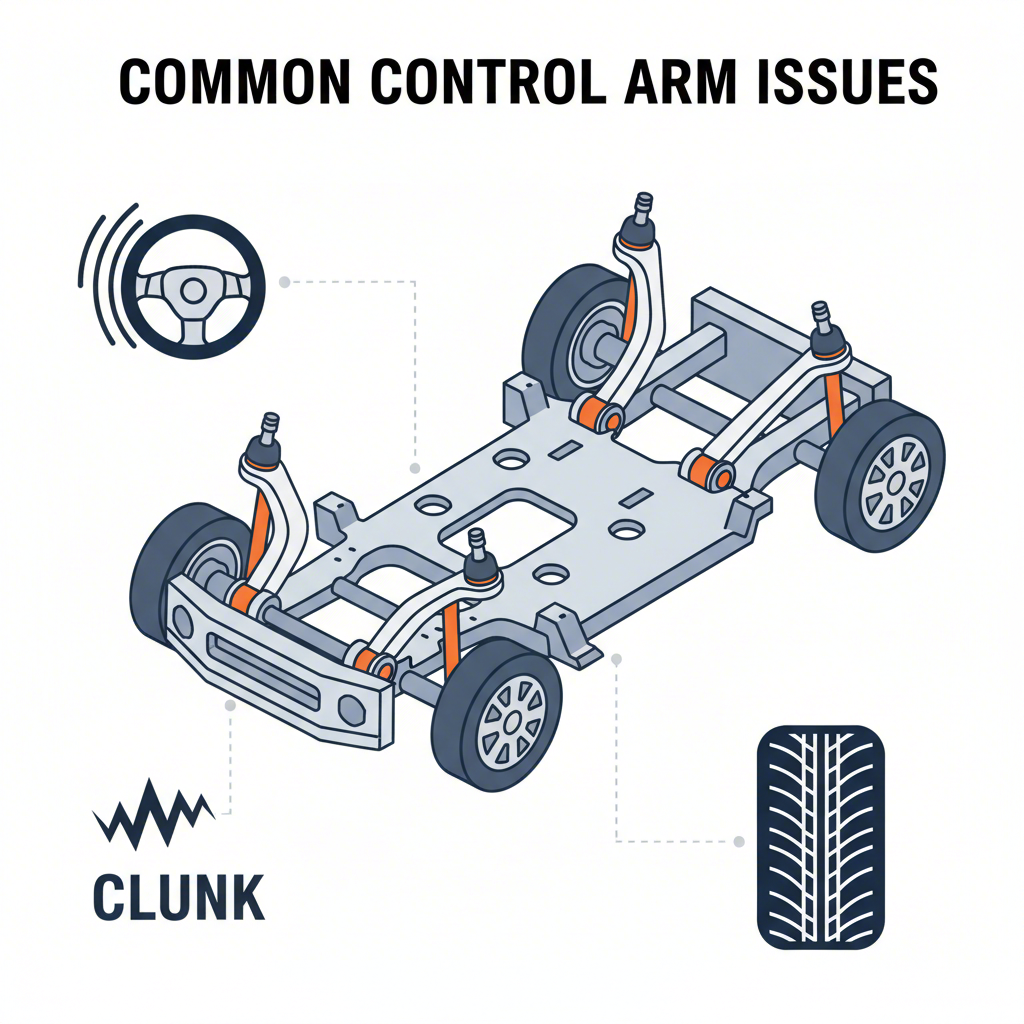
Listen for clunks when driving over bumps or entering driveways. Pay attention to steering that feels loose, vague, or unstable. Uneven tire wear can also appear when worn suspension parts allow wheel alignment to change.
Not every clunk or steering problem means the control arm itself is about to break. Tie rods, sway-bar links, struts, wheel bearings, ball joints, and other suspension parts can cause similar symptoms. A hands-on inspection is needed to identify the exact cause.

- ✦ Clunking over bumps
Movement at a worn bushing or joint may create a knock or clunk.
- ✦ Loose steering
The car may wander or need frequent steering correction.
- ✦ Uneven tire wear
Changing wheel geometry can wear one part of the tire faster.
- ✦ Pulling to one side
Suspension movement or damage can affect wheel alignment.
- ✦ Visible rust or cracks
Structural corrosion or impact damage deserves immediate attention.
- ✦ Wheel position looks wrong
One wheel sitting farther forward, backward, or at a different angle can signal significant suspension damage.
Bad Bushing Versus Broken Control Arm
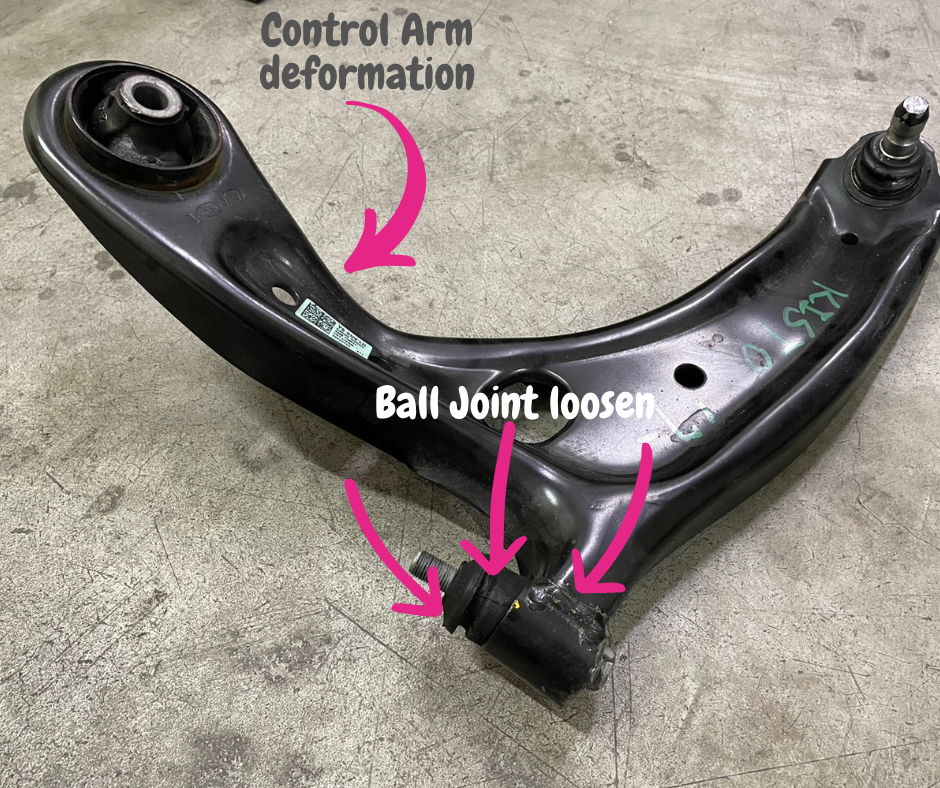
A worn control arm bushing and a broken control arm are not the same problem. A worn bushing usually allows too much movement while the arm remains attached. That can cause clunks, alignment changes, steering issues, and tire wear.
A broken arm is more severe because the metal structure or its connection has failed. However, severe bushing wear should still be repaired because it can reduce handling quality and place extra stress on nearby parts.
- ✦ Worn bushing
Usually causes excess movement while the suspension remains connected.
- ✦ Broken arm
Can allow major wheel movement and create an immediate safety risk.
What Other Damage Can a Broken Control Arm Cause?
When a control arm fails, the damage may not stay limited to the arm. The wheel and steering knuckle can move far enough to stress parts that normally have only a limited range of travel.
A tire may rub against the fender or suspension until its sidewall is damaged. A brake hose or wheel-speed sensor wire may stretch. On driven wheels, a CV axle can also be forced into an unusual angle.
This is another reason not to keep driving after a suspected failure. Even if you can move the vehicle, each rotation of the wheel may cause more damage and raise the final repair cost.

- ✦ Tire damage
Rubbing or abnormal wheel angle may cut or wear the tire.
- ✦ Wheel damage
A severe impact or collapsed suspension can damage the rim.
- ✦ Brake hose damage
Unexpected suspension travel can stretch or damage a flexible brake hose.
- ✦ ABS sensor wiring
Wheel-speed sensor wires may be pulled when the knuckle moves too far.
- ✦ CV axle damage
A drive axle may bind or separate if suspension geometry changes dramatically.
- ✦ Fender and body damage
A displaced tire can contact the wheel opening or inner body structure.
Can a Broken Control Arm Damage the Tire?
Yes. A broken control arm may let the tire lean or move into the wheel well. The tire can rub against metal, plastic liners, suspension parts, or the body.
A tire with sidewall cuts, exposed cords, a bulge, or severe rubbing damage should not be reused without professional inspection. Tire sidewall damage can create its own safety risk even after the suspension is repaired.
- ✦ Inspect the tire after suspension failure
Do not assume the tire is safe simply because it still holds air.
Can You Drive With a Bad Control Arm?
Driving with a control arm problem depends on what is actually wrong, but there is no reliable mileage limit that makes it safe. A slightly worn bushing is very different from a cracked arm, loose ball joint, or severely damaged mounting point.
If the arm is cracked, badly bent, heavily corroded, loose at its mounts, or close to separation, the vehicle should not be driven. The same rule applies when a wheel is visibly out of position or the steering feels dangerously unstable.
If you are asking what happens if a control arm breaks while driving because your car already has strong symptoms, do not use the article as a reason to test how long it will last. Have the suspension inspected before returning to normal driving.
- ✦ Do not rely on mileage estimates
A damaged suspension part may worsen suddenly after another pothole, turn, or braking event.
- ✦ Visible structural damage is serious
Cracks, major bends, deep corrosion, or separation require prompt repair.
- ✦ Severe steering symptoms matter
Strong pulling, wheel movement, or unstable steering should be treated as safety warnings.
Is It Safe to Drive to the Repair Shop?
If a control arm has actually broken, towing is the safer option. Trying to save the cost of a tow can lead to loss of control or extra damage that costs much more to repair.
If you only suspect mild bushing wear and the vehicle has no severe steering or wheel-position problems, a technician can advise you based on an inspection. Do not guess when structural suspension damage is possible.
- ✦ Broken means tow
A confirmed structural failure should not be treated as a normal drive-to-the-shop repair.
How a Mechanic Checks a Failed Control Arm
A technician normally starts with a visual inspection. The vehicle may be lifted so the control arm, bushings, ball joint, subframe mounts, steering parts, and surrounding components can be checked closely.
The technician looks for cracks, bending, rust perforation, torn bushings, loose fasteners, ball-joint play, and signs that the tire or wheel contacted other parts. The position of the wheel may also give clues about where the suspension moved.
After the damaged parts are replaced, an alignment is often needed because control arm work affects the position of the wheel. Other damaged components should be repaired first so the alignment can be set correctly.
- ✦ Visual inspection
The technician checks the arm and mounts for cracks, bends, rust, or separation.
- ✦ Bushing inspection
Rubber or hydraulic bushings are checked for tearing, separation, or excess movement.
- ✦ Ball-joint inspection
The joint is checked for looseness, damage, or separation where applicable.
- ✦ Related-part inspection
The tire, wheel, brakes, steering, axle, and sensor wiring may also need attention.
- ✦ Alignment check
Wheel alignment is commonly checked after suspension repairs.
Does the Whole Control Arm Need Replacement?
A broken or structurally cracked control arm normally requires replacement rather than a simple adjustment. Many replacement arms come with new bushings already installed, and some also include a ball joint.
The exact repair depends on vehicle design and the damaged components. A technician should also identify why the part failed so an underlying problem is not missed.
- ✦ Structural failure usually means replacement
A broken suspension arm is generally replaced as an assembly rather than treated as a minor wear item.
How to Reduce the Risk of Control Arm Failure
You cannot prevent every pothole or road hazard, but routine suspension checks can catch many problems early. Ask for an inspection if your vehicle develops new clunks, steering looseness, pulling, or unusual tire wear.
Drivers in snowy parts of the United States should pay special attention to corrosion. Road salt and winter moisture can attack suspension parts over many years. Washing road salt from the underside and checking for structural rust can help reveal trouble before it becomes severe.
It is also smart to inspect the suspension after a hard curb or pothole strike. A car can still drive even when a control arm is slightly bent, but that bend can change alignment and create stress on other parts.
- ✦ Inspect unusual noises
Do not ignore new clunks, knocks, or creaks from the suspension.
- ✦ Watch tire wear
Uneven tread wear may point to alignment or suspension movement.
- ✦ Check after severe impacts
Have the suspension inspected after a major pothole or curb strike.
- ✦ Monitor corrosion
Rust-belt vehicles may need closer inspection of steel suspension parts and mounts.
- ✦ Repair worn joints promptly
Bad bushings and ball joints should not be left to worsen for long periods.
Should Control Arms Be Replaced in Pairs?
Control arms do not always have to be replaced in pairs. If one arm is damaged by an isolated impact and the other side is in good condition, replacing only the failed side may be reasonable.
When both sides have similar age, mileage, corrosion, or bushing wear, inspecting both closely makes sense. Replacement decisions should be based on actual condition and the manufacturer’s repair guidance.
- ✦ Inspect both sides
Similar-age suspension parts may have similar wear even when only one side has obvious symptoms.