What Is a Shock Absorber? Function, Purpose, and What’s Inside
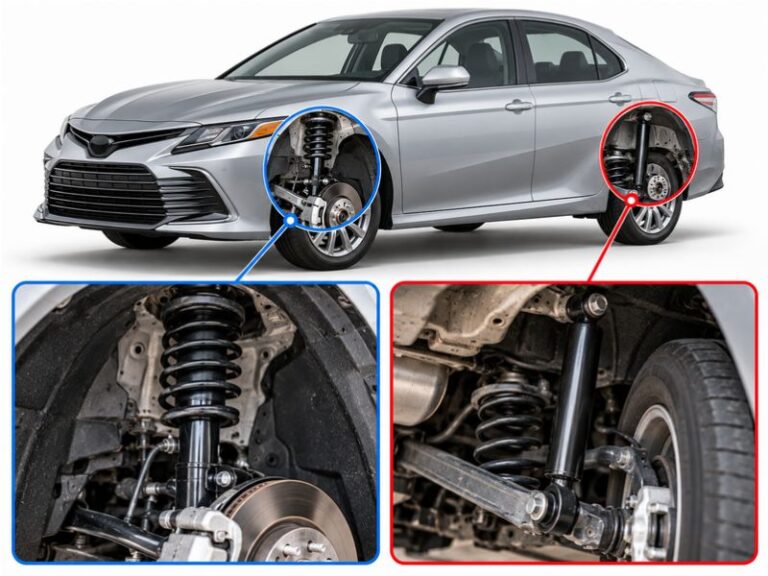
A shock absorber is a suspension component that controls how quickly a vehicle’s suspension moves up and down after bumps, dips, braking, acceleration, and other road inputs. It works with the springs to prevent excessive bouncing and helps keep the tires in controlled contact with the road.
So, what does a shock absorber do? It dampens spring movement by converting suspension motion into heat inside the damper, allowing the vehicle to settle instead of continuing to bounce.
The function of a shock absorber goes far beyond making a vehicle feel comfortable. Proper damping contributes to steering stability, tire contact, braking behavior, body control, and predictable handling. Springs support the vehicle and absorb road movement, but they naturally store and release energy. Without dampers, those springs could continue oscillating after every disturbance.
The purpose of a shock absorber is therefore to control that stored spring energy and regulate suspension movement.
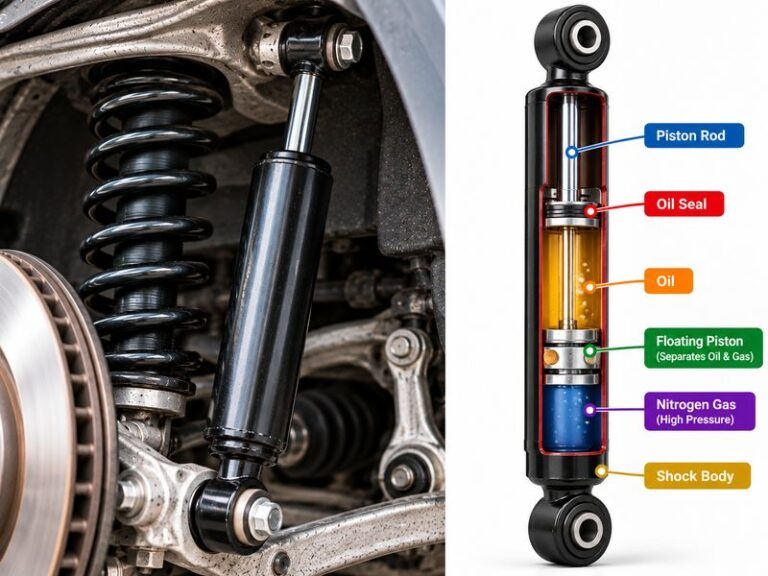
Inside a typical shock absorber are components such as a piston, piston rod, hydraulic fluid, valves, seals, and pressurized chambers. Depending on the design, it may also contain nitrogen gas, a reserve tube, a floating piston, or electronically controlled valves.
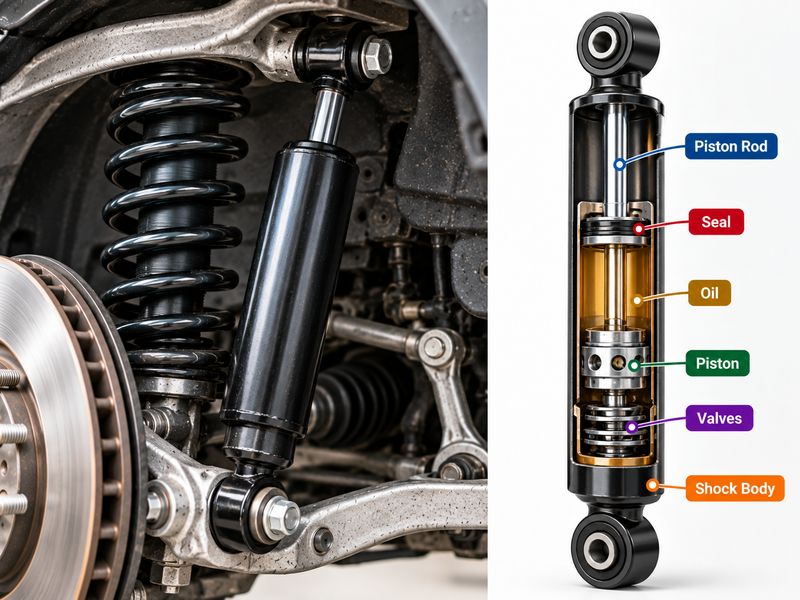
This pillar guide covers shock absorbers from basic function to internal construction, different designs, failure symptoms, diagnosis, replacement, safety, maintenance, and how shocks differ from springs, struts, and coilovers.
What Is a Shock Absorber?
A shock absorber is a hydraulic or electronically controlled damping device used in a vehicle’s suspension system to regulate movement between the wheels and the vehicle body.
Its primary job is not to hold the vehicle up.
That job is mainly handled by the suspension springs.
Instead, the shock absorber controls how quickly the springs compress and rebound.
Imagine pushing down on a spring and releasing it. A bare spring tends to bounce repeatedly before finally coming to rest.
A vehicle suspension spring behaves similarly.
When a tire hits a bump, the spring compresses and stores energy. After the tire passes the bump, the spring releases that energy and extends again.
Without a shock absorber, the spring could continue moving through several compression and rebound cycles.
The shock absorber resists those movements.
Inside the unit, a piston moves through hydraulic fluid. The fluid is forced through carefully designed valves and small passages, creating resistance.
That resistance slows suspension motion and converts part of the movement energy into heat.
The result is a vehicle that settles quickly instead of repeatedly bouncing.
What Does a Shock Absorber Do?
A shock absorber controls unwanted suspension movement and helps keep the vehicle stable after the springs react to road forces.
Every time the vehicle encounters a bump, pothole, dip, corner, braking event, or acceleration force, the suspension moves.
The shock absorber regulates how fast that movement occurs.
Its main effects include:
- Controlling spring oscillation
- Reducing repeated bouncing
- Helping maintain tire contact
- Controlling body roll
- Reducing excessive brake dive
- Limiting excessive acceleration squat
- Improving vehicle stability
- Helping the suspension recover after bumps
- Contributing to steering consistency
- Improving ride control
A shock absorber does not completely stop suspension movement.
That would make the vehicle extremely harsh and prevent the tires from following road irregularities.
Instead, it controls the rate of movement.
Good damping allows enough suspension travel for comfort and grip while preventing the vehicle from moving excessively.
What Is the Function of a Shock Absorber?
The function of a shock absorber is to damp suspension oscillation by creating controlled resistance to compression and rebound.
This sounds technical, but the concept is simple.
The spring wants to move.
The shock absorber controls how quickly it is allowed to move.
The shock generally performs this function in two directions.
Compression Damping
Compression occurs when the wheel moves upward relative to the vehicle body and the suspension compresses.
The shock absorber resists this movement.
Compression damping can influence how the vehicle responds to:
- Bumps
- Potholes
- Braking
- Cornering loads
- Sudden road impacts
Too little compression control may allow excessive suspension movement.
Too much can make the suspension harsh and prevent the tire from following uneven surfaces effectively.
Rebound Damping
Rebound occurs when the suspension extends after being compressed.
The spring wants to push the wheel and suspension back toward their normal position.
The shock absorber controls how quickly this happens.
If rebound damping is too weak, the vehicle may continue to bounce.
If it is excessive, the suspension may not extend quickly enough before the next bump.
Good shock tuning balances both movements.
What Is the Purpose of a Shock Absorber?
The purpose of a shock absorber is to make suspension movement controlled, predictable, and useful.
Many people think shocks exist mainly to improve ride comfort.
Comfort is important, but it is only part of their purpose.
A shock absorber also helps the tire remain connected to the road.
When a wheel bounces uncontrollably, tire load changes rapidly.
The tire may become lightly loaded or lose consistent contact with the surface.
That can affect:
- Steering
- Braking
- Cornering
- Vehicle stability
The shock absorber keeps the wheel from continuing to oscillate after a disturbance.
Another purpose is controlling body movement.
During braking, vehicle weight transfers toward the front.
During acceleration, weight can transfer rearward.
During cornering, the body tends to roll toward the outside of the turn.
Springs, sway bars, suspension geometry, and shocks all influence these movements.
The shock absorber specifically controls how quickly those movements occur.
How Does a Shock Absorber Work?
Most conventional shock absorbers work by moving a piston through hydraulic oil.
The piston is attached to a piston rod.
As the suspension moves, the piston travels inside the shock body.
Oil cannot pass freely from one side of the piston to the other.
Instead, it must flow through valves and calibrated passages.
These restrictions create damping force.
When suspension movement is slow, the internal valves may allow relatively controlled fluid flow.
During faster movement, valve behavior changes to provide the resistance engineered into the shock.
The exact response depends on the damper design.
The basic process is:
- The wheel encounters a road input.
- The suspension spring compresses or extends.
- The shock absorber piston moves.
- Hydraulic fluid is forced through internal valves.
- Fluid resistance slows the piston.
- Suspension energy is converted into heat.
- The suspension returns toward a stable position.
This cycle happens constantly whenever the vehicle is moving.
What Is Inside a Shock Absorber?
If you are wondering what is inside a shock absorber, the answer depends on whether it uses a twin-tube, monotube, gas-charged, adjustable, or electronically controlled design.
However, most conventional shocks contain several basic internal parts.
Hydraulic Fluid
Hydraulic oil is one of the most important materials inside a shock absorber.
As the piston moves, the oil flows through valves.
The resistance created by this movement produces damping.
The oil also helps transfer heat through the shock body.
Its characteristics are carefully chosen for the damper design.
Piston
The piston moves through the hydraulic fluid.
It contains passages and valve assemblies that regulate fluid movement.
The piston’s diameter, valve design, and flow characteristics all influence damping behavior.
Piston Rod
The piston rod connects the internal piston to the moving end of the shock absorber.
As suspension components move, the rod extends or retracts.
The rod surface must remain smooth because it passes through seals.
Damage, corrosion, or contamination can contribute to seal wear.
Valves
Internal valves are responsible for controlling fluid flow.
Different valve systems regulate compression and rebound.
Performance shocks may use sophisticated valve stacks that can be tuned for different speeds of suspension movement.
Seals
Seals keep hydraulic fluid inside the shock and prevent contamination from entering.
A damaged seal can allow oil to escape.
This is one reason visible shock absorber leakage may indicate failure.
Pressure Tube
The piston usually operates inside a pressure or working tube.
This tube contains the hydraulic fluid and provides the surface through which the piston travels.
Reserve Tube
A twin-tube shock absorber has an additional outer reserve tube.
Fluid can move between the inner working tube and the reserve chamber as the piston rod enters and leaves the shock.
Gas Chamber
Many shocks contain pressurized gas, commonly nitrogen.
The gas is not there to replace the hydraulic oil.
Instead, it helps manage pressure inside the damper and reduce foaming or cavitation under demanding operation.
Floating Piston
Monotube shocks commonly use a floating piston to separate the hydraulic oil from the pressurized gas chamber.
This keeps the fluids separated while allowing internal volume changes.
Why Is There Oil Inside a Shock Absorber?
Shock absorber oil creates the hydraulic resistance needed for damping.
When the piston moves, the oil is forced through small passages and valves.
Because the fluid cannot instantly move wherever it wants, it resists piston movement.
That resistance controls the suspension.
The movement energy is eventually converted into heat.
During demanding driving, shock absorbers can become warm because they are continuously converting suspension movement into thermal energy.
Oil quality and temperature behavior matter because the damper needs predictable performance across a range of operating conditions.
Why Do Some Shock Absorbers Contain Gas?
Gas-charged shocks contain pressurized gas in addition to hydraulic oil.
The gas helps reduce aeration and cavitation.
When hydraulic fluid is subjected to rapid pressure changes, air or vapor bubbles can form.
If excessive foaming occurs, damping can become less consistent because compressed gas behaves differently from hydraulic fluid.
Pressurized gas helps maintain more stable internal pressure.
A gas-charged shock is therefore still primarily a hydraulic damper.
The gas supports the operation of the hydraulic system rather than serving as the main damping medium.
Main Types of Shock Absorbers
Shock absorber construction varies depending on vehicle requirements.
Twin-Tube Shock Absorbers
A twin-tube shock contains an inner working cylinder and an outer reserve tube.
The piston operates inside the inner tube.
As the piston rod enters and exits the damper, fluid moves between the working cylinder and reserve chamber.
Twin-tube designs are widely used because they can provide good ride comfort and compact packaging.
Monotube Shock Absorbers
A monotube shock uses a single main cylinder.
The hydraulic oil and pressurized gas are usually separated by a floating piston.
Monotube designs can provide good heat dissipation because the working cylinder is directly exposed to the outer shock body.
They are common in performance and demanding applications, although design quality matters more than simply whether a shock is monotube or twin-tube.
Gas-Charged Shock Absorbers
Both twin-tube and monotube designs can use gas pressure.
Gas charging can help improve damping consistency under repeated suspension movement.
Adjustable Shock Absorbers
Adjustable shocks allow some damping characteristics to be changed.
Depending on the design, an adjustment may affect:
- Rebound
- Compression
- Both together
- Compression and rebound separately
These shocks are common in performance applications.
Electronic and Adaptive Dampers
Modern vehicles may use electronically controlled shock absorbers.
Sensors and control modules can alter damping depending on conditions such as:
- Vehicle speed
- Steering input
- Body movement
- Acceleration
- Drive mode
Some systems make adjustments many times while the vehicle is moving.
The exact technology varies by manufacturer.
Shock Absorber vs Spring
The shock absorber and suspension spring perform different jobs.
The spring supports vehicle weight and stores energy.
The shock absorber controls the release of that energy.
If a spring fails, vehicle ride height may change.
If a shock absorber fails, the vehicle may continue sitting at approximately normal height but become poorly controlled.
A spring without damping can bounce repeatedly.
A shock without a spring cannot perform the spring’s load-supporting role in a conventional suspension.
The two components are therefore designed to work together.
Shock Absorber vs Strut
Shock absorbers and struts both contain dampers, but they are not always interchangeable terms.
A shock absorber primarily provides damping.
A strut is usually a structural suspension component as well as a damper.
In a MacPherson strut suspension, the strut helps locate the steering knuckle and carries suspension loads.
Removing a strut can therefore affect suspension geometry differently from removing a conventional shock.
A shock absorber normally does not replace the structural role of a strut.
However, people sometimes use the words “shock” and “strut” casually when describing suspension dampers.
Shock Absorber vs Coilover
A conventional shock absorber may be installed separately from the coil spring.
A coilover places the coil spring around the damper assembly.
Many aftermarket coilovers also provide adjustable ride height and sometimes adjustable damping.
Both still use the same general principle of controlling spring and suspension movement.
The primary difference is how the spring and damper are packaged and whether additional adjustment is provided.
How Shock Absorbers Affect Ride Comfort
Shock absorbers significantly influence how controlled the vehicle feels over uneven roads.
If damping is too weak, the body may continue bouncing after a bump.
If damping is excessively firm, the suspension can transmit more road harshness into the cabin.
Properly tuned shocks allow the suspension to absorb road movement while preventing repeated oscillation.
Ride comfort therefore depends on the interaction between:
- Shocks
- Springs
- Tires
- Bushings
- Seat design
- Vehicle structure
- Suspension travel
A worn shock can make an otherwise good suspension feel loose or uncontrolled.
How Shock Absorbers Affect Handling
Shock absorbers help control how quickly vehicle weight moves during steering.
When the driver turns into a corner, weight transfers toward the outside wheels.
The suspension compresses on one side and extends on the other.
Damping controls the rate of this movement.
Healthy shocks can make transitions feel predictable.
Worn shocks may allow the body to move excessively or take longer to settle.
However, shocks are only one part of the handling system.
Tires, springs, sway bars, alignment, control arms, and suspension geometry also play major roles.
How Shock Absorbers Affect Braking
Shock absorbers do not directly create braking force.
However, they influence how the vehicle behaves during braking.
As weight transfers forward, the front suspension compresses.
Dampers control the rate of that compression.
Worn shocks can allow excessive body movement and may reduce the consistency of tire contact on rough surfaces.
Proper damping therefore supports stable braking behavior, even though the brake pads, rotors, tires, and braking system are responsible for actually slowing the vehicle.
How Shock Absorbers Affect Tire Contact
A tire produces useful grip when it remains properly loaded against the road.
An uncontrolled wheel can bounce after hitting a bump.
Each bounce changes the force between the tire and road.
The shock absorber reduces these oscillations.
This helps the wheel follow road irregularities more consistently.
This function is especially important on rough or uneven pavement where the suspension is constantly working.
What Causes Shock Absorbers to Wear Out?
Shock absorbers contain moving parts and seals, so they do not last forever.
Common causes of deterioration include:
- Repeated suspension movement
- Rough roads
- Potholes
- Heat
- Seal wear
- Contamination
- Corrosion
- Physical damage
- Heavy vehicle use
A damaged piston rod can also damage the seal.
Road salt and debris can corrode exposed surfaces.
Vehicle modifications may shorten shock life if the damper operates outside its intended range.
There is no single universal mileage at which every shock absorber must be replaced.
Condition and manufacturer guidance are more useful than relying on one fixed interval.
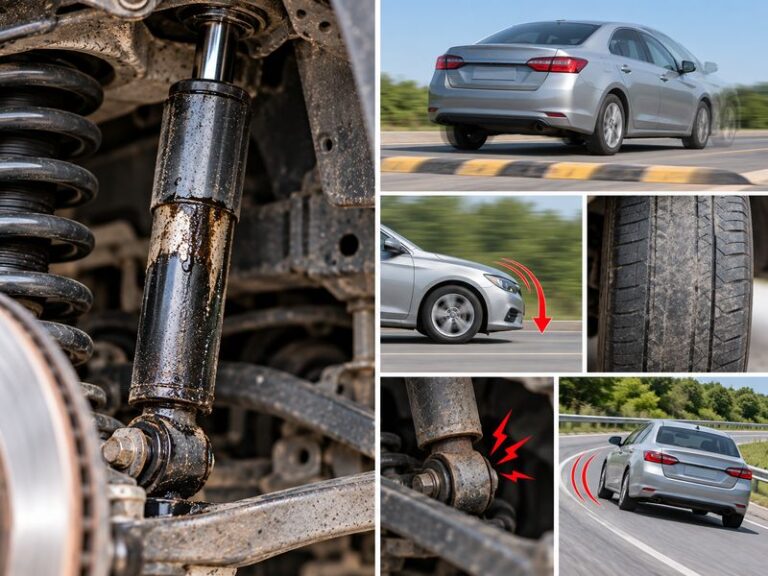
Symptoms of a Bad Shock Absorber
Worn or damaged shock absorbers can produce several symptoms.
Excessive Bouncing
A vehicle that continues bouncing after a bump may have insufficient damping.
Poor Body Control
The vehicle may feel floaty or take longer to settle after dips and road undulations.
Excessive Brake Dive
The front may move more dramatically during braking.
Springs and suspension geometry also influence dive, so this symptom alone does not prove shock failure.
Excessive Body Movement in Turns
Worn shocks may allow the body to move more quickly or continue moving after steering inputs.
Uneven or Unusual Tire Wear
Poor suspension control can contribute to irregular tire wear.
However, alignment, tire pressure, worn suspension joints, and wheel balance should also be checked.
Oil Leakage
Visible hydraulic fluid running down the shock body may indicate a failed seal.
A small amount of surface residue does not always mean the shock has failed, so manufacturer inspection criteria should be considered.
Knocking or Clunking
Internal damage, worn mounts, loose fasteners, or surrounding suspension components can cause noise.
Do not replace a shock based only on a clunk without confirming the source.
Reduced Stability
A badly worn damper can make the vehicle feel less controlled on rough roads or during rapid steering inputs.
How to Check Shock Absorbers
Start with a visual inspection.
Look for:
- Significant oil leakage
- Dented shock bodies
- Damaged piston rods
- Corrosion
- Broken mounting bushings
- Loose hardware
- Damaged dust boots
You can also observe how the vehicle behaves while driving.
Excessive bouncing, floating, or poor body control may indicate damping problems.
The traditional method of pushing down on a vehicle and watching it rebound can reveal a severely weak damper, but it is not a precise diagnostic test for every modern vehicle.
A shock absorber can lose performance without producing dramatic bouncing while parked.
A complete suspension inspection is more reliable.
Can You Drive With a Bad Shock Absorber?
The answer depends on how badly the shock has deteriorated.
Minor performance loss is different from a broken mount, badly damaged shock body, or severe suspension instability.
Continuing to drive with significantly worn shocks can reduce ride control and may negatively affect tire contact and vehicle stability.
If the vehicle:
- Bounces excessively
- Feels difficult to control
- Has a broken shock mount
- Has obvious structural damage
- Handles unpredictably
it should be inspected promptly.
Severe suspension damage may make continued driving unsafe.
Should Shock Absorbers Be Replaced in Pairs?
Replacing shock absorbers in axle pairs is commonly recommended because the left and right sides should have reasonably similar damping characteristics.
For example, if one rear shock is badly worn due to normal age and use, the other rear shock has usually experienced similar service.
Replacing only one could leave different damping behavior between the two sides.
However, there can be exceptions.
A nearly new shock damaged by an isolated impact may not necessarily mean the opposite new shock is also defective.
Vehicle manufacturer and shock manufacturer recommendations should be followed.
Do Shock Absorbers Affect Wheel Alignment?
A conventional shock absorber does not always directly determine wheel alignment.
However, the answer depends on suspension design.
A separate shock mounted independently of the steering knuckle may have little direct effect on alignment.
A strut-type damper can be part of the wheel-locating structure, so removing or replacing it may affect alignment.
Vehicle-specific design should determine whether alignment is required.
If other suspension components are disturbed during the repair, an alignment check may also be appropriate.
How Long Do Shock Absorbers Last?
There is no reliable universal lifespan for every shock absorber.
Service life depends on:
- Road conditions
- Vehicle weight
- Driving style
- Damper quality
- Climate
- Corrosion
- Suspension design
- Vehicle modifications
A vehicle regularly driven over rough roads may wear dampers differently from one used mainly on smooth highways.
Routine inspection is therefore more useful than assuming all shocks must fail at the same mileage.
Can Shock Absorbers Be Repaired?
Most standard factory-type replacement shock absorbers are replaced as complete units when worn or damaged.
Some performance dampers are rebuildable.
A rebuildable damper may allow servicing of:
- Seals
- Hydraulic fluid
- Internal valves
- Wear components
Whether rebuilding is possible depends entirely on the shock design and manufacturer.
A sealed non-serviceable road-car shock should not be opened casually because it may contain pressurized gas and hydraulic fluid.
Do Shock Absorbers Need Maintenance?
Most conventional road-car shock absorbers do not require routine fluid changes or lubrication.
Maintenance mainly involves inspection.
Look for:
- Leaks
- Damage
- Corrosion
- Worn mounts
- Loose fasteners
- Damaged dust boots
Suspension problems elsewhere should also be repaired because damaged springs, bushings, mounts, or other components can affect how the shock operates.
Adjustable or rebuildable performance dampers may have additional service requirements specified by their manufacturer.
Common Shock Absorber Problems
Several issues can occur as shocks age.
Internal Wear
Valve components and internal surfaces can gradually wear, reducing damping effectiveness.
Seal Failure
A damaged seal can allow hydraulic oil to escape.
Gas Pressure Loss
Some gas-charged shocks can lose pressure due to internal failure.
Damaged Piston Rod
A bent, pitted, or corroded rod can damage seals and interfere with smooth movement.
Worn Mounting Bushings
A shock can be mechanically healthy while its mounting bushings are worn.
This can cause clunking.
Physical Damage
A severe impact can dent or bend the shock body.
A damaged damper should be inspected carefully rather than continuing to use it.
Common Mistakes When Replacing Shock Absorbers
One mistake is diagnosing shocks solely from vehicle mileage.
Actual condition matters.
Another is replacing shocks because of a suspension noise without checking:
- Sway bar links
- Control arm bushings
- Ball joints
- Strut mounts
- Springs
- Wheel bearings
Other mistakes include:
- Incorrect mounting orientation
- Improper fastener torque
- Damaging the piston rod
- Installing incompatible shocks
- Reusing damaged mounts
- Ignoring worn springs
- Failing to inspect bump stops
- Mixing significantly different dampers on the same axle
Replacement parts should match the vehicle’s suspension design and intended use.
Safety When Replacing Shock Absorbers
Shock replacement can range from relatively straightforward to potentially hazardous.
A separate rear shock may be simple to remove when the spring is independently supported.
A strut assembly containing a compressed coil spring is very different.
Compressed suspension springs can store enough energy to cause serious injury.
If a spring must be removed from a strut, the correct spring compressor and service procedure are essential.
Never work under a vehicle supported only by a jack.
Use appropriately rated jack stands at approved lifting points.
Also ensure that suspension components are correctly supported before removing fasteners.
The exact procedure depends on the vehicle.
FAQs About Shock Absorbers
Is a shock absorber the same as a spring?
No. A spring supports vehicle weight and stores suspension energy, while a shock absorber controls how quickly that energy is released. The two components work together to control suspension movement.
A spring cannot provide proper damping by itself.
What does a shock absorber do when you hit a bump?
It controls the speed at which the suspension compresses and rebounds after the wheel encounters the bump. Hydraulic resistance prevents the spring from continuing to bounce uncontrollably.
This helps the wheel settle quickly and maintain more consistent road contact.
What is the main function of a shock absorber?
The main function of a shock absorber is to damp suspension oscillation and control compression and rebound movement. It prevents the springs from continuing to bounce after road disturbances.
This contributes to stability, tire contact, and ride control.
What is the purpose of a shock absorber in a car?
Its purpose is to control suspension movement so the vehicle remains stable and predictable. It works with the springs to reduce bouncing, body movement, and uncontrolled wheel motion.
Shock absorbers also influence steering and braking stability.
What is inside a shock absorber?
A typical shock absorber contains hydraulic fluid, a piston, piston rod, valves, seals, and a working cylinder. Depending on the design, it may also contain pressurized gas, a reserve tube, or a floating piston.
Electronic dampers can include additional control valves and electrical components.
Do shock absorbers support the weight of the car?
Conventional shock absorbers generally do not provide the main support for vehicle weight; the springs perform that job. The shock primarily controls the spring and suspension movement.
Some specialized suspension designs can combine functions differently.
Can bad shock absorbers cause uneven tire wear?
Yes, worn shocks can contribute to irregular tire wear by allowing excessive wheel movement. However, alignment, tire pressure, wheel balance, and worn suspension components can also cause unusual wear.
The entire suspension and tire system should be inspected.
Can a bad shock absorber cause clunking?
Yes, but the noise may come from the shock mounts or surrounding suspension components rather than the damper itself. Loose or damaged mounting hardware can also create clunks.
The noise source should be confirmed before replacing parts.
Should shock absorbers be replaced in pairs?
Replacing shocks in pairs on the same axle is generally advisable so both sides have similar damping performance. This is particularly relevant when they have worn through normal age and use.
Manufacturer recommendations should take priority for the specific vehicle.
Are shock absorbers and struts the same thing?
No. Both provide damping, but a strut is usually also a structural part of the suspension. A conventional shock absorber mainly controls movement without performing the same wheel-locating role.
The correct replacement depends on the vehicle’s suspension design.
Conclusion
Understanding what is a shock absorber starts with recognizing that it is the suspension component responsible for controlling movement rather than simply supporting the vehicle’s weight.
So, what does a shock absorber do? It resists excessive compression and rebound, controls spring oscillation, helps keep the tire connected to the road, and contributes to stable steering, braking, cornering, and ride behavior.
The function of a shock absorber is fundamentally hydraulic damping. As the piston moves, hydraulic fluid is forced through calibrated valves, creating resistance and converting suspension movement into heat.
The purpose of a shock absorber is to prevent the springs and wheels from continuing to bounce after road inputs while still allowing enough suspension movement for comfort and tire contact.
And what is inside a shock absorber? Most designs contain a piston, piston rod, hydraulic fluid, internal valves, seals, and a working cylinder. Twin-tube shocks add a reserve chamber, while many monotube shocks use pressurized gas separated from the oil by a floating piston.
Shock absorbers may appear simple from the outside, but their internal damping characteristics have a major influence on how a vehicle behaves.
When shocks wear, symptoms such as excessive bouncing, poor body control, oil leakage, unusual tire wear, or unstable handling can appear. Because many suspension faults produce similar symptoms, proper inspection is more reliable than replacing shocks based on mileage or one symptom alone.
Healthy shock absorbers allow the springs to do their job without letting suspension movement become uncontrolled. That balance between movement and control is what makes them one of the most important parts of a vehicle’s suspension system.