Where Are Shock Absorbers Located on a Car? Full Location Guide
Shock absorbers are located near the wheels as part of the suspension system, usually between the vehicle’s body, frame, or subframe and a suspension component such as a control arm, axle, or wheel assembly.
However, the exact answer to where are shock absorbers located on a car depends on the suspension design. Some vehicles have separate shock absorbers at both the front and rear, while many modern cars use struts at the front and separate shocks at the rear.
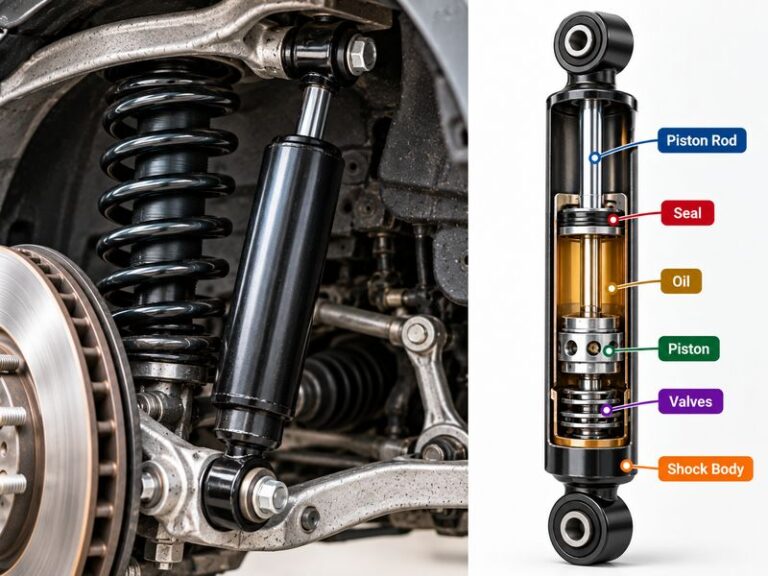
A conventional shock absorber usually looks like a narrow cylindrical tube running vertically or at an angle behind the wheel. Its upper end attaches to the body or frame, while its lower end attaches to the suspension or axle. In contrast, a MacPherson strut is larger, commonly has a coil spring wrapped around it, and also serves as a structural part of the suspension.
Finding a shock absorber is usually easiest by looking behind the wheel and following the suspension components inward. Rear shocks are often especially visible, while front dampers can be hidden inside strut assemblies.
This guide explains where front and rear shock absorbers are located, how their positions vary between cars, trucks, SUVs, independent suspension, and solid axles, how to identify shocks versus struts, and what to look for when inspecting them.
Where Are Shock Absorbers Located on a Car?
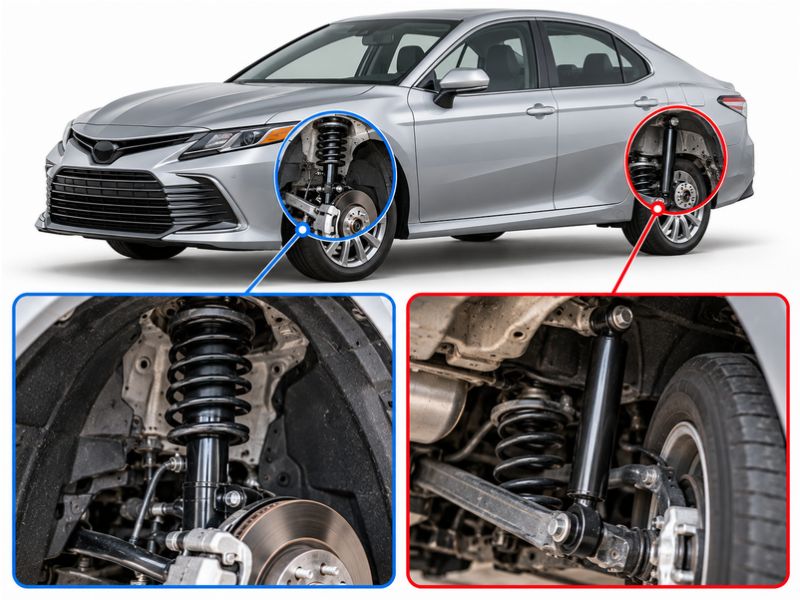
Shock absorbers are generally located at or near each wheel, connecting a moving part of the suspension to the vehicle’s body, frame, or subframe.
Their position allows them to control movement between the wheels and the vehicle body as the suspension compresses and extends.
On a typical passenger vehicle, you may find:
- Front shock absorbers or struts behind the front wheels
- Rear shock absorbers behind or slightly inward from the rear wheels
- An upper mounting point attached to the body, chassis, or frame
- A lower mounting point connected to a control arm, axle, steering knuckle, or another suspension component
The shock does not need to sit perfectly vertical.
Depending on the suspension design, it may lean:
- Inward
- Outward
- Forward
- Rearward
Some rear shocks are mounted at fairly noticeable angles.
The exact location is determined by suspension geometry, available space, vehicle packaging, and how the manufacturer wants the damper to respond to wheel movement.
A vehicle can also have different suspension designs at the front and rear, so the shock absorber locations may look completely different at opposite ends of the same car.
Where Are the Front Shock Absorbers Located?
The front dampers are normally positioned behind the front wheels.
However, many modern cars do not use a conventional separate shock absorber at the front.
Instead, they use MacPherson struts.
A MacPherson strut combines a damper with a structural suspension member and commonly has a coil spring installed around it.
If your car uses this design, you may see a large assembly extending upward from the steering knuckle toward the body.
The upper portion usually attaches inside the engine bay or under the body at a strut tower.
The lower portion attaches to the steering knuckle.
This means someone searching for a traditional narrow front shock absorber may not find one because the damping function is built into the strut assembly.
Other vehicles use a double-wishbone or multi-link front suspension with a separate shock or coilover unit.
In those designs, the shock may attach between:
- The lower control arm and chassis
- The suspension arm and upper body structure
- The knuckle area and chassis
The spring may be separate from the shock or mounted around it.
Where Are the Rear Shock Absorbers Located?
Rear shock absorbers are usually found behind the rear wheels or slightly inward from them.
On many vehicles, they are easier to identify than the front dampers because the rear suspension uses a separate coil spring and shock.
A typical rear shock has:
- An upper end connected to the body, frame, or rear shock tower
- A lower end attached to the axle, control arm, trailing arm, or rear wheel carrier
The shock may sit vertically or at an angle.
On some cars, the lower mounting point is close to the wheel hub.
On others, the shock mounts farther inward on a suspension arm.
You may be able to see the rear shocks by looking through the wheel opening, especially on trucks and SUVs.
On some passenger cars, the upper shock mount is hidden behind:
- Trunk trim
- Interior panels
- Rear seat trim
- Wheel-well liners
The visible shock body may therefore be underneath the car even though its upper fastener is accessed from inside the vehicle.
Why Are Shock Absorbers Located Near the Wheels?
Shock absorbers need to control the movement created when a wheel travels upward and downward.
Mounting them near the suspension allows wheel movement to create corresponding movement inside the damper.
As the wheel rises over a bump, the suspension arm or axle moves.
That movement compresses or extends the shock absorber.
The shock then creates resistance through its internal hydraulic system.
The location and angle of the shock determine how much the damper moves relative to wheel travel.
This relationship is sometimes called the motion ratio.
A shock mounted directly at the wheel may experience more movement than a shock mounted farther inward on a control arm.
Engineers account for this when selecting:
- Damper size
- Valving
- Spring rate
- Mounting angle
- Suspension travel
This is one reason moving a shock mounting point without proper engineering can significantly change suspension behavior.
How to Find Shock Absorbers on a Car
You can often identify shock absorbers visually without removing any suspension parts.
First, park the vehicle safely on a level surface and turn the ignition off.
Look behind one of the wheels.
A conventional shock absorber usually looks like a long cylindrical tube with a narrower piston rod extending from one end.
It will normally have mounting points at both ends.
Depending on the vehicle, the shock body may have:
- A black or painted metal finish
- A protective dust cover
- A rubber boot
- A metal shield
Follow the component upward and downward.
If it connects between the body and suspension but does not serve as a major steering-knuckle structure, it is probably a conventional shock absorber.
If the component is much larger, connects directly to the steering knuckle, and has a coil spring wrapped around it, it is more likely a strut.
Never crawl underneath a vehicle that is supported only by a jack just to locate a shock absorber.
What Does a Shock Absorber Look Like?
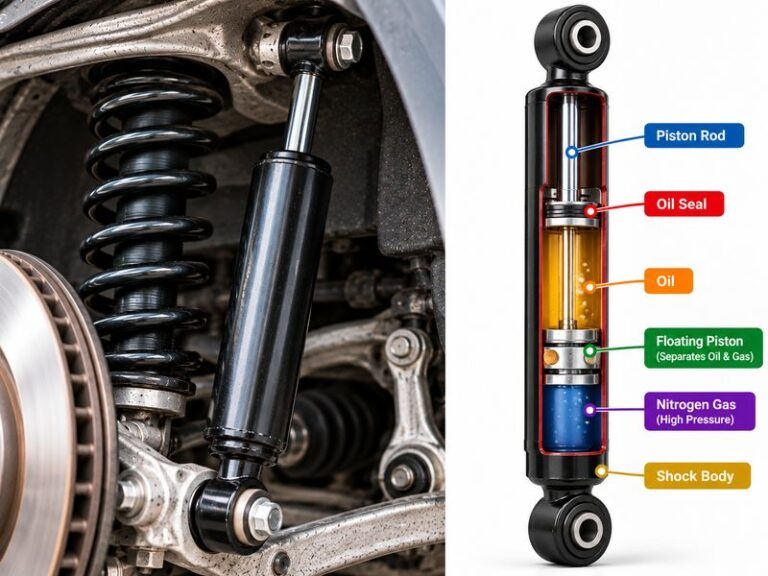
A conventional shock absorber usually resembles a telescoping cylinder.
The main features you may see include:
- Cylindrical shock body
- Piston rod
- Upper mounting eye or stud
- Lower mounting eye or bracket
- Rubber mounting bushings
- Dust boot or protective cover
The shock compresses and extends telescopically as the suspension moves.
Different shocks can look noticeably different.
A monotube performance shock may have a relatively large single body.
A twin-tube replacement shock may look narrower.
Some performance units have an external reservoir connected by a hose or mounted directly to the shock.
Electronic shocks may also include:
- Wiring
- Electrical connectors
- Electronic valves
These should not be confused with brake or ABS wiring.
Shock Absorber Location vs Strut Location
Understanding the difference between a shock and a strut can make locating them much easier.
A conventional shock absorber mainly controls suspension motion.
A strut provides damping but is also a structural part of the suspension.
On a common MacPherson front suspension, the strut is connected directly to the steering knuckle and plays a role in locating the wheel.
Its upper end attaches to the body through a strut mount.
The spring is typically wrapped around the strut.
A conventional shock can usually be removed without the wheel-locating geometry collapsing in the same way because other suspension links continue to locate the wheel.
This is why someone asking where the front shocks are may actually need to locate the front struts.
Do All Cars Have Four Shock Absorbers?
Not necessarily in the traditional sense.
Every normal passenger vehicle needs some form of suspension damping, but that does not mean it has four separate components all labeled “shock absorbers.”
A common layout is:
- Two front struts
- Two rear shock absorbers
Another vehicle may use:
- Four struts
- Four separate shocks
- Front coilovers and rear separate shocks
- Electronically controlled dampers
Some advanced suspension systems use specialized dampers that still perform the same basic control function.
So a vehicle may effectively have damping at all four corners without having four conventional stand-alone shocks.
Where Are Shock Absorbers Located on a MacPherson Strut Car?
On a MacPherson-strut vehicle, the front damping mechanism is built into the strut assemblies behind the front wheels.
Each strut generally runs from the steering knuckle upward to a body-mounted strut tower.
Open the hood and you may see the upper strut mount near each side of the engine bay.
The rear suspension may still use conventional shock absorbers.
For example, the rear springs might sit separately between a control arm and the vehicle body while the shock is mounted nearby.
This front-strut/rear-shock configuration is very common because manufacturers can use different suspension layouts at opposite ends of the vehicle.
Where Are Shock Absorbers Located on a Double-Wishbone Suspension?
A double-wishbone suspension uses upper and lower control arms to locate the wheel.
The shock absorber or coilover usually mounts between one of the control arms—commonly the lower arm—and the chassis or body.
The spring may:
- Surround the shock
- Sit next to the shock
- Mount separately on the control arm
In some vehicles, the shock passes through an opening in the upper control arm.
The damper may be positioned relatively far inward from the wheel compared with a MacPherson strut.
Therefore, simply looking directly behind the tire may not immediately reveal it.
Following the lower control arm inward toward the chassis can help locate the damper.
Where Are Shock Absorbers Located on Multi-Link Suspension?
Multi-link suspension uses several individual links to control the wheel.
A shock absorber may be mounted separately from the spring.
In the rear, the spring may sit on a lower suspension arm while the shock is mounted closer to the wheel carrier.
Other designs place the shock farther inward.
Multi-link layouts can look complicated because you may see several narrow arms around the wheel.
The shock is generally easier to identify because it has the characteristic telescoping cylindrical body rather than looking like a solid suspension link.
Some performance vehicles use rear coilovers instead, combining the spring and damper into one assembly.
Where Are Shock Absorbers Located on a Solid Rear Axle?
On a solid rear axle, the rear shock absorbers normally connect the axle housing to the vehicle’s frame or body.
Look underneath the rear of the vehicle and locate the large axle running between the rear wheels.
You may see one shock near each side.
The lower ends typically attach to brackets on the axle.
The upper ends connect to:
- The frame
- Body structure
- Crossmember
The shocks may lean inward or outward instead of sitting vertically.
Some vehicles even position the left and right shocks at different fore-aft angles to help package the suspension or control certain axle movements.
This arrangement is common on many trucks and some SUVs.
Where Are Shock Absorbers Located on Trucks?
Truck shock absorbers are generally easy to spot because of the open suspension layout.
At the front, location depends on whether the truck uses:
- Independent front suspension
- Coil springs
- Torsion bars
- Coilovers
- A solid front axle
A front shock usually sits between a control arm or axle and the frame.
At the rear, many trucks use leaf springs with a solid axle.
The shock absorber connects the axle to the frame and is often mounted at an angle.
Unlike the spring, which supports the vehicle’s load, the shock controls how quickly the suspension moves.
Heavy-duty or off-road trucks may also use:
- Larger dampers
- Remote reservoirs
- Dual shocks
- Specialized bypass shocks
These setups are more complex but still place the dampers where axle or wheel movement can activate them.
Where Are Shock Absorbers Located on SUVs?
SUV shock placement depends heavily on the platform.
A car-based crossover may use:
- Front MacPherson struts
- Rear independent suspension with separate shocks
A body-on-frame SUV may use:
- Front coilovers or separate shocks
- Rear shocks attached to a solid axle
Some SUVs have independent suspension at all four wheels.
Others combine independent front suspension with a solid rear axle.
Because the term SUV covers many different suspension layouts, the easiest way to identify shock location is to check behind each wheel rather than assuming every SUV uses the same system.
Are Shock Absorbers Inside the Coil Springs?
Sometimes, but not always.
A damper located inside a coil spring is essentially part of a coil-over arrangement.
MacPherson struts also commonly have the spring wrapped around the damper.
However, many vehicles use separate springs and shock absorbers.
For example, a rear coil spring may sit between a lower control arm and the body, while the shock sits several inches away.
Both designs can work effectively.
Packaging, suspension geometry, cost, and vehicle design determine whether the spring and damper are combined or separated.
Are Shock Absorbers Located Inside the Wheel?
No.
The shock absorber is not inside the wheel or tire.
It is located behind or inward from the wheel as part of the suspension.
The wheel connects to a hub or wheel carrier.
Suspension arms, springs, shocks, struts, and steering components are positioned behind it.
Removing the wheel usually provides a much clearer view of these components.
However, removing a wheel requires proper lifting and vehicle support procedures.
Can You See Shock Absorbers Without Removing the Wheels?
Often, yes.
Rear shocks on trucks and SUVs may be clearly visible from underneath or through the wheel well.
Passenger cars can be more difficult because:
- The body sits lower
- Wheel wells are tighter
- Plastic liners block the view
- Suspension components are compact
Front struts are often easy to identify through the wheel opening because of their large diameter and visible springs.
If you cannot see the component clearly, a suspension diagram for the exact year, make, and model is safer than reaching underneath an unsupported vehicle.
Where Are the Shock Absorber Mounts Located?
Every conventional shock has upper and lower mounting points.
Upper Shock Mount
The upper shock mount normally connects to:
- Vehicle body
- Chassis
- Frame
- Shock tower
- Crossmember
The upper mount may use:
- Rubber bushings
- Studs
- Bolts
- A mounting plate
On rear passenger cars, upper mounts can sometimes be accessed from the trunk or behind interior panels.
Lower Shock Mount
The lower end usually connects to a moving suspension component such as:
- Control arm
- Rear axle
- Wheel carrier
- Trailing arm
These mounting points allow suspension movement to extend and compress the shock.
Why Are Some Shocks Mounted at an Angle?
A shock absorber does not need to be perfectly vertical.
Manufacturers may angle shocks because of:
- Packaging space
- Suspension geometry
- Tire clearance
- Axle design
- Desired motion ratio
- Body structure
The mounting angle affects how much the shock moves for a given amount of wheel movement.
A sharply angled shock generally moves less than a vertically mounted shock for the same vertical wheel travel.
Engineers compensate for this when selecting damping characteristics.
This is another reason shock mounts should not be relocated casually.
How to Tell Which Shock Absorber Is Front or Rear
Replacement shocks are designed around specific mounting positions.
Front and rear shocks often differ in:
- Length
- Diameter
- Mounting style
- Damping characteristics
- Travel
- Bushings
- Brackets
Even left and right components can differ on some applications, particularly struts.
Do not identify replacement components only by appearance.
Use the exact year, make, model, suspension package, and manufacturer part information.
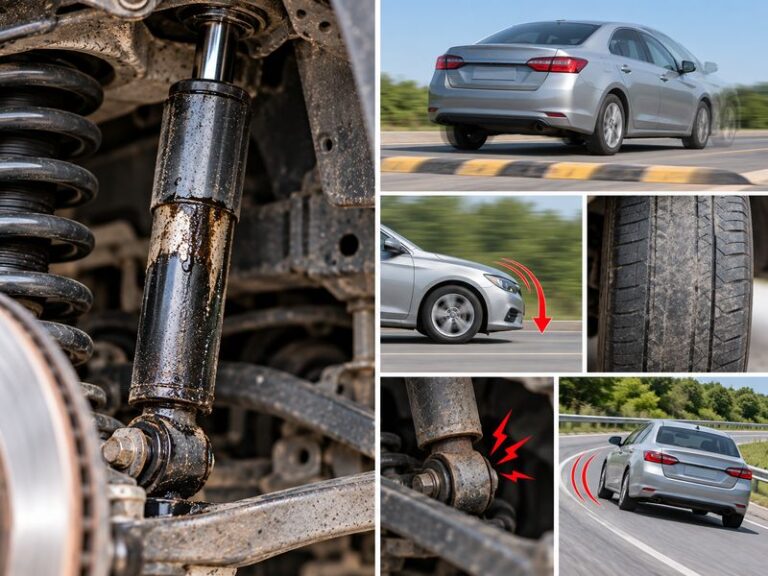
Where to Look for a Leaking Shock Absorber
If you are inspecting shock absorber condition, examine the main shock body and the area around the piston rod seal.
A failing seal may allow hydraulic oil to run down the shock body.
Look for:
- Wet oily streaks
- Dirt stuck to fresh oil
- Fluid covering a large section of the shock
A slight film around some dampers does not always indicate complete failure.
Manufacturers can have specific inspection criteria for acceptable seepage versus actual leakage.
Also check that the fluid is actually coming from the shock rather than nearby:
- Brake components
- Differential
- Powertrain
- Other leaking systems
Why Shock Location Matters When Diagnosing Noise
Knowing where shock absorbers are located on a car helps when diagnosing suspension noises.
A clunk near a shock does not necessarily mean the shock itself has failed.
Nearby components may include:
- Shock mounts
- Control arm bushings
- Sway bar links
- Ball joints
- Springs
- Bump stops
A worn shock mounting bushing can create noise even when the hydraulic damper still functions.
Likewise, a loose sway bar link close to the shock may sound as though the shock is knocking.
The noise source should therefore be confirmed physically before parts are replaced.
Does Shock Absorber Location Affect Performance?
Yes.
Damper position and angle influence its motion ratio, which determines how much the shock moves relative to the wheel.
A damper mounted close to the wheel may experience substantial travel.
One mounted far inward on a control arm may move less for the same wheel displacement.
This affects the damping force required.
Manufacturers design the shock specifically for the mounting geometry.
Installing a shock with inappropriate damping characteristics can make the suspension too soft or too stiff even if the physical dimensions appear similar.
Safety When Locating or Inspecting Shock Absorbers
Locating a shock absorber normally requires only visual inspection, but safety becomes important if you need to look underneath the car or remove a wheel.
Park on a solid, level surface.
If the vehicle must be raised:
- Use the correct lifting points
- Use properly rated jack stands
- Chock wheels when appropriate
- Never rely solely on a hydraulic jack
Do not remove suspension fasteners simply to identify the shock.
Some suspension systems contain compressed coil springs with significant stored energy.
Removing the wrong bolt can allow suspension parts or springs to move suddenly.
Identification should not require disassembling the suspension.
FAQs About Shock Absorber Location
Where are the front shock absorbers located?
Front shock absorbers are usually behind the front wheels between the suspension and vehicle body. Many modern cars use front struts instead of separate conventional shocks.
A MacPherson strut normally extends from the steering knuckle to the upper strut tower.
Where are the rear shock absorbers located?
Rear shocks are usually positioned near the rear wheels between the body or frame and the rear suspension or axle. They may sit vertically or at an angle.
Some upper mounts are accessed through the trunk or behind interior trim.
Does every car have shock absorbers at all four wheels?
Every normal passenger car requires damping at all four wheels, but it may use shocks, struts, or another damper design. A common arrangement is two front struts and two rear shocks.
The exact configuration depends on suspension design.
Are front shocks inside the coil springs?
They can be, especially in strut or coilover-style suspension assemblies, but not all front suspensions combine the spring and damper. Some double-wishbone designs use separate components.
Always identify the actual suspension layout.
Are rear shocks inside the springs?
Sometimes, but many vehicles mount the rear springs and shocks separately. A rear coil spring may sit on a control arm while the shock attaches nearby.
Both arrangements are common.
Can you see shocks without lifting the car?
Often you can see at least part of the shock through the wheel well or from beside the vehicle. Trucks and SUVs usually provide the clearest view.
Do not crawl beneath a vehicle unless it is safely supported.
Are shock absorbers and struts located in the same place?
They can occupy similar positions near the wheels, but a strut is also a structural suspension member. Front struts usually attach directly to the steering knuckle, while conventional shocks may attach to a control arm.
The distinction depends on suspension design.
Where is the upper rear shock mount?
The upper rear shock mount is generally attached to the body, frame, or rear shock tower. Access may be underneath the vehicle, inside the trunk, or behind interior panels.
Vehicle-specific service information can identify the exact access point.
Why are my rear shocks mounted diagonally?
Angled rear shocks are normal on many vehicles and are positioned that way because of suspension geometry and packaging requirements. Their damping is designed around that mounting angle.
They do not need to be perfectly vertical to work correctly.
How do I know whether my car has shocks or struts?
A strut usually attaches directly to the steering knuckle and serves as part of the wheel-locating structure, while a conventional shock mainly provides damping. Looking at a vehicle-specific suspension diagram is the easiest way to confirm the design.
Many cars have struts in front and shocks in the rear.
Conclusion
The simplest answer to where are shock absorbers located on a car is that they are positioned near the wheels, usually between a moving suspension component and the vehicle’s body, frame, or subframe.
However, their exact position depends on the suspension system.
Many modern passenger cars use front MacPherson struts, meaning you will not find a traditional separate front shock absorber. Instead, the damper is built into the larger strut assembly behind each front wheel.
At the rear, separate shock absorbers are extremely common. They usually connect the body or frame to a control arm, trailing arm, wheel carrier, or solid axle and may be mounted vertically or at an angle.
Trucks, SUVs, double-wishbone suspensions, multi-link systems, and solid-axle vehicles can all position their shocks differently.
The easiest way to locate one is to look behind the wheel for a telescoping cylindrical component connecting the suspension to the vehicle structure. A large unit with a spring wrapped around it may instead be a strut or coilover.
Knowing where the shocks are located is useful not only for identifying suspension parts but also for checking for leaks, damaged mounts, corrosion, or other visible problems. Just remember that suspension designs vary considerably, so vehicle-specific information should be used whenever the location or type of damper is unclear.