Can a Bent Control Arm Be Fixed? Repair vs Replacement Guide
If you are asking **can a bent control arm be fixed**, the key issue is not whether a shop can make the arm look straight again. The real question is whether that arm can still hold the wheel in the correct position and safely handle braking, cornering, bumps, and highway loads. For most daily-driven cars, SUVs, and light trucks in the U.S., replacement is the normal choice when a control arm is truly bent.
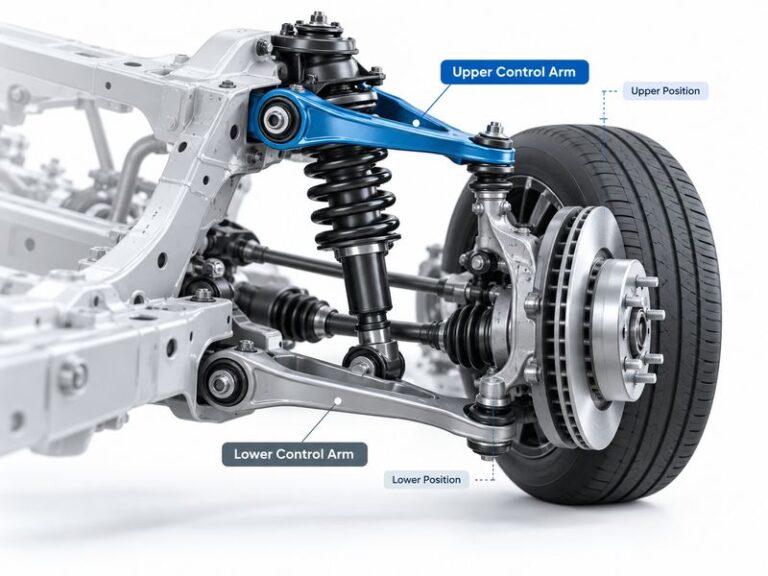
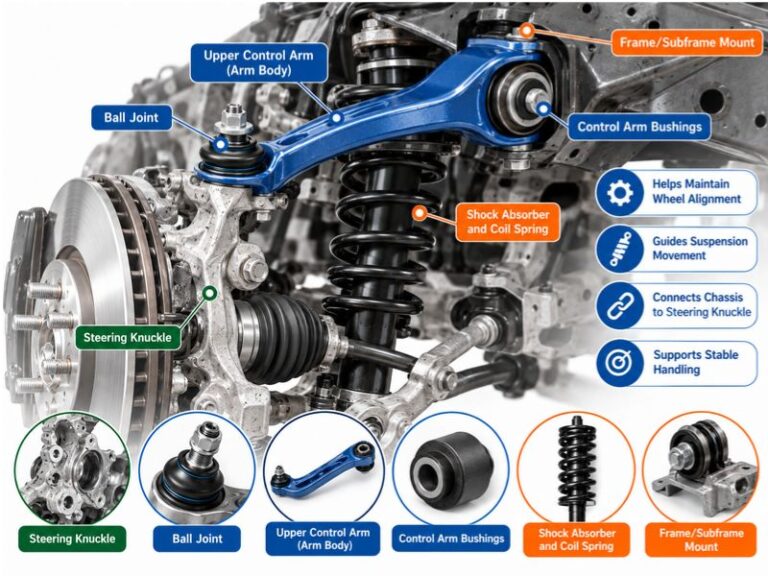
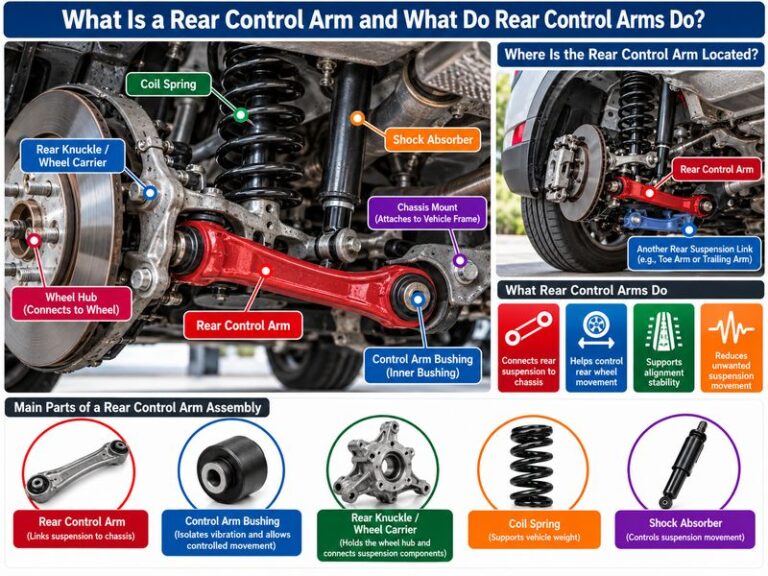
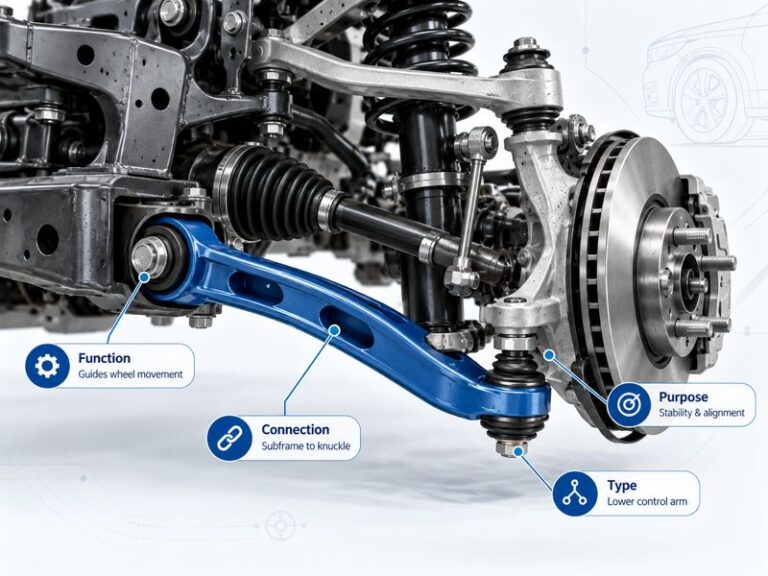
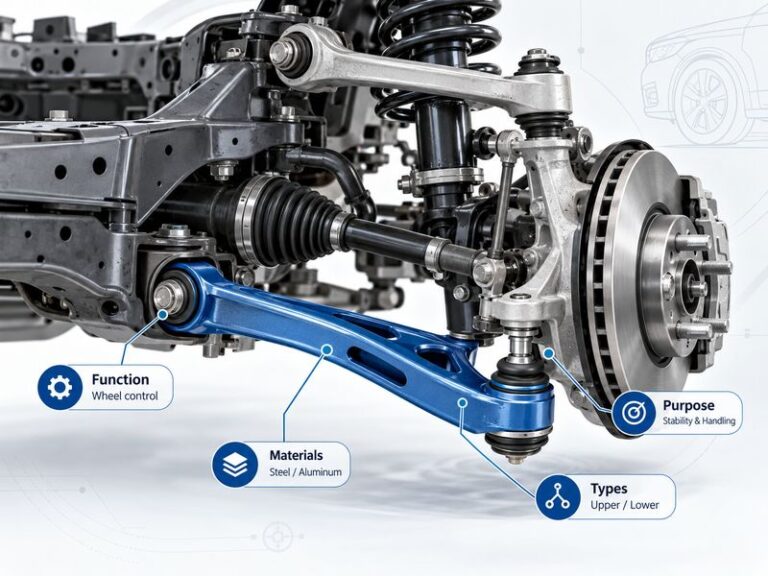
A control arm is a major suspension link. It connects the wheel assembly to the vehicle structure while allowing the suspension to move up and down. When an impact bends that link, the wheel may shift forward, backward, inward, or outward. That change can upset alignment and make the car pull, wear tires, or feel unstable.
In practical repair work, a damaged control arm also tells you to look beyond the arm itself. A curb strike strong enough to bend steel or aluminum may also damage a tie rod, ball joint, strut, wheel bearing, knuckle, subframe, wheel, or tire. Replacing the visible bent part without checking the rest of the suspension can leave the real problem partly unresolved.
This guide explains when a bent control arm might be repairable, why replacement is usually preferred, how to spot the damage, what else should be inspected, and what to expect after the repair.

Can a Bent Control Arm Be Fixed or Does It Need Replacement?
So, **can a bent control arm be fixed**? In a very narrow sense, some steel control arms can be straightened with specialized equipment. That does not mean straightening is the best repair for a road vehicle. Once metal has been bent by an impact, its shape and strength may no longer match the original design.
Replacement is usually preferred because a new or quality replacement arm restores the part to a known shape. Suspension geometry depends on exact mounting points. A change of only a small amount can affect camber, caster, toe, wheelbase, and tire position.
Modern control arms may also include pressed-in bushings or an integrated ball joint. If the arm has been hit hard enough to bend, those parts may have absorbed part of the impact as well. Installing a complete replacement arm can solve several concerns at once.
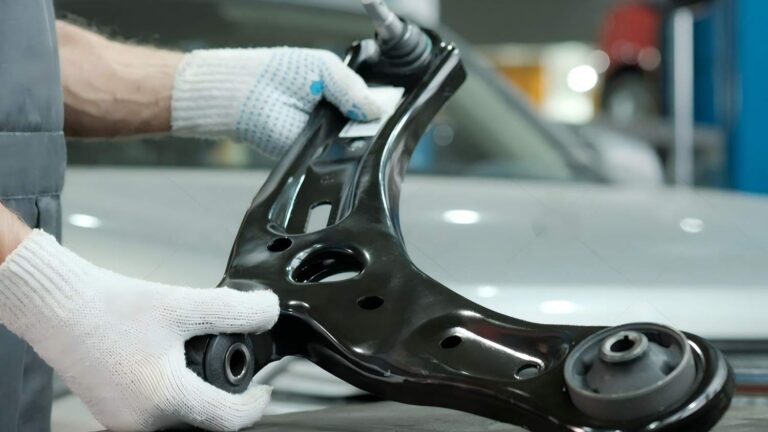
The answer also depends on what the arm is made from. A stamped steel arm behaves differently from a cast aluminum arm. Aluminum and cast components are generally poor candidates for bending back into shape because hidden cracks or structural damage may remain.
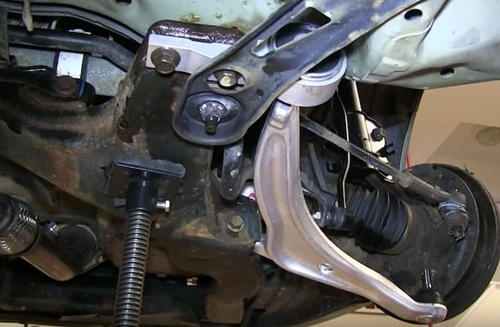
- ✦ Minor steel deformation
A specialist may be able to straighten some steel parts, but this is uncommon for routine passenger-car repairs.
- ✦ Severe bend
A visibly twisted, folded, kinked, or heavily displaced arm should normally be replaced.
- ✦ Cracked metal
Any crack, tear, broken weld, or damaged mounting area is a strong reason to replace the part.
- ✦ Cast or aluminum arm
Replacement is generally the safer approach because hidden structural damage can be difficult to judge.
- ✦ Unknown impact history
If the arm was damaged in a crash or hard curb hit, the surrounding suspension should be checked before deciding the repair.
Why Straightening Is Not the Same as Restoring the Part
A technician may be able to make a bent arm look close to its old shape. That does not prove that the metal has returned to its original strength. The bent area has already experienced stress beyond what the manufacturer intended.
Heating, hammering, pressing, or pulling the arm can add more stress. It may also alter the metal in ways that are hard to see. For a part that helps locate a wheel, that uncertainty is important.
- ✦ Shape
The arm may look straight but still be slightly off at its mounting points.
- ✦ Strength
Bent metal may have stretched or weakened even when no crack is visible.
- ✦ Alignment
Small dimensional errors can cause alignment settings to remain outside specification.
Why a Bent Control Arm Is a Serious Suspension Problem
A control arm does more than hold parts together. It helps control the path of the wheel as the suspension moves. Its length, angle, shape, and mounting points all affect how the tire sits against the road.
When the arm bends, the wheel can move away from its designed position. That may create a pull, crooked steering wheel, uneven tire wear, or poor handling. In more severe cases, the tire may sit farther back in the wheel opening or rub another part of the car.
This is why the question **can a bent control arm be fixed** should be viewed as a safety and geometry question, not just a metal-repair question. The correct repair must restore the wheel to the position intended by the vehicle maker.
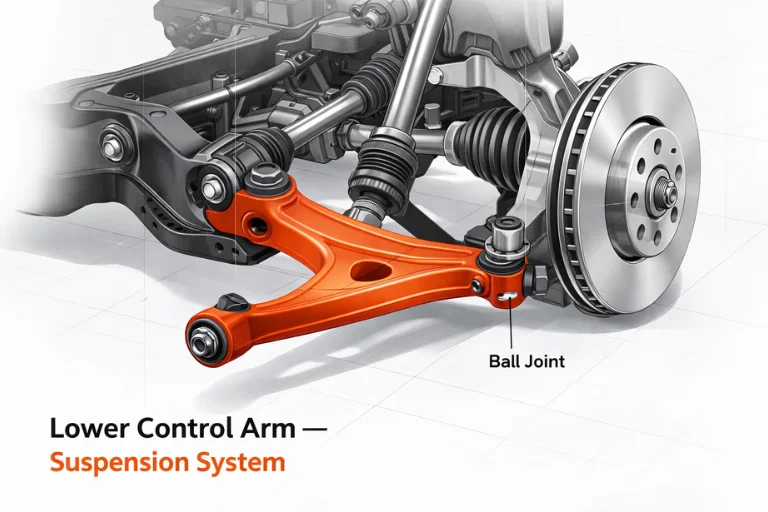
- ✦ Wheel position changes
The affected wheel may sit farther forward, backward, inward, or outward than the wheel on the other side.
- ✦ Alignment changes
Camber, caster, toe, or more than one angle may move outside specification.
- ✦ Tire wear increases
A tire that no longer tracks correctly can wear quickly on one edge.
- ✦ Handling becomes less predictable
The vehicle may pull, wander, or feel different during braking and cornering.
- ✦ Other parts receive extra load
Bushings, ball joints, tie rods, wheel bearings, and tires may work at angles they were not designed for.
How a Control Arm Affects Alignment
The control arm helps establish the wheel’s location in relation to the body or subframe. Its pivot points and ball-joint position are built into the suspension design. If the arm changes shape, those reference points can move.
An alignment machine can measure the result, but it cannot make a bent control arm straight. If the geometry is outside the available adjustment range, the damaged part must be corrected or replaced before the alignment can be completed properly.
What Causes a Control Arm to Bend?
Control arms are made to handle normal driving loads, but a sharp impact can exceed their design limit. Hitting a curb is one of the most common ways this happens. The tire and wheel take the first hit, and that force can travel through the hub and steering knuckle into the control arm.
Deep potholes can cause similar damage, especially at higher speed. A collision near a wheel can also push suspension parts out of position. On older vehicles, heavy rust can reduce the strength of a steel arm and make damage more likely.
If you are trying to decide **can a bent control arm be fixed** after an impact, knowing how the damage happened matters. A mild-looking bend caused by a severe crash may be only one sign of a larger suspension problem.
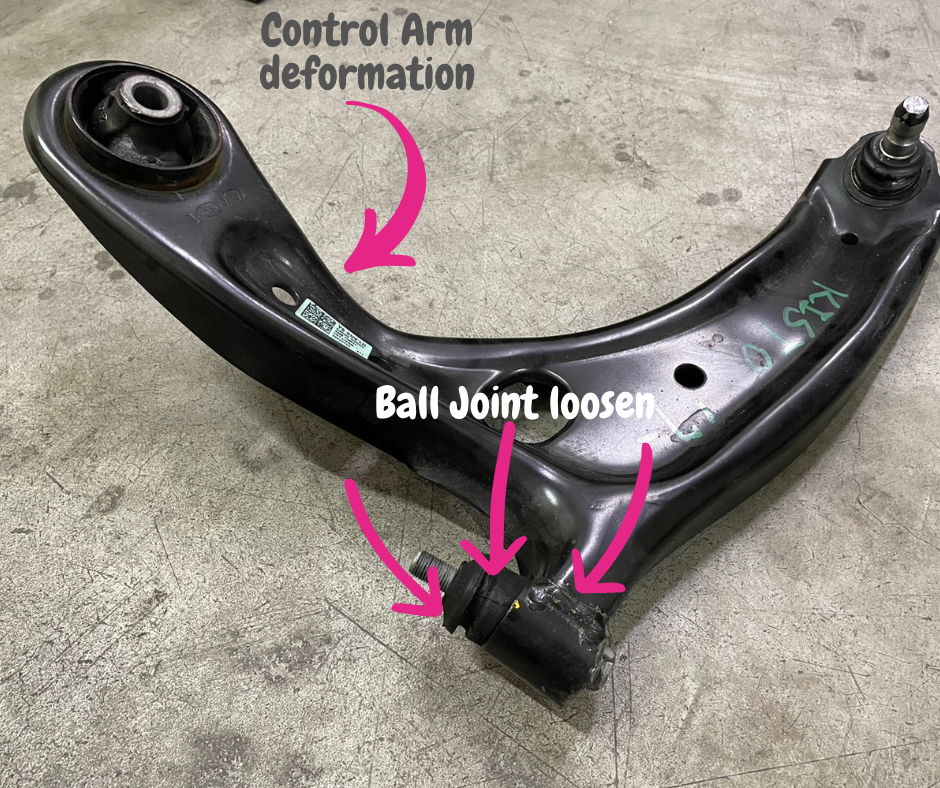
- ✦ Curb impact
Sliding or turning into a curb can push the wheel sideways or backward with enough force to deform the arm.
- ✦ Large pothole
A hard pothole hit can send a sharp load through the wheel and suspension.
- ✦ Collision
Front or side impacts near a wheel can bend multiple steering and suspension parts.
- ✦ Off-road impact
Rocks, deep ruts, and hard landings can damage control arms on trucks and SUVs.
- ✦ Severe corrosion
Rust can thin a steel arm and reduce its ability to handle normal loads.
Why Hitting a Curb Can Damage More Than One Part
A curb strike does not isolate its force to one component. The wheel, tire, bearing, steering knuckle, tie rod, ball joint, strut, and control arm all share the load. The subframe may also move or bend in a severe impact.
That is why a complete inspection matters. If a technician finds a bent control arm, the next step should be to compare the surrounding parts and mounting points with the undamaged side.
- ✦ Wheel and tire
Check for bent rims, sidewall damage, bulges, cuts, or broken internal tire cords.
- ✦ Steering parts
Inspect inner and outer tie rods for bending or looseness.
- ✦ Suspension mounting points
Look for shifted bolts, torn bushings, damaged brackets, or subframe movement.
Signs and Symptoms of a Bent Control Arm
A badly bent arm may be easy to see. A slight bend can be harder to spot without comparing the left and right sides. Often, the driver notices a change in the way the car drives before seeing the damaged part.
One common sign is a steering wheel that suddenly sits off-center after hitting a curb or pothole. The vehicle may also pull to one side. A tire can begin wearing unevenly because the impact changed the wheel angle.
Noise can occur too, but a bent arm itself does not always make a distinct sound. Clunks may come from a damaged bushing, ball joint, sway bar link, strut, or another part that was affected by the same impact.

- ✦ Vehicle pulls to one side
A wheel that has shifted position may cause the car to drift or pull on a level road.
- ✦ Steering wheel is crooked
The steering wheel may no longer sit centered while the vehicle travels straight.
- ✦ Uneven tire wear
One edge of the tire may wear faster due to incorrect camber or toe.
- ✦ Wheel looks out of position
The wheel may appear too far forward or rearward within the fender opening.
- ✦ Clunking or knocking
Impact damage may loosen or damage bushings, joints, or nearby suspension parts.
- ✦ Poor handling
The car may wander, feel unstable, or react differently during braking.
Can a Bent Control Arm Be Hard to See?
Yes. Some arms have complex shapes from the factory, so a curve does not automatically mean the part is damaged. A technician may need to compare the arm with the opposite side or with a known-good replacement part.
Alignment measurements can also provide clues. If one side shows an unusual caster or camber reading after a curb impact, a bent suspension component may be responsible.
How a Mechanic Checks a Bent Control Arm
A good diagnosis starts with the story of what happened. If the steering changed right after a curb strike, pothole, or collision, that gives the technician an important clue. The vehicle can then be raised so the suspension can be inspected safely.
The technician may compare both control arms and look for fresh scrape marks, distorted metal, cracked paint, damaged bushings, or a shifted wheel position. Measurements from an alignment rack can help confirm that the suspension geometry has changed.
A mechanic should also check whether the control arm mounting points are still in the correct position. Replacing the arm alone will not solve the problem if the subframe or body mounting area is bent.

- ✦ Visual inspection
Compare arm shape, seams, welds, bushings, and mounting points with the other side.
- ✦ Wheel position check
Compare the affected wheel’s position in the wheel opening with the opposite wheel.
- ✦ Ball joint inspection
Check for looseness, torn boots, impact marks, or binding.
- ✦ Alignment measurement
Review camber, caster, toe, and side-to-side differences.
- ✦ Subframe inspection
Look for movement, bent mounting points, damaged bolts, or distorted brackets.
Why an Alignment Check Is So Useful
Alignment numbers show how each wheel sits in relation to the road and the vehicle. A large side-to-side caster difference after an impact may point to a wheel that has moved forward or backward. Unusual camber can point to a bent arm, knuckle, strut, or mounting point.
The readings do not always identify the exact bent part by themselves. They work best when combined with a careful physical inspection.
Can You Straighten a Bent Steel Control Arm?
A steel control arm may be physically capable of being bent back. Some race, restoration, fabrication, or emergency repair settings use specialized straightening methods. That is different from saying it is the preferred repair for a normal road car.
When a steel arm bends, part of the metal can stretch beyond its elastic range. Straightening it requires moving that material again. The arm may end up close to its original shape while still having weaker areas or small distortions.
For that reason, when a vehicle owner asks **can a bent control arm be fixed**, replacement is usually the more predictable option. A replacement arm provides known dimensions and avoids depending on a previously deformed structural suspension part.

- ✦ Do not judge by appearance alone
A straight-looking arm can still have incorrect dimensions between its mounting points.
- ✦ Avoid uncontrolled heating
Heating suspension parts can change material properties and damage nearby bushings.
- ✦ Do not rely on hammering
Hammering can introduce new bends and does not provide precise control of suspension geometry.
- ✦ Check replacement availability
For many passenger vehicles, replacing the arm is far more practical than trying to restore a damaged one.
What About a Very Small Bend?
A small bend can still matter because suspension geometry uses precise distances. The key question is whether the arm matches its original dimensions and whether alignment can be brought back within specification.
If the arm has a confirmed impact-related bend, replacing it removes doubt. This is especially sensible when the vehicle is used for daily commuting, highway travel, family transport, or towing.
Can a Fabrication Shop Repair One?
A skilled fabrication shop may be able to reshape certain steel suspension parts. That ability does not automatically make the repair appropriate for every vehicle. The technician must consider material type, design, cracks, heat treatment, mounting accuracy, and the way the vehicle will be used.
For a common production vehicle with readily available replacement parts, replacement is usually simpler and easier to verify.
Can an Aluminum or Cast Control Arm Be Repaired?
Aluminum and cast suspension parts need extra caution. Unlike a simple stamped steel piece, they may crack or suffer hidden damage when forced out of shape. Trying to bend them back can make the damage worse.
For most passenger vehicles, a visibly bent aluminum control arm should be replaced. The same cautious approach applies to cracked or distorted cast parts. A part does not need to break in half to be unsafe.
If you are asking **can a bent control arm be fixed** and the arm is aluminum, replacement should be the default discussion with the repair shop. The new part should then be followed by an inspection and alignment.
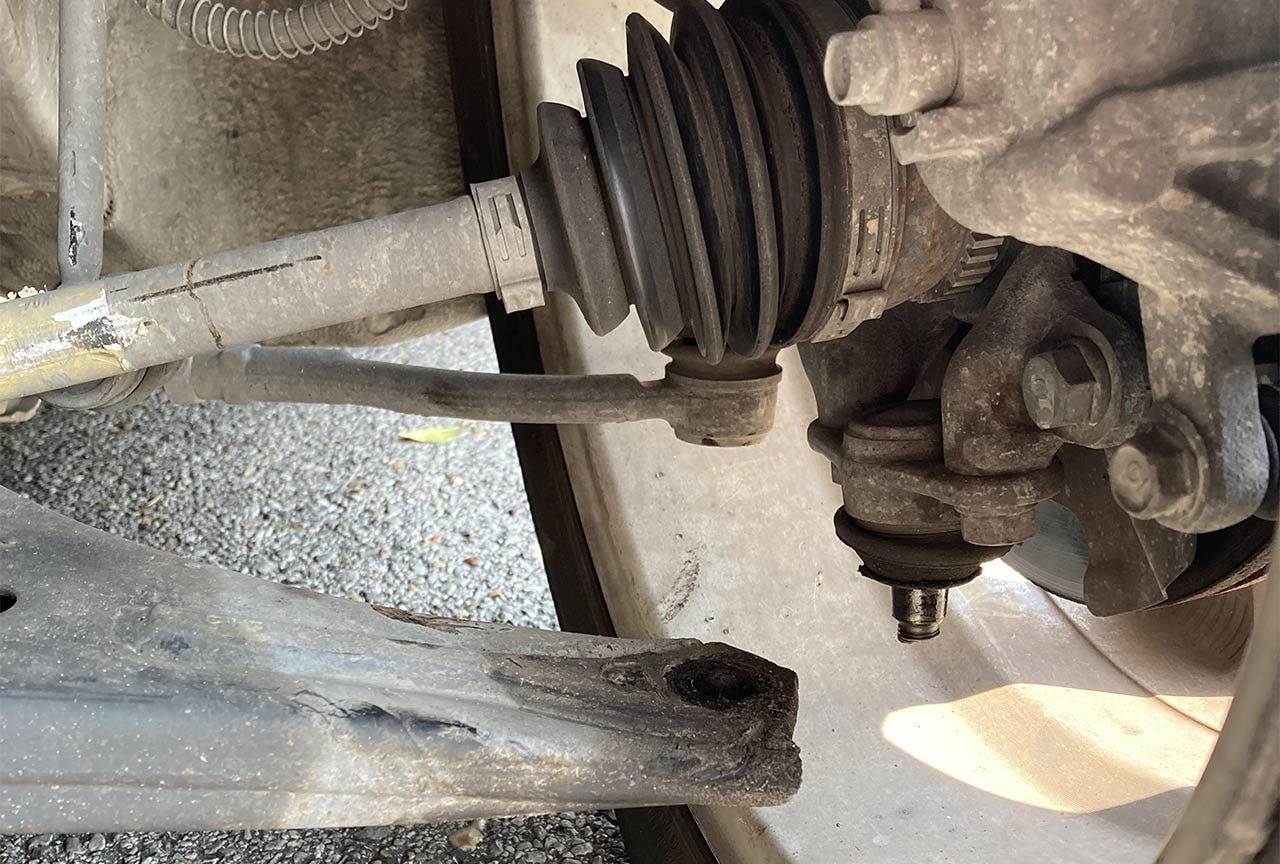
- ✦ Look for cracks
Cracking near bends, mounting holes, or ball-joint areas means the part should not be reused.
- ✦ Check mounting bores
Impact force can distort holes and surfaces even if the main body looks acceptable.
- ✦ Replace rather than reshape
A replacement part avoids the uncertainty created by forcing a damaged aluminum or cast component back into position.
Is It Safe to Drive With a Bent Control Arm?
Driving with a confirmed bent control arm is not a good idea. The arm helps locate the wheel, so its condition directly affects steering and suspension geometry. The amount of risk depends on the degree of damage and whether other parts were also hurt.
A slightly bent arm may not fail right away, but it can still create poor alignment and uneven tire wear. A severely bent, cracked, or distorted arm can create a much more serious problem. The wheel may not stay in the position the suspension was designed to maintain.
If the car pulls hard, the wheel sits visibly out of place, the tire rubs, steering feels unstable, or there is major suspension noise, avoid driving it. A tow is a safer choice when the extent of the damage is unknown.
- ✦ Do not keep driving to test it
Repeated driving can worsen tire wear and may put more load on damaged parts.
- ✦ Watch for tire contact
A shifted wheel can rub the fender liner, body, spring, or suspension.
- ✦ Treat unstable steering seriously
Pulling, wandering, or sudden steering changes after an impact call for an inspection.
- ✦ Tow when damage is severe
A visibly displaced wheel or major suspension damage should be inspected before road use.
Can You Drive a Short Distance to a Repair Shop?
There is no single safe distance that applies to every damaged control arm. A minor alignment change and a severely bent suspension component are very different conditions. Without an inspection, the true level of damage may not be clear.
If the wheel is obviously out of position or the steering feels unsafe, towing is the sensible option. It also prevents further damage to a tire or nearby suspension components.
Bent Control Arm vs Bad Bushings or Ball Joint
Not every control arm problem means the metal arm itself is bent. The bushings at the inner mounting points can wear, split, or separate. The ball joint at the outer end can also loosen or wear.
These problems can cause clunks, wandering, poor steering feel, and uneven tire wear. That overlap is why a visual and physical inspection is important. Replacing a control arm simply because the car makes noise may not solve the real issue.
Many modern replacement control arms come with new bushings and sometimes a new ball joint. In those cases, replacing the complete arm can be practical when several components are worn.
- ✦ Bent arm
Often follows an impact and may change wheel position or alignment.
- ✦ Worn bushing
Often causes excess movement, clunks, and vague steering.
- ✦ Worn ball joint
Can create looseness, noise, uneven tire wear, and poor wheel control.
What Else Should Be Checked After a Control Arm Bends?
A bent control arm is often evidence of a larger impact. That means replacing the arm should not be the end of the inspection. The wheel and steering system need attention too.
One lesson that matters in impact repairs is that the most obvious damaged part is not always the only damaged part. A new control arm can be installed correctly, yet the vehicle may still refuse to align because a strut, knuckle, tie rod, or subframe is also bent.
A good repair plan checks the entire load path from the tire inward. That reduces the chance of paying for an alignment only to learn that another damaged component must be replaced first.
- ✦ Tire
Check for bubbles, cuts, sidewall damage, unusual wear, and internal impact damage.
- ✦ Wheel
Check for bends, cracks, runout, and damaged bead areas.
- ✦ Tie rod
Compare its shape with the opposite side and check for looseness.
- ✦ Steering knuckle
Inspect for cracks or distortion that can affect camber and wheel position.
- ✦ Strut or shock
Look for bending, leaking, damaged mounts, or unusual shaft movement.
- ✦ Wheel bearing
Listen and feel for play or roughness after a severe impact.
- ✦ Subframe
Check mounting points and compare its position with manufacturer references when needed.
Why the Opposite Side Is Useful for Comparison
The undamaged side can provide a useful visual reference. Technicians often compare bends, distances, bushing positions, and wheel placement from side to side.
The two sides may not always be perfect mirror images, so manufacturer specifications still matter. But a large visual difference after an impact is an important clue.
Should You Replace One Control Arm or Both?
If one control arm bent because of an impact, you do not automatically need to replace the arm on the other side. Impact damage is different from normal wear. If the opposite arm is straight and its bushings and ball joint are in good shape, it may remain in service.
The decision changes when the vehicle has high mileage and both sides have worn bushings or joints. Replacing both may make sense in that case because the suspension parts have aged together.
Part design also matters. Some vehicles use control arms with integrated bushings or ball joints. A shop may recommend replacing a complete assembly instead of servicing individual pieces.
- ✦ Impact damage only
Replacing only the bent side can be reasonable when the other side is healthy.
- ✦ Both sides worn
Replacing both may make sense when bushings or joints show similar age-related wear.
- ✦ Check alignment afterward
The vehicle should be aligned regardless of whether one arm or both arms are replaced.
What Happens During Bent Control Arm Replacement?
The exact repair procedure varies by vehicle. In general, the technician raises and supports the car, removes the wheel, disconnects the necessary suspension connections, and removes the damaged control arm from its mounting points.
The replacement part is then installed in the correct position. Some control arm bushings must be tightened with the suspension near normal ride height. This helps prevent the rubber bushing from being twisted at rest.
After installation, the technician should confirm that all fasteners are tightened to the correct specification. The vehicle should then receive a wheel alignment so the suspension settings can be checked.
- ✦ Remove damaged arm
The ball joint and inner mounting points are separated according to the vehicle’s design.
- ✦ Inspect mounting areas
The technician checks for damaged bolts, brackets, subframe points, and nearby components.
- ✦ Install replacement
A correct-fit arm is installed with the proper hardware and procedures.
- ✦ Set bushing position
Where required, final bushing torque is applied at or near normal ride height.
- ✦ Perform alignment
Alignment readings confirm whether the wheel geometry has returned to specification.
Why Bushing Torque Position Matters
Many rubber control arm bushings twist as the suspension moves. If a bushing is fully tightened while the suspension hangs down, it may already be twisted when the car returns to normal ride height.
Following the manufacturer’s procedure helps the bushing rest in the correct position. This can improve bushing life and prevent unnecessary stress.
Do You Need an Alignment After Replacing a Bent Control Arm?
Yes, an alignment is strongly recommended after replacing a bent control arm. The damaged arm changed a component that directly influences wheel location. Even a correctly installed replacement may leave the alignment different from where it was before the impact.
An alignment also works as a final diagnostic check. If camber, caster, or toe still cannot be brought into specification, another part may be bent or shifted.
Skipping this step can lead to poor steering and rapid tire wear. It can also hide remaining suspension damage that should have been found during the repair.
- ✦ Confirm geometry
Alignment readings show whether the replacement restored the wheel to a normal position.
- ✦ Protect tires
Correct alignment reduces the risk of rapid edge wear.
- ✦ Check steering center
A proper alignment helps return the steering wheel to a centered position.
- ✦ Find hidden damage
Readings that remain outside specification may point to another bent component.
How Much Does It Cost to Fix a Bent Control Arm?
There is no single U.S. price that fits every vehicle. Control arm prices vary widely by make, model, suspension design, part quality, and whether the ball joint and bushings come with the assembly. Labor time also changes from one vehicle to another.
The final bill may include more than the arm itself. A wheel alignment is usually part of a complete repair. A severe impact can also add a tire, wheel, tie rod, ball joint, strut, knuckle, bearing, or subframe repair.
When comparing estimates, look at what is included rather than focusing only on the lowest number. One quote may include a complete control arm assembly and alignment while another may list only the arm and labor.
- ✦ Replacement control arm
Cost depends on vehicle design, brand, material, and whether bushings or a ball joint are included.
- ✦ Labor
Rust, difficult fasteners, suspension layout, and shop labor rates can change the total.
- ✦ Wheel alignment
Plan for an alignment after impact-related control arm replacement.
- ✦ Related damage
A damaged tire, wheel, tie rod, strut, knuckle, or subframe can raise the total repair cost.
Is Straightening Cheaper Than Replacement?
It may look cheaper at first, but price alone should not decide how a structural suspension part is repaired. Accurate straightening requires labor and measurement, and the repaired arm still carries a history of deformation.
When a new replacement arm is readily available, replacing it often gives the repair shop a more predictable result. It also makes the post-repair alignment easier to evaluate.
Can a Bent Control Arm Cause Tire Wear?
Yes. A bent arm can change the angle and position of the wheel. That can cause one side of the tread to carry more load or make the tire scrub against the road as it rolls.
Toe problems are especially hard on tires because the tire no longer points in the same direction as the vehicle’s travel. Camber problems can wear the inner or outer shoulder. The exact pattern depends on which suspension angles changed.
New tires will not solve this problem by themselves. If the control arm or another suspension component remains bent, the new tire may begin wearing unevenly too.
- ✦ Inner-edge wear
Excess negative camber or a toe problem can contribute to wear on the inside shoulder.
- ✦ Outer-edge wear
A changed suspension angle may overload the outer shoulder.
- ✦ Feathering
Incorrect toe can leave a sharp or feathered feel across the tread blocks.
- ✦ Rapid wear
Severe misalignment can shorten tire life much faster than normal.
Can a Bent Control Arm Cause Steering Problems?
Yes. Steering feel depends on the wheel and suspension staying in the geometry intended by the manufacturer. A bent control arm can alter caster, camber, toe, or wheel position, and that can change how the vehicle tracks.
You may notice a pull, a steering wheel that no longer centers, or a vehicle that wanders. Braking can also feel different if one front wheel sits at a different angle or position from the other.
These symptoms do not prove the control arm is the only problem. Tie rods, tires, wheel bearings, struts, steering knuckles, and alignment settings can produce similar symptoms.
- ✦ Pulling
The vehicle may drift toward one side because the front wheels no longer share similar geometry.
- ✦ Off-center steering wheel
A sudden change after an impact can indicate altered toe or suspension position.
- ✦ Wandering
The car may require more steering corrections to stay in its lane.
- ✦ Poor return-to-center
Caster changes can affect how naturally the steering returns after a turn.
Can a Bent Control Arm Damage Other Suspension Parts?
A bent arm can place nearby parts in positions they were not designed to use. Bushings may remain twisted, a ball joint can operate near the edge of its normal range, and the tire can place unusual loads on the wheel bearing.
The original impact is usually a bigger concern than the bend alone. The same event that bent the arm may already have damaged the tie rod, knuckle, wheel, strut, or subframe.
This is another reason why the answer to **can a bent control arm be fixed** should include a full inspection. A complete repair restores the whole corner of the suspension, not just the one part that looks damaged.
- ✦ Ball joint stress
A changed arm shape can place the joint at an unusual angle.
- ✦ Bushing stress
The rubber may stay twisted or compressed when the arm no longer sits in its normal position.
- ✦ Tire and wheel stress
Misalignment and rubbing can damage the tire or place extra load on the wheel.
- ✦ Bearing load
Impact forces strong enough to bend suspension parts can also affect a wheel bearing.
How to Decide Between Repair and Replacement
For most owners, the decision becomes much easier once the arm’s material, damage level, and replacement availability are known. A cracked or severely bent arm should not be treated as a simple straightening job. Replacement offers a known shape and removes a damaged component from a critical part of the suspension.
The vehicle’s purpose matters too. A daily driver that carries family members, travels at highway speed, or tows needs predictable suspension behavior. Saving a damaged control arm rarely offers enough benefit to justify added uncertainty when a correct replacement is available.
If a specialty vehicle uses a rare part that cannot be replaced, a qualified suspension or fabrication specialist may evaluate whether restoration is possible. That is a different situation from routine repair on a common passenger vehicle.
- ✦ Replace if cracked
Cracks, tears, damaged welds, and distorted mounting holes are strong reasons for replacement.
- ✦ Replace if severely bent
A kinked or visibly twisted arm should generally be removed from service.
- ✦ Use caution with aluminum
A bent aluminum or cast arm is normally replaced rather than reshaped.
- ✦ Consider specialist evaluation for rare parts
Restoration may be discussed when no replacement exists and the part is suitable for professional repair.
- ✦ Always verify alignment
The repair is not complete until wheel geometry can be checked and brought within specification.
A Practical Rule for Daily-Driven Vehicles
For a normal street vehicle, a confirmed bent control arm is usually treated as a replacement item. That approach is simple, repeatable, and easier to verify with an alignment afterward.
If a shop recommends straightening, ask why that method is preferable to replacement for your exact part. Also ask how the shop will confirm the arm’s dimensions, structural condition, and final alignment.
What to Do Immediately After Hitting a Curb or Pothole
If you hit a curb or deep pothole hard, pay attention to any immediate change in the car. A steering wheel that suddenly sits crooked, a new pull, vibration, rubbing noise, or visible tire damage should not be ignored.
Park in a safe place and look at the affected wheel. Check whether it appears farther back in the wheel opening than the wheel on the other side. Also look for tire bulges, cuts, a bent rim, leaking fluid, or parts hanging unusually low.
Do not crawl under a vehicle supported only by its factory jack. A proper suspension inspection requires safe lifting equipment and secure support.
- ✦ Check the tire first
Sidewall bubbles, cuts, or obvious damage can make continued driving unsafe.
- ✦ Compare wheel position
A wheel sitting noticeably farther back can indicate control arm or other suspension damage.
- ✦ Notice steering changes
A new pull or crooked steering wheel suggests the alignment or suspension geometry has changed.
- ✦ Arrange an inspection
Have the vehicle checked before normal driving if the impact was hard or symptoms appeared immediately.
Common Mistakes to Avoid With a Bent Control Arm
A common mistake is assuming that an alignment will solve everything. An alignment adjusts the parts that were designed to be adjustable. It cannot restore a control arm that has physically changed shape.
Another mistake is replacing only the visible bent arm without checking the impact path. A damaged tie rod or shifted subframe can leave the car pulling even after a new arm is installed.
The third mistake is judging safety by how the vehicle feels during a short drive. Some suspension damage creates only mild symptoms at low speed but becomes much more noticeable during hard braking, cornering, or highway driving.
- ✦ Do not align around a bent part
Repair or replace damaged suspension components before performing the final alignment.
- ✦ Do not ignore the tire
Impact damage can exist inside the tire even when the suspension gets most of the attention.
- ✦ Do not assume one bent part is the whole problem
Inspect the steering, wheel, hub, strut, knuckle, and subframe too.
- ✦ Do not use appearance as the only test
Alignment measurements and dimensional checks can reveal damage that is difficult to see.