You can sometimes drive a short distance with a mildly worn shock absorber, but it is not safe to ignore the problem. Severe leaks, poor vehicle control, tire damage, or unstable handling mean you should stop driving and arrange professional help.
Across the United States, drivers depend on their suspension systems to handle highways, city streets, rural roads, and uneven pavement. A worn shock absorber can make a car bounce, sway, or lose stable contact with the road. These changes may seem minor at first, yet they can affect steering, braking, and control during sudden stops or emergency maneuvers.
Whether you can keep driving depends on the severity of the damage and how the vehicle behaves. A shock that has lost some damping may allow a cautious trip to a nearby repair shop. A shock that has failed badly, broken loose, or caused severe instability can make continued driving dangerous. There is no reliable distance limit that makes a damaged shock safe.
This guide explains how to recognize a bad shock absorber, decide whether to stop driving, reduce risk while arranging repairs, and understand what a mechanic should inspect. The goal is to help you make a practical safety decision without assuming that every worn shock requires the same response.
Yes, in limited circumstances, but driving with a bad shock absorber is not recommended. If the shock is only mildly worn, the vehicle tracks straight, the tires remain in good condition, and there are no signs of loose or broken parts, a short trip to a repair shop may be reasonable. Drive only if the vehicle remains predictable and you can avoid fast roads, heavy traffic, and rough pavement.
If the vehicle bounces excessively, sways during turns, feels unstable when braking, or shows damage near a wheel, do not continue driving. Arrange roadside assistance or a tow. A shock absorber can fail without warning, and a driver cannot reliably judge its remaining service life by appearance alone.
The key question is not simply whether the engine starts or the car can move. It is whether the suspension can keep the tires in effective contact with the road and help the vehicle respond predictably to steering and braking. If control is uncertain, the safest choice is not to drive.
Source: www.youtube.com, MaxTheCarGuy
A short trip may be reasonable
Consider this only when symptoms are mild, the vehicle remains stable, no parts appear broken or loose, and a qualified repair facility is nearby.
Stop driving when control is affected
Excessive bouncing, severe swaying, unusual wheel movement, damaged tires, or a broken mounting point can indicate a safety-critical problem.
There is no universal safe distance
A damaged shock may deteriorate further, and road conditions, speed, load, weather, and the condition of other suspension parts all affect risk.
Is It Safe to Drive to a Mechanic?
Driving to a mechanic may be acceptable when the only known symptom is mild loss of damping and the vehicle still handles normally. Choose the shortest practical route on familiar roads, avoid heavy loads, and leave extra room for stopping. If the repair shop is far away or requires sustained highway speeds, a tow may be the safer option.
Do not use a short test drive to prove that the shock is safe. A suspension fault may be most noticeable during a sharp turn, a pothole impact, or an emergency stop. If any symptom becomes worse, pull over somewhere safe and arrange assistance.
Before moving
Check for obvious tire damage, a wheel that sits at an unusual angle, fluid leaking from the suspension, and loose or broken components without crawling beneath an unsupported vehicle.
During a necessary short trip
Use a low speed appropriate to the conditions, increase following distance, avoid sudden maneuvers, and stop if the vehicle becomes unstable.
What Happens When You Drive With Bad Shocks?
Shock absorbers control suspension movement after a wheel encounters a bump. They convert some of that movement into heat through hydraulic resistance, helping the vehicle settle instead of continuing to bounce. When a shock loses its ability to control movement, the suspension may oscillate more than intended.
The spring supports the vehicle and compresses or extends as the wheel moves. The shock absorber controls that motion. Because the two components perform different jobs, a weak shock can allow excessive bouncing even when the spring still supports the vehicle’s weight.
The practical effect depends on the failure. A small reduction in damping may mainly affect comfort and handling. A badly failed shock can contribute to reduced tire contact, unstable body movement, uneven tire wear, and less predictable vehicle behavior during braking or steering.
Source: dsi.ericlacombe.com
Reduced tire contact
A wheel that bounces over uneven pavement may not maintain steady contact with the road, which can reduce available traction and make steering less predictable.
Less stable handling
Excess body movement can make the vehicle feel loose, sway in turns, or respond less consistently to steering inputs.
Possible braking problems
Poor suspension control can affect tire loading and stability during braking. The exact effect on stopping distance varies with the vehicle, tires, road surface, and severity of the fault.
Greater wear on other parts
A failed shock may contribute to irregular tire wear and added stress on suspension components, especially when the vehicle continues to travel over rough roads.
Can Bad Shock Absorbers Increase Stopping Distance?
They can contribute to longer or less consistent stops in some conditions, but the size of the effect cannot be predicted from the shock alone. Braking depends on tire grip, brake condition, vehicle speed, road texture, load, and how effectively the suspension keeps the tires in contact with the surface.
During hard braking, the vehicle’s weight shifts forward. Worn shocks may allow more body movement and make the car less settled, especially on uneven pavement. This can make emergency braking more difficult, even when the brake pads and rotors are in good condition.
Do not assume that new brakes compensate for bad shocks. If braking feels unstable, the pedal changes unexpectedly, or the vehicle pulls sharply to one side, stop driving when safe and have the entire braking and suspension system inspected.
Do not test emergency stopping on public roads
A sudden braking test can endanger you and other road users. Have a technician evaluate the problem under controlled conditions.
Signs That a Bad Shock Absorber Makes Driving Unsafe
Some symptoms indicate wear, while others suggest that the vehicle may be unsafe to operate. Look at the whole pattern rather than relying on one sign. A bouncing ride can point to weak damping, but a damaged tire, loose suspension joint, or failing spring can create similar symptoms.
The most useful clues are changes in control, visible damage, and tire condition. If the vehicle no longer responds as it normally does, do not keep driving simply because the problem began gradually. A developing suspension fault can become more serious under a sudden load or impact.
Source: cartreatments.com
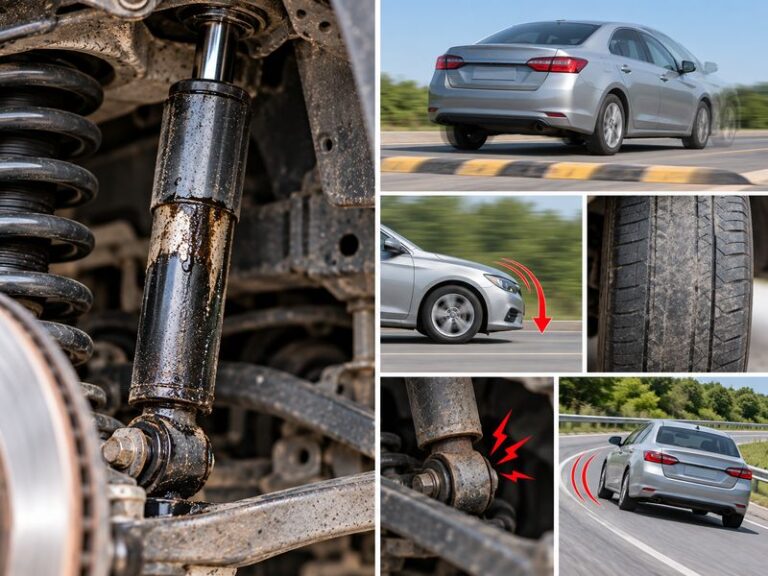
Excessive bouncing
The body continues to rise and fall after bumps instead of settling quickly. Severe or repeated bouncing is a reason to stop and arrange an inspection.
Swaying or unstable turns
The vehicle leans or feels loose during ordinary turns, lane changes, or changes in road direction.
Fluid leakage
Wet oil covering the shock body may indicate a leak. A light film can sometimes be normal, so the amount and location of fluid need professional assessment.
Uneven or cupped tire wear
Repeated high and low patches around the tread may be associated with poor suspension control, but wheel balance, alignment, and other faults can also cause irregular wear.
Clunking or knocking
A worn shock bushing, loose mount, damaged link, or other suspension fault can cause noise over bumps. A sound alone does not identify the failed part.
Visible damage or a broken mount
A bent shock, loose fastener, detached mount, or broken suspension component can affect wheel control and may require towing.
Nose dive or rear squat
Excessive front-end movement during braking or rear-end movement during acceleration can indicate suspension problems, although springs and load distribution may also be involved.
Which Symptoms Mean You Should Stop Immediately?
Stop at the first safe location if the car suddenly becomes difficult to control, a wheel appears unstable, a tire is damaged, or you hear a severe impact followed by a major change in handling. Do not continue to a repair shop under those conditions.
If the steering remains predictable but you notice mild bouncing, arrange an inspection as soon as practical. A technician can determine whether the shock itself has failed or another component is responsible. When the cause is uncertain, treat a significant handling change as a safety issue rather than assuming it is only a worn shock.
Tow the vehicle
Use a tow when a mount is broken, the tire contacts the body, the wheel sits abnormally, or the vehicle cannot be controlled with confidence.
Avoid roadside repairs beneath the car
Never crawl under a vehicle supported only by a jack. Suspension parts may be under spring force, and an unstable vehicle can fall.
How Long Can You Drive With a Bad Shock Absorber?
There is no dependable number of miles or days that a driver can safely use a vehicle with a bad shock absorber. One vehicle may show mild wear for a period, while another may have a damaged mount or a shock that has lost most of its damping. Mileage alone cannot establish whether continued driving is safe.
A mechanic may judge a short trip acceptable after checking the vehicle, but that decision depends on the actual fault. The type of road matters too. Potholes, uneven pavement, sharp turns, high speeds, and heavy loads can increase suspension movement and expose weaknesses that are less noticeable on smooth roads.
Do not wait for the shock to fail completely. Continued use can allow tire wear and handling problems to worsen, and the condition of related parts may deteriorate. Arrange an inspection promptly when you notice a change.
Source: slideshare.net
Mild symptoms with stable handling
A short, cautious trip to a nearby repair facility may be possible after considering the visible condition and overall behavior of the vehicle.
Moderate symptoms or uncertain condition
Avoid unnecessary trips and ask a qualified mechanic whether the vehicle should be towed rather than driven.
Severe symptoms or structural damage
Do not continue driving. Arrange a tow or roadside assistance.
Does Driving Speed Change the Risk?
Yes. Higher speeds reduce the time available to respond to a sudden change in vehicle behavior and can make an unstable suspension harder to manage. A pothole or road dip can also create a stronger impact at speed than at a lower speed, although the actual forces depend on the road and vehicle.
Lower speed does not make a severely damaged suspension safe. It only reduces some driving demands. If the vehicle has a broken component, major tire damage, or unpredictable handling, use a tow instead of trying to reach the shop slowly.
Highway driving
Avoid highway travel with suspected shock failure, especially when the car sways, bounces, or feels unstable during lane changes.
Rough roads
Repeated bumps and potholes can worsen symptoms and make a weak shock’s loss of control more noticeable.
How to Check a Suspected Bad Shock Absorber Safely
You can look for obvious warning signs without removing suspension parts or lifting the vehicle. A basic visual check will not confirm every shock failure, but it can help you decide whether to arrange immediate assistance. Park on level ground, set the parking brake, switch off the engine, and let the vehicle settle before inspecting it.
Do not touch hot exhaust parts or reach into moving suspension components. Do not loosen shock mounts, remove springs, or place any part of your body beneath a vehicle that is supported only by a jack. If a wheel must be removed or the suspension unloaded, leave that work to a properly equipped technician.
Source: www.youtube.com, car PROblems
Look for oil on the shock
Check the visible shock body for wet fluid, heavy grime stuck to oil, or obvious physical damage. Surface dirt alone does not prove a leak.
Inspect the tires
Look for unusual tread wear, bulges, cuts, or signs that a tire has rubbed against the wheel well. A tire with a serious defect must be addressed before driving.
Observe vehicle stance
Check whether one corner sits noticeably lower than the others. A sagging corner can point to a spring or another suspension issue rather than the shock alone.
Listen for unusual noises
Note whether knocks, rattles, or squeaks occur over bumps. Report when they happen because similar noises can come from several suspension components.
Arrange a professional inspection
Ask the mechanic to check damping, mounts, bushings, springs, tires, alignment, and related suspension parts before deciding what to replace.
Should You Perform the Bounce Test?
A traditional bounce test involves pressing down on a corner of the vehicle and observing how it settles after release. Repeated bouncing may suggest weak damping, but the test is only a rough screening method. Modern suspension designs, vehicle weight, spring rates, and other components can affect the result.
A car that passes the bounce test may still have a worn or leaking shock. Do not use the test as proof that a vehicle is safe for highway travel. A professional inspection is more useful when handling has changed or a visible leak is present.
What a result may suggest
Several continued oscillations can indicate poor damping and justify further inspection.
What a result cannot prove
A single bounce or quick return cannot confirm that the shock, mount, spring, and other suspension components are in good condition.
What to Do If You Must Move a Car With Bad Shocks
If the vehicle shows no severe warning signs and a mechanic or roadside professional considers a short drive reasonable, reduce the demands placed on the suspension. This is a temporary measure to reach a repair facility, not a way to make the vehicle safe for normal use.
Plan the route before setting off. Choose familiar roads with smooth surfaces where possible, avoid steep or rough routes, and do not carry extra passengers or heavy cargo. Keep a large gap from the vehicle ahead and avoid sudden braking, sharp turns, and abrupt lane changes.
If conditions are wet, icy, or otherwise slippery, the available margin for correcting a handling problem is smaller. Consider a tow instead of driving, even when the symptoms seem moderate. Do not assume that hazard lights, a low speed, or a quiet road can compensate for a suspension fault.
Source: www.youtube.com, Mechanic Base
Keep the trip short
Travel only to the nearest suitable repair facility when the vehicle has been judged safe enough to move.
Avoid sudden inputs
Use smooth steering and gradual braking, while maintaining enough space to react to traffic.
Do not overload the vehicle
Extra weight can increase suspension demands and worsen instability.
Stop if symptoms increase
If bouncing, swaying, noise, or steering problems worsen, pull over safely and call for assistance.
When Is a Tow the Better Choice?
A tow is the better option when the shock is detached, the mounting point is damaged, a spring appears broken, the tire is rubbing against the body, or the car cannot maintain stable control. It is also sensible when you cannot tell whether a visible suspension problem is minor or severe.
Tell the towing provider whether the vehicle has unusual ride height, a damaged wheel, or a suspension part hanging loose. The operator can choose an appropriate towing method. Some vehicles, including certain all-wheel-drive models, require specific towing procedures to prevent drivetrain damage.
Request roadside help
Use roadside assistance if a severe suspension problem prevents safe travel or if you are unsure whether the vehicle can move safely.
Follow the vehicle manual
Check the manufacturer’s towing instructions, particularly for all-wheel-drive vehicles and models with special suspension systems.
Can Bad Shock Absorbers Damage Other Parts?
Yes, worn or failed shocks can contribute to wear elsewhere, especially when the vehicle continues to travel on rough roads. The shock controls suspension movement, so poor damping may let the wheel and body move more than intended. That extra movement can contribute to irregular tire wear and increased stress on mounts, bushings, and related parts.
The damage is not automatic, and a worn shock is not always the sole cause of another problem. Tire wear can also result from incorrect inflation, wheel imbalance, alignment faults, worn joints, or bent suspension parts. A mechanic should look for the actual cause before recommending repairs.
Repairing the shock without checking related components may leave the original symptom unresolved. For example, a new shock will not correct a broken spring or a worn control-arm joint. A complete inspection helps prevent repeat work and supports safer handling.
Source: mechlesson.com
Tires
Poor damping may contribute to cupping or scalloped tread wear. Inspect tire condition and inflation, and have the cause of irregular wear diagnosed.
Mounts and bushings
Loose, cracked, or worn mounting parts may create noise and allow unwanted movement. Replace damaged parts as required.
Springs and suspension links
A broken spring or worn joint can cause similar symptoms and may make the vehicle unsafe even if the shock is intact.
Wheel alignment
A shock replacement does not automatically mean an alignment is required on every vehicle, but related repairs or signs of abnormal tire wear may make an alignment check appropriate.
Can Bad Shocks Cause Uneven Tire Wear?
They can contribute to uneven tire wear when poor damping allows repeated wheel movement over road bumps. The tread may develop alternating high and low areas, often called cupping or scalloping. Drivers may also notice extra road noise or vibration as the tire wears.
This pattern is not proof that the shock has failed. Incorrect wheel balance, alignment problems, worn suspension joints, and tire pressure issues can produce overlapping symptoms. If the tire has deep irregular wear, exposed cords, a bulge, or other serious damage, do not keep driving on it while waiting for shock repairs.
Inspect the tire and suspension together
Ask the shop to identify the cause of the wear, check tire safety, and determine whether alignment or balancing work is needed.
How Much Does It Cost to Fix a Bad Shock Absorber?
Repair costs vary with the vehicle, part design, labor rate, and condition of the surrounding suspension. A basic shock replacement can cost much less than replacing a complete strut assembly or repairing a damaged mounting point. There is no single reliable price that applies to every car in the United States.
The total bill may include parts, labor, mounting hardware, an inspection of related suspension components, and an alignment when required. Some vehicles use a strut assembly that combines structural and damping functions, while others use separate shocks and springs. These designs affect both the repair method and the labor involved.
Ask the repair shop for a written estimate that identifies the failed parts and explains whether the price covers one component or an axle pair. If the tires have been damaged by irregular wear, replacement tires may add to the cost. Addressing the problem early may help limit further damage, but savings are not guaranteed.
Source: www.youtube.com
Parts
The price depends on the vehicle, shock or strut design, brand, and whether additional mounting hardware is needed.
Labor
Access, rust, seized fasteners, suspension layout, and the need to remove other components can affect labor time.
Related repairs
A damaged spring, mount, tire, or suspension joint may require separate work.
Alignment
Some repairs require or benefit from an alignment check, depending on the vehicle design and the parts disturbed.
Should You Replace One Shock or Both?
Shock absorbers are generally best replaced in pairs on the same axle when one has worn out. Matching both sides helps maintain more consistent damping and vehicle behavior. Replacing only one can leave a noticeable difference between the two sides if the remaining shock is also worn.
The correct choice depends on the vehicle manufacturer’s guidance, the type of failure, and the condition of the other shock. A nearly new shock damaged by an isolated incident may be a different case from a pair that has worn gradually over years of use. Ask the mechanic to assess both sides and explain the recommendation.
Replace in pairs when appropriate
Matching parts on the same axle can help preserve balanced suspension performance.
Check the complete assembly
If the vehicle uses struts, inspect mounts, springs, bearings, and other associated parts as required by the repair procedure.
Common Mistakes to Avoid When a Shock Is Bad
The most dangerous mistake is treating a gradual change in ride quality as proof that the vehicle is still safe. Drivers can become used to bouncing or swaying over time, so the problem may seem normal until a sudden stop or evasive maneuver exposes the loss of control.
Another mistake is replacing a shock based on one symptom without checking the rest of the suspension. A clunk, uneven tire wear, or a low ride height can have several causes. Correct diagnosis reduces the chance of replacing a part that does not solve the problem.
Source: promtengine.com
Do not rely only on a bounce test
It is a rough screening method, not a complete test of damping or suspension safety.
Do not assume every leak means the same thing
A heavy leak may indicate failure, but a light film requires context. Have the shock inspected instead of guessing from appearance.
Do not drive until the shock breaks completely
Waiting for total failure can increase the chance of worsening handling, tire damage, or other suspension problems.
Do not confuse shocks with springs
Shocks control motion, while springs support the vehicle. A sagging corner or broken spring requires its own diagnosis.
Do not assume new shocks fix every handling problem
Tire, brake, alignment, steering, and suspension faults may coexist and need separate repairs.
What Should a Repair Shop Inspect?
A useful inspection should assess the shock or strut, its mounting points, rubber bushings, springs, suspension joints, and tires. The technician should also consider alignment, wheel balance, and braking concerns when the symptoms point in those directions.
Before approving repairs, ask which observations support the diagnosis and whether the opposite-side component has similar wear. Request an explanation of any additional recommended work. A clear diagnosis should distinguish confirmed damage from parts that are being replaced as a precaution.
Ask for the cause
Find out whether the shock leaks, has lost damping, has physical damage, or is affected by a failed mount or another part.
Ask about related damage
Confirm whether tire wear, broken springs, worn joints, or alignment issues need attention.
Frequently Asked Questions
Q
Can I drive with one bad shock absorber?
Possibly for a short trip if the damage is mild and the vehicle remains stable, but it is not recommended for routine driving. One weak shock can create a difference in damping across the axle. If the car bounces excessively, sways, has a damaged mount, or shows tire damage, arrange a tow instead.
Q
Can a bad shock absorber cause an accident?
A failed shock can contribute to an accident by reducing suspension control and making steering or braking less predictable. Risk depends on the severity of the failure, road conditions, vehicle speed, tire condition, and other factors. Severe instability or a broken suspension component should be treated as a reason not to drive.
Q
Can bad shocks cause a car to shake?
They can contribute to bouncing or vibration, especially over uneven pavement. However, shaking can also result from tire imbalance, damaged tires, wheel problems, worn steering parts, or brake faults. If shaking is sudden, severe, or accompanied by steering problems, stop when safe and arrange an inspection.
Q
Will a bad shock absorber trigger a dashboard warning light?
A conventional shock absorber usually does not have a dedicated dashboard warning light, so mechanical wear may go unnoticed by the vehicle’s electronics. Some vehicles have electronically controlled suspension systems that can display a suspension-related warning when a monitored fault occurs. Check the owner’s manual and have any warning diagnosed.
Q
Can I drive on the highway with bad shocks?
Highway driving is not advisable when shock failure is suspected, particularly if the vehicle bounces, sways, or feels unstable during lane changes. Higher speeds leave less time to respond to unexpected movement. If the problem is significant or its severity is uncertain, arrange a tow rather than testing the car at highway speed.
✦ Wrapping Up
Conclusion
You may be able to drive a short distance with a mildly worn shock absorber, but that does not mean the vehicle is safe for everyday use. Bad shocks can affect suspension control, tire contact, handling, and braking stability. The risk becomes more serious when the car bounces heavily, sways, has a damaged tire, or shows signs of a broken suspension part.
Do not rely on mileage estimates, a bounce test, or the absence of a dashboard warning light to decide whether continued driving is safe. Check for visible damage, pay attention to changes in handling, and arrange a professional inspection promptly. If control is uncertain or structural damage is present, stop driving and have the vehicle towed.
💡 Key Takeaway
If the vehicle remains stable and has only mild symptoms, contact a nearby repair shop about a short, cautious trip. If it has severe bouncing, unstable handling, a broken mount, or tire damage, do not drive it; arrange roadside assistance or a tow.
Eric
Hi, I’m Eric Bennett, the person behind OffRoadTruckAccessories.com.
I created this blog to share my interest in trucks, off-road driving, automotive accessories, and DIY modifications. I enjoy learning how different truck accessories work, testing their usefulness, and understanding whether they are truly worth buying.
Shock absorbers are located near the wheels as part of the suspension system, usually between the vehicle’s body, frame, or subframe and a suspension component such as a control arm, axle, or wheel assembly. However, the exact answer to where are shock absorbers located on a car depends on the suspension design. Some vehicles have…
You should change shock absorbers when they are worn, leaking, damaged, or no longer controlling suspension movement properly. There is no single replacement interval that applies to every vehicle because shock absorber life depends on road conditions, vehicle weight, driving habits, suspension design, and component quality. If you are wondering when to change shock absorbers,…