Can You Stack a Leveling Kit on a Suspension Lift? Full Guide
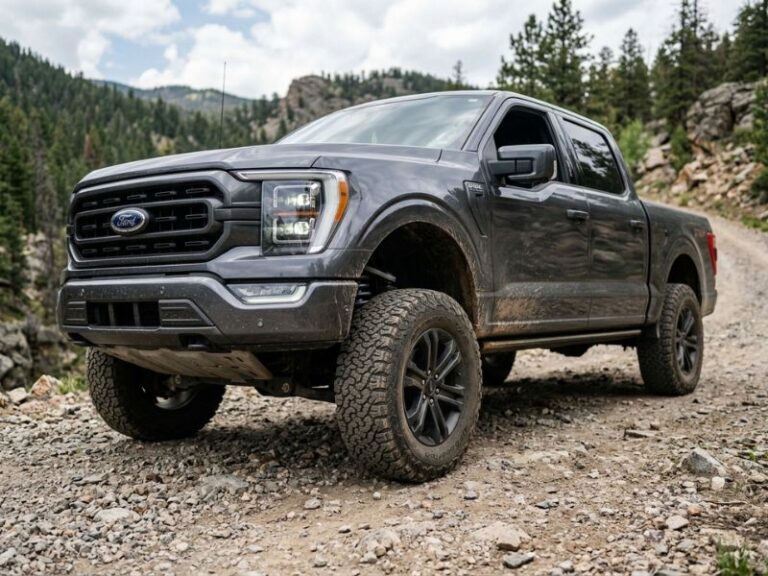
Can you stack a leveling kit on a suspension lift? Physically, it may be possible on some vehicles, but it is generally not recommended unless the suspension-lift manufacturer specifically approves the combination. Stacking independently designed kits can over-lift the front, disturb suspension geometry, reduce travel, and place extra stress on steering and drivetrain parts.
The details are explained below. This article will show you what stacking suspension kits means, why manufacturers often warn against it, which components may be affected, when an approved combination could work, and what safer alternatives can provide the additional height or level stance you want.
Can You Stack a Leveling Kit on a Suspension Lift Safely?

In most cases, you should not install a separate leveling kit on top of an existing suspension lift without written approval from the manufacturers of both systems.
A complete suspension lift is engineered around a specific final ride height. Its crossmembers, knuckles, control arms, brackets, shocks, springs, steering components, and differential correction parts are selected to work together at that height.
Adding another front spacer, leveling strut, torsion-key adjustment, or coil spacer changes the final height without necessarily correcting the rest of the suspension. The truck may sit higher, but its components may no longer operate within the geometry intended by the lift-kit manufacturer.
ReadyLIFT states in its lift-kit installation guidance that it does not recommend combining suspension lifts, body lifts, or other lifting devices. Its instructions also warn installers against overextending suspension components during assembly.
That warning does not mean every possible combination will immediately fail. It means a combination should not be treated as safe merely because the parts can be physically bolted together.
What Does Stacking a Leveling Kit Mean?
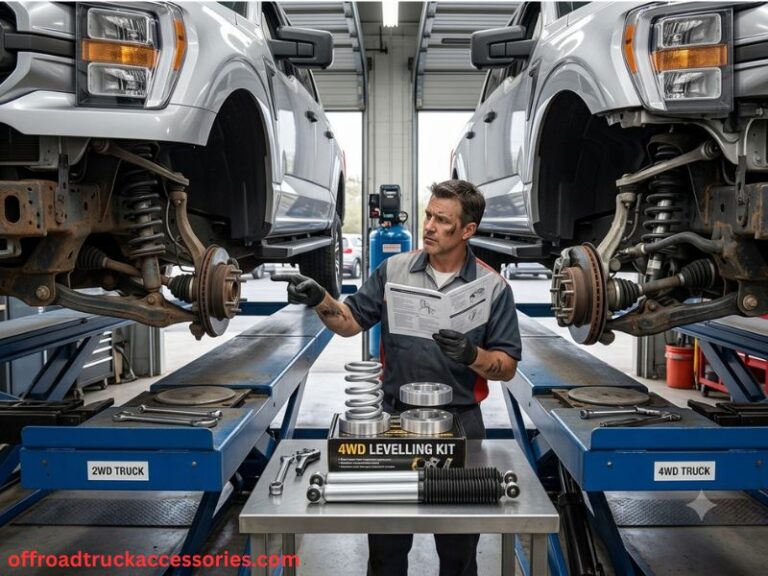
Stacking usually means installing a front leveling component in addition to an existing suspension lift.
For example, a truck may already have a 4-inch suspension lift. The owner then adds a 1.5-inch or 2-inch front strut spacer because the truck still has some rake or because the owner wants more tire clearance.
Another example is combining adjustable leveling struts with the front spacer supplied in a complete lift kit. On a torsion-bar vehicle, stacking may involve using lift-system components while also turning the torsion keys higher than the kit’s intended setting.
The advertised heights are often added together in the owner’s mind. A 4-inch lift combined with a 2-inch leveling kit appears to create 6 inches of front lift.
Suspension geometry does not always work through simple addition. Spacer thickness, strut position, spring preload, control-arm leverage, and factory ride-height differences can cause the final measurement to vary.
A suspension system designed for stock-height mounting points may therefore become over-lifted when additional parts are introduced.
Why Suspension-Lift Manufacturers Design Complete Systems
A proper suspension lift is more than a collection of parts that makes the body sit higher.
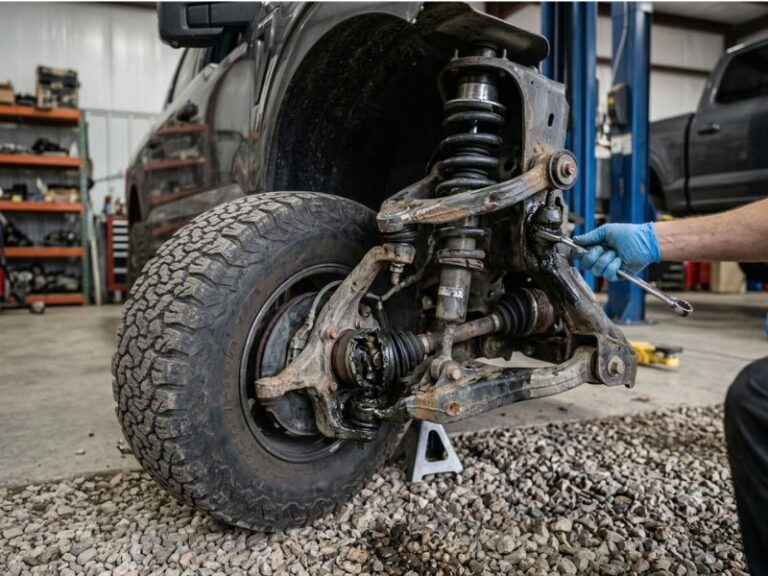
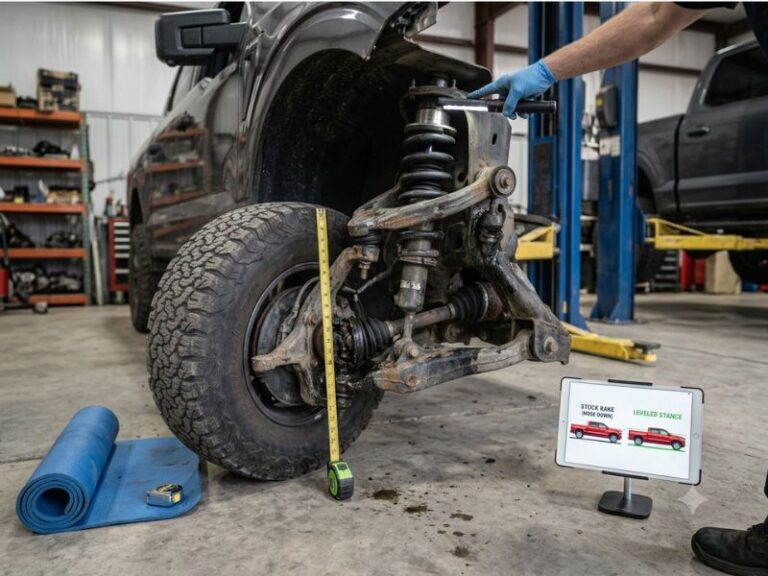
On an independent front suspension, a complete lift may relocate the front differential and control-arm mounting points. It may also include replacement steering knuckles, crossmembers, skid plates, strut spacers, sway-bar brackets, bump-stop extensions, brake-line brackets, and alignment hardware.
These parts are designed to maintain acceptable CV axle angles, ball-joint angles, steering geometry, alignment range, and suspension travel at the advertised lift height.
On a solid-axle vehicle, a lift may include springs, control arms, track bars, relocation brackets, pitman arms, drag-link correction, bump stops, and longer shocks.
Adding an unrelated leveling component changes one part of that engineered relationship without automatically correcting the others.
ReadyLIFT installation instructions for one of its larger lift systems specify that the system was designed for vehicles at stock lift height. The same instructions warn that using it with unrelated leveling struts, control arms, or other manufacturers’ lift components can create over-lifting and clearance problems.
Stacking Can Overextend Ball Joints and Control Arms
One of the main risks is pushing the upper control arms and ball joints beyond their intended operating range.
When the front suspension is raised, the upper control arms usually sit at a steeper downward angle. The upper ball joint then operates closer to its maximum angle while the truck is resting on level ground.
If another leveling spacer is added, the joint may have very little movement remaining when the suspension extends. It can bind, contact the edge of its housing, damage the protective boot, or experience repeated impact loads at full droop.
An aftermarket upper control arm can sometimes improve ball-joint position and alignment range, but it does not automatically make every stacked setup safe. The arm must be designed for the final ride height and must remain compatible with the lift system’s knuckles, mounting locations, and clearances.
BDS describes its vehicle-specific leveling systems as being engineered to gain height without overextending suspension and driveline angles at full droop. That illustrates why lift height and component position must be engineered together rather than increased with random spacers.
CV Axle Angles May Become Too Steep
On four-wheel-drive trucks with independent front suspension, the CV axles transfer power from the front differential to the wheels.
A complete suspension lift often lowers the differential so the CV axles remain close to their normal operating angles. However, adding a separate front leveling kit may raise the control arms and wheel hubs without lowering the differential any farther.
The result can be a steeper CV angle than the main lift was designed to support.
Excessive angles can place more stress on the CV joints and boots. Possible symptoms include vibration, clicking during turns, torn boots, grease leakage, or premature joint wear.
The risk becomes greater during full suspension droop because the axle angle increases as the wheel moves downward.
Adding a differential drop is not automatically a solution. The lift kit may already use specific differential brackets, crossmembers, and driveshaft clearances. Installing extra spacers can create interference or alignment problems elsewhere.
Suspension Travel Can Be Reduced
Stacking a leveling kit may increase static ride height while reducing usable droop travel.
Droop is the amount the wheel can move downward when it enters a hole or the body rises over uneven terrain. A suspension needs both upward compression and downward extension to keep the tires in contact with the road.
When additional spacers or excessive strut height place the suspension close to full extension at rest, very little downward movement remains.
The shock or strut may top out before the control arm reaches its natural limit. This can create clunking, a harsh impact over dips, reduced traction on uneven terrain, and premature shock or mount wear.
Installing longer shocks does not necessarily correct the problem. A longer shock may allow additional droop, but the ball joints, CV axles, brake lines, tie rods, sway-bar links, and control arms must also be able to move safely through that range.
The entire suspension system must be evaluated together.
Alignment May Become Difficult or Impossible
Any suspension-height change affects camber, caster, and toe. A properly engineered lift kit includes enough adjustment or correction to align the vehicle at its intended height.
Adding a leveling kit can move the suspension beyond that adjustment range.
Excessive positive or negative camber can cause the tires to lean and wear unevenly. Insufficient caster can make the truck wander on the highway and reduce steering-wheel return. Incorrect toe can destroy an expensive set of tires surprisingly quickly.
An alignment technician may be able to turn the adjustment cams to their limits while still failing to achieve good numbers.
Even when the readings fall barely inside a broad factory range, the truck may not handle as well as it did at the lift kit’s intended height.
ReadyLIFT specifies that alignment is required after installation of its suspension systems and warns that final ride height must be measured because initial vehicle height varies.
Steering Geometry Can Also Change
On solid-front-axle trucks and Jeeps, suspension height affects the relationship between the track bar and drag link.
These components should move through compatible arcs. Raising the front without correcting their angles can contribute to bump steer, axle shift, or inconsistent steering response.
A complete lift kit may include a track-bar bracket, adjustable track bar, pitman arm, drag-link correction, or other steering components selected for the kit’s height.
Adding an extra leveling spring or spacer changes the suspension height without necessarily changing the steering correction.
BDS, for example, includes a track-bar bracket, alignment cams, and height-matched shocks in a vehicle-specific 2-inch Super Duty leveling system. This shows that even a moderate height increase can require multiple coordinated components on certain solid-axle trucks.
A Lifted Truck May Already Be Level
Before stacking parts, measure the truck’s actual stance.
Some suspension lifts raise the front and rear equally, leaving part of the factory rake. Others provide more front lift than rear lift and already level the truck.
Manufacturing tolerances, cab configuration, engine weight, bumpers, winches, toolboxes, fuel tanks, and permanent cargo can also change the final stance.
Measure from the center of each wheel hub to the lower edge of the fender. Do not measure from the ground because tire pressure, tread depth, and tire diameter can affect the result.
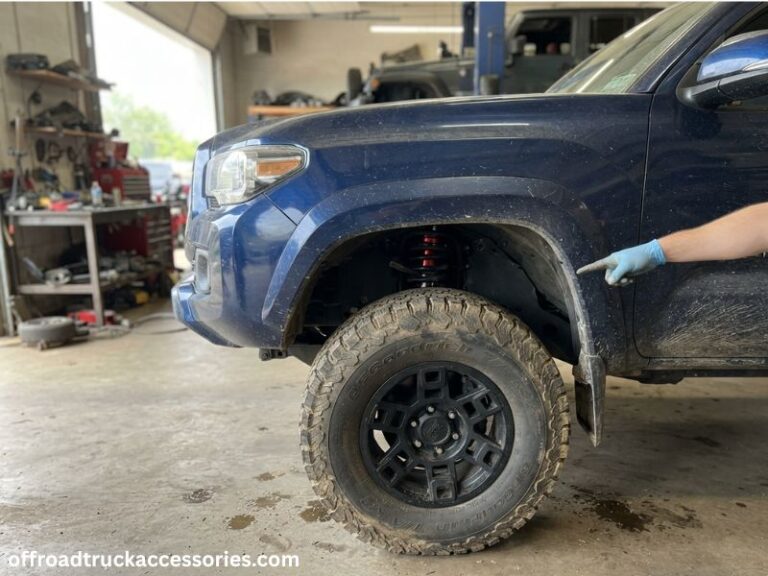
If the truck has only half an inch of rake, adding a 2-inch leveling kit may make it noticeably nose-high. This can look unusual and cause the rear to appear even lower when towing or carrying cargo.
Sometimes the better solution is adjusting rear height rather than adding more front lift.
Factory-Lifted Models Need Special Attention
Certain trucks leave the factory with off-road suspension or additional ride height. Many aftermarket leveling kits specifically exclude those models.
For example, Rough Country states that one of its GM 1500 leveling kits does not fit AT4, AT4X, Trail Boss, or ZR2 configurations because those models already have factory lift components or specialized dampers. (Rough Country)
This principle also applies to an aftermarket suspension lift. A kit designed for stock ride height cannot automatically be assumed compatible with a vehicle that has already been raised.
Before ordering any additional parts, confirm the truck’s factory package, existing lift brand, part numbers, current suspension measurements, and installed components.
When Can a Leveling Kit and Suspension Lift Work Together?
A combined setup may be acceptable when it has been specifically engineered, tested, and approved as one system.
Some manufacturers offer “lift plus” or upgrade packages designed to work with a particular factory lift or a specific existing suspension system. These are not random stacked kits. The company has considered final ride height, component travel, steering geometry, and fitment.
A manufacturer may also offer adjustable coilovers or struts with an approved height range for use within one of its lift systems. In that case, the allowed setting should be followed precisely.
Approval should come from the manufacturer’s installation instructions or technical support department. A seller saying that the parts “should fit” is not the same as engineering approval.
For a safe combination, you need confirmation that the final setup maintains acceptable ball-joint angles, CV angles, shock travel, brake-line length, alignment range, steering geometry, and tire clearance.
Without that confirmation, stacking remains an experiment on critical suspension components.
Warning Signs of an Incorrect Stacked Setup
A stacked lift should be inspected immediately if the truck develops clunking over dips, visible tire lean, steering pull, highway wandering, vibration under acceleration, torn CV boots, or an off-center axle.
Other warning signs include shocks sitting close to full extension at normal ride height, upper control arms contacting the spring, ball joints operating at severe angles, brake hoses becoming tight at full droop, and an alignment shop being unable to achieve acceptable settings.
Uneven tire wear may develop slowly, so the absence of immediate steering problems does not prove that the setup is correct.
A qualified suspension shop should inspect the truck at normal ride height, full steering lock, compression, and droop. Merely checking whether the parts touch while the vehicle is parked is not enough.
Safer Alternatives to Stacking Kits
When you want more height, the safest option is usually replacing the current lift with a complete system designed for the desired final height.
For example, replacing a 4-inch kit with a properly engineered 6-inch lift is generally better than adding a separate 2-inch spacer. The 6-inch system should include the brackets, crossmembers, steering correction, shocks, and driveline adjustments required for that height.
When the goal is only to correct rake, consider adjusting the rear components, changing spring rates, or using an approved height setting within the existing suspension system.
A heavier front bumper or winch may cause the front to sit lower. In that case, springs or coilovers selected for the added weight may be more appropriate than stacking a cosmetic spacer.
Consult the original lift-kit manufacturer before making any change. Provide the vehicle identification, lift-kit part number, current measurements, wheel and tire specifications, and any additional weight attached to the vehicle.
Professional Installation and Inspection Matter
Suspension modifications affect handling, braking, steering, and vehicle stability. ReadyLIFT recommends professional installation and warns that raised vehicles may handle differently from stock.
A professional installer should inspect all current suspension parts before adding or replacing components. Worn ball joints, bushings, tie rods, wheel bearings, shocks, and CV boots should be repaired first.
After any approved height change, the vehicle needs a professional alignment. Headlight aim, tire clearance, brake hoses, ABS wiring, sway-bar links, driveshaft angles, and fastener torque should also be checked.
Keep the installation instructions, invoices, alignment report, and written manufacturer approval with the vehicle records.
Final Thoughts
So, can you stack a leveling kit on a suspension lift? It may be physically possible, but it is generally not a safe or recommended approach unless the suspension manufacturer specifically approves that exact combination.
A complete lift kit is designed around a particular ride height and suspension geometry. Adding an unrelated leveling spacer can overextend ball joints, increase CV axle angles, reduce suspension travel, limit alignment adjustment, and disturb steering geometry.
Instead of combining independent kits, use a complete suspension system engineered for your desired final height or an approved upgrade offered by the original lift manufacturer. That approach provides a better chance of maintaining predictable handling, proper alignment, useful suspension travel, and long-term reliability.