Do Ford Dealers Install Leveling Kits? What Owners Should Know
Do Ford dealers install leveling kits? Yes, many Ford dealerships install leveling kits, particularly vehicle-specific Ford Performance suspension kits. However, services vary by dealership, and some locations may refuse to install customer-supplied or unsupported aftermarket kits. The complete details are explained below.
In this article, you will learn which leveling kits Ford dealers may install, whether you must purchase the kit through the dealership, how dealer installation affects warranty coverage, what the service normally includes, why installation prices vary, and when an independent suspension shop may be a better choice.
Do Ford Dealers Install Leveling Kits?
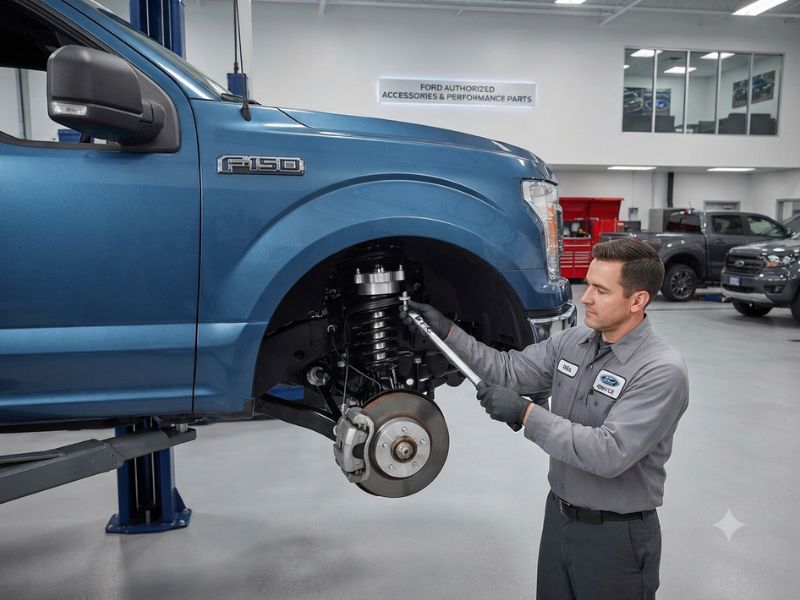
Many authorized Ford dealerships install leveling kits on compatible Ford trucks and SUVs. Dealers are generally more likely to accept a kit when it comes from Ford Performance, is designed for the exact vehicle, and includes official installation instructions.
Ford currently lists suspension packages that qualify for specific Ford Performance warranty coverage when installed by a Ford dealer or an ASE/Red Seal-certified technician. For example, Ford Performance offers an F-150 suspension package that raises the front approximately two inches and carries a three-year or 36,000-mile warranty from the vehicle’s original in-service date when installed by an eligible technician.
This does not mean every Ford dealer is required to offer leveling-kit installation. Dealerships are independently operated businesses, so their service policies, labor rates, technician experience, and willingness to install modified suspension parts can differ.
One dealership may install Ford Performance and selected third-party kits, while another may work only with parts ordered through its own parts department. A smaller dealer may not regularly perform suspension modifications at all.
Contact the service department before purchasing a kit and provide the vehicle identification number, exact kit part number, desired lift height, tire size, and current suspension configuration.
What Type of Leveling Kits Will Ford Dealers Install?
Ford dealers are most likely to install kits that are specifically designed and documented for Ford vehicles. These may include Ford Performance suspension packages, dealership-approved accessory packages, and selected aftermarket products.
A dealer may be comfortable installing a Ford Performance kit because it includes vehicle-specific components, installation instructions, fitment limitations, and defined warranty conditions.
Ford’s current F-150 off-road suspension package, for example, is designed for selected 2021–2026 F-150 4×4 models and raises the front approximately two inches. It is not compatible with every configuration, including certain hybrid, diesel, Tremor, Raptor, Lightning, dynamic-suspension, and heavy-duty payload applications.
That fitment information illustrates why a dealer should inspect the exact truck before ordering or installing anything. Two F-150s from the same model year may require different suspension solutions because of their drivetrain, engine, payload package, factory suspension, or electronic equipment.
Some dealers also install reputable third-party spacer kits, adjustable struts, coilovers, torsion-key systems, or complete front suspension packages. However, they may require the kit to meet their internal quality and safety requirements.
Can You Bring Your Own Leveling Kit to a Ford Dealer?
Some Ford dealers allow customers to bring their own leveling kits, but others do not.
A dealership that accepts customer-supplied parts may require the kit to be new, complete, vehicle-specific, and produced by a recognized manufacturer. The service adviser may ask to inspect the hardware and instructions before scheduling the work.
Dealers may decline customer-supplied products for several reasons. The kit could be incompatible with the truck, missing hardware, poorly designed, previously used, or unable to achieve proper alignment.
There may also be uncertainty about who is responsible if the supplied component fails. The dealership may warranty its installation labor while refusing responsibility for a defective part purchased elsewhere.
When the dealer supplies the kit, responsibility is usually easier to document. The parts department confirms fitment, the technician installs the approved components, and the invoice identifies the parts and labor involved.
Before buying anything independently, ask the dealer these questions in writing:
Will you install this exact part number on my truck? Does the kit include everything required? Will you warranty the installation labor? Who handles a defective part? Is alignment included in the quote?
Getting these answers before ordering can prevent expensive compatibility problems.
Is a Ford Performance Kit the Same as a Genuine Ford Part?
Not necessarily. Ford states that Ford Performance or Ford Racing components are aftermarket parts and are not automatically classified as Genuine Ford Parts. Their use can also affect the operating characteristics of other vehicle systems.
This distinction matters because the truck’s original factory warranty, a Genuine Ford Accessory warranty, and a Ford Performance Parts warranty may have different terms.
Dealer installation does not automatically convert every third-party or Ford Performance suspension component into a factory-installed part. The invoice and warranty documents should clearly explain who covers the kit, installation labor, and potentially affected components.
Ford Performance offers specific warranty protection on selected suspension products when the stated installation requirements are followed. Owners should check the warranty attached to the exact part number rather than assuming all leveling kits receive identical coverage.
Does Dealer Installation Protect the Ford Warranty?
Having a leveling kit installed by a Ford dealer can reduce uncertainty, but it does not guarantee that every future suspension or drivetrain repair will be covered.
Ford states that installing or using an aftermarket product does not necessarily void the entire New Vehicle Limited Warranty or Ford Protect coverage. However, failures caused by an aftermarket modification may not qualify for factory warranty repair.
Suppose a dealer installs a leveling kit and the infotainment screen later fails because of an unrelated manufacturing defect. The suspension modification would not reasonably explain the screen failure.
However, if a ball joint, CV axle, shock, wheel bearing, or steering component fails, Ford may investigate whether the changed suspension height, wheel offset, oversized tires, or installation contributed to the damage.
Dealer installation provides useful documentation showing which components were installed, who performed the work, and whether an alignment was completed. It does not eliminate the need to establish whether a future failure is a factory defect or modification-related damage.
For the best protection, keep the kit invoice, installation record, alignment report, warranty statement, tire specifications, and any written guidance from the service department.
Which Ford Vehicles Can Receive a Leveling Kit?
Leveling kits are commonly available for the Ford F-150, Ranger, Super Duty, Bronco, and some other Ford vehicles. The correct solution depends on the suspension platform.
The F-150 and Ranger commonly use independent front suspension, where leveling may be achieved through spacers, adjustable struts, replacement coilovers, or complete suspension packages.
Ford Performance has offered a Ranger suspension system that levels the truck from front to rear and improves its front approach angle.
Ford Super Duty trucks use different front suspension arrangements depending on the exact model and drivetrain. A leveling kit may require springs, shocks, radius-arm components, track-bar correction, or other supporting parts.
The Bronco also has vehicle-specific lift packages. Ford lists selected Bronco suspension kits with Ford Performance warranty coverage when installed by a Ford dealer or another eligible certified technician.
A kit should never be selected based only on the model name. The technician needs the year, trim, drivetrain, engine, factory suspension package, payload equipment, and existing modifications.
What Does Ford Dealer Installation Usually Include?
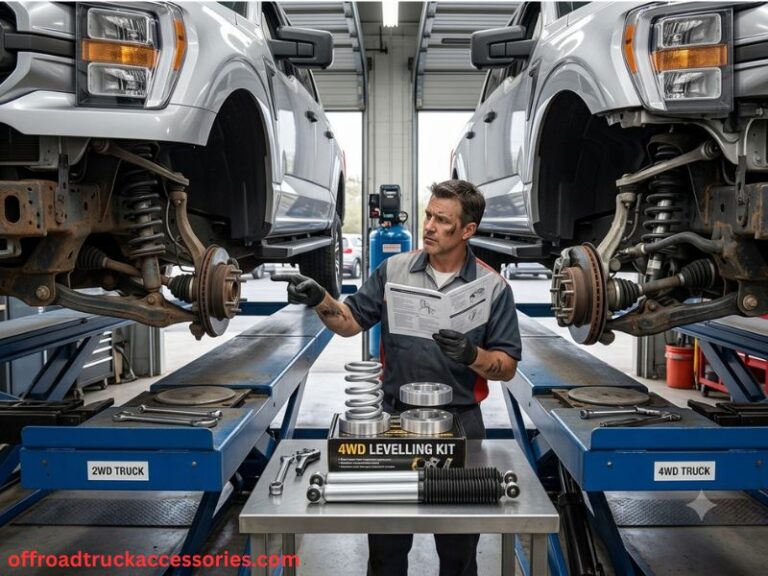
The exact service depends on the kit and dealership, but professional installation normally begins with a suspension inspection. The technician checks the existing shocks, struts, control arms, ball joints, tie rods, CV boots, wheel bearings, bushings, and related hardware.
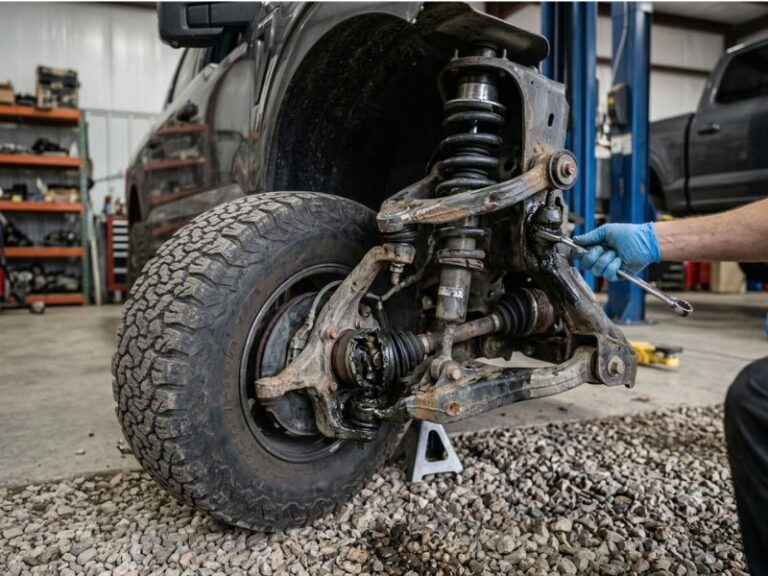
The truck is then raised, and the required suspension components are removed or repositioned. New spacers, struts, shocks, springs, or other components are installed according to the product instructions and specified torque values.
After the suspension is reassembled, the technician should verify brake-hose routing, ABS wiring, tire clearance, control-arm position, and suspension movement.
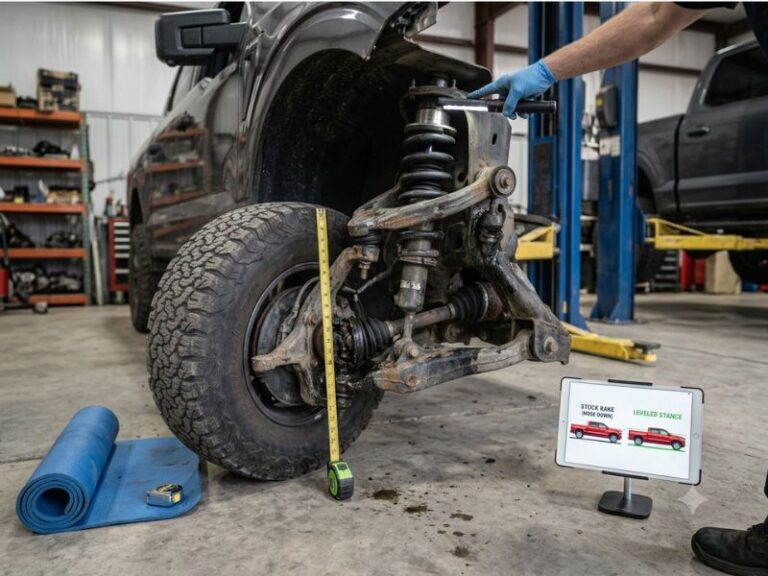
A wheel alignment should be completed after the front ride height changes. Raising the truck can alter camber, caster, and toe. Driving without correcting these measurements may cause steering pull, unstable highway tracking, an off-center steering wheel, or uneven tire wear.
Some dealer quotes include alignment, while others list it as a separate service. Tire installation, balancing, steering recalibration, headlight adjustment, or advanced driver-assistance calibration may also cost extra.
Request an itemized estimate so you know precisely what is included.
How Much Does Dealer Installation Cost?
There is no single nationwide Ford dealer price for leveling-kit installation. The total depends on the vehicle, kit design, labor rate, installation time, alignment requirements, and additional parts.
A simple spacer kit generally requires less labor than a complete suspension system with replacement shocks, springs, coilovers, control arms, or track-bar components.
Dealer labor rates are often higher than those of independent shops because the dealership employs Ford-trained technicians, uses brand-specific service information, and documents the modification within its service system.
The estimate may include the kit, installation labor, alignment, shop supplies, taxes, tire mounting, and any necessary calibration. Always compare the complete installed price rather than comparing labor alone.
A lower quote may exclude alignment or necessary supporting components, while a higher quote may include a more complete suspension package and stronger warranty support.
Will the Dealer Install Larger Tires at the Same Time?
Many Ford dealers can install larger tires and wheels during the leveling-kit appointment. However, the dealer must confirm that the complete combination fits safely.
A leveling kit creates additional space around the front wheel opening, but it does not guarantee that every advertised tire size will fit. Clearance also depends on wheel offset, backspacing, tire width, true tire diameter, suspension travel, and fender design.
A tire may appear to fit while the truck is parked but rub during full steering lock or suspension compression. Potential contact areas include the inner liner, crash bars, mud flaps, control arms, bumper brackets, and body mounts.
Larger and heavier tires can also increase stress on steering, wheel bearings, brakes, and drivetrain components. They may change speedometer accuracy, effective gearing, fuel economy, and braking behavior.
Ask the dealer to confirm the exact wheel-and-tire specification rather than relying on a general claim that a particular lift height “fits 35s.”
Can a Dealer Refuse to Install a Leveling Kit?
Yes. A Ford dealer can refuse the work if it believes the kit is unsafe, incompatible, incomplete, unsupported, or likely to cause alignment and warranty problems.
The dealer may also decline if the truck has existing suspension damage, excessive rust, worn ball joints, damaged mounting points, or previous modifications that interfere with installation.
Some dealers avoid third-party suspension products because they do not want responsibility for part quality or future repair disputes. Others may install only parts purchased directly through their dealership.
A refusal does not necessarily mean the leveling kit is unsafe. It may simply fall outside that dealership’s service policy or technician experience.
Another Ford dealer or a reputable independent suspension shop may accept the job, but the same fitment and safety checks should still apply.
Ford Dealer vs Independent Suspension Shop
A Ford dealer can be a strong choice when you want a Ford Performance kit, factory-oriented documentation, and technicians familiar with the vehicle’s electronic and mechanical systems.
Dealer installation may also simplify warranty records because the modification appears in the truck’s service history.
An independent suspension shop may offer more brand options and greater experience with customized builds. It may be more familiar with aftermarket control arms, coilovers, off-road shocks, track bars, larger tires, and nonstandard wheel offsets.
The quality of the technician matters more than the sign outside the building. A dealership with little suspension-modification experience may not be as suitable as a respected truck specialist that performs these installations every day.
Compare technician experience, included services, alignment capability, labor warranty, part warranty, and post-installation support before making a decision.
What to Ask Before Scheduling Installation
Before authorizing the work, confirm that the dealer has checked your vehicle identification number and the kit’s exact part number.
Ask whether the kit is a Ford Performance product, Genuine Ford Accessory, or independent aftermarket component. Find out which warranty applies to the part and which company covers installation labor.
The service adviser should explain whether factory shocks, struts, control arms, or other components will be retained. For taller systems, ask whether geometry-correction parts are needed.
Also confirm that the price includes alignment and whether the dealership can achieve acceptable camber, caster, and toe at the proposed height.
When larger tires are planned, provide the exact tire size, wheel width, offset, and backspacing. These details are necessary for reliable clearance evaluation.
Finally, ask for a printed invoice, alignment report, and warranty documentation after installation.
Is Dealer Installation Worth It?
Dealer installation can be worth the additional cost when warranty documentation, Ford-specific technical knowledge, and convenience are priorities.
It is especially attractive when installing a Ford Performance package that provides additional warranty benefits when fitted by a Ford dealer or qualified certified technician.
For example, Ford Performance identifies selected suspension products that include three-year or 36,000-mile warranty protection under stated installation conditions. (Ford Performance Parts)
Dealer installation may be less valuable when the dealership has limited experience with modified trucks, refuses the specific kit you want, or charges significantly more without offering better parts or warranty support.
The safest choice is the installer who understands the exact suspension platform, follows the manufacturer’s instructions, completes the alignment correctly, and accepts responsibility for the quality of the work.
Final Thoughts
So, do Ford dealers install leveling kits? Yes, many Ford dealerships install Ford Performance and selected aftermarket leveling kits, but availability, accepted brands, pricing, and installation policies vary by location.
A Ford dealer is most likely to accept a vehicle-specific kit that includes proper fitment documentation and clear installation instructions. Selected Ford Performance suspension products may also receive defined warranty coverage when installed by a Ford dealer or another eligible certified technician.
Before purchasing a kit, contact the dealer with your VIN and the exact part number. Confirm the total installed cost, alignment service, warranty terms, tire compatibility, and responsibility for customer-supplied parts. This preparation can help you avoid fitment problems and ensure the truck receives a safe, properly documented suspension upgrade.