To adjust a Jeep Cherokee XJ track bar, safely support the vehicle, measure the front axle’s position, adjust the bar according to its design, and verify that the axle sits centered under the body. Follow the track bar manufacturer’s instructions and use the correct torque specifications for your exact XJ model.
On a Jeep Cherokee XJ sold in the United States, the front track bar helps keep the solid front axle centered beneath the body. If you install a suspension lift, change the track bar, or find that the axle sits off-center, you may need to adjust the bar’s effective length. The correct setting depends on the lift height, track bar design, mounting geometry, and the vehicle’s actual axle position.
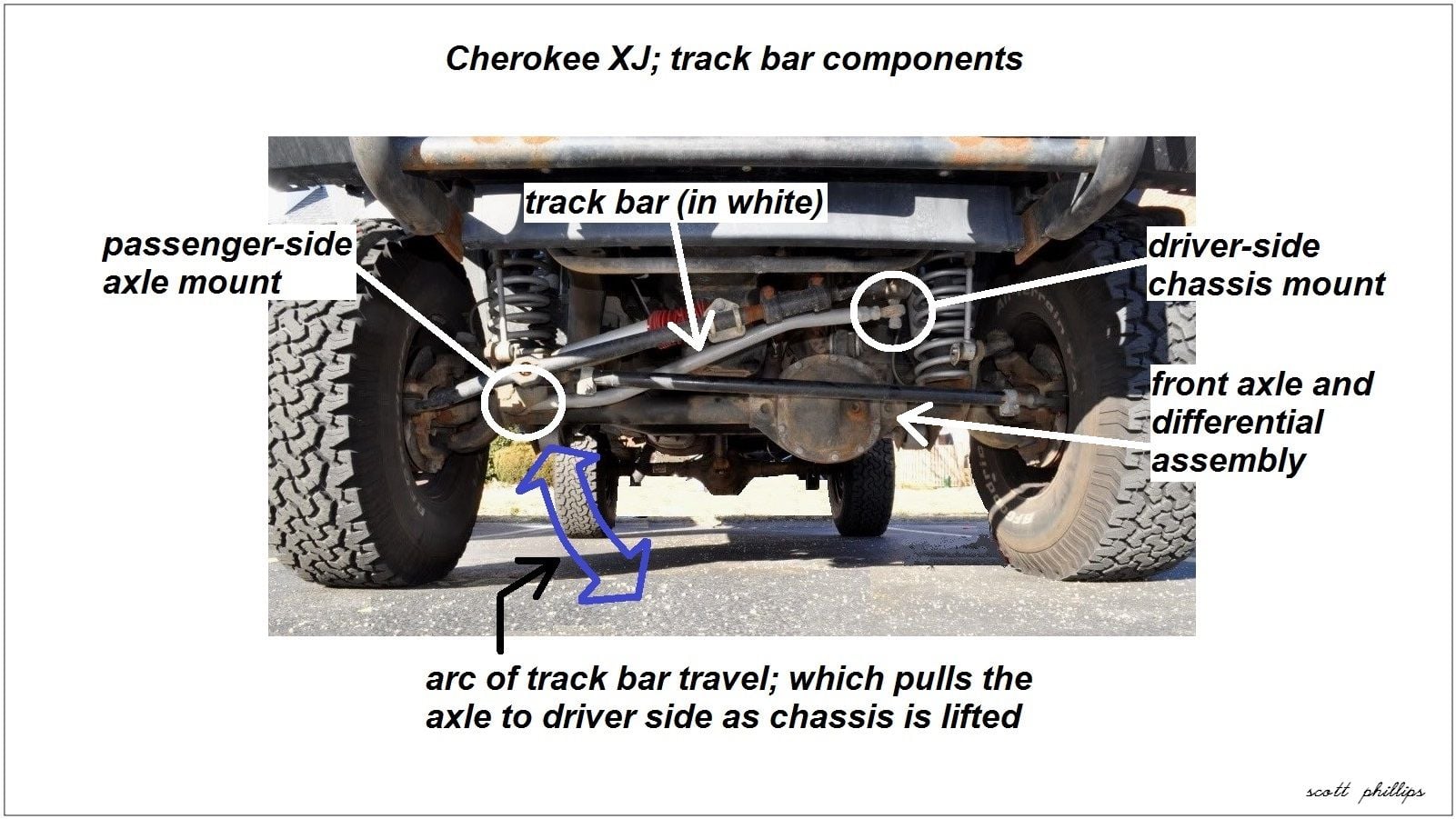
The XJ uses a solid front axle with a track bar connecting the axle assembly to the vehicle’s body or unibody structure. When the suspension moves, the bar follows an arc. Changing its length changes the axle’s lateral position at the suspension’s normal ride height. This adjustment does not replace a steering alignment, and it cannot repair worn bushings, bent parts, loose mounts, or damaged steering components.
Before starting, identify whether your Cherokee has the factory-style fixed track bar or an aftermarket adjustable unit. The procedures differ because a fixed bar has no normal length adjustment, while an adjustable bar usually has a threaded section, an adjuster sleeve, or another manufacturer-specific mechanism. Do not loosen a fixed bar’s mounting bolts and attempt to force it into a different length.
The front track bar controls side-to-side movement of the front axle relative to the Cherokee’s body. It works with the suspension links to keep the axle located as the springs compress and extend. Without a sound, correctly installed track bar, the axle can shift laterally and the Jeep may feel unstable.
The track bar is not the same as the tie rod or drag link. The tie rod connects the steering knuckles, while the drag link transfers steering input from the steering gear to the steering linkage. The track bar locates the axle rather than directly steering the wheels, although its geometry affects how the axle and steering system move together.
Many XJ owners consider track bar adjustment after installing a suspension lift because the lift changes the relationship between the body-side and axle-side mounting points. A stock-length bar may pull the axle away from the centerline when the suspension sits higher. The amount and direction of that shift depend on the actual mounting geometry, so measure instead of assuming a particular correction.
Source: storage.googleapis.com
Axle location
The track bar limits lateral axle movement while allowing the suspension to travel through its designed range.
Steering behavior
Loose mounts, worn bushings, or incorrect geometry can contribute to wandering, clunks, or instability. These symptoms can also have other causes.
Lift compatibility
An adjustable track bar can help restore the axle’s lateral position when a lift changes the original geometry, provided the bar is designed for the Jeep and lift configuration.
Fixed Versus Adjustable Track Bars
A factory-style fixed track bar has a set effective length. Its mounting hardware secures the bar, but the hardware does not provide a legitimate length adjustment. If the axle is off-center because of changed suspension geometry, a compatible adjustable bar or another manufacturer-approved correction may be necessary.
An adjustable track bar provides a way to change effective length within a specified range. Depending on the design, the adjustment may use a threaded end, a sleeve, or another mechanism. Some designs require removal or loosening of specific fasteners before adjustment, while others have different procedures. Follow the instructions for the exact part rather than applying a universal method.
Fixed bar
Inspect for wear, damage, incorrect fitment, and loose mounting hardware. Replace it with a suitable component if its length is no longer appropriate.
Adjustable bar
Confirm the allowed adjustment range, minimum thread engagement, locking method, and fastener torque before making changes.
When Should You Adjust an XJ Track Bar?
Adjust the track bar when measurements show that the front axle is not centered under the body and the installed bar allows a safe, correct adjustment. A suspension lift is a common reason to check axle centering, but the lift height alone does not tell you the exact length required. Different track bar designs and mounting locations can produce different results.
A Jeep that appears to have one front tire closer to its fender than the other may have an axle-centering issue. However, body panels, fender flares, prior collision damage, uneven ground, steering angle, and tire position can make visual comparisons misleading. Measure from repeatable reference points and confirm the result before changing anything.
Do not use track bar adjustment as a cure for every steering complaint. A clunk during turns, visible axle movement, or a loose steering feel may indicate worn bushings or loose fasteners. Severe steering oscillation, often called death wobble by Jeep owners, can involve several worn or improperly installed parts. It requires a full inspection rather than simply lengthening or shortening the bar.
Source: storage.googleapis.com
After a suspension lift
Check the axle position at normal ride height and determine whether the existing bar can achieve correct centering.
After replacing the track bar
Verify fitment, mounting orientation, axle centering, and clearance before driving.
When steering symptoms appear
Inspect the complete steering and suspension system before deciding that bar length is the cause.
After mount or bushing repairs
Recheck the bar’s position and fasteners because repairs can expose or correct earlier movement.
Signs That Need Inspection Before Adjustment
Look for cracked or separated bushings, an oval or damaged mounting hole, a bent bar, loose hardware, damaged threads, or metal-to-metal contact around the mounts. Any of these conditions can make length adjustment ineffective or unsafe. Replace or repair damaged parts using an approved method before setting the bar.
If the steering wheel is off-center, the Jeep pulls to one side, or the tires wear unevenly, do not assume the track bar needs adjustment. These symptoms can arise from toe settings, caster, tire pressure, tire condition, steering linkage, or other suspension faults. A proper alignment and mechanical inspection may be needed.
Stop if a mount is damaged
Do not drive normally with a loose, cracked, or distorted track bar mounting point.
Check for play
Have an assistant move the steering wheel gently while you observe the track bar mounts from a safe position, keeping clear of moving parts.
Tools and Preparation for Track Bar Adjustment
Gather the correct hand tools, a suitable torque wrench, a tape measure, a paint marker, wheel chocks, and the service instructions for the vehicle and track bar. You may also need the specified jack and properly rated jack stands if the manufacturer’s procedure requires lifting. The exact socket sizes and torque values depend on the model year, fasteners, and aftermarket components.
Park on firm, level ground, select Park or first gear as appropriate, set the parking brake, and chock the wheels. Keep the vehicle stable throughout the work. Never rely on a hydraulic jack alone to support the Jeep, and never work beneath a vehicle supported by unstable blocks or improvised stands.
Start with the suspension at its normal ride height whenever the measurement or adjustment procedure calls for that condition. If the wheels must remain loaded, use an approved setup that safely supports the vehicle and does not require anyone to work beneath an unsupported axle. Do not loosen a loaded suspension joint unless the manufacturer’s procedure specifically permits it.
Source: storage.googleapis.com
Vehicle service information
Use the factory service manual for the exact XJ model year to confirm mounting details and applicable fastener torque values.
Track bar instructions
Confirm the adjustment mechanism, thread limits, required locking hardware, and tightening sequence for the installed bar.
Measurement tools
Use the same reference points and the same measurement method on both sides of the axle.
Personal protection
Wear eye protection and gloves when appropriate, and keep hands clear of pinch points and moving suspension parts.
Identify Your Exact XJ Configuration
The Jeep Cherokee XJ was sold in several model years and may now have original, replacement, or modified suspension components. Before starting, record the model year, suspension lift height if known, track bar manufacturer and part number, and whether the body-side and axle-side mounts are factory or aftermarket.
If the bar’s identity is unknown, compare its shape and mounting ends with the manufacturer’s fitment information. Do not assume that every adjustable bar fits every XJ or that bars intended for a Wrangler will fit a Cherokee. A component that bolts into place may still have the wrong geometry or inadequate clearance.
Confirm application
Check the part number and intended vehicle, axle, lift range, and mounting configuration.
Check prior modifications
Look for relocated brackets, altered steering linkage, aftermarket control arms, and other changes that affect suspension geometry.
How to Measure Front Axle Centering
Measure the axle’s lateral position before adjusting the bar. Park the Jeep on level ground, set the steering straight ahead, and make sure the suspension is settled at normal ride height. Use consistent points on the body or frame reference structure and the corresponding axle-side points.
One practical method is to measure from a defined body reference point to a matching axle reference on each side. The left and right measurements should be comparable, but the reference points must be genuinely symmetrical. Fender edges alone may not be accurate because body panels and flares can differ or may have been changed.
Record both measurements before making adjustments. If one side has more clearance than the other, verify that the difference is not caused by uneven ground, tire position, body damage, or a measurement error. Repeat the measurements and, when possible, compare them with a reliable chassis reference or the component manufacturer’s instructions.
Source: www.youtube.com, Mark H
Choose fixed reference points
Use matching points on the body or chassis and axle. Avoid comparing unrelated edges or measuring one side from a different type of surface.
Keep conditions consistent
Use level ground, straight-ahead steering, normal ride height, and the same tape-measure orientation on each side.
Record the baseline
Write down the initial left and right measurements so you can tell whether each adjustment moves the axle in the intended direction.
Understand the Measurement Difference
The difference between the two side measurements can help show which way the axle is displaced, but it is not a universal track bar length formula. The amount of bar adjustment needed depends on the mounting points and the angle of the bar. A small change in bar length does not necessarily move the axle by the same distance.
For example, suppose matching measurements show that the axle sits farther from the body reference on the driver’s side than on the passenger side. After checking the reference points, the result may indicate that the axle is shifted toward the passenger side relative to the intended centerline. Confirm the direction using the actual mounting geometry before turning the adjuster.
Do not use an assumed half-difference calculation to set the track bar without understanding the measurement method. Such a calculation can be useful in a properly defined symmetrical setup, but body and chassis reference points may not match that assumption.
If the result is inconsistent
Repeat the measurements, inspect for damaged mounts, and consult a chassis or alignment professional if the axle’s position remains uncertain.
How to Adjust an Adjustable XJ Track Bar
Adjust an adjustable XJ track bar in small, controlled increments, checking axle centering after each change. The following sequence is a general workflow, not a substitute for the instructions supplied with the specific bar. Some products must be adjusted with one end disconnected, while others have a different approved procedure.
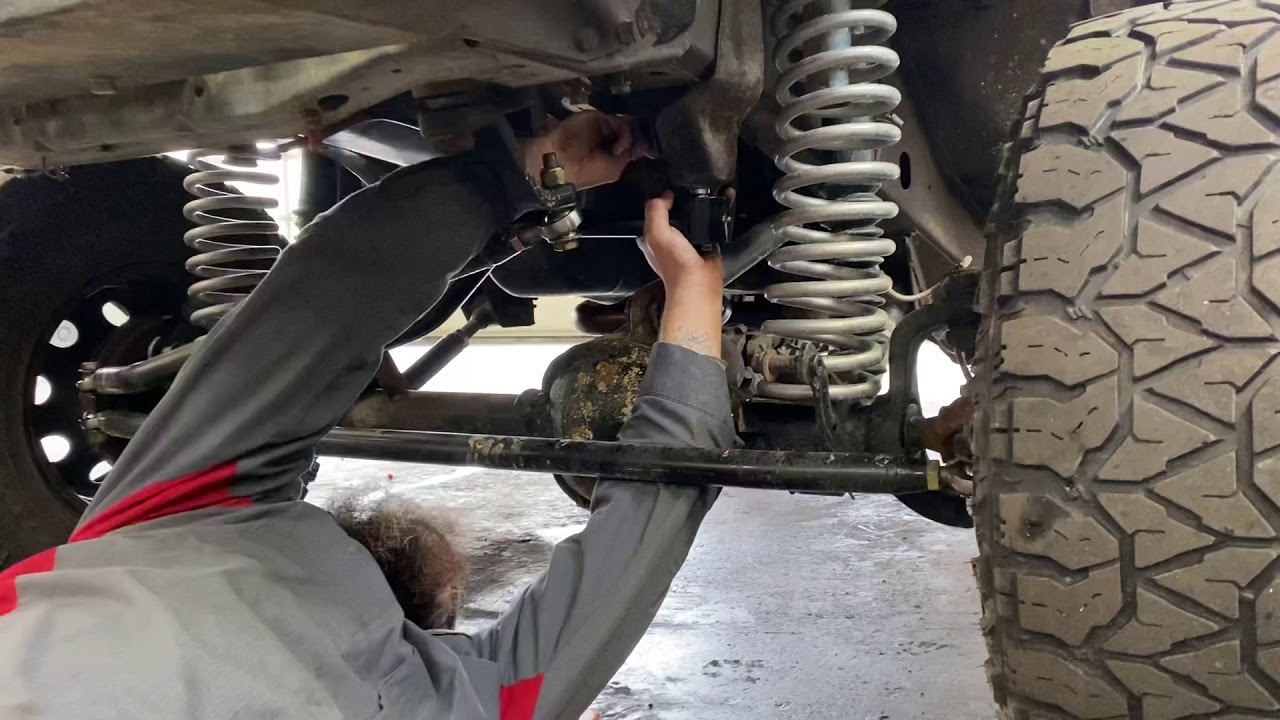
Before loosening any fastener, mark the original adjuster position and measure the exposed threads if the design permits. This gives you a reference if the adjustment moves in the wrong direction. Do not exceed the manufacturer’s maximum extension or minimum thread engagement, even if the axle still appears off-center.
Never loosen the track bar’s mounting bolts merely to make the axle shift sideways by force. The bar must be set to the correct effective length and installed without binding or forcing the mounts into alignment. If the bolt holes do not line up naturally under the approved procedure, investigate the cause rather than using the bolts to pull the parts together.
Source: YouTube, Fohringer’s Auto Detailing
Step 1: Confirm the bar can be adjusted
Identify the adjuster and locking hardware. If the bar is fixed length, stop and determine whether a compatible adjustable replacement is required.
Step 2: Record the starting position
Mark the sleeve or threaded end and note the exposed thread length, initial axle measurements, and mounting orientation.
Step 3: Follow the specified release procedure
Loosen only the designated locknut or fasteners, and disconnect an end only if the manufacturer’s procedure requires it.
Step 4: Change the effective length
Turn the adjuster in small increments using the correct method. Keep enough thread engagement and maintain the required orientation.
Step 5: Recheck the axle position
Return the suspension to the specified measuring condition and repeat the left and right measurements. Correct the direction of adjustment if the axle moved away from center.
Step 6: Secure the adjustment
Tighten the locknut or locking hardware to the track bar manufacturer’s specified value and method. Do not substitute a guessed torque.
Step 7: Install and torque the mounts
Seat the mounting ends correctly, use the specified hardware, and tighten fasteners to the applicable service specifications under the required suspension condition.
Which Way Should You Turn the Adjuster?
There is no safe universal rule that clockwise always moves the axle toward the driver’s side or passenger side. The result depends on which end of the bar is threaded, how the adjuster is built, and the mounting geometry. The adjuster may also be viewed from different ends, making a generic clockwise instruction confusing.
Make a small adjustment, restore the required suspension condition, and measure again. Record the direction and result. If the axle moves farther from center, reverse the adjustment and reassess the geometry rather than continuing to turn the sleeve without measurements.
Use measured results
Determine the correct direction by checking axle movement after a small approved adjustment, not by guessing from the thread direction.
Stop at the adjustment limit
If the axle cannot be centered within the approved range, verify part compatibility, lift configuration, and mount location.
What If the Mounting Bolts Will Not Line Up?
A hole that does not line up can mean the axle is displaced, the bar length is incorrect, the suspension is not in the required position, or a component has been installed incorrectly. It can also indicate a damaged bracket or incompatible track bar. Do not hammer the bolt into place or use the fastener as a puller unless the service procedure specifically calls for a safe alignment method.
Recheck the vehicle’s support, the bar’s orientation, the adjuster setting, and the suspension’s ride-height condition. If the holes still will not align without force, stop and obtain the manufacturer’s installation instructions or professional help.
Do not force the bolt
Forcing misaligned mounting hardware can damage threads, distort a bracket, or leave the joint improperly seated.
How to Handle a Fixed-Length Track Bar
A fixed-length track bar cannot be lengthened or shortened through a normal adjustment mechanism. If an otherwise sound factory-style bar leaves the axle off-center after a suspension lift, determine whether the lift manufacturer specifies a compatible adjustable bar or another approved geometry correction. Do not bend the bar, cut it, heat it, or improvise a threaded extension.
Before replacing the bar, rule out simpler faults. Worn bushings can allow movement that makes the axle appear incorrectly located, and loose or damaged mounts can prevent stable positioning. Confirm that the bar is the correct part for the vehicle and that previous suspension modifications have not introduced a fitment problem.
A replacement must be suitable for the XJ’s front axle, intended lift height, steering setup, and mount configuration. Check the manufacturer’s application details, installation requirements, and adjustment limits. A part intended for another Jeep platform is not automatically interchangeable.
Source: www.rustysoffroad.com
Inspect before replacing
Check both ends, bushings, brackets, mounting holes, and hardware for damage or excessive movement.
Verify the replacement
Confirm vehicle application, bar length range, end design, mount compatibility, and any required steering or suspension modifications.
Do not modify a structural component casually
Cutting, welding, heating, or drilling a track bar can weaken it and change its geometry. Use an engineered part and approved installation method.
When a Lift Requires More Than a Track Bar Adjustment
A suspension lift changes more than axle height. It can affect caster, control-arm angles, steering linkage geometry, driveline angles, and available clearance. A track bar may center the axle laterally, but it cannot correct all of these changes.
If the Jeep has a large lift, altered mounting brackets, unusual steering angles, or persistent handling problems, assess the entire suspension system. A professional familiar with solid-axle Jeep suspensions can check the geometry and identify whether additional corrections are appropriate.
Check the complete setup
Review track bar geometry alongside control arms, steering linkage, caster, toe, and clearance through suspension travel.
Torque, Thread Engagement, and Safe Reassembly
Correct adjustment is only part of the job. The track bar must be secured with the correct hardware, proper thread engagement, and the specified torque. Because XJ model years and aftermarket bars may use different components, do not rely on one torque value found in an unrelated forum post or for a different product.
Use the factory service information for the vehicle’s original mounting points and the aftermarket manufacturer’s instructions for replacement components. If the instructions give different requirements for a modified bracket or supplied bolt, confirm which specification applies to that exact joint before tightening.
Inspect the threads and mating surfaces during reassembly. Replace damaged fasteners, worn bushings, or specified single-use hardware as directed. Do not add threadlocker, lubricant, washers, or substitute bolts unless the applicable instructions call for them, because these changes can affect clamping force or joint fit.
Source: www.rustysoffroad.com
Mounting hardware
Use the specified bolt, nut, washer, and locking method. Confirm that the fastener seats fully and the joint is not binding.
Adjustment hardware
Secure locknuts, clamps, or set screws using the manufacturer’s sequence and torque.
Ride-height requirements
Some suspension fasteners must be tightened at normal ride height to limit bushing preload. Follow the exact service instructions for each joint.
Final inspection
Check that the bar is correctly oriented, the axle is centered, and no hose, wire, tire, or steering component contacts the bar.
Why a Generic Torque Number Is Not Enough
Torque depends on the fastener diameter, grade, thread condition, joint design, and manufacturer specification. A value suitable for one original bolt may not be correct for an aftermarket bolt or bracket. A guessed value can leave the joint loose or overload the fastener.
If the correct specification cannot be verified, pause the job until the vehicle service information or track bar instructions are available. This is a safety-critical connection, not a place to estimate torque by feel.
Avoid torque guessing
Do not use a universal online number unless it is verified for the exact fastener and application.
How to Check the Adjustment Before Driving
After tightening the track bar and adjustment hardware, verify axle centering with the same reference points used before the repair. The measurements should show the intended improvement, within the limitations of your reference points and suspension geometry. Recheck any hardware disturbed during the work.
With the vehicle safely supported or on the ground as appropriate, inspect the track bar through the steering range and suspension movement allowed by the service procedure. Confirm that the bar does not contact the differential cover, steering linkage, brake hoses, wiring, tires, or other components. Do not place yourself beneath a vehicle while someone turns the steering wheel or moves the suspension unless the setup is specifically safe for that inspection.
Before a normal road drive, confirm that the wheels point in the expected direction, steering components are secure, and no fasteners remain loose. If the Jeep’s steering feels unstable, the axle visibly shifts, or the bar makes a clunk, do not continue driving to see whether the problem goes away. Correct the fault first.
Source: www.youtube.com, Prelude Dude Si
Axle position
The left and right reference measurements should be consistent with the intended centered position.
No binding or contact
The bar and adjacent parts should clear one another throughout the approved range of steering and suspension movement.
Secure mounting
All fasteners and locking devices should meet the correct specifications, with no visible joint movement.
Stable handling
The vehicle should not exhibit new clunks, unexpected steering changes, or visible lateral axle movement.
Does Track Bar Adjustment Require an Alignment?
Track bar adjustment is not the same as a wheel alignment. Changing the bar’s effective length primarily changes the axle’s lateral location, while alignment settings such as toe and caster are controlled by other parts and adjustments. Nevertheless, suspension work can reveal or coincide with alignment problems, especially on a modified Jeep.
Check the steering wheel position and tire direction after the work. If the Jeep pulls, the steering wheel is off-center, or the tires show abnormal wear, arrange a suitable alignment and inspect the steering linkage. Do not use track bar length to compensate for incorrect toe or caster.
Seek alignment service when needed
Have toe, caster, and other applicable settings checked after suspension modifications or when handling symptoms persist.
Common XJ Track Bar Adjustment Problems
If the axle remains off-center after adjustment, first confirm the measurements and part compatibility. An adjuster at its limit, a bent bar, an incorrectly located bracket, or a damaged mount can prevent proper centering. Continuing to extend the bar beyond its approved range is not a valid fix.
If the axle appears centered but the Jeep still wanders or clunks, look for another fault. Worn control-arm bushings, loose steering components, damaged ball joints, tire issues, incorrect alignment, and loose track bar hardware can produce overlapping symptoms. A sound diagnosis checks these systems rather than replacing parts based on one symptom.
If the track bar spins while you try to tighten a fastener or turn an adjuster, determine which part is rotating. A spherical joint, threaded adjuster, and mounting bolt each require a different procedure. Use the specified counter-hold points and tools, and never grip a polished shaft or damage a threaded section with locking pliers.
Source: YouTube
Axle will not center
Verify the lift and bar application, inspect bracket locations, repeat measurements, and check whether the adjuster is within its safe range.
Clunking after adjustment
Recheck mount tightness, bushings, joint seating, and nearby steering or suspension parts before driving.
Steering wheel off-center
Inspect steering linkage and alignment. Do not assume a steering-wheel position problem proves the track bar is the wrong length.
Persistent vibration or wobble
Stop driving if control is compromised and arrange a full front-end inspection. Track bar adjustment alone may not address the cause.
Can You Adjust the Bar With the Jeep on the Ground?
Some adjustable track bars can be measured or adjusted with the vehicle at ride height, but the permitted method depends on the design and the manufacturer’s instructions. The fact that a bar is reachable from underneath does not make it safe to loosen under load.
If the procedure calls for the vehicle to remain at ride height, use a safe setup designed to support that condition. If an end must be disconnected or the axle repositioned, follow the specified support and restraint method. Never work under an inadequately supported Jeep.
Follow the product procedure
Use the manufacturer’s required support condition and keep clear of pinch points while the axle or steering can move.
Frequently Asked Questions
Q
How do I know if my Jeep Cherokee XJ track bar needs adjustment?
Measure the front axle’s lateral position using matching reference points on level ground at normal ride height. An axle that is measurably off-center after a lift or track bar installation may need adjustment if the installed bar is designed for it. Inspect the bushings, mounts, and steering parts before changing the length.
Q
Can I adjust the factory XJ track bar?
A factory-style fixed-length track bar does not normally have a length adjustment. If it cannot center the axle with the current suspension geometry, inspect it for damage and verify the suspension setup. A compatible adjustable replacement may be appropriate when the lift or mounting geometry requires a different effective length.
Q
How long should an adjustable XJ track bar be?
There is no single correct length for every Cherokee XJ. The required setting depends on the model, mounting locations, suspension lift, bar design, and measured axle position. Use the manufacturer’s adjustment range and center the axle using consistent reference points rather than copying a length from another Jeep.
Q
Will adjusting the track bar fix death wobble?
Not necessarily. Incorrect track bar length or loose track bar mounts can contribute to handling problems, but severe steering oscillation can also involve worn ball joints, steering linkage, control-arm bushings, tires, alignment, or other faults. Stop driving if the vehicle cannot be controlled safely and have the complete front suspension and steering system inspected.
Q
Do I need an alignment after adjusting an XJ track bar?
Track bar adjustment alone does not set toe or caster, but a lift or related suspension work can affect alignment and steering behavior. Check that the steering components are secure and that the vehicle tracks correctly. Arrange an alignment when the steering wheel is off-center, the Jeep pulls, tire wear is uneven, or suspension modifications require alignment verification.
Q
What if my adjustable track bar reaches its limit before the axle is centered?
Stop adjusting and verify that the bar is intended for your XJ and lift configuration. Check the mounting brackets, axle position, thread engagement, bar orientation, and any previous suspension modifications. Do not exceed the adjustment range or reduce thread engagement to force the axle into position; obtain a compatible component or professional assessment.
✦ Wrapping Up
Conclusion
Adjusting a Jeep Cherokee XJ track bar starts with measuring the front axle, identifying the installed bar, and confirming that its design permits length adjustment. An adjustable bar can help center the axle after a suspension lift, but the correct setting must come from the actual mounting geometry and measured position rather than a guessed number of turns.
Use the manufacturer’s procedure, preserve the required thread engagement, and tighten every joint to the correct specification. Inspect the mounts, bushings, steering linkage, and surrounding clearance before driving. If the axle cannot be centered safely or the Jeep still has steering instability, stop and arrange a complete suspension inspection.
💡 Key Takeaway
Before turning the adjuster, record the left and right axle measurements, confirm the exact track bar instructions, and identify the correct torque specifications for every fastener you will loosen.
Eric
Hi, I’m Eric Bennett, the person behind OffRoadTruckAccessories.com.
I created this blog to share my interest in trucks, off-road driving, automotive accessories, and DIY modifications. I enjoy learning how different truck accessories work, testing their usefulness, and understanding whether they are truly worth buying.