How to Tell if Track Bar Is Bad: Simple Checks for Your Jeep
A track bar can be easy to overlook because it does not carry the vehicle’s weight like a spring or control the wheels like a tie rod. On a solid-axle vehicle, though, it has an important job: it keeps the axle centered under the frame while the suspension moves. When its bushings, mounting bolts, or bar itself wear out, the vehicle may begin to wander, clunk, or shift sideways under braking.
Learning how to tell if track bar is bad does not require immediately removing the part. You can start with a short road-symptom review, a visual inspection, and a controlled movement test. These checks can reveal looseness, damaged rubber, bent metal, or a mounting problem, although they cannot replace a professional inspection when the diagnosis is uncertain.
This guide explains how to identify the track bar on a typical solid-front-axle vehicle, inspect its mounting points, test for movement safely, and separate track bar symptoms from similar steering or suspension faults. You will also learn when to stop driving and what evidence to show a repair shop.
At a glance
- A clunk by itself does not prove the track bar is bad; looseness at a mounting point is stronger evidence.
- The axle should not shift noticeably side to side while an assistant moves the steering wheel.
- Any severe wandering, repeated wobble, or visibly loose mounting hardware deserves prompt professional attention.
How to Tell if Track Bar Is Bad With Safe Suspension Checks
The most reliable beginner-friendly approach combines several observations instead of relying on one noise or one short drive. First identify the bar and understand its mounting points, then inspect it with the vehicle safely supported, and finally watch for unwanted movement while an assistant operates the steering.
Track bar layouts vary. On many solid front axles, the bar runs diagonally from the axle housing to the frame, while some rear suspensions use a similar bar. A four-wheel-drive truck, Jeep, or SUV may have a factory bar, an adjustable replacement bar, or a bar with rubber or polyurethane bushings.
Tools you will need
- Vehicle owner’s manual, for the correct lifting and support points
- Flashlight, for viewing bushings, brackets, and bolt holes
- Wheel chocks, to prevent the vehicle from rolling
- Floor jack and appropriately rated jack stands, if lifting is needed
- Torque wrench and the manufacturer’s service specifications, for checking or tightening hardware
- Optional: assistant, to turn the steering wheel during the movement test
Step 1 Park the Vehicle and Set Up a Safe Inspection
Park on a hard, level surface, place the transmission in Park or in first gear, set the parking brake, and chock the wheels that will remain on the ground. Keep hands, loose clothing, and tools away from moving steering and suspension parts.
A visual inspection can often be done with the vehicle on the ground. If you need to raise it, use the owner’s manual to locate safe lifting points and support the vehicle with jack stands on solid structural locations. Never rely on a floor jack alone, and do not place any part of your body beneath an unsupported vehicle.
The suspension should normally be checked in the position specified by the vehicle manufacturer. Some movement tests are most useful with the vehicle sitting on its tires, while others require the axle to hang. If the manual does not explain the inspection, keep the vehicle on the ground for the first checks and leave under-vehicle work to a qualified technician.
Step 2 Locate the Track Bar and Follow Its Mounts
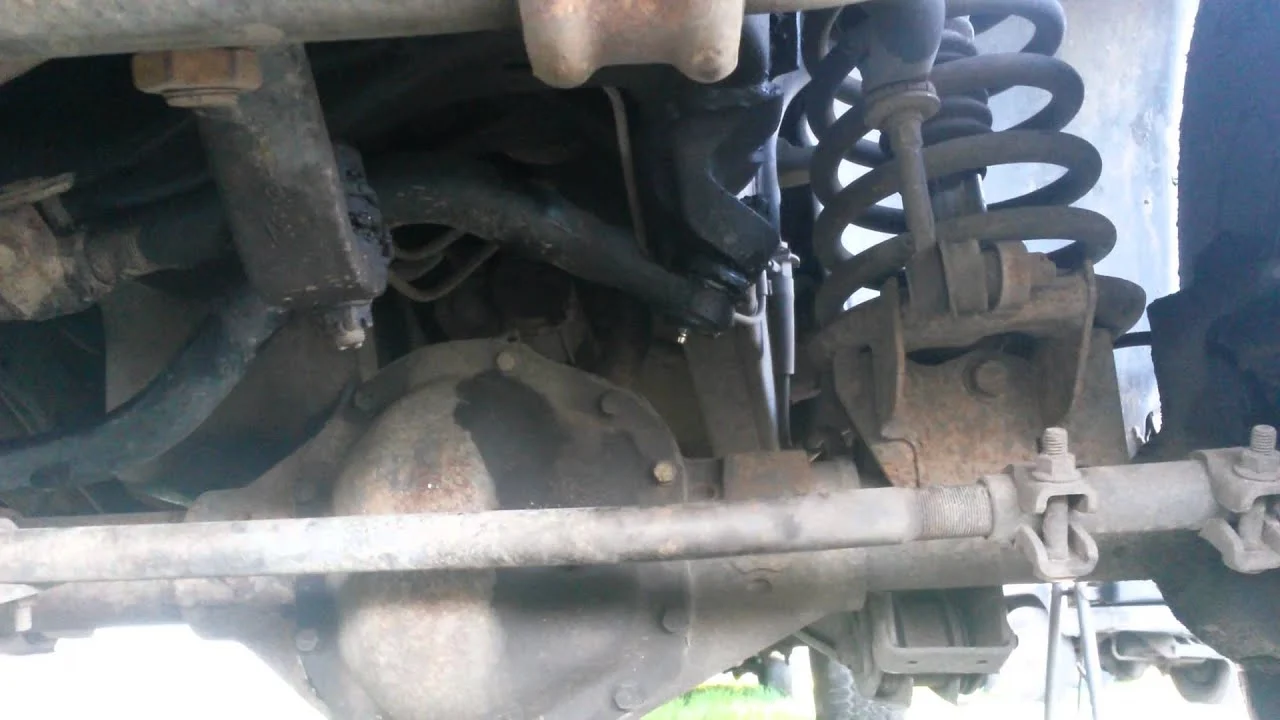
Look for a sturdy bar connecting the axle housing to the vehicle frame. It usually runs at an angle across the front suspension. One end attaches to a bracket on the axle, and the other attaches to a bracket on the frame.
The part may also be called a panhard bar.
Do not confuse it with the steering drag link or tie rod. Steering links connect to the steering knuckles and change wheel direction. The track bar does not turn the wheels; it limits side-to-side axle movement.
A factory service diagram can help if several bars appear similar.
Once identified, trace the bar from one end to the other. Note whether the bar is straight, whether its bushings are centered in their sleeves, and whether the brackets appear flat and firmly attached. If the bar is adjustable, inspect the adjuster sleeve and its jam nuts as well as the end bushings.
Step 3 Inspect the Track Bar Bar and Bushings for Damage
Use a flashlight to examine the bar, its end fittings, and both mounting brackets. Look for a visibly bent tube, cracked welds, fresh metal contact, rust-through, or a bracket that has pulled away from the axle or frame.
Inspect each bushing for splitting, chunks missing from the rubber, severe compression, or rubber that has separated from its metal sleeve. A little surface weathering is not the same as a bushing that allows the sleeve to move inside the mount. Grease around a joint may also indicate a worn serviceable joint, but the presence of grease alone does not prove failure.
Compare the track bar’s position with the surrounding parts. Shiny rub marks can show that the bar is contacting a bracket or another suspension component. A bent bar or damaged bracket can change axle position even when the bushings look acceptable.
Step 4 Check the Mounting Bolts and Brackets Without Guessing
Look directly at both track bar fasteners. The bolt head and nut should sit squarely against their mounting surfaces, and the hole should not look elongated or egg-shaped. Paint or rust dust around a joint can be a sign that the parts have been shifting against each other.
Do not use a wrench to tighten a fastener to an arbitrary “tight enough” setting. Track bar bolts often require a specific torque, and some vehicles call for a particular ride height or tightening sequence. Use the service information for the exact year, model, suspension configuration, and replacement hardware.
If a bolt turns freely, the nut is missing, the bracket is cracked, or the fastener cannot be torqued because the hole is damaged, stop the inspection and arrange a repair. A loose track bar mount can allow rapid axle movement and can affect steering control.
Step 5 Watch for Axle Movement During a Steering Test
With the vehicle on the ground, ask an assistant to sit in the driver’s seat and gently move the steering wheel left and right through a small range. The assistant should not turn the wheel far enough to steer the tires sharply. Stand to the side where you can see the track bar mounts, and keep clear of the tires and linkage.
Watch the axle-side and frame-side mounts closely. The bar and its mounting bolts should move together as a unit, with only the small elastic flex expected from a healthy bushing. If the bolt shifts inside the bracket, the bushing sleeve moves separately from the mount, or the axle jumps sideways before the wheels respond, the track bar system needs further diagnosis.
A useful way to approach how to tell if track bar is bad is to check your progress after each stage.
A helper can also watch the front of the vehicle while you observe from a safe position, but nobody should place a hand on the bar or reach between components during the test. If the vehicle has a steering lock or electronic steering system that behaves differently with the engine off, follow the manufacturer’s procedure rather than forcing the wheel.
Check your result
A useful result is a firm-looking connection at both ends, with no visible gap, clunk, bracket flex, or sideways axle shift during the gentle steering movement.
Step 6 Perform a Careful Play Check Only When Safe
If the vehicle is safely supported and the manufacturer allows a wheel or axle play check, try to move the axle laterally by hand while observing the track bar mounts. A long pry bar can damage a bushing or bracket, so do not force the suspension to create movement that would not occur normally.
Any noticeable side-to-side movement should be traced to its source. The track bar bushing, bolt, bracket, wheel bearing, steering linkage, or another suspension joint can each produce play. Have an assistant observe the exact joint while you apply only moderate hand pressure.
Do not interpret a small amount of normal rubber flex as failure. The finding becomes more concerning when the sleeve shifts in the bushing, the bar moves independently of the bracket, a joint clicks, or the axle moves before the rest of the suspension responds.
Step 7 Take a Short, Controlled Drive to Confirm the Symptoms
Only drive if the vehicle has no loose hardware, severe steering problem, damaged bracket, or obvious safety defect. Choose a quiet, familiar road and keep the speed low. Pay attention to whether the vehicle wanders, needs frequent steering correction, clunks over bumps, or shifts when you brake.
Track bar trouble may cause the steering wheel to sit off-center after the axle moves sideways, but an off-center wheel can also result from an alignment change. Note whether the symptom appears during acceleration, braking, cornering, or one-wheel bumps. A repeatable pattern is more useful than a general impression that the vehicle feels loose.
Stop the drive if the vehicle pulls sharply, the steering becomes difficult to control, a severe wobble begins, or a new loud impact occurs. Do not try to reproduce a dangerous wobble at higher speed.
Track Bar Symptoms and What They Can Mean
A bad track bar commonly produces a combination of steering and suspension symptoms rather than one conclusive sign. The most useful clue is a symptom that matches visible movement at one of the track bar mounts. Noise without movement can come from many other components.

Recognize Track Bar Clunks, Wandering, and Axle Shift
A worn track bar bushing may clunk when the axle moves or when the vehicle changes direction under braking. The sound often seems to come from the front suspension, but the cab and frame can transmit it away from the actual mount.
Steering wander can occur when the axle is no longer held firmly under the frame. On a lifted vehicle, a track bar that is too short, poorly adjusted, or installed with loose hardware can create similar symptoms even if the bar itself is not bent.
One especially useful observation is a steering wheel that moves slightly while the axle shifts side to side. That pattern points toward axle location or steering linkage movement, but it still requires a joint-by-joint inspection.
Separate Track Bar Problems From Death Wobble
“Death wobble” describes a severe, rapid oscillation of the front axle or steering system, often felt as violent shaking through the steering wheel. A loose or worn track bar can contribute to it, but so can a damaged steering joint, incorrect alignment, worn wheel bearing, tire problem, or other suspension fault.
Do not assume replacing the track bar alone will solve every wobble. If the vehicle has experienced a severe oscillation, inspect all steering and suspension connections and have the vehicle evaluated before returning to normal driving.
Compare Similar Steering and Suspension Faults
The following patterns can help narrow the inspection, but they are not a substitute for observing the actual loose joint.
| Observed symptom | Other possible source |
|---|---|
| Clunk over bumps | Control arm bushing, sway bar link, shock mount, or loose hardware |
| Steering wander | Alignment, tire pressure, tie rod, ball joint, or wheel bearing |
| Wheel shake at speed | Wheel balance, bent wheel, tire damage, or worn steering joint |
| Axle appears off-center | Track bar length, lift geometry, shifted bracket, or incorrect installation |
If the track bar passes its movement check, inspect the drag link, tie rod ends, ball joints, control arms, wheel bearings, shocks, tires, and alignment. Looking for one familiar part and ignoring the rest can lead to an incomplete repair. Understanding how to tell if track bar is bad also means recognizing the limits of the method.
How to Confirm a Track Bar Diagnosis Before Repair
Confirmation means identifying the location and type of movement, not simply matching a symptom to a part. A repair decision is much stronger when the inspection shows a worn bushing, loose fastener, bent bar, or damaged bracket at the same time the vehicle displays the related symptom.

Use the Mounting Point as the Main Evidence
Ask an assistant to repeat the gentle steering movement while you watch one mount at a time. If the frame-side mount stays solid but the axle-side bushing shifts, the problem is likely localized to that end. If the entire bracket flexes against the frame, the bracket or its surrounding structure needs attention.
On an adjustable track bar, verify that the jam nuts are tight and that the adjustment has not changed. An adjustment problem can imitate bushing wear by placing the axle off-center or creating poor suspension geometry.
Check the Vehicle’s Alignment and Axle Position
A track bar controls lateral axle position, so a changed axle position may make the body appear uneven over the tires or alter the steering wheel position. Measure or inspect only according to the vehicle’s service information; visual centering is not a substitute for a proper alignment.
After a track bar or mounting bracket is repaired, the vehicle may need an alignment check. Replacing the part without checking related geometry can leave a pull, uneven steering wheel, or tire wear unresolved.
Know When Professional Inspection Is the Safer Choice
Stop driveway diagnosis if you find a cracked bracket, missing fastener, elongated bolt hole, badly bent bar, separated bushing, or severe steering movement. Also seek help if you cannot safely support the vehicle or cannot distinguish the track bar from the steering linkage.
Important
Do not drive normally with a loose track bar mount, uncontrolled steering wander, or repeated severe wobble. Have the vehicle towed or inspected where it is if control feels uncertain.
Give the technician specific observations: which end moved, whether the bolt shifted, when the noise occurred, and whether the vehicle had recently been lifted or repaired. This information is more useful than reporting only that the “front end feels bad.”
Track Bar Inspection Troubleshooting and Repair Mistakes
Some inspections produce confusing results because the vehicle is loaded differently, the wrong component is being watched, or the test creates movement that is not present during normal driving. The following corrections can keep a beginner from drawing an unsafe conclusion.
When the Track Bar Looks Fine but the Vehicle Still Wanders
Check tire pressure and tire condition first, then inspect the steering linkage and wheel bearings. A proper alignment check may be needed, especially after hitting a pothole, changing suspension height, or replacing steering components.
Also consider that a track bar can be incorrectly sized or adjusted without showing obvious damage. Lifted vehicles often need suspension geometry designed for the new ride height. The correct solution depends on the vehicle and the parts installed.
When You Hear a Clunk but Cannot Find Play
Repeat the inspection while an assistant applies the brake and gently changes steering direction, if the manufacturer’s procedure permits it. A brake can change how the axle reacts, but keep clear of all moving parts and do not crawl under a vehicle supported only by a jack.
Inspect nearby components for contact marks and check sway bar links, shocks, control arm bushings, and exhaust or skid-plate interference. A clunk can be real even when the track bar is healthy.
When a Track Bar Bushing Has Been Replaced Before
Review whether the replacement part matches the vehicle and whether the bolt was tightened at the specified ride height. Tightening some suspension bushings while the axle is hanging can preload the rubber and shorten its life.
Use the manufacturer’s procedure for press-fitting bushings, fastener reuse, and final torque. Do not hammer on a pressurized or damaged component, and do not substitute a generic bushing based only on similar dimensions.
Track Bar Questions Beginners Commonly Ask
These answers address common first inspections without treating a symptom as a confirmed diagnosis.
Can I tell if track bar is bad by shaking the vehicle?
Shaking the body by hand is usually not a reliable test. It may create noise without reproducing the forces that move the axle during steering. Watching the mounts during a gentle steering test is more informative.
Can a bad track bar cause an off-center steering wheel?
Yes. If the axle shifts sideways or the track bar geometry changes, the steering wheel may no longer sit centered. Alignment changes, bent steering parts, and incorrect suspension modifications can cause the same result.
Is a cracked track bar bushing safe to drive on?
A small surface crack may not mean immediate failure, but a separated, torn, or visibly shifting bushing should not be treated as safe for normal driving. Have the mount inspected before driving farther.
Does a loose track bar always make a noise?
No. A loose bushing or bolt can cause wandering or axle movement without a noticeable clunk. The absence of noise does not clear the track bar.
Should I replace both track bar bushings?
That depends on the vehicle, the condition of each bushing, and the design of the replacement part. Replace parts according to the service procedure rather than assuming both ends have failed equally.
How to Tell if Track Bar Is Bad and Choose the Next Repair
Learning how to tell if track bar is bad starts with identifying the bar, inspecting both mounts, and watching for movement that should not be there. A healthy connection keeps the axle located under the vehicle while allowing the suspension to work without visible looseness, sharp clunks, or bracket flex.
Use the vehicle’s service information for lifting, torque, adjustment, and alignment requirements. If you find a loose fastener, damaged bracket, separated bushing, severe wander, or repeated wobble, stop treating the inspection as a do-it-yourself diagnosis and arrange a qualified repair. The safest next action is the one that confirms the exact source of movement before the vehicle returns to regular driving.