Lift Kits Vs Leveling Kit: Performance Limits, Material Choices
Choose a leveling kit to correct a nose-down stance and fit slightly larger tires; choose a lift kit for more ground clearance and suspension travel.
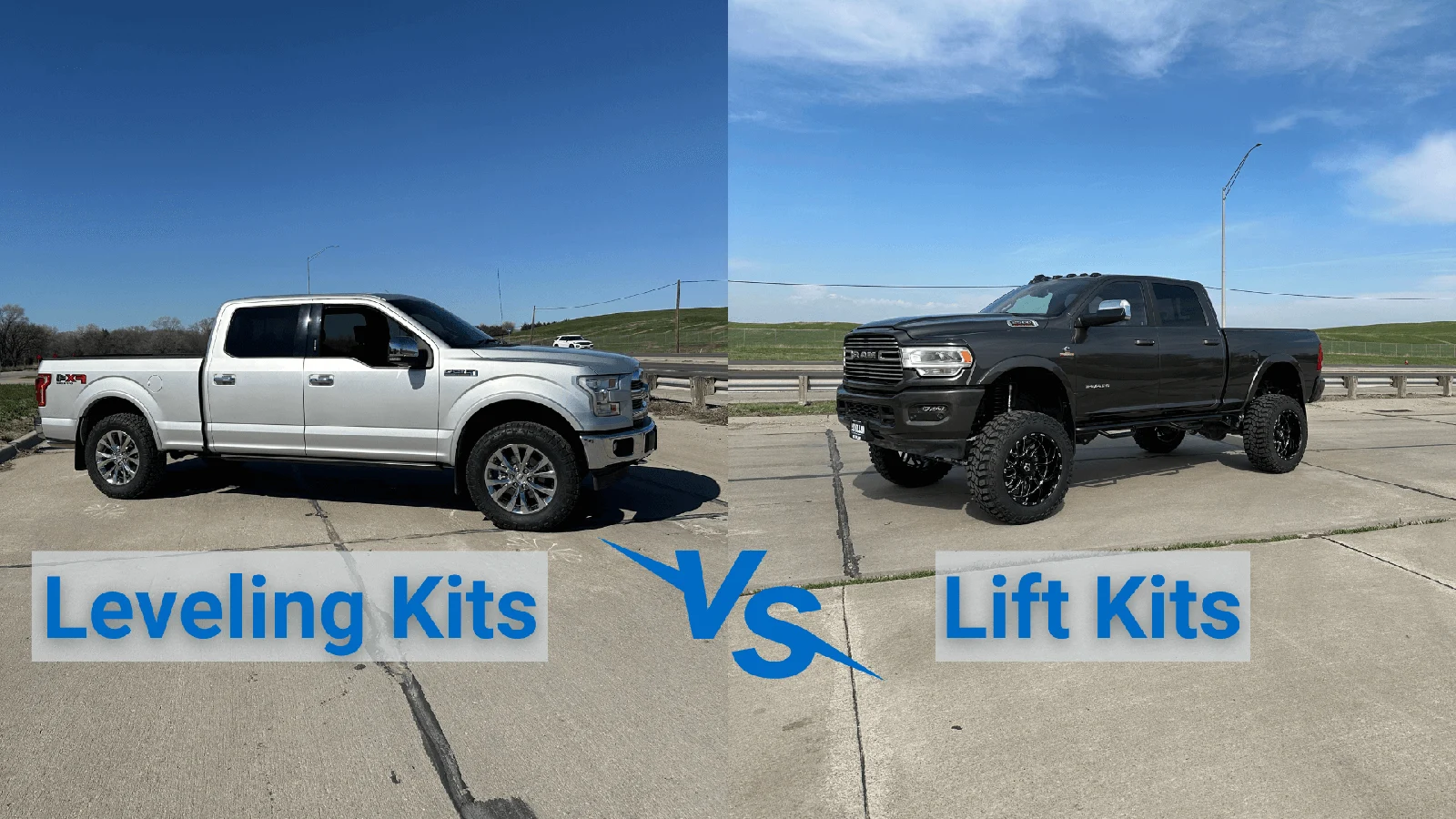
A leveling kit and a lift kit both raise part of a truck or SUV, but they solve different problems. A leveling kit usually adds height to the front so it sits closer to the rear, while a lift kit raises the body or suspension more broadly.
The right choice depends on tire size, off-road terrain, towing needs, suspension design, budget, and how much factory ride and handling you want to retain. The comparison below focuses on clearance, fitment, suspension behavior, installation, maintenance, and safety.
- ✓A leveling kit mainly corrects front-to-rear stance; a lift kit creates more overall clearance.
- ✓Neither option automatically improves suspension performance. Component quality and correct installation matter.
- ✓A leveling kit is usually the simpler choice for modest tire clearance and appearance changes.
- ✓A lift kit makes more sense for demanding off-road use, but it can require more supporting parts and alignment attention.
Lift Kits vs Leveling Kit: Main Differences
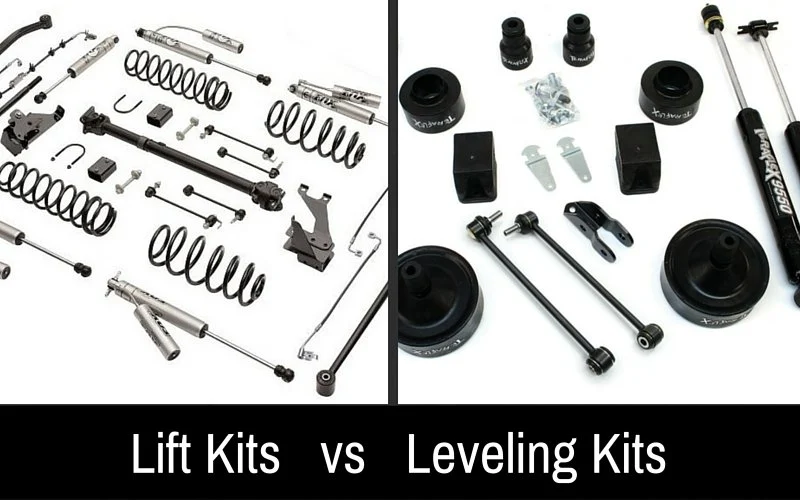
The main difference is how much of the vehicle is raised and why. A leveling kit typically increases front ride height to reduce the factory rake, while a lift kit raises the vehicle farther through suspension changes, body spacers, or a combination of both.
“Leveling kit” describes a purpose more than one universal design. A kit may use front strut spacers, coil spacers, torsion-bar adjustments, or replacement springs, depending on the vehicle. Lift kits also vary widely: a mild suspension lift is not equivalent to a high-clearance system with replacement control arms, shocks, steering components, and other supporting hardware.
| Criterion | Leveling kit | Lift kit |
|---|---|---|
| Primary purpose | Reduce the front-low stance and create modest additional front clearance. | Raise the vehicle for more overall ground, approach, and departure clearance. |
| Typical scope | Often focuses on the front suspension, though some kits include rear components. | Usually changes front and rear suspension height or uses a broader vehicle-lift design. |
| Tire fitment | May allow a modestly larger tire, subject to wheel offset, trimming, and suspension travel. | Generally offers more tire-clearance potential, but the result depends on lift design and vehicle geometry. |
| Ride and handling | Can stay close to factory behavior when properly matched to the vehicle and not overextended. | May alter steering response, ride quality, body roll, braking feel, and suspension travel. |
| Off-road benefit | Helps with front clearance and stance but does not automatically add major suspension capability. | Can improve clearance and tire placement, especially when paired with suitable suspension components. |
| Installation complexity | Often lower, but fitment and alignment still require careful attention. | Ranges from moderate to extensive, depending on height and included components. |
| Supporting parts | May need alignment correction, longer shocks, or other parts on some applications. | May require control arms, brake-line changes, driveline corrections, bump stops, shocks, or steering parts. |
| Best fit | Daily drivers seeking a more even stance and limited tire-clearance improvement. | Owners who need more clearance for trails, obstacles, larger tires, or a specific suspension setup. |
What a Leveling Kit Actually Changes
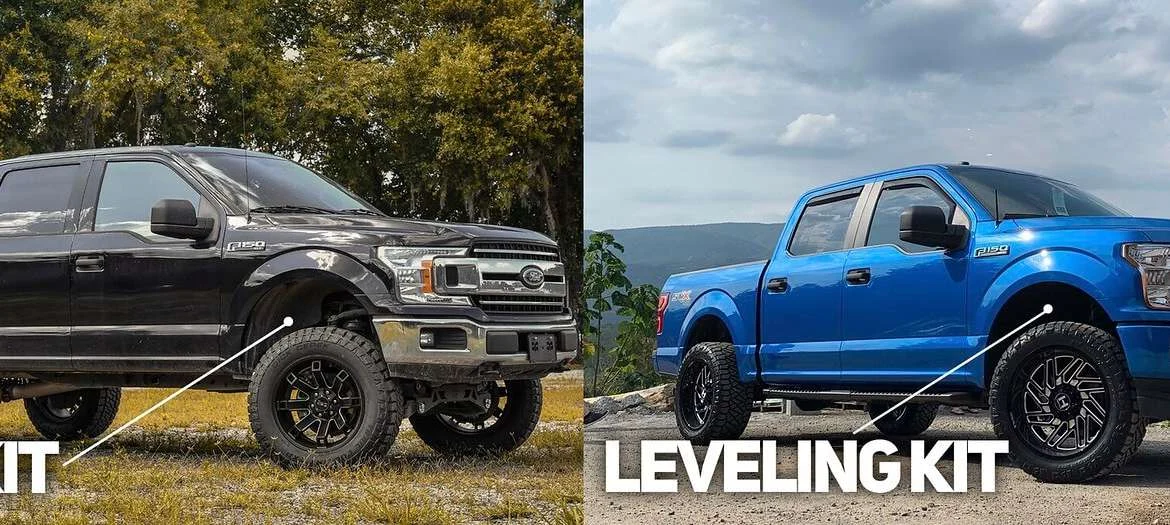
A leveling kit addresses the visual and functional difference between the front and rear ride heights. Many trucks are designed with some factory rake, meaning the rear sits higher when empty so the truck can carry cargo without appearing excessively low at the back.
Adding height to the front can make the truck appear more even. It may also create room for a different tire and wheel combination, but the actual clearance depends on steering angle, compression, wheel offset, tire construction, and the shape of the fender liner.
Common leveling-kit designs
Front strut spacers sit above or below a complete strut assembly on vehicles that use struts. Coil spacers fit with coil springs, while torsion-bar adjustments change the position of the front suspension on some older truck designs. These systems do not all affect suspension geometry in the same way.
A spacer raises the vehicle’s resting position, but it does not necessarily provide a longer spring, a longer shock, or more usable suspension travel. That distinction matters if the truck will leave the pavement regularly.
Where a leveling kit helps
- Stance: The truck can look less nose-down when unloaded.
- Front clearance: Extra front height may reduce contact with some approach obstacles.
- Tire fitment: A modest increase in clearance may support a larger tire, depending on the complete wheel-and-tire setup.
- Factory feel: A conservative kit can preserve more of the original driving character than a larger lift.
A leveling kit does not automatically increase payload, towing capacity, axle strength, or suspension load rating. It also cannot correct a worn spring, sagging component, accident damage, or a vehicle loaded beyond its design limits.
What a Lift Kit Adds Beyond Extra Height
A lift kit is a broader category that raises the vehicle to create more space beneath the chassis and around the tires. Depending on the design, it may change spring position, shock length, control-arm angles, axle location, steering geometry, and driveline alignment.
More height can help a truck clear rocks, ruts, and uneven ground, but height by itself is not the same as suspension capability. A properly designed system should match the vehicle’s suspension layout and the owner’s intended use rather than chase the largest possible number.
Suspension lifts and body lifts
A suspension lift changes the suspension’s relationship to the chassis and may provide more room for wheel movement. A body lift raises the body away from the frame with spacers but leaves much of the suspension geometry closer to stock. The two approaches have different effects on clearance, ride, steering, and appearance.
A suspension lift is usually the more relevant option for demanding trail use, but it can require more parts and adjustment. A body lift may create tire and fender clearance without providing the same increase in under-vehicle clearance.
Why supporting components matter
As lift height increases, original components may operate outside the angles and travel ranges intended by the manufacturer. Depending on the platform and kit, corrected control arms, longer shocks, brake-line extensions, bump-stop changes, track-bar correction, or driveline work may be needed.
Not every vehicle needs every part. The correct list depends on the suspension layout, the lift design, the tire size, and whether the truck has independent front suspension or a solid axle. A kit that includes the needed geometry corrections is generally easier to evaluate than a collection of unrelated spacers.
Ride, Handling, and Suspension Performance
A leveling kit often changes fewer suspension relationships than a taller lift, but it can still affect ride quality and handling. Raising the front may reduce available droop travel or increase operating angles if the original shocks and control arms remain in place.
A lift kit can produce a larger change in steering response, cornering behavior, ride firmness, and body motion. Those changes are not automatically defects; they are tradeoffs that should be expected when the vehicle’s center of gravity and suspension geometry move away from stock.
Daily driving and highway use
For commuting, family transportation, and regular highway travel, a moderate leveling kit is often the less disruptive path. It can meet a stance or tire-clearance goal without requiring as many changes to the rest of the vehicle.
A lift kit can still work well as a daily-driver setup when the kit is properly matched and aligned. A tall or poorly matched system may feel less settled, wear components faster, or produce a ride that does not suit a vehicle used mainly on pavement.
Off-road performance
More lift can help the chassis and body clear obstacles, but tire size, tire pressure, suspension travel, traction, approach angle, and driver technique also affect trail performance. A leveling kit may be enough for maintained gravel roads and light trail use, while more technical terrain can justify a suspension system designed for that work.
Extra static height does not guarantee more usable travel. If a lift limits droop, causes the suspension to bind, or leaves shocks too short, the vehicle may perform worse than expected despite sitting higher.
Tire and Wheel Fitment: The Part Many Buyers Miss
Neither a leveling kit nor a lift kit guarantees that a particular tire will fit. Tire diameter, section width, wheel width, wheel offset, backspacing, steering angle, suspension compression, and fender shape all influence clearance.
Two trucks with the same model name may have different fitment results because of trim, axle configuration, factory wheel design, brake hardware, or suspension differences. The kit’s application notes should be checked against the exact year, drivetrain, cab, and trim.
Leveling kits and modest tire changes
A leveling kit may create room at the front of the fender, but the tire can still contact the liner, mud flap, bumper, or control arm when the wheels are turned or the suspension compresses. Wheel offset can move the tire outward and create inner clearance while increasing the chance of outer fender contact.
Trimming is not always a flaw, but it should be planned rather than discovered after installation. The manufacturer’s stated tire guidance is a starting point, not a substitute for checking the full wheel-and-tire combination.
Lift kits and larger tires
A lift kit generally provides more tire room, but the extra clearance may come with new constraints. Larger tires add weight and can change acceleration, braking feel, steering effort, fuel use, and gearing. They can also place greater demands on wheel bearings, ball joints, axles, and steering components.
On independent front suspension vehicles, a lift may increase the importance of control-arm angles and alignment range. On solid-axle vehicles, axle centering and steering geometry may become more significant as height increases.
Installation, Alignment, and Long-Term Maintenance
Installation difficulty ranges from straightforward to involved for both choices. The vehicle’s design and the kit’s construction matter more than the label alone.
After installation, the vehicle should receive an alignment when the kit changes ride height or steering geometry. The alignment should be checked again if the truck pulls, the steering wheel is off-center, the tires wear unevenly, or the suspension produces unusual noise.
Leveling-kit maintenance
- Confirm that the spacer, spring, or torsion adjustment is appropriate for the vehicle.
- Inspect shock travel and suspension angles at full droop and compression.
- Check tire clearance with the wheels straight and turned in both directions.
- Torque fasteners according to the kit and vehicle instructions, not a generic estimate.
- Inspect for uneven tire wear and changes in steering feel after installation.
Lift-kit maintenance
- Inspect control arms, ball joints, tie-rod ends, track bars, bushings, and shock mounts.
- Check brake-line routing and confirm that lines do not become tight at full suspension travel.
- Look for driveline vibration if the lift changes shaft angles.
- Recheck fasteners after the initial driving period according to the manufacturer’s instructions.
- Monitor alignment and tire wear, especially after hard trail use or suspension impacts.
SAFETY NOTE: Never rely on a jack alone while working beneath a vehicle. Use suitable jack stands, support the vehicle at approved points, and follow the suspension manufacturer’s installation procedure.
Cost and Complexity Without a False Price Promise
A leveling kit often costs less to install because it may contain fewer parts and require less geometry correction. That is not guaranteed. A vehicle with difficult suspension access, electronic damping, or a more involved strut design can make even a modest height change labor-intensive.
Lift-kit cost is shaped by lift height, suspension type, included shocks, replacement arms, driveline corrections, wheel and tire changes, alignment, and any required trimming. The kit price alone does not represent the complete project.
A low-cost spacer system can become expensive if it requires replacement shocks, correction parts, repeated alignments, or repairs caused by incorrect installation. Conversely, a complete lift system may offer better value when it includes the components needed to maintain suitable suspension geometry.
Choosing Between a Leveling Kit and a Lift Kit
The better option follows the job, not the appearance alone. Start by identifying the problem the truck needs to solve: an uneven empty stance, tire clearance, trail obstacles, suspension travel, or a particular load and wheel combination.
Choose a leveling kit when
- The main goal is reducing the front-low appearance of an unloaded truck.
- The vehicle is used mostly on pavement, gravel, or mild trails.
- A modest tire or wheel change is planned and the full combination fits after careful checking.
- Keeping factory-like ride and handling is more important than maximum clearance.
- The owner wants a smaller project with fewer supporting changes.
Choose a lift kit when
- Additional underbody, approach, departure, or breakover clearance is needed.
- The truck regularly travels on rough trails where a leveling kit leaves too little room.
- A larger tire requires more clearance than a front spacer can reasonably provide.
- The owner is prepared to address alignment, suspension geometry, driveline angles, and related parts.
- The selected kit is designed for the vehicle and intended use rather than chosen only for height.
If the truck carries heavy front accessories such as a winch, plow, or steel bumper, the correct spring rate may matter more than a simple spacer. Added equipment can change ride height and suspension behavior, so the kit should account for the actual load.
Common Mistakes With Both Options
The most common mistake is treating ride height as a complete suspension upgrade. A taller truck may look different without gaining better damping, stronger parts, more travel, or improved traction.
Another mistake is selecting a tire first and assuming any advertised lift will make it fit. The wheel, tire, suspension, fender, and steering-clearance checks need to be considered as one system.
Buying mistakes to avoid
- Ignoring exact vehicle fitment, including drivetrain, trim, and suspension configuration.
- Assuming a kit’s advertised height will be identical on every vehicle.
- Using original shocks when the new ride height leaves insufficient travel.
- Skipping alignment because the vehicle still drives straight after installation.
- Choosing a kit without checking whether brake lines, control arms, or driveline parts need correction.
- Assuming a larger tire will not affect braking, gearing, steering, or component wear.
- Mixing parts from different systems without confirming that their geometry is compatible.
Local inspection, lighting, bumper-height, tire-coverage, and modification rules can also apply. Requirements vary by state and vehicle type, so legal compliance should be checked before installation.
FAQs About lift kits vs leveling kit
Is a leveling kit the same as a lift kit?
No. A leveling kit usually raises the front to reduce factory rake, while a lift kit raises the vehicle more broadly for additional clearance. Some leveling kits technically add lift, but their purpose and scope are usually smaller.
Does a leveling kit improve off-road performance?
It can improve front clearance and may help accommodate a suitable tire, but it does not automatically add suspension travel or stronger components. Its benefit is usually modest compared with a properly designed off-road lift system.
Can a leveling kit fit larger tires?
It may, but fitment depends on tire width, wheel offset, steering angle, suspension compression, and fender shape. Check the complete wheel-and-tire setup rather than relying on the leveling height alone.
Will a lift kit make a truck ride worse?
Not necessarily, but a lift can change ride quality, steering response, body motion, and suspension angles. Results depend on the design, components, height, installation, and how closely the setup matches the vehicle’s use.
Do both modifications require an alignment?
An alignment is generally appropriate when ride height or steering geometry changes. It is especially important if the steering wheel is no longer centered, the vehicle pulls, or tire wear changes after installation.
Is a leveling kit better for towing?
Not by itself. A leveling kit does not increase payload or towing capacity, and raising the front can change the vehicle’s attitude when loaded. Towing decisions should follow the truck’s ratings and the complete suspension setup.
Should a daily driver get a lift kit or a leveling kit?
A leveling kit is often the better fit when the goal is stance and modest tire clearance with limited change to daily driving. A lift kit can suit a daily driver that also needs trail clearance, provided the owner accepts the added complexity and checks the resulting handling and fitment.
Conclusion
Lift kits vs leveling kit is not a contest with one universal winner. A leveling kit is the more sensible choice for correcting a nose-down stance, making a modest tire change, and keeping the project relatively restrained. A lift kit is better suited to owners who need more clearance for rough trails, larger tires, or a purpose-built suspension setup.
Both options require exact fitment checks, correct installation, alignment, and realistic expectations. Neither modification increases the truck’s factory payload or towing rating, and extra height alone does not guarantee better off-road performance.
Define the tire, terrain, and load goal first; choose a leveling kit for a modest stance correction, or a complete lift system when the vehicle truly needs broader clearance and suspension changes.