Yes, nearly all modern passenger cars have shock absorbers or another suspension component that performs the same damping function. Some cars use separate shocks, while others use struts that combine several suspension functions.
On American roads, a car may face potholes, rough pavement, speed bumps, and uneven highway surfaces. Its suspension helps the wheels move over these bumps while the body stays more stable. Shock absorbers play a key role by controlling how quickly the suspension moves after a bump.
The confusing part is that not every car has a separate shock absorber at each wheel. Many vehicles sold in the United States use MacPherson struts at the front, separate shocks at the rear, or other suspension designs. A strut contains a damping unit and also supports or locates parts of the suspension, so it can do more than a conventional shock absorber.
This guide explains why nearly all road cars need suspension damping, how shocks differ from struts, where these parts are found, and how to tell when they may need attention. It also covers unusual suspension designs and practical safety checks for car owners.
Almost all modern passenger cars have a suspension damping system. This includes conventional gasoline cars, diesel cars, hybrids, and electric vehicles. Most use hydraulic shock absorbers, struts, or comparable components to control wheel movement and reduce unwanted body motion.
However, the answer depends on what you mean by a shock absorber. If you mean a separate component commonly sold as a shock, not every car has one at every wheel. If you mean a device that controls suspension movement, nearly every modern road car has one or an equivalent system.
A vehicle without adequate suspension damping would tend to keep bouncing after hitting a bump. Its tires could lose consistent contact with the pavement, and the driver could find it harder to maintain control. That is why damping is a basic feature of conventional road-car suspension.
Source: blog.torqueusa.com
Most passenger cars
Use hydraulic shock absorbers, struts, or a combination of the two to control suspension movement.
Cars with MacPherson struts
Often use struts at the front and separate shock absorbers at the rear, although designs vary.
Cars with specialized suspension
May use adaptive dampers, air suspension with dampers, or other systems that provide the same basic control function.
Older or unusual vehicles
May have different suspension layouts, but conventional road vehicles generally need a way to control spring movement.
Why Cars Need Suspension Damping
A car’s springs compress when a wheel passes over a bump. After the wheel clears the bump, the springs release energy and push the suspension back toward its normal position. Without damping, the springs can continue moving up and down for too long.
A shock absorber controls this motion. It converts some of the suspension’s movement energy into heat, usually by forcing hydraulic fluid through small internal passages or valves. This helps the suspension settle sooner instead of allowing repeated bouncing.
Damping also helps the tires follow uneven road surfaces. Good tire contact matters because the tires must transmit steering, braking, and driving forces to the road. Shock absorbers do not create grip on their own, but they help the suspension maintain more consistent contact.
Body control
Damping helps reduce repeated bouncing after bumps and limits unwanted body motion.
Tire contact
It helps the wheels follow road changes instead of allowing uncontrolled suspension movement.
Handling
It supports predictable steering and vehicle stability during turns and sudden maneuvers.
How Many Shock Absorbers Does a Car Have?
Many cars have four suspension damping units, but the number of separate shock absorbers depends on the suspension design. Some vehicles have four conventional shocks, some use four struts, and others combine front struts with rear shocks.
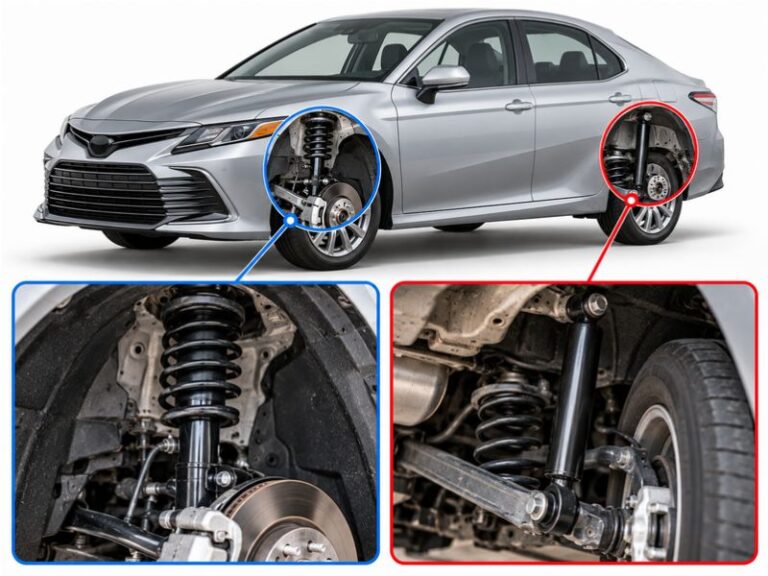
A common arrangement on front-wheel-drive passenger cars is a MacPherson strut at each front wheel and a separate shock absorber at each rear wheel. Other vehicles use struts at all four corners, while some use separate shocks at both the front and rear.
The number of visible shock absorbers is not always the same as the number of damping units. A strut contains a damper, so a car with two front struts and two rear shocks still has four damped suspension corners, even though only two components may be described as separate shocks.
Source: nbmaxauto.com
Four separate shocks
A suspension layout that uses one conventional shock absorber at each wheel.
Four struts
A layout in which each wheel uses a strut assembly that provides damping and structural suspension support.
Two front struts and two rear shocks
A common arrangement on many passenger cars, though the exact setup varies by model.
How to Find the Correct Number for Your Car
Check the owner’s manual, the manufacturer’s service information, or a parts catalog that matches your car’s exact model year and trim. If the vehicle has optional sport suspension, adaptive damping, or a special rear suspension package, the parts may differ from those used on the base model.
You can also have a repair shop identify the suspension layout during an inspection. Do not assume that every car has four identical shock absorbers or that a component described as a strut can be replaced with a conventional shock.
Identify the vehicle
Record the make, model, year, trim, and any factory suspension options.
Check the parts diagram
Look for separate shock absorbers, strut assemblies, and any integrated damping components.
Confirm fitment
Verify the exact part numbers before buying or installing replacement components.
What Is the Difference Between Shock Absorbers and Struts?
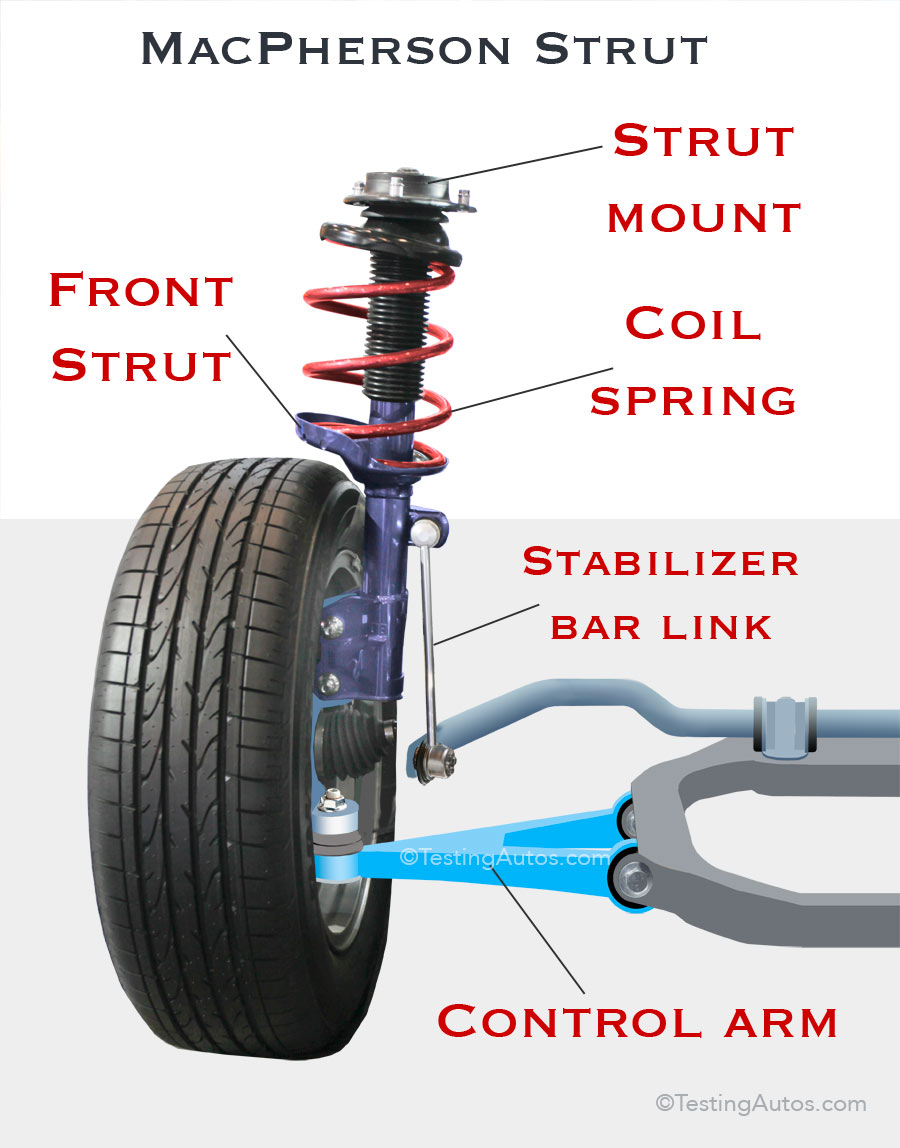
Shock absorbers and struts both help control suspension movement, but they are not interchangeable terms. A conventional shock absorber primarily provides damping. A strut provides damping and also forms a structural part of the suspension assembly.
On many vehicles, the front strut helps locate the wheel and supports the steering knuckle. The coil spring may sit around the strut, and the upper mount connects the assembly to the vehicle body. Because the strut serves structural functions, removing it can affect wheel alignment and may require a specific repair procedure.
A conventional shock absorber usually attaches between suspension components and the vehicle body or frame. It controls movement but does not normally replace the structural role of a strut. The precise mounting arrangement varies by vehicle.
Source: Vecteezy
Shock absorber
Primarily controls suspension motion through hydraulic, gas-pressure, or other damping mechanisms.
Strut
Combines a damping function with a structural role in locating and supporting suspension components.
Coil spring
Supports vehicle weight and compresses or extends as the wheel moves over bumps.
Suspension mount
Connects suspension components to the body and may include rubber or other materials to reduce noise and vibration.
Can a Car Have Struts Instead of Shock Absorbers?
A car can use struts instead of separate conventional shock absorbers at some or all wheels. However, a strut still contains a damping element, so it is not a suspension system without shock absorption.
For example, a car with front MacPherson struts and rear shocks uses two different types of assemblies. Both the front and rear systems control suspension motion, but their mounting, structural duties, and replacement procedures differ.
When shopping for parts, use the name specified in the vehicle’s service information. Buying a shock absorber when the vehicle requires a complete strut assembly, or confusing a strut insert with a complete assembly, can lead to an incorrect repair.
Front suspension
Often uses struts, double-wishbone components with separate dampers, or another design.
Rear suspension
May use separate shocks, struts, or dampers integrated into a more complex assembly.
Do Electric Cars and Hybrid Cars Have Shock Absorbers?
Yes. Most electric and hybrid passenger cars use shock absorbers, struts, or other suspension dampers just like conventional gasoline cars. Their powertrains differ, but their wheels still need to move over uneven roads while the body remains controlled.
Electric vehicles can be relatively heavy because of their battery packs. Their suspension must be designed for the vehicle’s weight, weight distribution, wheel travel, and handling targets. The exact damping setup depends on the model rather than on the fact that the car uses electricity.
Some electric and hybrid models offer adaptive dampers or air suspension. These systems can change damping characteristics or ride height under certain conditions. They still need to control wheel and body motion, and they require compatible replacement parts and diagnostic procedures.
Source: carandtruck.org
Electric cars
Usually use conventional or electronically controlled dampers matched to the vehicle’s mass and suspension design.
Hybrid cars
Use suspension damping similar to other passenger vehicles, with exact parts determined by the model.
Performance models
May use adjustable damping systems designed to balance comfort and handling.
Air-suspension vehicles
Use air springs for support and separate or integrated dampers to control motion.
What About Cars With Active or Adaptive Suspension?
Adaptive suspension changes damping in response to driver settings or vehicle inputs. Depending on the design, electronic controls can adjust valves within the dampers to change how strongly suspension movement is resisted.
Active suspension is a broader term for systems that can control suspension forces or vehicle body movement more directly. Some designs combine springs, dampers, sensors, and powered actuators. Their complexity does not remove the need to control wheel movement.
Because these systems may use electrical connectors, sensors, control modules, and model-specific calibration, suspension diagnosis should follow the manufacturer’s service procedure. A generic replacement damper may not work correctly in an electronically controlled system.
Variable damping
The system changes resistance to suspension movement as conditions or settings change.
Electronic controls
Sensors and control modules may be used to adjust the damping response.
Special service needs
Some systems require fault-code checks, calibration, or ride-height procedures after repairs.
What Happens If a Car Does Not Have Working Shock Absorbers?
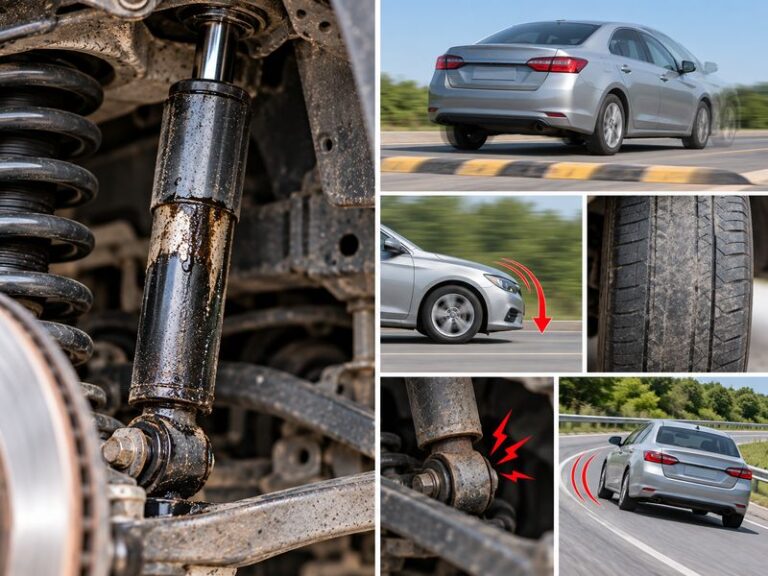
If a car’s shock absorbers or strut dampers stop working properly, the suspension may bounce excessively, tires may struggle to maintain steady road contact, and handling may become less predictable. The effects depend on the severity of the fault and the rest of the suspension system.
A worn damper does not always cause an obvious problem at low speed. A car may still drive, but the driver may notice more movement after bumps, extra body roll, or a less settled feel on uneven roads. These changes can become more concerning during hard braking, evasive maneuvers, or travel over rough surfaces.
Faulty dampers can also contribute to uneven tire wear, although alignment problems, worn bushings, incorrect tire pressure, and damaged tires can cause similar patterns. A proper inspection should look at the entire suspension and tires rather than replacing parts based on one symptom.
Source: mitmunk.com
Repeated bouncing
The vehicle continues moving up and down after a bump instead of settling promptly.
Poor body control
The car may pitch more during braking or feel less settled during turns.
Tire wear
Some damper faults can contribute to irregular wear or cupping, but other causes must be checked.
Fluid leakage
A wet, oily film or visible fluid running from a damper can indicate a seal problem; a light surface film alone is not always proof of failure.
Unusual noises
Clunks or knocks may come from mounts, bushings, links, loose fasteners, or other suspension parts rather than the damper itself.
Can Bad Shock Absorbers Make a Car Unsafe?
Yes, severely worn or damaged shock absorbers can reduce vehicle stability and affect tire contact with the road. They may also make the car less predictable during sudden steering changes or hard braking. The level of risk depends on the fault, speed, road surface, tires, and vehicle design.
If a suspension component is broken, a wheel is visibly out of position, a tire rubs against the body, or the vehicle is difficult to control, stop driving when it is safe to do so and arrange professional assistance. Do not continue driving simply because the engine and brakes still work.
For less severe symptoms, arrange an inspection soon. A technician can check the dampers, springs, mounts, bushings, tires, and alignment to identify the actual cause before recommending repairs.
Stop and seek help
Do this when there is severe instability, a broken suspension part, a displaced wheel, or tire interference.
Schedule an inspection
Arrange a prompt check for repeated bouncing, worsening handling, persistent leaks, or unusual suspension noise.
How to Check Whether Your Car Has Shock Absorbers
The easiest way to identify your car’s suspension design is to check the owner’s manual, a reliable parts catalog, or manufacturer service information. These sources can show whether the vehicle uses separate shocks, struts, or an electronic suspension system.
A visual inspection may also help, but many suspension parts sit behind the wheels, inside wheel wells, or under body panels. Do not crawl beneath a car supported only by a jack. If you cannot see the components safely from outside the vehicle, leave the inspection to a qualified technician.
Source: testingautos.com
Step 1: Find the vehicle details
Record the make, model, model year, trim, and any suspension options.
Step 2: Consult reliable information
Use the owner’s manual, manufacturer service information, or a vehicle-specific parts diagram.
Step 3: Identify the suspension layout
Look for separate shock absorbers, strut assemblies, or electronic damping components in the diagram.
Step 4: Look for visible damage
From a safe position, check for obvious leaks, broken parts, or abnormal vehicle height without reaching into moving or unsupported areas.
Step 5: Arrange a professional inspection
Ask a qualified technician to confirm any suspected fault and explain which component needs repair.
Should You Use the Bounce Test?
A traditional bounce test involves pressing down on a corner of the vehicle and observing how the body returns. Repeated bouncing may suggest weak damping, but this test cannot reliably diagnose every modern suspension system.
Some vehicles have stiff springs, different suspension geometries, or electronically controlled dampers that make the result hard to interpret. A car may also have a defective damper without showing an obvious result during a simple bounce test.
Use the test only if the vehicle manufacturer permits it and the car is parked on a level surface with the parking brake applied. Never place your hands or body near moving suspension parts. A professional inspection is more reliable when symptoms persist or safety is in doubt.
Excessive bouncing may indicate a damping problem, especially when paired with other symptoms.
Important limitation
A normal-looking bounce response does not prove that the dampers are in good condition.
Do Shock Absorbers Need to Be Replaced on Every Car?
Shock absorbers and struts are wear items, but they do not all fail at the same mileage. Their service life depends on road conditions, vehicle load, driving habits, climate, part quality, and the suspension design. A car driven often on rough roads may wear its dampers faster than one used mostly on smooth highways.
There is no single replacement interval that applies to every car. Follow the vehicle manufacturer’s maintenance guidance and have the suspension checked when symptoms appear. Do not replace dampers solely because the odometer has reached a mileage figure taken from another vehicle.
When one damper fails, the condition of the unit on the opposite side of the same axle should also be assessed. Replacing dampers in axle pairs is often recommended because a large difference in damping between the left and right sides can affect balance. The correct repair depends on the vehicle, component condition, and manufacturer’s guidance.
Source: deinfa.com
Mileage
High mileage can increase wear, but mileage alone does not confirm damper failure.
Road conditions
Potholes, rough pavement, and repeated heavy impacts can place greater demands on suspension components.
Vehicle load
Frequent heavy loads or towing, where permitted, may increase suspension demands.
Physical condition
Leaks, damaged mounts, bent parts, and poor damping performance warrant inspection.
Should Shock Absorbers Be Replaced in Pairs?
Replacing shock absorbers or struts in pairs across the same axle is commonly recommended when one side has failed or worn substantially. This helps maintain a more consistent response between the two sides of the vehicle.
However, the exact repair should follow the manufacturer’s instructions. Some systems require additional parts, electronic setup, wheel alignment, or calibration. A technician should also check whether damage to one unit has affected mounts, springs, tires, or other suspension components.
Assess both sides
Check the matching component on the other side of the axle before deciding on repairs.
Inspect related parts
Look for worn mounts, damaged springs, loose bushings, and tire wear that may affect performance.
Follow the service procedure
Use the correct parts, torque specifications, and calibration steps for the vehicle.
Common Misunderstandings About Car Shock Absorbers
Confusion about suspension parts can lead to wrong diagnoses or incorrect replacement purchases. Knowing the basic differences helps drivers ask better questions and understand repair estimates.
The most useful rule is to identify the component fitted to the exact vehicle rather than rely on a generic description. Shock absorbers, struts, springs, and electronic dampers have related jobs, but they do not all perform the same function.
Source: i.pinimg.com
Myth: Every car has four separate shocks
Fact: Many cars have two struts and two separate shocks, while other layouts use different combinations.
Myth: Struts and shocks are exactly the same
Fact: Both provide damping, but a strut also performs a structural suspension function.
Myth: Electric cars do not need shocks
Fact: Most electric cars use dampers or equivalent systems to control suspension movement.
Myth: A small leak always means immediate failure
Fact: A technician must assess the amount of leakage, the component design, and damping performance.
Myth: A car is safe as long as it still drives
Fact: A vehicle can remain mobile while having suspension damage that affects control and stability.
Myth: All suspension parts fit the same way
Fact: Suspension design, electronic features, trim level, and model year can change fitment and service requirements.
What Information Should You Give a Mechanic?
Describe the symptoms, when they occur, and whether they began after hitting a pothole or having other work done. Mention repeated bouncing, clunks, visible leaks, uneven tire wear, or changes in vehicle height. This information helps the technician narrow the inspection.
Ask which component is faulty, what evidence supports the diagnosis, and whether the repair requires alignment or electronic calibration. A clear explanation helps distinguish a failed damper from a problem with a spring, mount, bushing, tire, or alignment.
Share the symptoms
Explain what you feel, hear, or see and when it happens.
Request a clear diagnosis
Ask the technician to identify the failed part and any related damage.
Confirm the repair requirements
Check whether paired replacement, alignment, calibration, or additional components are needed.
A Practical Comparison of Common Suspension Setups
The table below compares common suspension damping arrangements. These are general examples, not a specification for every vehicle in a category. The exact layout should be verified using the manufacturer’s information for the individual car.
Source: liveabout.com
Front struts and rear shocks
The front uses structural strut assemblies, while separate shocks control movement at the rear.
Struts at all four corners
All four corners use strut assemblies that combine damping with a structural suspension role.
Separate shocks at all four corners
The suspension uses conventional dampers separate from its main structural locating components.
Adaptive or air suspension
Damping may be electronically controlled or paired with air springs, depending on the design.
Which Setup Is Best?
There is no single best suspension layout for every car. A conventional shock arrangement can be simple to service, while a strut can combine several functions in a compact package. Adaptive systems can adjust damping, but they may require more specialized diagnosis and parts.
Ride comfort and handling depend on the complete suspension design, including spring rates, damping settings, geometry, tires, bushings, and vehicle weight. The number of separate shock absorbers does not by itself show whether a car rides well or handles safely.
For routine maintenance
Choose replacement parts that match the original specification and intended vehicle use.
For ride or handling changes
Check compatibility with springs, tires, vehicle load, and electronic suspension features before changing parts.
Research Notes and Next-Question Gap Map
The central reader question is whether every car has shock absorbers. The key distinction is between a separate shock absorber and the broader damping function provided by a shock, strut, or specialized suspension system.
The following editorial gap map separates practical questions inferred from the main topic from questions that would need direct search-result or community research to establish that people are actively asking them. No live search-volume figures, search rankings, or People Also Ask findings are claimed here.
Source: gdstauto.com
Question: Does my car have shocks or struts?
Stage: Identification. Basis: Inferred next need. Coverage in this article: Answered with instructions to check vehicle-specific service information. Reader benefit: Helps avoid buying the wrong part. Priority: High.
Question: Can I drive with bad shocks?
Stage: Safety decision. Basis: Inferred next need. Coverage in this article: Answered with warning signs and guidance on when to stop driving. Reader benefit: Helps identify potentially unsafe suspension damage. Priority: High.
Question: How many shocks does my specific model have?
Stage: Repair planning. Basis: Inferred next need. Coverage in this article: General answer provided, but exact model-specific layouts are not established. Reader benefit: Directs the reader to accurate parts information. Priority: Medium.
Stage: Maintenance. Basis: Inferred next need. Coverage in this article: Answered with condition-based guidance and manufacturer recommendations. Reader benefit: Reduces unnecessary replacement and helps identify wear. Priority: High.
Question: Are shocks and struts interchangeable?
Stage: Parts selection. Basis: Inferred next need. Coverage in this article: Answered by explaining their different functions and fitment requirements. Reader benefit: Prevents incorrect parts selection. Priority: High.
Research Scope and Evidence Limits
This article provides a general technical explanation of conventional automotive suspension systems. It does not claim that a live review of three to five competing pages, current search features, manufacturer manuals for a specific vehicle, or first-hand vehicle testing was completed. No individual car’s suspension layout or failure condition can be confirmed without vehicle-specific information.
For a model-specific answer, the strongest next source is the manufacturer’s service documentation or a verified parts diagram matched to the vehicle’s model year and trim. Safety-related repair instructions should also be checked against the correct service procedure.
Documented general principle
Conventional passenger cars use suspension damping to control spring and wheel movement.
Vehicle-specific fact requiring verification
The number, type, location, and service procedure of the damping units depend on the exact suspension design.
Not established by this article
A specific car’s damper condition, remaining service life, or exact replacement interval cannot be established from general symptoms alone.
Frequently Asked Questions
Q
Do all cars have four shock absorbers?
No, not all cars have four separate shock absorbers. Many use two front struts and two rear shocks, while others have struts at all four corners or a different suspension layout. Nearly all modern passenger cars have a damping system at each wheel, but the exact components vary.
Q
Can a car have struts instead of shocks?
Yes. Many cars use struts instead of separate conventional shock absorbers at the front, rear, or all four corners. A strut contains a damper and also serves a structural role in the suspension. It therefore provides shock absorption even though it is not a separate conventional shock.
Q
Do electric cars have shock absorbers?
Yes. Most electric cars use shock absorbers, struts, adaptive dampers, or other suspension systems that control wheel and body movement. The battery and electric motor affect the vehicle’s design requirements, but they do not remove the need for suspension damping.
Q
Can you drive a car with a broken shock absorber?
A car may still move with a damaged shock absorber, but that does not mean it is safe to drive. Severe damage can affect tire contact, handling, and stability. If the car is difficult to control, a wheel is displaced, or a suspension part is broken, stop when safe and arrange professional assistance.
Q
How do I know if my car’s shock absorbers are bad?
Common warning signs include repeated bouncing, increased body movement, visible fluid leakage, uneven tire wear, and unusual suspension noises. These symptoms can also come from other suspension or tire problems. A qualified technician should inspect the dampers and related components before confirming the cause.
Q
Are shock absorbers the same as suspension springs?
No. Springs support vehicle weight and compress or extend as the wheels move. Shock absorbers control the speed of that movement by dissipating energy. Both parts work together, but one cannot perform the full job of the other in a conventional suspension system.
Q
Do all cars use hydraulic shock absorbers?
Many conventional cars use hydraulic dampers, often with gas pressure to support consistent operation. Other vehicles use electronically controlled dampers or specialized active suspension systems. The design differs, but road cars still need a way to control suspension movement.
Q
Should I replace all four shock absorbers at once?
Not always. The condition of each damper should be assessed, and replacing matching components in pairs across the same axle is commonly recommended when one has failed. Replacing all four may be appropriate in some cases, but the decision should follow the vehicle manufacturer’s guidance and the inspection findings.
✦ Wrapping Up
Conclusion
Nearly all modern passenger cars have shock absorbers or another type of suspension damper. The main difference is how the damping system is built. Some cars use four separate shocks, others use struts, and many combine front struts with rear shocks.
Shock absorbers and struts help control bouncing, keep the tires in contact with the road, and support predictable handling. When these parts wear or become damaged, the car may feel less stable, develop unusual noises, or show uneven tire wear. Those signs deserve attention, but a proper inspection is needed to identify the cause.
The best way to confirm which components your car has is to check its exact model-year service information or a reliable parts diagram. If you notice severe bouncing, visible damage, or a sudden change in handling, arrange a suspension inspection instead of relying on appearance alone.
💡 Key Takeaway
Check the owner’s manual or a vehicle-specific parts diagram to confirm whether your car uses separate shock absorbers, struts, or adaptive dampers. If you notice signs of suspension trouble, have the system inspected by a qualified technician.
Eric
Hi, I’m Eric Bennett, the person behind OffRoadTruckAccessories.com.
I created this blog to share my interest in trucks, off-road driving, automotive accessories, and DIY modifications. I enjoy learning how different truck accessories work, testing their usefulness, and understanding whether they are truly worth buying.
Shock absorbers are located near the wheels as part of the suspension system, usually between the vehicle’s body, frame, or subframe and a suspension component such as a control arm, axle, or wheel assembly. However, the exact answer to where are shock absorbers located on a car depends on the suspension design. Some vehicles have…
You should change shock absorbers when they are worn, leaking, damaged, or no longer controlling suspension movement properly. There is no single replacement interval that applies to every vehicle because shock absorber life depends on road conditions, vehicle weight, driving habits, suspension design, and component quality. If you are wondering when to change shock absorbers,…