Can Bad Struts Cause Grinding Noise? Real Risks, Common Mistakes
Yes, damaged struts can cause a grinding noise, but worn mounts, bearings, springs, brakes, or wheel hubs may sound similar.
Struts support the vehicle’s weight, control spring movement, and help keep the tires planted during braking, steering, and uneven-road travel. A failed strut usually causes clunking, knocking, leaking fluid, or a bouncy ride, but grinding can occur when a strut mount bearing, spring seat, or nearby component is damaged.
The sound’s timing matters. Noise during turning points toward a strut mount bearing or coil spring problem, while grinding that follows wheel speed may indicate a brake shield, wheel bearing, or brake component instead.
A careful inspection can separate a suspension fault from a more urgent brake or wheel problem. The checks below explain what to listen for, which parts can mimic strut noise, and when driving should stop.
- ✓Bad struts can cause grinding, especially when the upper mount bearing or spring seat is damaged.
- ✓Grinding during braking, turning, or straight-line driving points to different likely causes.
- ✓A leaking or weak strut should be repaired, but severe wheel, brake, or steering symptoms require immediate attention.
- ✓Do not replace struts based on sound alone; inspect the entire corner of the suspension and wheel assembly.
How Struts Produce Grinding or Rubbing Noises
A vehicle strut combines a shock absorber with a structural suspension member. The shock absorber controls spring movement, while the coil spring carries the vehicle’s weight and the upper strut mount connects the assembly to the body.
Grinding usually means two surfaces are rubbing without proper lubrication or clearance. A damaged strut mount bearing can bind as the steering turns, and a broken spring can rub against the spring seat or nearby suspension hardware.
The shock absorber itself commonly loses damping fluid rather than producing a true metal-on-metal grind. However, a severely worn strut can allow excess movement, causing the spring, mount, tire, or other suspension parts to contact surrounding components.
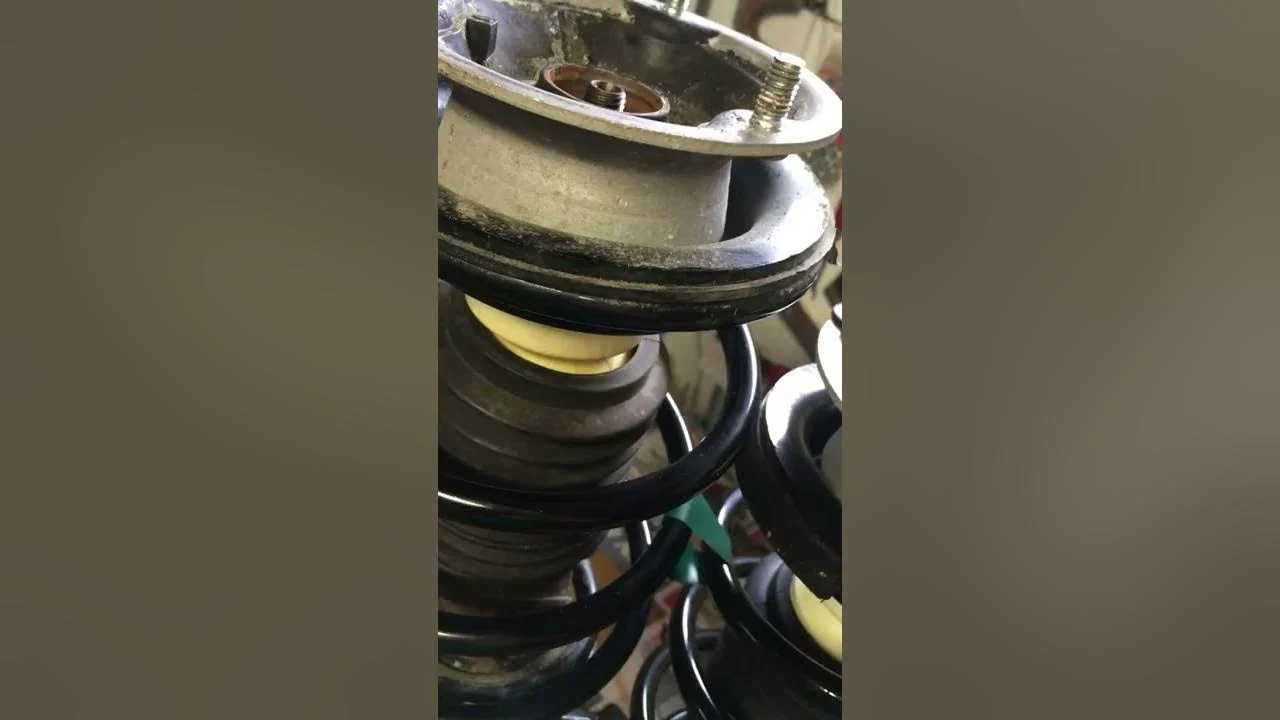
Strut mount bearing noise during steering
Many front struts use a bearing in the upper mount so the strut assembly can rotate with the steering. When that bearing wears, the spring may wind up and release instead of turning smoothly.
The result may sound like grinding, groaning, popping, or a rough rubbing noise near the top of the wheel well. The noise often appears while turning the steering wheel at low speed or while the vehicle is stationary.
Broken coil spring contact
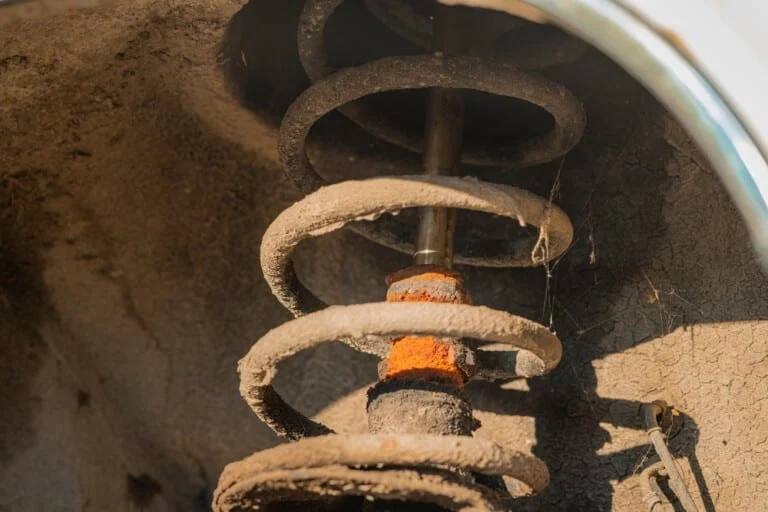
A coil spring can crack near its end, where corrosion and stress are common. The broken section may shift in the spring seat and scrape against metal during steering, braking, or bumps.
A broken spring can also change ride height and leave the vehicle leaning on one side. The damaged spring may puncture a tire or allow the suspension to move outside its normal range, so this condition should not be ignored.
Can Bad Struts Cause Grinding Noise Under Different Conditions?
Noise behavior provides useful clues, but it does not identify a part with certainty. A road test should be followed by an inspection because several components share the same area and can transmit sound through the body.
Pay attention to whether the noise changes with steering angle, vehicle speed, braking force, bumps, or engine load. A noise that follows wheel rotation is usually more suspicious for a brake, bearing, tire, or shield problem than for the hydraulic part of a strut.
Never place a hand near a moving wheel or suspension assembly during testing. If the vehicle must be raised, use a level surface, properly rated jack stands, and wheel chocks rather than relying on a jack alone.
| When the noise occurs | Possible strut-related cause | Other likely causes |
|---|---|---|
| Turning at low speed | Upper strut mount bearing, spring binding, or broken spring | Outer tie-rod end, ball joint, steering gear, or tire rubbing |
| Driving over bumps | Loose mount, worn strut, damaged spring seat, or broken spring | Sway bar link, control arm bushing, ball joint, or loose underbody panel |
| Braking or accelerating | Loose strut hardware or excessive suspension movement | Brake hardware, control arm bushing, engine mount, or wheel bearing |
| Constantly with road speed | Strut contact caused by a shifted or broken part | Wheel bearing, brake shield, brake rotor, tire, or axle component |
| At a standstill while steering | Strut mount bearing or coil spring wind-up | Steering linkage, power steering system, or tire-to-ground scrub |
Grinding during turns
Noise during turns is one of the stronger clues for a front strut mount or bearing problem. The spring may twist and release in small jumps, creating a rough sound or a feeling of resistance in the steering wheel.
Check for tire contact inside the wheel well as well. Incorrect tire size, a bent suspension part, a sagging spring, or a damaged fender liner can create rubbing that sounds like a strut fault.
Grinding over bumps
Bump-related noise can come from a loose upper mount, worn strut hardware, or a spring that has shifted in its seat. A weak strut more often causes repeated bouncing and a dull knock than a continuous grinding sound.
Other suspension parts deserve equal attention. Stabilizer-bar links, control-arm bushings, ball joints, and loose brake shields can all make noise when the wheel moves through its travel.
Grinding that follows wheel speed
A rotating noise that becomes faster as the vehicle speeds up commonly points to the wheel end rather than the strut. A failing wheel bearing may produce a growl, while a bent dust shield can scrape against the rotor.
Brake pads worn down to the backing plate can create severe metal-on-metal grinding. That problem can reduce braking performance and damage the rotor, so brake-related noise should be checked promptly.
Signs That a Strut Is Actually Worn
Sound alone is not enough to condemn a strut. A proper diagnosis combines the noise with visible leakage, ride-quality changes, tire wear, steering behavior, and the condition of the spring and mounting hardware.
Most struts gradually lose damping rather than failing in one dramatic moment. The vehicle may still move normally while stopping distance, corner control, and tire contact become less consistent.
Compare the left and right sides, but do not assume both parts have the same condition. Struts often wear at different rates because of potholes, road debris, alignment problems, corrosion, or uneven vehicle loading.
Fluid leakage and weak damping
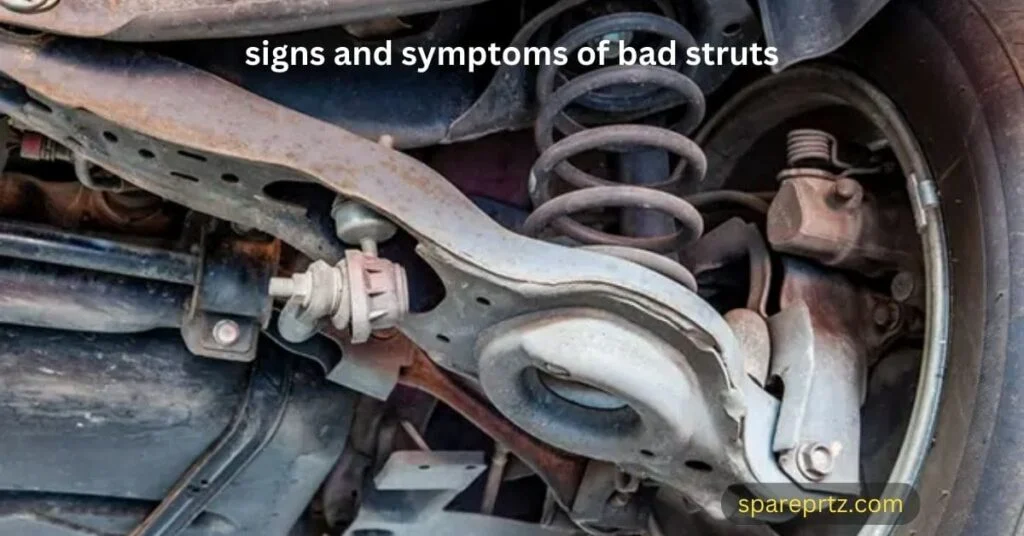
A light oily film can sometimes be mistaken for a serious leak, but wet fluid running down the strut body is a warning sign. A leaking shock absorber has lost some of its ability to control spring movement.
After driving over a bump, a healthy suspension should settle without repeated bouncing. This informal check is not a substitute for inspection, but repeated oscillation supports the possibility of weak damping.
Uneven tire wear and poor control
Worn struts can allow the tire to lose consistent contact with the road, especially on rough surfaces. The result may include cupped or scalloped tread wear, nose-diving during braking, extra body roll, or a nervous feel in sweeping turns.
Those symptoms can also come from incorrect tire pressure, poor alignment, worn control-arm parts, or damaged tires. A tire inspection and alignment check may be needed alongside strut testing.
Loose mounts and changed ride height
A damaged upper mount may create movement, knocking, or grinding at the top of the strut tower. A broken or sagging spring can lower one corner, create a side-to-side height difference, and change alignment angles.
Inspectors should look for cracked rubber, missing hardware, spring fragments, corrosion, and contact marks. Suspension fasteners should be tightened using the vehicle manufacturer’s service procedure because access and torque requirements vary by model.
- Top mount: Listen for grinding or binding while the steering wheel turns slowly.
- Strut body: Look for wet fluid, dents, heavy corrosion, or contact marks.
- Coil spring: Check for a broken end, shifted seating, or a leaning vehicle.
- Wheel area: Inspect the brake shield, tire sidewall, rotor, and wheel bearing symptoms.
Suspension Problems That Mimic a Bad Strut
The front suspension contains several moving parts close to the strut. Replacing the strut without locating the source can leave the grinding noise unchanged and add unnecessary repair cost.
Brake and wheel components deserve priority because they affect stopping and wheel control. A technician may need to remove the wheel and inspect for looseness, contact marks, heat damage, or abnormal movement.
Noise can also travel through the body, making a problem on one side seem as though it comes from the opposite side. A road test and hands-on inspection are more reliable than sound location alone.
Brake shield and brake hardware
A thin metal dust shield behind the rotor can bend after road impact and scrape the rotor. Small stones can also become trapped between the shield and rotor, causing a sharp, persistent scraping sound.
Brake pads worn past their friction material may grind against the rotor. Pulling to one side, a hot wheel, a burning odor, vibration, or a change in pedal feel makes brake inspection more urgent.
Wheel bearing wear
A worn wheel bearing often produces a humming, growling, or grinding noise that rises with road speed. The sound may change when the vehicle turns because cornering shifts the load from one bearing to the other.
Wheel bearing diagnosis requires care because looseness may be difficult to detect on some vehicles. A professional inspection is appropriate if the noise is constant, the wheel feels loose, or the vehicle wanders.
Ball joints, control arms, and stabilizer links
Ball joints and control-arm bushings can clunk or grind as the suspension moves. A worn ball joint is especially serious because it helps connect the steering knuckle to the suspension.
Stabilizer-bar links usually create a rattle or knock over small bumps, but damaged joints can rub or bind. These parts should be checked whenever a strut is replaced or a suspension noise persists.
Safe Checks Before Scheduling a Repair
Basic observations can help describe the problem without taking apart the suspension. Record whether the noise occurs during left or right turns, braking, bumps, acceleration, or steady cruising.
Look through the wheel opening for a leaking strut, broken spring, damaged tire, loose liner, or bent brake shield. Do not crawl under a vehicle supported only by a factory jack, and do not place fingers near springs or steering joints.
A bounce test may show weak damping, but it cannot prove that a strut is the noise source. Avoid striking suspension parts with a hammer or loosening spring hardware; compressed coil springs store significant energy.
- Park on level ground, set the parking brake, and compare the ride height on both sides.
- Inspect the tire tread and sidewall for rubbing, scalloping, exposed cords, or unusual damage.
- Turn the steering slowly while stationary and listen near the upper strut mount.
- Drive at low speed on a familiar road and note whether the sound follows turns, bumps, braking, or wheel speed.
- Schedule an inspection if the noise continues, the vehicle handles differently, or any steering, brake, spring, or wheel problem is visible.
When driving should stop
Stop driving and arrange a tow if the vehicle has severe grinding during braking, a loose or wobbling wheel, a broken coil spring, exposed tire cords, major fluid leakage, or a sudden change in steering control.
A vehicle that pulls sharply, sits low on one corner, or repeatedly bottoms out may have a suspension failure that can damage the tire or reduce control. Short, slow travel to a repair shop may be reasonable only when the vehicle remains stable and no urgent brake or wheel symptoms are present.
Repair Decisions for Struts and Related Parts
Struts are commonly replaced as complete assemblies or as individual shock cartridges, depending on the vehicle design and repair method. A complete assembly may include the spring, mount, bearing, and other hardware, while a bare strut may require transferring existing parts.
Replacing only a noisy mount will not correct a weak or leaking damper. Replacing only the damper may also leave a damaged spring or mount in service, so the repair should match the failed component and the condition of nearby parts.
When one strut is clearly worn, many repair shops recommend replacing both struts on the same axle so damping remains more even from side to side. The exact recommendation depends on mileage, part condition, vehicle design, and the inspection findings.
Alignment after suspension work
Strut removal can change camber or other wheel-alignment settings on many vehicles. An alignment check after installation helps prevent uneven tire wear and confirms that the steering wheel and tracking are correct.
Alignment is especially important when the vehicle has a bent component, uneven ride height, or a history of pothole damage. New struts cannot correct a bent knuckle, control arm, or subframe.
Common mistakes to avoid
- Replacing struts based only on a vague grinding sound without inspecting the brakes and wheel bearing.
- Assuming every front-end noise comes from the shock absorber rather than the mount, spring, or steering linkage.
- Reusing damaged mounts, cracked springs, or worn fasteners during a strut replacement.
- Ignoring a brake shield, tire rub, or loose liner because the noise seems to come from the suspension.
- Skipping an alignment check after work that changes strut position or ride height.
FAQs About can bad struts cause grinding noise
Can a bad front strut make a metal grinding sound?
Yes, a front strut can make a grinding sound when its upper mount bearing, spring seat, or coil spring is damaged. The shock absorber alone more commonly causes leaking, bouncing, or knocking than a pure metal grind.
Do bad struts grind when turning the steering wheel?
They can, especially when the upper strut bearing binds and prevents the spring assembly from rotating smoothly. Grinding or popping while turning at low speed should also prompt an inspection of the tire, ball joint, tie rod, and steering components.
How can grinding from a strut differ from grinding
Strut or mount noise often changes with steering input or suspension movement, while wheel-bearing noise usually follows road speed and may change during gentle cornering. These patterns are clues, not a final diagnosis.
Is it safe to drive with a grinding strut?
It may be unsafe if the noise comes from a broken spring, loose mount, damaged wheel bearing, or brake component. Avoid driving and arrange an inspection or tow when steering, braking, wheel stability, tire condition, or ride height has changed.
Conclusion
Can bad struts cause grinding noise? Yes, particularly when a strut mount bearing, spring seat, or coil spring is damaged, but grinding also commonly comes from brakes, wheel bearings, shields, tires, and other suspension parts. The noise pattern, ride height, fluid condition, tire wear, and handling symptoms must be considered together.
Use a visual inspection and careful low-speed observations to describe the problem, then have the entire wheel and suspension corner checked before buying parts. Treat brake, wheel, steering, and broken-spring symptoms as higher-priority safety concerns.
Note exactly when the grinding occurs, inspect the tire and visible suspension parts, and schedule a full brake, wheel-bearing, and strut inspection before continued driving.