Can a Leveling Kit Hurt Your Truck? Risks and Facts
Can a leveling kit hurt your truck? Yes, a leveling kit can hurt your truck if it is incorrectly installed, poorly matched to the vehicle, or pushed beyond the suspension’s limits. However, a properly designed and professionally installed leveling kit usually does not cause major problems when the height, alignment, and supporting components are appropriate.
The complete details are explained below. In this article, you will learn how leveling kits affect suspension components, when they can create problems, which warning signs to watch for, how they affect reliability, and how to install one without damaging your truck.
Can a Leveling Kit Hurt Your Truck?

A leveling kit can hurt your truck, but the risk depends on several factors including the kit design, lift height, installation quality, driving conditions, and existing suspension condition.
A leveling kit itself is not automatically harmful. Thousands of truck owners use leveling kits successfully for years without major issues.
Problems usually occur when owners install a kit that creates too much additional height, combine incompatible suspension components, ignore alignment requirements, or continue driving with worn factory parts.
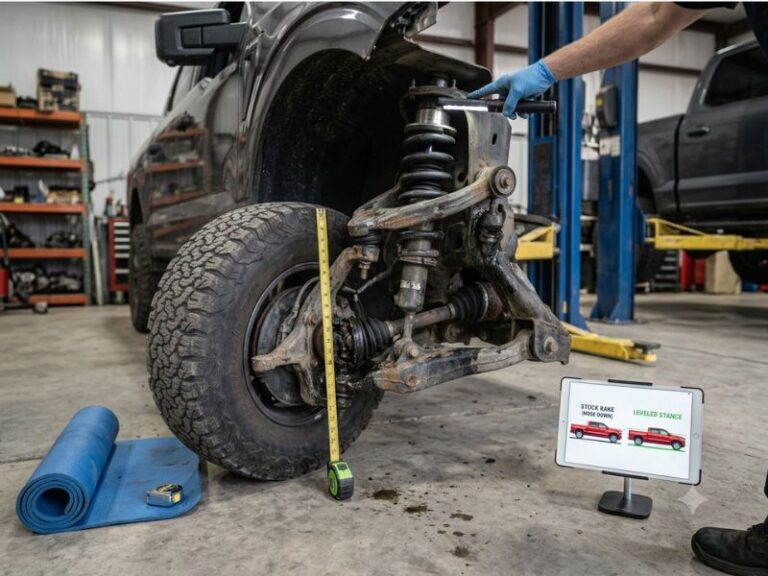
A leveling kit changes the original position of suspension components. Even a small increase in ride height can affect:
- Control arm angles
- Ball joint movement
- Steering geometry
- Alignment settings
- Shock travel
- Tire clearance
When these changes remain within the suspension’s designed operating range, the truck can continue working normally. When they exceed those limits, premature wear and handling problems may develop.
How a Leveling Kit Changes Your Truck’s Suspension
A truck’s suspension is designed around a specific factory ride height. Engineers choose the position of springs, shocks, control arms, steering parts, and axles to work together.
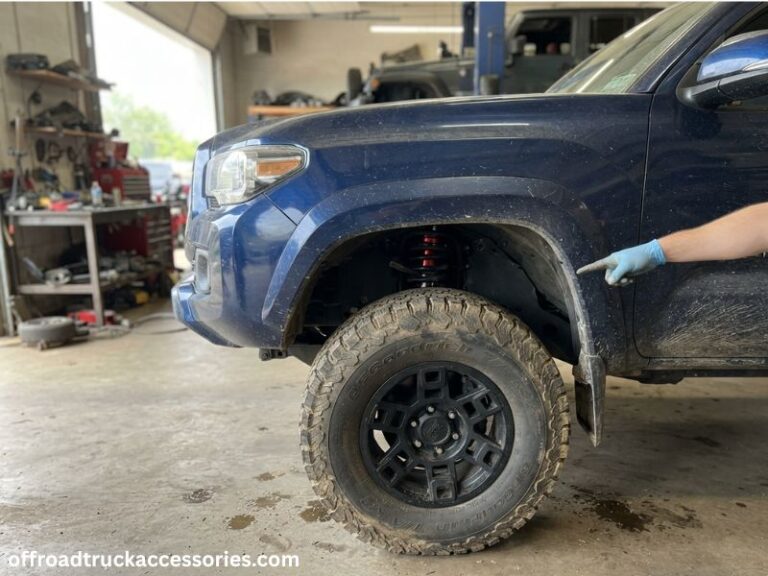
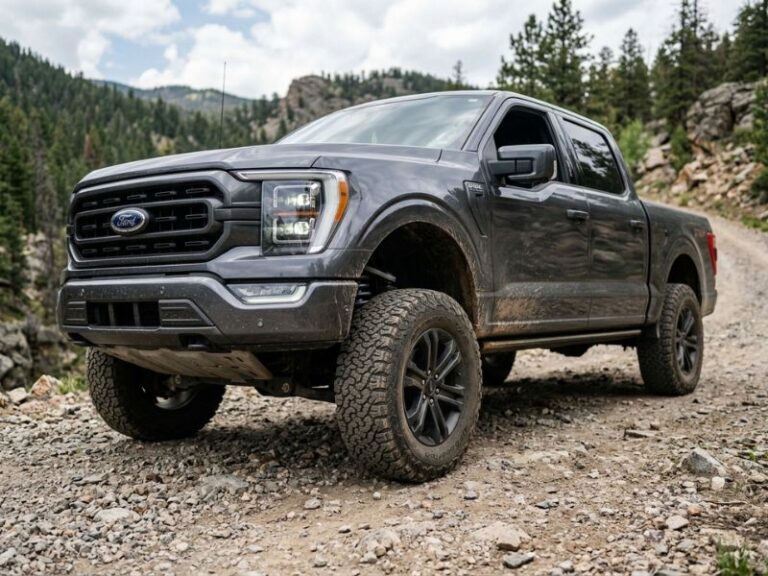
A leveling kit raises the front of the truck to reduce the factory nose-down stance.
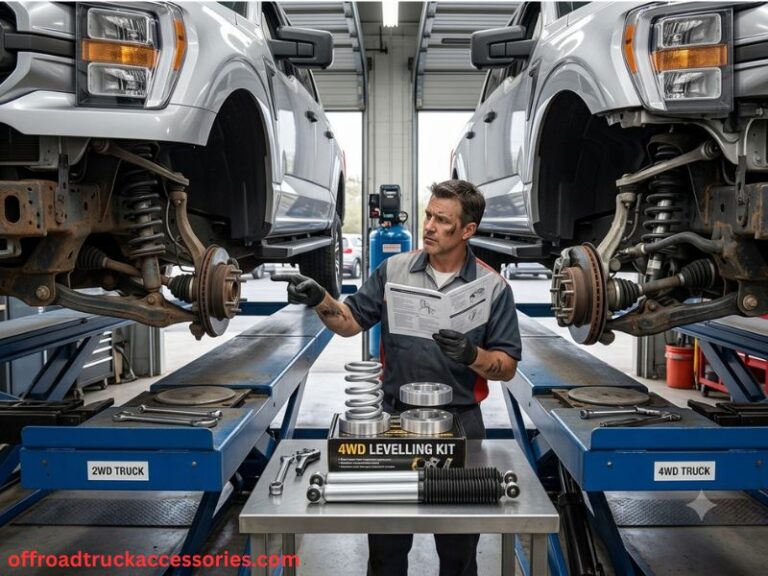
Depending on the vehicle, this may be done using:
- Strut spacers
- Coil spacers
- Replacement struts
- Adjustable coilovers
- Torsion keys
When the front height changes, the suspension no longer sits in its original position.
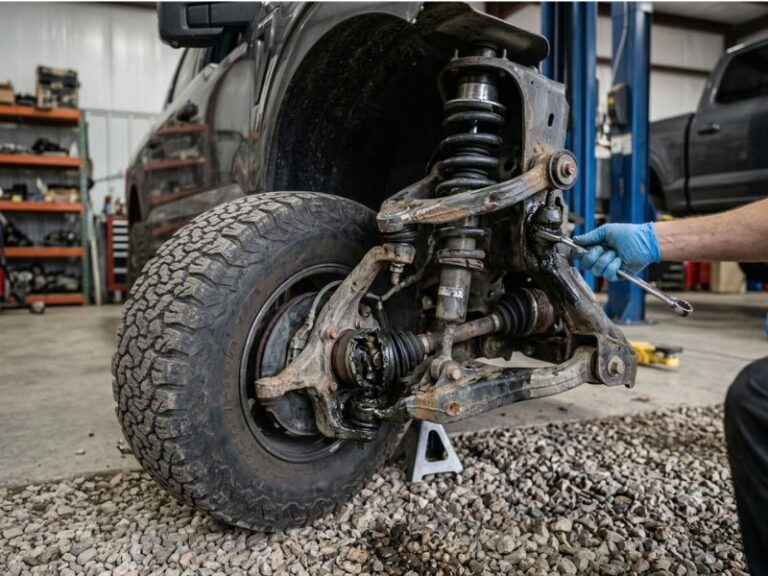
The control arms may operate at a different angle. The steering components may move through a different range. The shocks may have less available extension travel.
A small change is often manageable. A larger change can create stress on components that were not designed to operate at that angle.
Can a Leveling Kit Damage Ball Joints?
Yes, a leveling kit can increase stress on ball joints, especially when the front suspension is raised too much.
Ball joints connect the control arms to the steering knuckle and allow the suspension and steering system to move together.
When a truck is lifted, the control arms sit at a different angle. This can force the ball joints to operate closer to their maximum range.
Over time, excessive angles may contribute to:
- Faster ball-joint wear
- Torn protective boots
- Loose steering
- Clunking noises
- Alignment problems
The risk is higher when combined with:
- Large tires
- Heavy wheels
- Aggressive wheel offset
- Frequent off-road driving
Many moderate leveling kits are designed to work with factory control arms. However, taller setups may require aftermarket upper control arms to restore proper suspension geometry.
Can a Leveling Kit Damage CV Axles?
On four-wheel-drive trucks, a leveling kit can affect CV axle angles.
CV axles transfer power from the front differential to the wheels while allowing suspension movement.
When the front suspension is raised, the CV axles operate at a steeper angle. A small increase may be acceptable, but excessive angles can place additional stress on the joints and boots.
Possible problems include:
- Torn CV boots
- Grease leaks
- Clicking noises during turns
- Premature CV joint wear
- Vibration under acceleration
The risk increases when the truck also has:
- A large leveling kit
- Oversized tires
- Heavy aftermarket wheels
- Frequent trail use
This is one reason why extreme leveling heights are not always the best choice. More height does not always mean better performance.
Can a Leveling Kit Cause Alignment Problems?
Yes, alignment issues are one of the most common problems after installing a leveling kit.
Changing suspension height affects the truck’s alignment angles:
Camber controls how the tire sits vertically. Incorrect camber can cause uneven inner or outer tire wear.
Caster affects steering stability and steering-wheel return. Poor caster can make the truck feel unstable on highways.
Toe affects whether the tires point slightly inward or outward. Incorrect toe can destroy tires quickly.
A professional alignment should always be completed after installing a leveling kit.
Skipping alignment may save money initially, but it can lead to expensive tire replacement later.
A truck that appears to drive normally can still have incorrect alignment settings that slowly damage the tires.
Can a Leveling Kit Wear Out Tires Faster?
Yes, a leveling kit can cause faster tire wear if the suspension is not properly aligned afterward.
Larger tires are often installed with leveling kits, which increases the importance of correct alignment.
Incorrect suspension angles can cause:
- Feathering
- Uneven tread wear
- Reduced tire lifespan
- Steering pull
A set of truck tires can be expensive, especially when using larger all-terrain or mud-terrain tires.
After installation, regularly inspect the tire tread. Uneven wear patterns often provide the first sign that the suspension needs adjustment.
Can a Leveling Kit Make Your Ride Rougher?
A leveling kit can change ride quality, but the effect depends on the design.
A simple spacer kit that keeps the factory springs and shocks may maintain a ride quality close to stock.
However, raising the front suspension can change how the shocks and springs operate.
Some drivers notice:
- Slightly firmer ride
- More road feedback
- Reduced suspension travel
- Different handling characteristics
The effect is usually more noticeable with taller leveling kits.
A worn suspension may also feel worse after installation because the leveling kit places additional demands on old shocks and bushings.
Replacing worn components during installation can improve the final result.
Can a Leveling Kit Cause Shock Problems?
A leveling kit can affect shock performance if it changes the operating range too much.
Every shock has a designed compressed length and extended length.
If the truck is raised too far, the shock may sit closer to full extension. When the wheel drops over a bump, the shock may reach its limit and create a harsh impact known as topping out.
Signs of shock-related problems include:
- Clunking sounds
- Harsh impacts over bumps
- Reduced suspension movement
- Poor ride comfort
Some leveling kits are designed to work with factory shocks, while others require longer shocks or replacement suspension components.
Always follow the manufacturer’s recommended height range.
Can a Leveling Kit Cause Steering Problems?
A leveling kit can affect steering feel because suspension height changes steering geometry.
Possible symptoms include:
- Steering wheel off-center
- Pulling to one side
- Increased steering effort
- Highway wandering
- Reduced steering return
These issues are usually related to alignment changes or suspension geometry rather than the leveling kit alone.
On solid-axle trucks, raising the suspension can also affect track bar and drag link angles. Incorrect steering geometry may contribute to bump steer or inconsistent handling.
A proper suspension inspection and alignment can identify whether additional correction parts are needed.
Does a Leveling Kit Hurt Fuel Economy?
A leveling kit by itself usually has a small effect on fuel economy.
However, many owners install leveling kits together with:
- Larger tires
- Heavier wheels
- More aggressive tread patterns
These changes increase weight and rolling resistance, which can reduce fuel efficiency.
A heavier 35-inch tire setup can have a much larger impact than the leveling kit itself.
The truck’s aerodynamics may also change slightly when the front height increases, but tire choice and weight usually have a greater effect.
Can a Leveling Kit Damage the Transmission or Engine?
A properly installed leveling kit normally does not directly damage the engine or transmission.
However, larger tires installed after leveling can affect drivetrain performance.
Oversized tires increase the load placed on:
- Transmission
- Differential
- Axles
- Brakes
The engine must work harder to accelerate heavier wheels, especially from a stop or while towing.
A leveling kit combined with reasonable tire sizing is unlikely to create major drivetrain issues. Extreme tire upgrades require more careful planning.
Does a Leveling Kit Affect Towing Ability?
A leveling kit does not increase your truck’s towing capacity.
In some cases, reducing factory rake can affect how the truck sits when carrying heavy loads.
Manufacturers often design trucks with rear rake because the rear suspension compresses under cargo or trailer weight.
If the truck is completely level when empty, it may sit lower in the rear when loaded.
This can affect:
- Headlight aim
- Steering feel
- Trailer balance
Truck owners who frequently tow should consider how the vehicle will behave under load before choosing a leveling height.
Can a Cheap Leveling Kit Hurt Your Truck?
The quality of the leveling kit matters.
A low-quality kit may use poor materials, incorrect measurements, weak hardware, or poor design.
Potential problems include:
- Spacer failure
- Incorrect suspension angles
- Alignment difficulties
- Noise
- Poor fitment
A reputable leveling kit manufacturer typically designs products around specific vehicles and provides installation instructions.
The cheapest option is not always the most affordable if it creates additional repair costs later.
Can Installing a Leveling Kit Yourself Damage Your Truck?
A DIY installation can damage your truck if proper procedures are not followed.
Common installation mistakes include:
- Incorrect torque specifications
- Improper spring compression
- Damaged suspension hardware
- Incorrect spacer placement
- Skipping alignment
Some suspension components store significant energy, especially coil springs. Incorrect handling can be dangerous.
If you install the kit yourself, follow the manufacturer’s instructions carefully and have the truck professionally aligned afterward.
How to Prevent a Leveling Kit From Hurting Your Truck
A leveling kit can provide years of reliable service when installed correctly.
To reduce risk:
Choose a kit designed specifically for your truck model, year, drivetrain, and suspension type.
Avoid excessive lift heights that push factory components beyond their intended range.
Inspect existing suspension parts before installation, including:
- Ball joints
- Tie rods
- Bushings
- Shocks
- Wheel bearings
Use proper wheel and tire combinations.
Complete a professional alignment after installation.
Monitor tire wear and suspension performance regularly.
A well-planned setup is much less likely to create problems.
Are Leveling Kits Bad for Trucks?
Leveling kits are not automatically bad for trucks.
The reputation of leveling kits often comes from poorly designed installations, excessive lift heights, incorrect tire setups, and neglected maintenance.
A properly matched leveling kit can provide benefits such as:
- Improved appearance
- Better front-end clearance
- Space for larger tires
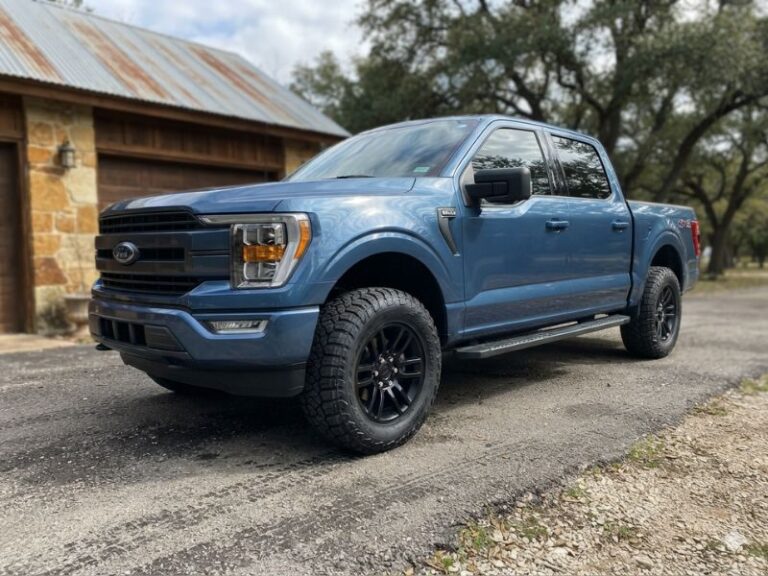
- More balanced stance
The key is maintaining proper suspension geometry and avoiding unnecessary modifications.
A moderate leveling kit installed correctly is very different from an extreme suspension setup that places components under constant stress.
Final Thoughts
So, can a leveling kit hurt your truck? Yes, but mainly when it is incorrectly chosen, poorly installed, or pushed beyond the limits of the factory suspension.
A properly designed leveling kit can be a safe and effective modification when the height is reasonable, alignment is corrected, and supporting components remain within their intended operating range.
Before installing one, consider your truck’s suspension design, tire size, driving habits, and long-term use. The best leveling setup is not the tallest one—it is the one that improves appearance and function while keeping your truck reliable.