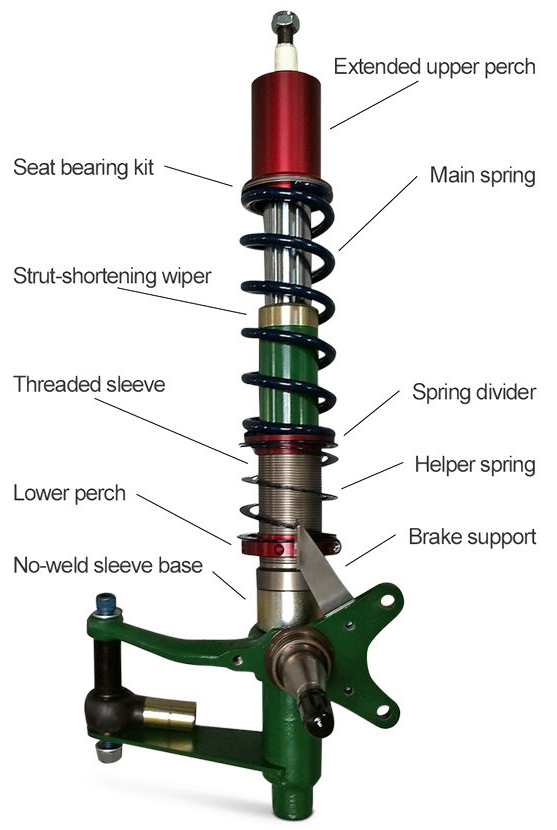
Helper springs on coilovers are small, low-rate springs that keep the main suspension spring seated when the suspension extends. They help prevent the main spring from becoming loose or moving out of place when the wheel drops, such as over a dip, crest, or when a car is lifted.
For drivers in the United States who install coilovers on street cars, sports cars, or track builds, helper springs solve a specific suspension setup problem. When a car is lowered or its suspension has a wide range of movement, the main coil spring may lose contact with its seats at full droop. A helper spring fills the available space and helps keep the main spring properly positioned.
A helper spring is not the same as the main coilover spring. It usually has a much lower spring rate and compresses easily once the car rests on its suspension. Its job is to maintain spring contact through the suspension’s range of motion, not to provide the main support for the vehicle. Whether a helper spring is needed depends on the coilover design, main spring length, ride height, and available suspension travel.
Helper springs are secondary springs fitted alongside the main springs on some coilover suspension systems. They are commonly used to keep the main springs captured between their spring seats when the suspension extends far enough for the main springs to unload.
A coilover combines a coil spring and a shock absorber or damper in one assembly. The main spring supports the vehicle and resists suspension movement, while the damper controls how quickly that movement occurs. A helper spring has a different role: it helps maintain contact between the main spring and its seats when the main spring is no longer under enough compression to remain firmly in place.
The helper spring is often installed next to the main spring, with a spring separator or seat between them as required by the coilover design. The exact order, hardware, and orientation depend on the manufacturer’s instructions. Not every coilover uses the same arrangement, and a helper spring should never be added based on appearance alone.
Source: storage.googleapis.com
Main spring
Provides most of the spring force that supports the vehicle and controls body movement over bumps, turns, and braking loads.
Helper spring
Keeps the main spring seated when the suspension extends and the main spring unloads.
Damper
Controls suspension movement by resisting the speed of compression and rebound.
Spring seats and collars
Locate the springs and, on adjustable coilovers, help set spring position and ride height according to the system’s design.
Where Are Helper Springs Located?
A helper spring is usually fitted directly next to the main coilover spring. Depending on the design, it may sit above or below the main spring, with the correct seats and spacers keeping the assembly aligned. The damper shaft, spring seats, and any adjustment collars must remain compatible with the full spring stack.
Before identifying a helper spring, check the coilover manufacturer’s parts diagram. A short spring can be a helper spring, a tender spring, or another part of a purpose-built spring assembly. Size and appearance alone do not establish its function.
Check the spring stack
Look for a short secondary spring next to the longer main spring and verify its role in the product documentation.
Confirm the hardware
Make sure the spring seats, separators, and adjustment collars match the intended assembly.
How Do Helper Springs Work?
Helper springs work by staying compressed enough to keep the main spring in contact with its seats as the suspension moves through extension. Their low spring rate lets them compress readily under the load applied by the main spring and vehicle. When the suspension unloads, they can extend and occupy the space that would otherwise allow the main spring to become loose.
Think of the helper spring as a small link that keeps the spring stack together when the suspension hangs down. It does not replace the main spring or hold up the full vehicle on its own. Its purpose is to preserve correct spring placement across a wider range of suspension movement.
The difference becomes clear when a wheel moves downward relative to the body. During this motion, the distance between the coilover’s spring seats may increase. If the main spring is too short to stay compressed across that distance, a helper spring can extend and maintain contact. When the wheel returns to its normal position, the main spring compresses the helper spring again.
Source: storage.googleapis.com
At normal ride height
The main spring carries the primary load and usually compresses the low-rate helper spring substantially.
During suspension extension
The helper spring extends as the spring seats move apart, helping prevent the main spring from becoming loose.
During suspension compression
The main spring and helper spring compress according to their rates and the available travel, subject to the design of the assembly.
What Happens When a Wheel Drops?
When a car crosses a crest, enters a dip, or lifts a wheel over uneven pavement, the suspension may extend toward full droop. Full droop is the point at which the suspension reaches its available extension limit. Without enough main spring preload or a suitable secondary spring, the main spring can lose firm contact with one of its seats.
If the spring becomes loose, it may shift, sit incorrectly when the suspension compresses again, or make noise. A correctly designed helper spring helps keep the main spring captured. It does not prevent the suspension from reaching its extension limit, and it cannot correct a damper that has the wrong travel range.
Spring remains seated
The helper spring maintains contact through suspension extension when the main spring alone cannot do so.
Suspension returns
The spring assembly should return to its intended position without a loose or displaced main spring.
Do Helper Springs Compress Fully?
Many conventional helper springs compress nearly flat under normal ride-height loads. In that state, they contribute little additional spring movement because their available travel has been used up. However, the exact behavior depends on the spring design, installed length, load, and suspension setup.
Do not assume that every short secondary spring is intended to reach solid height. Follow the specified spring travel and installed dimensions. A spring that is forced beyond its design limits can be damaged, and a spring stack with inadequate clearance can interfere with safe suspension operation.
Near-solid helper spring
A conventional helper spring may be almost fully compressed at normal ride height and primarily serve to retain the main spring during extension.
Travel-sensitive design
Some secondary springs are designed to remain active through more of the suspension’s operating range, so their behavior must be confirmed from the specifications.
Why Do Coilovers Use Helper Springs?
The main reason to use a helper spring is to keep the main spring correctly seated during suspension extension. This matters when the spring becomes unloaded at full droop or when the suspension has been adjusted to a ride height that leaves limited main spring preload.
Helper springs can also make the spring assembly easier to manage when the coilover is removed for maintenance or when the suspension hangs freely on a lift. They help retain the intended spring arrangement rather than allowing a short main spring to move between its seats.
A helper spring is not automatically a performance upgrade. If the main spring stays securely seated throughout the designed suspension travel, adding a helper spring may provide no useful benefit. The correct decision depends on the spring’s free length, installed length, rate, preload, and the coilover’s extension range.
Source: storage.googleapis.com
Spring retention
Helps keep the main spring captured when the suspension reaches full droop.
Consistent placement
Reduces the chance of the main spring shifting after it unloads and compresses again.
Setup flexibility
Can help certain coilover designs accommodate a short main spring or a wide range of suspension extension.
Correct assembly
Maintains the intended spring stack when the hardware and spring dimensions match the manufacturer’s design.
Are Helper Springs Needed on Lowered Cars?
Lowered cars do not always need helper springs. Lowering changes the suspension’s operating position, but it does not by itself determine whether the main spring will become loose at full droop. Some coilovers use a spring and damper combination that keeps the main spring captured without a separate helper spring.
A helper spring may be useful if a lowered setup uses a short main spring or has insufficient preload to retain the spring when the wheel hangs down. Before changing the setup, check the manufacturer’s minimum spring preload, recommended spring length, and allowable adjustment range. Lowering a car beyond the intended range can also reduce bump travel and cause the suspension to hit its stops more often.
Inspect at full droop
A qualified installer can check whether the main spring remains properly seated when the suspension reaches its designed extension limit.
Verify ride-height range
Use the adjustment range specified for the exact coilover model rather than relying on a generic lowering measurement.
Helper Springs vs. Main Springs and Tender Springs
Helper springs, main springs, and tender springs are related parts, but their roles are not always interchangeable. The main spring provides the primary spring force. A conventional helper spring mainly retains the main spring during extension, while a tender spring is often intended to remain active over a meaningful portion of suspension movement before it becomes fully compressed.
Manufacturers do not always use these terms in exactly the same way. Some product descriptions use overlapping labels, and a spring’s actual behavior depends on its rate, free length, installed length, and the load it carries. The product specification is more reliable than the label alone.
A dual-rate setup may use two springs that both contribute to the suspension’s behavior during part of its travel. A typical helper spring is selected mainly for retention, so it should not be treated as a substitute for a carefully engineered dual-rate spring system.
Source: storage.googleapis.com
Main spring
Supports the vehicle and provides the primary resistance to suspension compression.
Helper spring
Usually has a very low rate and helps retain the main spring when the suspension extends.
Tender spring
May contribute to suspension compliance and spring behavior over part of the operating range before compressing substantially.
Dual-rate spring assembly
Uses a planned combination of spring rates and travel to create a changing effective spring response.
Does a Helper Spring Change the Main Spring Rate?
A conventional helper spring that is nearly solid at normal ride height usually has little effect on the main spring’s working rate during ordinary suspension movement. Once the helper spring has compressed to its designed limit, the main spring generally provides the dominant spring response.
While both springs are actively compressing in series, the effective rate depends on both spring rates. For two ideal linear springs in series, the effective rate is calculated as one divided by the sum of the reciprocals of the individual rates. Real spring stacks can behave differently as a helper spring reaches solid height or as other parts of the assembly engage.
Before the helper reaches solid height
Both springs may contribute to total deflection, giving the combined stack a lower effective rate than either spring alone.
After the helper reaches its designed limit
The helper contributes little additional compression, so the main spring largely controls the spring rate.
Helper Springs vs. Tender Springs: A Practical Comparison
The practical difference is the amount of useful suspension movement each spring is designed to provide. A helper spring is commonly intended to retain the main spring and compress substantially under normal load. A tender spring may be designed to remain active for longer, affecting how the suspension responds during part of its travel.
This distinction matters when choosing replacement parts. A spring with the wrong rate or free length can change installed height, preload, and the way the spring stack moves. If the goal is simply to keep a main spring seated at full droop, a suitable helper spring may be enough. If the goal is to change the suspension’s rate progression, a purpose-designed tender or dual-rate system may be more appropriate.
Source: driftworks.com
Choose a helper spring when
The main spring needs help staying seated through the intended range of suspension extension.
Consider a tender spring when
The suspension design calls for a secondary spring to remain active and influence response over part of the travel.
Use a matched assembly when
The manufacturer specifies a particular spring combination, separator, or spring-seat arrangement.
Can You Replace a Helper Spring With a Tender Spring?
Not without checking the suspension design. A tender spring may have a different rate, free length, compressed length, and travel requirement. Those differences can change the spring stack’s total length and operating behavior, even if the spring fits over the damper body.
Use a replacement that meets the coilover manufacturer’s dimensions and performance requirements. If the manufacturer approves more than one spring configuration, follow the specified combination and setup instructions.
Match the dimensions
Check inner diameter, free length, solid height where applicable, and available travel.
Match the intended function
Do not assume that a spring with a similar appearance will retain the main spring or produce the same rate progression.
How to Tell Whether Your Coilovers Need Helper Springs
The key check is whether the main spring remains correctly seated throughout the suspension’s intended range of movement. A car that sits at a low ride height, a coilover with a short main spring, or a setup with limited spring preload may need a closer inspection. These conditions are clues, not proof that a helper spring is required.
Do not rely only on the car’s stance or how it feels on a smooth road. A main spring can remain seated at normal ride height but become loose when the wheel hangs down. The suspension needs to be assessed at its designed extension limit, with the vehicle supported safely and the spring assembly handled according to the service instructions.
If a spring moves, rattles, or appears loose when the suspension unloads, stop treating the issue as a minor noise. The cause could be an incorrect spring length, insufficient preload, a missing spring seat, worn hardware, or an unsuitable damper and spring combination. Adding a helper spring without checking these factors may hide the underlying setup problem.
Source: motoiq.com
Signs worth checking
A loose main spring at full droop, spring movement in its seat, unexplained spring-stack noise, or a coilover setup that differs from the manufacturer’s specified parts.
Signs that do not prove a need
A low ride height, a firm ride, or the presence of a short spring by itself does not establish that a helper spring is necessary.
Best confirmation
Compare the actual spring assembly with the coilover manufacturer’s parts diagram and setup specifications.
What Should You Check Before Changing the Setup?
First, identify the exact coilover model and confirm the recommended main spring dimensions. Then check the specified preload and adjustment range, along with any instructions for full droop. Verify that the spring seats, locking collars, and separators are present and correctly installed.
Next, confirm that the damper has the intended travel and that no part of the spring stack can bind, rub against nearby components, or interfere with the brake hoses and wiring. These checks should be carried out with proper vehicle supports and the correct tools. A loaded coilover spring stores energy and can cause serious injury if released improperly.
Read the setup manual
Use the instructions for the exact make and model of coilover, not a generic guide for a different kit.
Inspect spring hardware
Check for damaged seats, loose locking collars, incorrect separators, or signs of spring contact with nearby parts.
Get help when uncertain
A qualified suspension technician should inspect a spring that is loose, damaged, incorrectly fitted, or under uncertain preload.
How Spring Rate, Preload, and Ride Height Affect Helper Springs
Spring rate, preload, and ride height all influence whether a helper spring is needed, but they describe different parts of the setup. Spring rate is the force required to compress a spring by a given distance. Preload is the initial compression applied to the spring when the suspension is assembled or adjusted. Ride height is the vehicle’s resting height above the road or another defined reference point.
A higher main spring rate does not automatically remove the need for a helper spring. A stiff spring may still become unloaded when the suspension extends far enough, depending on its free length, installed length, preload, and the damper’s extension range. Likewise, adding preload can affect how securely the main spring stays seated, but excessive preload or incorrect adjustment can compromise the intended setup.
Ride-height adjustment should follow the coilover manufacturer’s method. Some systems use a threaded body or lower mount to change ride height while preserving spring preload. Other designs use the spring perch for adjustment, which can change preload as well. The correct procedure depends on the specific suspension system.
Source: suspensionsetups.com
Spring rate
Determines how much force is needed for a given amount of spring compression.
Preload
Sets the spring’s initial compression and can affect whether it remains seated at full droop.
Ride height
Changes the suspension’s resting position and available travel, but does not by itself prove that a helper spring is needed.
Damper travel
Sets how far the suspension can extend and compress within the limits of the coilover design.
Does Adding a Helper Spring Make the Ride Softer?
Not necessarily. A conventional helper spring that is nearly compressed at ride height generally does not make the main spring noticeably softer during normal driving. It is mainly there to maintain contact when the suspension extends.
If a secondary spring remains active during normal suspension movement, the combined spring rate can differ from the main spring rate alone. Ride comfort also depends on damper valving, tire pressure, tire sidewalls, suspension geometry, bushings, and the amount of available travel. A helper spring alone is not a reliable fix for a harsh ride.
For spring retention
Choose a helper spring with the correct dimensions and low rate specified for the coilover.
For ride comfort
Assess the complete suspension setup, including damper settings, spring rate, tire pressure, and available travel.
Can Helper Springs Improve Handling?
A helper spring can support consistent spring seating, which helps the suspension return to its intended arrangement after extension. That is useful for a properly designed setup, but it does not automatically add grip or make a car corner faster.
Handling depends on the whole vehicle, including tire performance, alignment, damping, suspension geometry, spring rates, weight distribution, and driver inputs. A helper spring should be selected to solve a spring-retention or specifically engineered suspension problem rather than as a universal handling upgrade.
Useful contribution
Helps maintain the intended spring position when the suspension unloads.
Not a guaranteed result
Does not independently guarantee better traction, less body roll, shorter stopping distances, or faster lap times.
Common Helper Spring Mistakes to Avoid
The most common mistake is treating a helper spring as a universal fix for a coilover that has been lowered too far or assembled with the wrong parts. A helper spring can retain the main spring, but it cannot restore missing bump travel, correct an incompatible damper, or make an unsafe spring combination suitable.
Another mistake is selecting a spring by its outer appearance or advertised diameter alone. The spring must fit the coilover, clear nearby components, and provide the intended travel. Even a spring with the correct inner diameter can be unsuitable if its free length, rate, solid height, or load capacity is wrong.
Spring assembly also involves stored energy. Never loosen a loaded spring seat or remove a spring without the correct procedure and equipment. If the spring stack is damaged, binds, or does not match the manufacturer’s diagram, stop and have the setup checked before driving.
Assuming every coilover needs one
Many coilover systems are designed to keep their main springs seated without a separate helper spring.
Using the wrong spring
A mismatched rate, length, or inner diameter can change the stack’s behavior or prevent correct installation.
Ignoring preload
Incorrect preload can cause a spring to become loose or change the setup beyond its intended range.
Confusing spring retention with ride tuning
A helper spring is not a direct substitute for the right main spring rate, damper settings, or suspension travel.
Working on a loaded spring without proper tools
Spring energy can cause severe injury. Follow the service manual and use an appropriate spring compressor or professional service where required.
When Should a Suspension Shop Inspect the Car?
Have a qualified suspension shop inspect the car if the main spring can move freely at full droop, the spring seats or collars are damaged, the coilover binds, or the vehicle makes repeated metallic noises from the spring assembly. Professional inspection is also appropriate after an unknown coilover modification or when the setup instructions are missing.
A technician can verify the spring dimensions, preload, damper travel, and clearance around the wheel, tire, brake lines, and suspension links. This is more useful than adding parts until the noise stops because it addresses the cause rather than only one symptom.
Stop driving if a spring is displaced
A spring that is out of its seat or interfering with another component needs correction before the car is used.
Request a setup check
Ask the technician to verify the spring stack against the coilover maker’s specifications and confirm safe travel.
Frequently Asked Questions
Q
What are helper springs on coilovers used for?
Helper springs are used to keep the main coilover spring seated when the suspension extends and the main spring unloads. They help prevent the main spring from becoming loose or moving out of position at full droop. They are not usually intended to support the full vehicle load.
Q
Do all coilovers need helper springs?
No. Some coilovers have enough main spring length or preload to keep the spring seated through their designed travel. Others use helper springs as part of the intended spring assembly. Check the exact coilover manual and spring specifications before adding or removing a helper spring.
Q
Do helper springs make coilovers softer?
Usually, a conventional helper spring has little effect on normal ride firmness once it is nearly compressed at ride height. If the secondary spring remains active through part of the suspension’s travel, it can affect the combined spring rate. Damper settings, tire pressure, main spring rate, and available travel also affect comfort.
Q
Can I drive without helper springs?
You can drive without them only if the coilover is designed to operate safely without a helper spring and the main spring stays correctly seated throughout the intended suspension travel. Removing a helper spring from a system that requires it may allow the main spring to become loose at full droop. Confirm the correct configuration before driving.
Q
Are helper springs and tender springs the same?
Not always. A conventional helper spring mainly retains the main spring when the suspension extends and often compresses nearly flat at ride height. A tender spring may be intended to remain active over more suspension travel and affect the spring response. Manufacturers may use these terms differently, so verify the specific spring’s design and specifications.
Q
How do I know if my helper springs are working?
The main spring should remain correctly located when the suspension reaches its designed extension limit, and the spring stack should move without binding or interference. A loose spring, damaged seat, or repeated spring noise warrants inspection. Because the assembly stores energy, use the manufacturer’s service procedure or have a qualified technician check it.
Q
Can I add helper springs to any coilover?
No. The helper spring must fit the coilover’s spring diameter, seats, separators, available space, and intended travel. Its free length and rate must also suit the spring assembly. Use a manufacturer-approved setup or have a suspension specialist confirm compatibility before installing one.
✦ Wrapping Up
Conclusion
Helper springs on coilovers are small secondary springs designed mainly to keep the main spring seated when the suspension extends. They are especially useful when the main spring would otherwise become loose at full droop. They do not automatically make the ride softer, improve grip, or increase the main spring’s working rate.
The right setup depends on the coilover’s design, main spring dimensions, preload, ride height, and damper travel. A car that has been lowered does not always need helper springs, and a spring that looks similar to the original is not necessarily a suitable replacement. The manufacturer’s specifications should guide the decision.
If your main spring moves, rattles, or loses contact with its seat, inspect the complete assembly rather than adding a helper spring without diagnosis. A correct spring stack helps preserve the intended suspension behavior and avoids problems caused by mismatched parts or unsafe adjustment.
💡 Key Takeaway
Check your coilover model and setup manual first. If the main spring can become loose at full droop, confirm the correct helper spring, spring seats, preload, and travel requirements before making changes. Have a qualified suspension technician inspect the assembly if any part is damaged, displaced, or uncertain.
Eric
Hi, I’m Eric Bennett, the person behind OffRoadTruckAccessories.com.
I created this blog to share my interest in trucks, off-road driving, automotive accessories, and DIY modifications. I enjoy learning how different truck accessories work, testing their usefulness, and understanding whether they are truly worth buying.
Will G37 coilovers fit G35? Learn which model years may share fitment, what changes with coupe, sedan, and AWD setups, and how to verify compatibility.