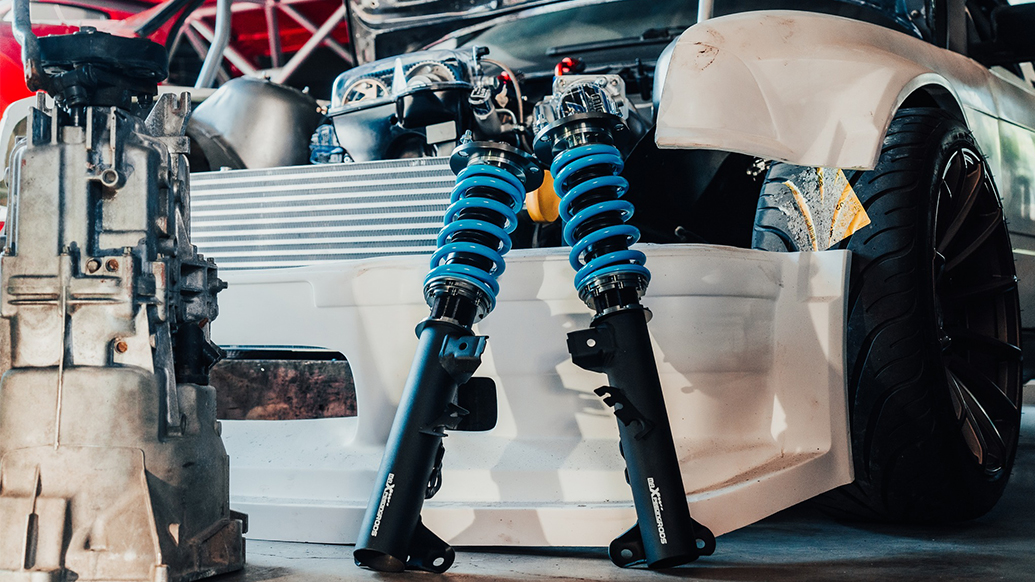
No, not all cars have coilovers. Most cars have springs and shock absorbers or struts, but a factory coilover is only one type of suspension design. Some cars use coilovers from the factory, while others use separate springs and dampers.
In the United States, millions of passenger cars, pickup trucks, SUVs, and sports cars use different suspension designs. A family sedan sold in Texas may use MacPherson struts in the front and a separate spring and shock arrangement in the rear. A performance car may use integrated coilover units at one or both ends. Both designs can provide a safe, stable ride when properly designed and maintained.
The confusion comes from the way people use the word coilover. In general automotive terms, a coilover combines a coil spring and a damper in one assembly. A damper controls how quickly the suspension moves, while the spring supports the vehicle and helps absorb bumps. In the aftermarket, the word often refers to an adjustable suspension kit that can change ride height and, on some models, damping.
If you want to know whether your car has coilovers, you need to identify its actual suspension layout. The owner’s manual, factory service information, parts catalog, and a visual inspection can help. Do not assume that every strut is a coilover or that every car with a coil spring uses a coilover suspension.
Coilovers are suspension assemblies that combine a coil spring with a shock absorber or damper. The spring supports the vehicle’s weight and compresses when a wheel encounters a bump. The damper controls that movement so the car does not keep bouncing after the spring compresses.
The term comes from coil-over, meaning a coil spring fitted over the damper body. Many coilovers also include a spring seat, mounting points, and other parts needed to connect the assembly to the vehicle. Some designs allow changes to ride height, damping force, or both.
Not every coilover has the same features. A factory unit may have a fixed spring seat and nonadjustable damping. An aftermarket kit may offer threaded height adjustment, while a more advanced kit may include adjustable damping. These features depend on the specific design, not on the name alone.
Source: suspensionsetups.com
Coil spring
Supports the vehicle and compresses as the wheel moves over bumps or dips.
Damper
Controls spring movement and helps maintain tire contact with the road.
Spring seat
Holds the spring in position. On some coilovers, a threaded seat allows ride-height adjustment.
Mounting points
Connect the assembly to the vehicle’s suspension and body or chassis.
Factory Coilovers Versus Aftermarket Coilovers
Factory coilovers are designed as part of a vehicle’s original suspension system. Their spring rates, damping characteristics, travel, and mounting points are selected for the vehicle’s intended use. Most factory units are not intended for routine ride-height adjustment.
Aftermarket coilovers are replacement assemblies designed for specific vehicle applications. Depending on the kit, they may offer ride-height adjustment, damping adjustment, different spring rates, or performance-oriented components. Some kits focus on road comfort, while others are designed for track use.
A car can have coilovers from the factory without having adjustable suspension. Likewise, installing an aftermarket coilover kit does not automatically improve handling or comfort. The result depends on the kit, setup, installation, alignment, tires, and driving conditions.
Factory equipment
Usually prioritizes the balance of comfort, handling, durability, cost, and the vehicle’s intended use.
Aftermarket equipment
May offer more setup options, but performance and comfort depend on the specific kit and its adjustment range.
Do All Cars Come With Coilovers From the Factory?
No. Automakers use several suspension layouts because vehicles have different weight, space, cost, comfort, load, and handling needs. A compact commuter car, a heavy-duty pickup, and a track-focused sports car do not need identical suspension hardware.
Many passenger cars use MacPherson struts at the front. This layout combines a structural strut with a coil spring mounted around it. Other vehicles use double-wishbone, multilink, or torsion-beam designs, with the spring and damper arranged together or separately according to the design.
The rear suspension can differ from the front. A vehicle may have front strut assemblies and rear coil springs mounted separately from the shock absorbers. Another model may use integrated spring-and-damper units at both ends. The same vehicle name can also have different suspension designs across model years, trims, or markets.
For this reason, it is not accurate to say that all cars have coilovers simply because most cars use coil springs somewhere in their suspension. A coil spring is one component; a coilover is an assembly that combines a coil spring and a damper.
Source: 8020automotive.com
Economy cars
Often use cost-effective suspension designs such as front MacPherson struts and a rear torsion beam or separate spring-and-damper arrangement.
Family sedans
May use struts in front and a multilink or other independent suspension layout in the rear.
Sports cars
May use integrated coilovers, separate spring-and-damper assemblies, or other performance suspension designs.
Pickup trucks and SUVs
May use coil springs, leaf springs, struts, separate shocks, or combinations that vary by axle and vehicle configuration.
Why Automakers Use Different Suspension Designs
Suspension design involves several trade-offs. Engineers must manage ride comfort, handling, wheel travel, passenger space, cargo capacity, production cost, and durability. A design that suits a small sedan may not be suitable for a truck that must carry heavy loads or tow a trailer.
Integrated spring-and-damper units can save space and simplify certain layouts. Separate springs and dampers can give engineers more freedom to position components around other parts of the vehicle. Neither arrangement is automatically better in every situation.
Automakers also tune suspension systems for the tires, brakes, steering, body structure, and expected driving conditions. Changing one component can affect how the whole system behaves, so factory designs should be judged as complete systems rather than by whether they use coilovers.
Packaging
The available space around the wheels, engine, drivetrain, and cargo area affects component placement.
Load capacity
Vehicle weight, passengers, cargo, and towing needs influence spring design and suspension layout.
Ride and handling
Spring rates, damping, suspension geometry, and available travel work together to shape road behavior.
Which Cars Have Coilovers?
Cars with coilovers include some factory-equipped sports cars, performance models, and vehicles fitted with compatible aftermarket suspension kits. However, the exact answer depends on the make, model, year, trim, and suspension package.
Some high-performance vehicles use integrated spring-and-damper assemblies as part of their original suspension. Other performance cars use struts or separate springs and dampers, even when their suspension is tuned for spirited driving. A performance badge alone does not prove that a vehicle has coilovers.
Everyday cars can also use coilovers after an owner installs an aftermarket kit. This is common among enthusiasts who want adjustable ride height or a particular handling setup. The kit must be designed for the vehicle’s suspension layout and weight range.
A vehicle does not need coilovers to drive well. Many standard suspension systems offer a carefully balanced ride, predictable handling, and lower maintenance costs. If the original suspension meets your needs, there may be no practical reason to replace it with an adjustable kit.
Source: cdn.pixabay.com
Sports Cars and Performance Models
Performance cars may use coilovers to package the spring and damper together and, in some designs, allow adjustment. Some factory systems offer electronically controlled damping or other advanced features. These systems may look different from common aftermarket kits and may not provide user-adjustable ride height.
A model’s exact suspension should be verified through its factory specifications or parts catalog. Two trims of the same vehicle may use different dampers, springs, mounting parts, or electronic controls. A used car may also have been modified by a previous owner.
Factory performance suspension
May include integrated spring-and-damper assemblies designed around the vehicle’s original handling targets.
Modified performance cars
May use aftermarket coilovers that replace some or all of the original suspension assemblies.
Sedans, Hatchbacks, and Compact Cars
Many sedans, hatchbacks, and compact cars use front MacPherson struts. These have a coil spring surrounding a damper and can resemble a coilover assembly. The distinction is that a conventional factory strut is not necessarily a coilover kit with adjustable height or other aftermarket features.
The rear suspension may use a separate coil spring and shock absorber. On some vehicles, the rear spring sits near the wheel while the damper is mounted elsewhere. A visual check of only the front suspension cannot establish what is fitted at the rear.
Front suspension
A strut assembly may combine a coil spring and damper in one unit.
Rear suspension
A separate spring and shock absorber are common on some layouts, while others use integrated units.
Pickup Trucks and SUVs
Pickup trucks and SUVs use several suspension designs. Some have front coil-spring struts, while others use control arms with separate dampers and springs. Rear suspensions may use coil springs, leaf springs, or other arrangements depending on the model and its load requirements.
A truck may have coilover-style front suspension and leaf springs at the rear. Another may use separate spring and shock components at both ends. Heavy-duty models can differ substantially from lighter versions, even within the same manufacturer’s lineup.
When shopping for suspension upgrades, confirm whether the kit fits a two-wheel-drive or four-wheel-drive model, the correct cab and bed configuration where relevant, and any factory suspension package. Lift kits and off-road coilovers may require additional compatible parts and professional setup.
Daily driving
A well-maintained factory suspension may provide the right balance of comfort, handling, and load support.
Off-road use
A suitable coilover may offer useful tuning options, but travel, heat control, spring rate, and vehicle load must match the intended use.
Are Coilovers the Same as Struts?
No, the terms are related but are not interchangeable in every context. A strut is a structural suspension component that helps locate the wheel and manage suspension movement. A coilover describes a spring-and-damper arrangement, although automotive sellers often use the term more narrowly for an adjustable suspension assembly.
A common MacPherson strut has a coil spring around the damper. Because the spring and damper form one assembly, the unit may look like a coilover. However, a standard replacement strut and spring assembly does not necessarily have the threaded body, adjustable spring seat, or tuning features associated with aftermarket coilover kits.
Some coilover designs use strut-style mounting, while others fit different suspension architectures. The names describe different aspects of the hardware, so it is best to check the manufacturer’s technical description rather than rely on appearance alone.
The practical difference matters when buying parts. A listing for a strut may refer to a direct replacement for a factory component, while a coilover kit may replace a larger assembly and provide different adjustment options. Always confirm compatibility with the exact vehicle.
Source: low-offset.com
Coilovers Versus Separate Springs and Shocks
In a separate spring-and-shock arrangement, the coil spring supports the vehicle while the shock absorber controls its movement. The two parts may be mounted in different locations and connect to different suspension points. Replacing one part does not always require replacing the other, although their condition and compatibility must be considered together.
A coilover combines the spring and damper into a single assembly. This can simplify some replacement or tuning tasks, but it does not guarantee easier installation, better comfort, or greater durability. The result depends on the design and how well it suits the vehicle.
If the goal is to restore a factory ride, quality replacement components with the correct specifications may be more appropriate than a performance coilover kit. If the goal is adjustable ride height, a compatible coilover system may be worth considering.
Separate spring and shock
The spring and damper are distinct parts, which can give the suspension designer flexibility in component placement.
Integrated coilover
The spring surrounds or sits over the damper as part of one assembly.
Structural strut
Helps locate the wheel and carries suspension loads; its design and features vary by vehicle.
How to Check Whether Your Car Has Coilovers
The most reliable way to identify your car’s suspension is to match the factory documentation to the components actually installed. A visual inspection can help, but it may not reveal the exact part type or whether a previous owner changed the suspension.
Start with the vehicle identification number, or VIN, and the correct model year. Use an official owner’s manual, factory service manual, dealer parts catalog, or reputable vehicle-specific parts catalog. Look for the front and rear suspension diagrams and the names of the original components.
Next, consider a visual inspection by a qualified mechanic. A coil spring fitted around a damper is a useful clue, but it is not enough to confirm that the assembly is an adjustable aftermarket coilover. Threaded adjustment collars, separate locking rings, and manufacturer labels may provide more information.
Never crawl under a car supported only by a jack. Suspension components can be under spring pressure, and a vehicle can fall if it is not supported correctly. If inspection requires removing a wheel or lifting the vehicle, use suitable equipment and follow the service procedure, or ask a qualified technician to do the work.
Source: suspensionsetups.com
Step 1: Identify the Exact Vehicle
Write down the make, model, model year, engine or trim where relevant, and drivetrain. Use the VIN when checking a factory parts catalog because suspension parts can vary within a model range. Do not assume that a catalog for a similar-looking car will list the correct assembly.
Check the year
Suspension designs and part numbers may change between model years.
Check the trim
Sport, luxury, towing, or off-road packages may use different suspension parts.
Check modifications
Previous owners may have replaced factory parts with aftermarket components.
Step 2: Review the Suspension Diagram
Look for terms such as strut assembly, coil spring, shock absorber, damper, spring seat, and suspension assembly. A parts diagram can show whether the spring and damper are sold as one unit or as separate parts. However, how a manufacturer names an assembly does not always settle every technical distinction, so review the design and specifications too.
Integrated assembly
A spring surrounding a damper may indicate a coilover-style layout or a conventional strut assembly.
Separate components
A separate spring and shock indicate that the two parts are not one integrated coilover assembly at that location.
Step 3: Look for Aftermarket Adjusters
If the vehicle has been modified, look for threaded bodies, spring-height collars, locking rings, adjustment knobs, or visible brand and model labels. These features can indicate aftermarket coilovers, but not every kit includes all of them. Some factory performance dampers also have adjustment features, so verify the part number before drawing a conclusion.
Manufacturer label
Record the brand and model number, then check the manufacturer’s specifications.
Threaded spring seat
May allow ride-height adjustment, but confirm the intended adjustment method in the installation instructions.
Adjustment knob
May control damping rather than ride height, so identify its purpose before changing it.
Step 4: Check the Front and Rear Separately
Do not assume the front and rear suspension use the same layout. A vehicle may have integrated assemblies at the front and separate springs and shocks at the rear. Record what the factory documentation shows for each axle and verify whether modifications have changed either end.
Front axle
Check the strut or damper layout, spring location, and mounting arrangement.
Rear axle
Check whether the spring surrounds the damper or is mounted separately.
Can You Install Coilovers on a Car That Does Not Have Them?
Often, yes, if a manufacturer offers a coilover kit designed for the specific vehicle and suspension layout. However, not every car has a suitable direct-fit kit, and a universal assembly should not be assumed to fit safely. The correct design must match the mounting points, vehicle weight, suspension geometry, and intended range of motion.
A direct-fit coilover kit is generally designed around the vehicle’s original mounting locations. Other conversions may require additional components or substantial engineering. The more a conversion changes the original suspension geometry, the more important professional assessment becomes.
Before buying, check whether the kit fits the exact model year, trim, drivetrain, and axle configuration. Read the installation instructions and confirm whether the kit requires compatible top mounts, replacement hardware, electronic suspension cancellation modules, or other parts. Not every kit includes everything needed for every configuration.
After installation, the vehicle may need a wheel alignment. Ride height can affect camber, toe, suspension travel, headlight aim, and the relationship between the tires and bodywork. Follow the manufacturer’s specified setup and alignment procedure, then check for interference and unusual noises before returning the vehicle to normal use.
Source: static.wixstatic.com
What to Consider Before Buying Coilovers
Choose coilovers based on how the car will be used, not only on price or the lowest advertised ride height. A street-driven vehicle needs suitable bump compliance, predictable handling, and enough travel for uneven roads. A track-focused kit may use firmer springs and damping that are less comfortable on public roads.
Also consider maintenance and operating conditions. Threaded adjustment parts may need periodic cleaning and inspection, especially where road salt, moisture, or dirt can cause corrosion. Some kits may require more frequent inspection than standard replacement suspension parts.
Vehicle fitment
Confirm the exact application and axle compatibility before ordering.
Ride height
Use the approved adjustment range and retain enough suspension travel for safe road use.
Damping adjustment
Check whether damping is adjustable and follow the maker’s instructions for setup.
Legal requirements
Check applicable state and local vehicle rules, inspection requirements, and headlight or bumper-height requirements.
Total cost
Allow for installation, alignment, replacement mounts or hardware, and future maintenance.
Are Coilovers Better Than Standard Suspension?
Coilovers are not automatically better than standard suspension. They offer benefits when their design and adjustment options meet the driver’s needs, but a well-designed factory system may provide a better balance for everyday use. The right choice depends on ride comfort, handling goals, budget, road conditions, and the vehicle itself.
An adjustable coilover kit can help an enthusiast set ride height and, on some models, damping. This can be useful for a carefully planned track setup or for achieving a specific stance. However, adjustment alone does not ensure better grip, shorter stopping distances, or safer handling.
Poor spring rates, incorrect damping, excessive lowering, or inadequate suspension travel can make a car uncomfortable and less predictable. An unsuitable setup can also cause tire rubbing, accelerated tire wear, or contact between suspension parts and the body. These problems can affect control and should be corrected before the vehicle is driven normally.
Standard suspension parts are often the sensible choice when the original ride and handling are satisfactory. Replacing worn components with the correct specification can restore normal performance without introducing new fitment or setup issues. If you are uncertain which route to take, ask a suspension specialist to compare compatible options for your driving needs.
When Coilovers May Make Sense
Coilovers may suit drivers who need adjustable ride height, want to tune a vehicle for a specific motorsport activity, or are replacing a modified suspension system. Their value depends on the adjustment range, build quality, compatibility, and actual use.
Track driving
A suitable kit may offer useful control over ride height and damping for a defined setup.
Enthusiast projects
Adjustability can help achieve a chosen stance while retaining a properly engineered suspension arrangement.
Specialized applications
Some kits are designed for particular vehicle weights, driving conditions, or performance goals.
When Standard Suspension May Be Better
For many daily drivers, standard suspension provides the comfort, reliability, and ease of maintenance they need. If the car is used mainly for commuting, carrying passengers, or traveling over rough roads, an adjustable performance kit may add cost without offering a meaningful benefit.
Factory ride quality
Keep a correctly functioning factory setup if it already meets your comfort and handling needs.
Lower complexity
Standard replacement parts may be easier to source and install for an unmodified vehicle.
Budget control
Replacing worn parts with compatible components may cost less than a full coilover conversion.
Common Coilover Myths and Mistakes
Several common misconceptions make it harder to identify or choose suspension parts. Understanding the difference between a spring, a shock absorber, a strut, and a coilover helps prevent unnecessary purchases and unsafe modifications.
Myth: Every car has coilovers
False. Cars use different suspension layouts, including integrated spring-and-damper assemblies and separate springs and shocks.
Myth: Every strut is an adjustable coilover
False. A conventional strut may combine a coil spring and damper without offering the height adjustment associated with many aftermarket kits.
Myth: Coilovers always improve handling
False. The result depends on the design, spring rate, damping, geometry, tires, alignment, and setup.
Myth: Lower is always better
False. Excessive lowering can reduce suspension travel and create tire, body, or component interference.
Mistake: Buying by appearance alone
A spring wrapped around a damper does not establish exact fitment or prove that the part is an adjustable aftermarket coilover.
Mistake: Ignoring alignment
Changing suspension parts or ride height can affect wheel alignment. Follow the vehicle and kit manufacturer’s requirements.
Frequently Asked Questions
Q
Do all cars have coilovers from the factory?
No. Some cars use coilover-style spring-and-damper assemblies, while others use separate springs and shock absorbers or other suspension designs. The exact layout depends on the make, model, year, trim, and axle.
Q
Do all cars have coil springs?
No. Many passenger cars use coil springs, but other vehicles use leaf springs, torsion bars, or air springs. Some suspension systems combine different spring types at the front and rear. Check the factory specifications for your vehicle.
Q
Does a MacPherson strut count as a coilover?
A MacPherson strut usually has a coil spring fitted around a damper in one assembly. However, a conventional strut is not necessarily an adjustable coilover kit. The exact terminology depends on the design and the way the manufacturer classifies the part.
Q
Can I put coilovers on any car?
No. A suitable direct-fit kit may be available for many cars, but not every vehicle has a compatible kit. Check the exact vehicle application, mounting points, axle design, weight range, and any required additional parts before buying.
Q
Do coilovers make a car ride rougher?
They can, but not all coilovers produce a rough ride. Comfort depends on spring rates, damping, suspension travel, tire choice, road conditions, and setup. A stiff or poorly adjusted kit may ride more harshly than a suitable factory suspension.
Q
How can I tell if my car has aftermarket coilovers?
Look for manufacturer labels, threaded adjustment bodies, spring-height collars, or damping adjusters, then verify the part number. These features are clues rather than definitive proof. A qualified mechanic can identify the installed components if the design is unclear.
Q
Should I replace factory suspension with coilovers?
Only if the kit suits your goals and vehicle. Coilovers can be useful for adjustable ride height or specialized handling setups, but standard replacement suspension may be more practical for everyday driving. Compare total cost, ride comfort, compatibility, maintenance, and installation needs before deciding.
✦ Wrapping Up
Conclusion
Not all cars have coilovers. Automakers use several suspension designs, and a vehicle may have integrated spring-and-damper assemblies at one end and separate springs and shocks at the other. The correct answer depends on the vehicle’s actual suspension layout, not simply on whether it has coil springs.
Coilovers can be useful when a driver needs specific adjustment options, but they are not required for good everyday handling or comfort. A well-maintained factory suspension can be the most practical choice for a daily driver, while a compatible aftermarket kit may suit a carefully planned performance project.
To identify your car’s setup, check its factory service information and parts catalog, then verify any installed modifications. If you plan to change the suspension, confirm exact fitment, follow the manufacturer’s installation and adjustment instructions, and arrange a proper alignment when required.
💡 Key Takeaway
Check your car’s make, model year, trim, and front and rear suspension diagrams before buying parts. If the factory layout or existing modifications are unclear, ask a qualified suspension technician to identify the components and confirm compatible replacement options.
Eric
Hi, I’m Eric Bennett, the person behind OffRoadTruckAccessories.com.
I created this blog to share my interest in trucks, off-road driving, automotive accessories, and DIY modifications. I enjoy learning how different truck accessories work, testing their usefulness, and understanding whether they are truly worth buying.
Will G37 coilovers fit G35? Learn which model years may share fitment, what changes with coupe, sedan, and AWD setups, and how to verify compatibility.