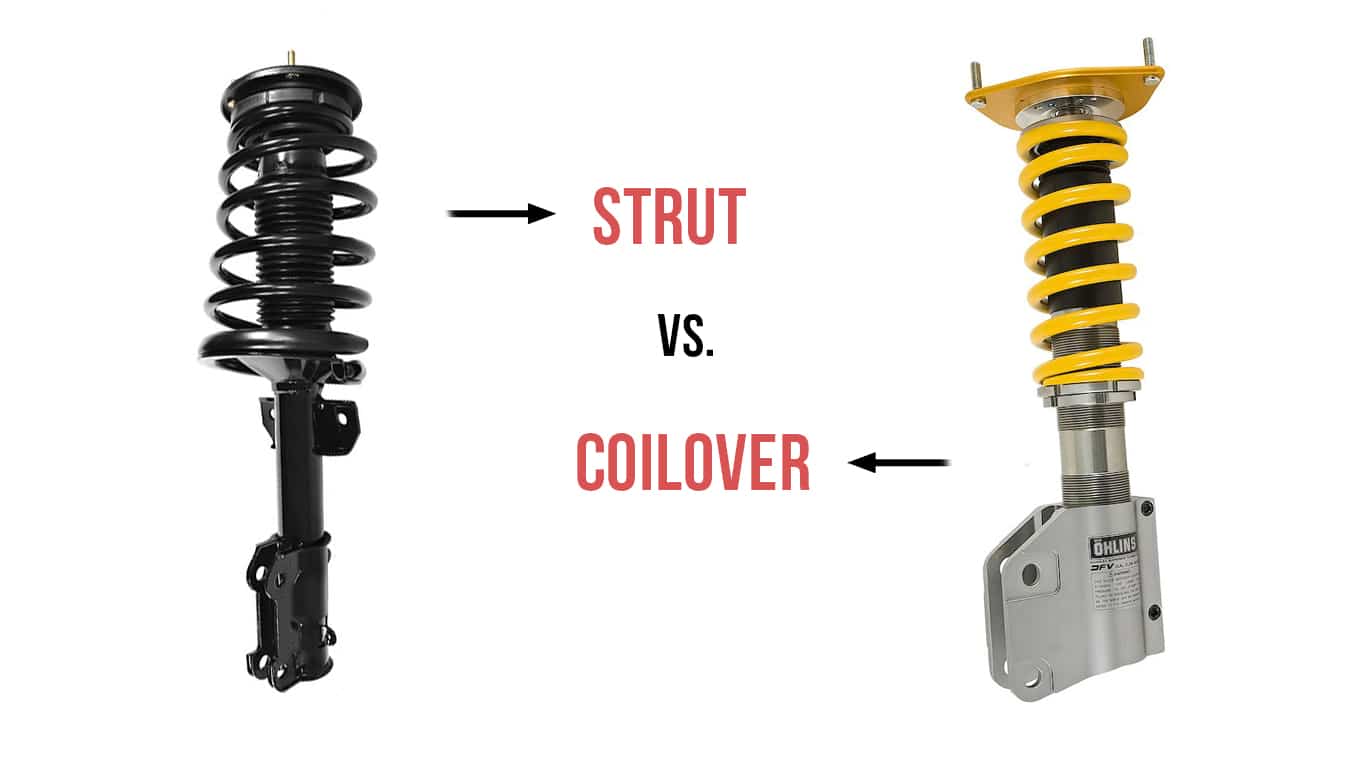
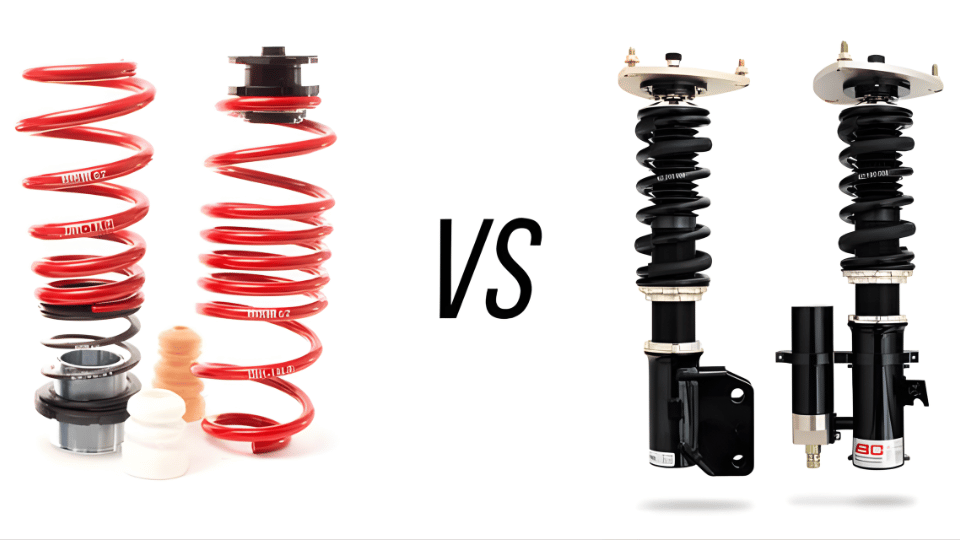
Coilovers can be lighter than stock suspension, but they are not always lighter. The result depends on the vehicle, the factory setup, the coilover design, and which parts you compare.
For drivers in the United States, suspension weight can matter when building a street car, track car, or weekend project. A lighter suspension may help reduce vehicle mass, but the size of that benefit depends on the parts being replaced. A complete factory suspension can include springs, shocks, struts, mounts, and related hardware. A coilover kit may replace several of these parts with a compact assembly.
The key is to compare complete systems, not just individual parts. A lightweight aluminum coilover may weigh less than a steel factory strut assembly, while another coilover may weigh more than the original parts. Spring design, damper size, mounting hardware, and vehicle layout all affect the final result.
This guide explains how coilover weight compares with stock suspension, how to measure the difference, and why unsprung weight matters. It also covers the trade-offs between weight, ride comfort, durability, and handling so you can judge whether a suspension upgrade makes sense for your car.
Coilovers are sometimes lighter than stock suspension, but there is no universal weight advantage. Some kits use lightweight materials and compact components. Others use thick steel bodies, large dampers, or heavy springs that make them similar in weight to the factory setup or heavier.
The comparison also depends on what the factory suspension uses. Some vehicles have separate springs and dampers. Others use a strut assembly that combines the spring and damper in one unit. A coilover may replace a complete strut assembly, or it may replace only part of a more complex suspension system.
For a fair comparison, measure every part removed and every part installed. Include springs, dampers, upper mounts, adjustment collars, brackets, and any hardware supplied with the kit. This gives you the net weight change for the actual installation.
Source: shiftmaxx.com
Lighter coilover design
A compact damper body, suitable aluminum components, and a well-designed spring can help reduce the total assembly weight.
Heavier performance design
Large dampers, robust steel parts, and high-load springs can add weight, especially when the kit is built for demanding track use.
Factory suspension design
The original equipment may already be light and compact, leaving little or no weight to save with an aftermarket kit.
Why There Is No Single Weight Answer
A coilover is a suspension design, not a fixed material or weight class. Two kits made for the same car can have different weights because their damper bodies, springs, mounts, and adjustment systems differ. The same is true when comparing parts from different vehicle models.
Published product weights can help with an initial comparison, but check whether the figure covers one corner, one axle, or the complete kit. Packaging, tools, spare springs, and shipping materials should not be counted as installed vehicle weight.
Check the scope
Confirm whether the quoted weight covers one assembly, a pair, or a complete four-corner kit.
Check the included parts
Look for upper mounts, helper springs, brackets, and other items that may not be included in a basic damper weight.
What Parts Make Up the Suspension Weight?
To understand the weight difference, first identify the parts in each system. Stock suspension is not one part. Depending on the car, it may contain separate coil springs, shock absorbers, struts, top mounts, rubber isolators, and supporting brackets.
A coilover usually combines a spring and damper in one adjustable assembly. Many kits also include spring seats, threaded collars, and mounting hardware. Some kits reuse factory top mounts, while others include replacement mounts. These details can change the total installed weight.
The correct comparison follows the parts that are actually removed from the vehicle. If the installation retains a factory mount, that mount belongs in both the old and new system totals. If a kit adds a bracket or a replacement mount, include it in the new total.
Source: ar.inspiredpencil.com
Springs
Spring weight depends on its material, wire size, length, and design. A shorter spring is not automatically lighter because it may use thicker wire or a different rate.
Dampers and struts
Damper body material, piston design, fluid capacity, and structural requirements affect weight.
Mounts and hardware
Top mounts, bearings, isolators, brackets, and adjustment collars contribute to the final assembly weight.
Related suspension parts
Control arms, knuckles, anti-roll bars, and other components may remain unchanged during a coilover installation, so do not count them as weight savings unless they are also replaced.
Coilovers Versus Separate Springs and Shocks
On a suspension that uses a separate spring and shock absorber, the total weight of both parts must be compared with the corresponding replacement assembly and any required hardware. Comparing a coilover with the shock alone gives an incomplete result.
On a strut-based system, compare the complete original strut and spring assembly with the new coilover and its included or reused mounts. The result may differ between the front and rear because many vehicles use different suspension layouts at each end.
Front axle
Check whether the original front setup uses MacPherson struts, separate dampers and springs, or another design.
Rear axle
Check whether the rear spring sits on the damper or in a separate pocket, since this affects which parts a kit replaces.
How Materials Affect Coilover Weight
Materials can make a major difference in suspension weight. Steel is strong and widely used, but aluminum parts can weigh less than comparable steel parts of suitable design. The actual saving depends on the shape, dimensions, strength requirements, and material grade of each component.
An aluminum damper housing does not mean the entire coilover is aluminum. The assembly may still use steel springs, shafts, threaded parts, and mounting hardware. A manufacturer may also use thicker walls or larger parts to meet its design goals, which can reduce or eliminate some of the potential weight saving.
The choice of material affects more than weight. Corrosion resistance, stiffness, heat management, fatigue life, repair options, and cost can all matter. The best material depends on the component and its intended use, not on the material name alone.
Source: f2suspension.com
Aluminum components
These can reduce mass where their strength and design suit the application, but they do not guarantee a lighter complete assembly.
Steel components
Steel offers useful strength and durability. A steel coilover can still be lighter than a stock assembly if the design uses less material overall.
Spring material
Spring weight depends on more than the metal type. Wire dimensions, coil count, and load requirements all affect the result.
Does an Aluminum Coilover Always Weigh Less?
No. Aluminum is generally less dense than steel, but complete assemblies cannot be compared by density alone. An aluminum part may need a different shape or thickness to meet its strength requirements, and other parts in the assembly may account for much of the total mass.
Use the listed weight of the complete assembly when available. If a manufacturer provides only a housing weight, treat it as one component rather than proof that the entire kit is lighter than the original suspension.
Look for complete-kit specifications
A full assembly weight is more useful than a material claim or an isolated component measurement.
Verify the exact application
Weights for a similar kit on another vehicle may not match your car because the dimensions and mounting parts can differ.
Unsprung Weight: Why Suspension Weight Matters
Unsprung weight is the mass of parts that move largely with the wheels as the suspension travels. It includes the wheels and tires, along with portions of the brakes and suspension components. Sprung weight is the mass supported by the suspension, such as most of the body and cabin.
Reducing unsprung mass can help a wheel respond to bumps and changes in road surface. Less mass for the suspension to control can support better tire contact in some conditions. However, the result depends on the damper, spring rate, tire, road surface, and the amount of mass removed.
A coilover does not automatically reduce unsprung weight by a large amount. The spring and damper are mounted in different positions across suspension designs, and only part of each component’s mass moves with the wheel. The exact contribution depends on the geometry and mounting points.
Weight reduction also needs to be viewed in context. A small saving at one corner may have little noticeable effect on a street car, while a carefully planned reduction across wheels, brakes, and suspension may matter more for a performance build. There is no universal handling improvement tied to a particular coilover weight saving.
Source: ar.inspiredpencil.com
Potential benefit
Lower unsprung mass may help the suspension follow uneven road surfaces and maintain tire contact.
Important limit
A lighter part does not guarantee better grip, shorter stopping distances, or faster lap times.
Whole-car context
Tire choice, alignment, damping, spring rates, and suspension condition also affect real-world behavior.
Are Coilovers Unsprung or Sprung Weight?
Coilovers contribute to both categories because their parts are attached at different points in the suspension. The lower damper body and related components may move more directly with the wheel, while the upper mounting area moves with the body to varying degrees. The spring’s contribution also depends on its mounting arrangement and motion.
For this reason, a simple scale measurement of a coilover gives its total physical weight, not its exact unsprung contribution. Engineers can estimate the effective unsprung mass by considering suspension geometry and component motion, but that is different from weighing the assembly alone.
Total assembly mass
Use a scale to compare the physical weight of the old and new parts.
Effective unsprung mass
Account for how each component moves during suspension travel if an engineering-level comparison is needed.
How to Compare Coilover Weight With Stock Suspension
The most reliable way to answer the question for your car is to compare the original and replacement components under the same conditions. Use the exact vehicle model, year, and suspension configuration when checking manufacturer specifications. If those specifications do not provide complete assembly weights, measure the parts directly.
A consistent method prevents misleading results. Weigh parts in the same state, remove loose packaging, and include the same categories of hardware on both sides of the comparison. If the factory mount is reused, do not count its weight twice.
For safety, do not remove suspension parts unless you have the right tools, vehicle support, and mechanical experience. Springs can store substantial energy, and suspension removal can affect steering and vehicle stability. If you are not trained to handle the job, have a qualified technician perform the installation and measurements.
Source: www.youtube.com > MDrives
Step 1: Identify the exact parts
Record the vehicle, axle, original equipment, coilover model, and every part included in the replacement kit.
Step 2: Check published specifications
Look for complete assembly weights from the vehicle or suspension manufacturer, and confirm that both figures cover the same scope.
Step 3: Weigh the removed components
If safe and practical, use a suitable scale to measure the original spring, damper or strut, mounts, and hardware that will be replaced.
Step 4: Weigh the replacement components
Measure the new assemblies and any additional hardware that will remain on the car after installation.
Step 5: Calculate the difference
Subtract the total new installed-part weight from the total removed-part weight to find the net weight saved. A negative result means the new setup adds weight.
A Simple Weight Calculation
Use this formula: net weight saved = total weight of removed parts minus total weight of installed replacement parts. Keep all measurements in the same unit, such as pounds or kilograms, and use either the complete front axle, complete rear axle, or complete vehicle as the comparison scope.
For a hypothetical example, suppose the removed parts for one axle weigh 40 pounds in total, including the relevant mounts and hardware. Suppose the replacement assemblies and their additional hardware weigh 36 pounds. The net saving is 4 pounds for that axle, provided both totals cover the same parts.
If the replacement parts instead weigh 43 pounds, the result is a 3-pound increase. Neither example represents a typical or verified weight for a particular car. Actual results must come from the specifications or measurements for the exact parts being compared.
Keep the comparison consistent
Do not compare one bare coilover with a complete factory assembly or mix one-corner figures with four-corner figures.
Record front and rear separately
Different suspension layouts can produce different results at each axle.
Coilovers vs Stock Suspension: Weight and Performance
Weight is only one part of the comparison between coilovers and stock suspension. Factory suspension is usually developed around the vehicle’s intended balance of comfort, handling, load capacity, durability, noise control, and cost. An aftermarket kit may allow ride-height or damping changes, but its design goals can differ from those of the original equipment.
A well-matched coilover setup can improve body control or allow a driver to set a lower ride height. However, the outcome depends on the kit, installation, adjustment, and vehicle. A poorly chosen spring rate or damper setting can make the car less comfortable and reduce its ability to follow rough roads.
The factory system may also be lighter than expected. Original equipment designers face strict cost, packaging, noise, and durability requirements, but they also work with the vehicle’s exact dimensions and load targets. An aftermarket part is not automatically an upgrade in every measurable category.
Source: storage.googleapis.com
Weight
The winning setup is the one with the lower measured total weight for the parts actually replaced.
Adjustability
Many coilovers offer ride-height adjustment, and some offer damping adjustment. Features vary by kit.
Ride comfort
Comfort depends on spring rate, damping, travel, tires, and road conditions rather than weight alone.
Cost and maintenance
Consider installation, alignment, replacement parts, corrosion protection, and long-term service needs.
Can Lighter Coilovers Improve Handling?
They may help when the weight reduction is meaningful and the suspension is properly matched to the car. Lower unsprung mass can support better wheel control over uneven surfaces, while suitable damping and spring rates help keep the tire in contact with the road.
But weight alone does not determine handling. A heavier coilover with well-matched damping may work better than a lighter unit with unsuitable settings. Ride height, alignment, tire grip, suspension travel, and the condition of other components can all change the result.
For daily driving
Prioritize ride quality, safe suspension travel, predictable handling, and compatibility with local road conditions.
For track use
Consider repeatable damping, temperature performance, spring options, service support, and total vehicle balance.
Common Mistakes When Comparing Suspension Weight
The most common mistake is comparing parts that do not serve the same role. A coilover may combine a spring and damper, while the stock setup may use separate components. Comparing only one of those factory parts can make the new assembly appear heavier or lighter for the wrong reason.
Another mistake is treating a manufacturer’s advertised material or performance claims as proof of lower installed weight. A lightweight housing may be only one part of the complete assembly. The weight of springs, mounts, collars, and other hardware can change the total.
Finally, avoid assuming that every reduction in vehicle mass produces a noticeable gain. The size and location of the change matter, as do the suspension’s tuning and the road or track conditions. Use measured data for weight claims and real performance evidence for claims about handling.
Source: pridecustomizing.com
Comparing different quantities
Confirm that both weights refer to the same number of corners and include the same types of components.
Ignoring reused factory parts
Count reused mounts and hardware consistently instead of treating them as removed weight.
Confusing shipping weight with installed weight
Packaging, tools, and spare components should not be counted as mass installed on the vehicle.
Assuming lighter means better
Check handling, comfort, durability, and safety as separate factors.
What to Check Before Buying Coilovers
Before choosing a kit, confirm that it fits the exact vehicle and suspension configuration. Check whether it replaces the front and rear components you intend to change, and find out which original mounts or other parts must be reused.
Review the manufacturer’s technical specifications for weight, ride-height range, spring options, damping adjustment, service requirements, and replacement parts. If weight is a main reason for buying the kit, ask for the mass of the complete assemblies rather than relying on a general claim about lightweight construction.
Plan for correct installation and a wheel alignment afterward. A changed ride height can alter alignment angles and available suspension travel. Follow the kit’s instructions and have the finished setup checked by a qualified technician when required.
Fitment
Verify the vehicle year, model, trim, drivetrain, and any relevant factory suspension differences.
Installation requirements
Check required mounts, tools, torque specifications, and whether the kit needs other compatible parts.
Alignment and safety
Arrange a proper alignment and verify that the tires, brake lines, and other components have safe clearance throughout suspension travel.
When Is a Lighter Coilover Setup Worth It?
A lighter coilover setup is most useful when its weight saving supports a clear vehicle goal and does not require an unwanted compromise. A track-focused driver may value lower unsprung mass, predictable damping, and adjustability. A daily driver may care more about ride comfort, reliability, and reasonable maintenance costs.
If the only goal is to reduce vehicle weight, compare coilovers with other options before spending money. The actual saving may be small, or the new kit may add weight. Other changes to wheels or other components may offer a different balance of cost, mass reduction, and performance, but each change needs its own compatibility and safety checks.
Do not choose a coilover solely because its advertised design sounds lighter. Start with the exact factory parts, obtain comparable weights, and calculate the net difference. Then decide whether that difference is meaningful for the way you use the car.
Choose based on measured weight
Use complete-system weights or direct measurements instead of relying on general claims about aftermarket parts.
Choose based on the vehicle’s purpose
Match the spring, damper, and adjustment range to street use, competition, or another clearly defined goal.
Account for the full cost
Include installation, alignment, maintenance, and possible replacement parts in the decision.
Should You Replace Stock Suspension Just to Save Weight?
Usually, not without confirming that the weight saving is real and useful for your goal. A coilover conversion can cost more than simply maintaining the original suspension, and the replacement may weigh the same or more. It may still be worthwhile for adjustability or handling, but those are separate reasons from weight reduction.
If the factory suspension is worn, a properly selected replacement may restore ride control and stability. The right choice could be original-style replacement parts or coilovers, depending on fitment, budget, driving needs, and the condition of the vehicle. Weight should be one factor in that decision, not the only one.
Weight is the main goal
Measure the existing parts first and compare complete replacement weights before purchasing.
Adjustability is the main goal
Review the available ride-height and damping settings, along with their effect on comfort and suspension travel.
Restoring worn suspension is the main goal
Compare suitable replacement options and make sure the finished system meets the vehicle’s safety and fitment requirements.
Frequently Asked Questions
Q
Are coilovers always lighter than factory struts?
No. Some coilovers weigh less than factory strut and spring assemblies, while others weigh more. The result depends on the vehicle, the materials, the damper design, and the included hardware. Compare complete assemblies for the same axle to find the actual difference.
Q
Do lightweight coilovers make a car faster?
Not automatically. Lower weight can help in some situations, especially when it reduces unsprung mass, but lap times and road handling also depend on tires, damping, spring rates, alignment, suspension travel, and driver skill. A lighter part alone does not establish a performance gain.
Q
How much weight can coilovers save?
There is no reliable universal figure. Some kits may save weight, some may make little difference, and others may add weight. Check the exact kit’s complete assembly specifications or weigh the original and replacement parts using the same measurement method.
Q
Are aluminum coilovers better than steel coilovers?
Neither material is automatically better in every application. Aluminum components can reduce mass, while steel can offer useful strength and durability. The complete design, corrosion protection, serviceability, fitment, and intended use matter more than the material name alone.
Q
Should I weigh coilovers before installing them?
Yes, if weight reduction is a key reason for buying them. Record the weight of the new assemblies and compare it with the original parts they will replace. Include mounts and hardware consistently, and make sure the figures cover the same number of corners. Use a qualified technician for removal or installation if you lack the right tools and training.
✦ Wrapping Up
Conclusion
Coilovers can be lighter than stock suspension, but the result depends on the exact vehicle and replacement kit. Material, spring design, damper construction, mounts, and included hardware all affect the total. There is no sound basis for claiming that every coilover setup saves weight.
For the clearest answer, compare the complete factory components with the complete installed replacement parts. Keep the measurements consistent and calculate the net change. If the goal is better handling, consider unsprung mass along with damping, spring rates, alignment, tire grip, comfort, and durability.
💡 Key Takeaway
Before buying coilovers for weight reduction, identify the exact kit, obtain complete assembly weights, and compare them with the stock parts being removed. Choose the setup that meets your driving needs and safety requirements, whether or not it is lighter.
Eric
Hi, I’m Eric Bennett, the person behind OffRoadTruckAccessories.com.
I created this blog to share my interest in trucks, off-road driving, automotive accessories, and DIY modifications. I enjoy learning how different truck accessories work, testing their usefulness, and understanding whether they are truly worth buying.
Will G37 coilovers fit G35? Learn which model years may share fitment, what changes with coupe, sedan, and AWD setups, and how to verify compatibility.